
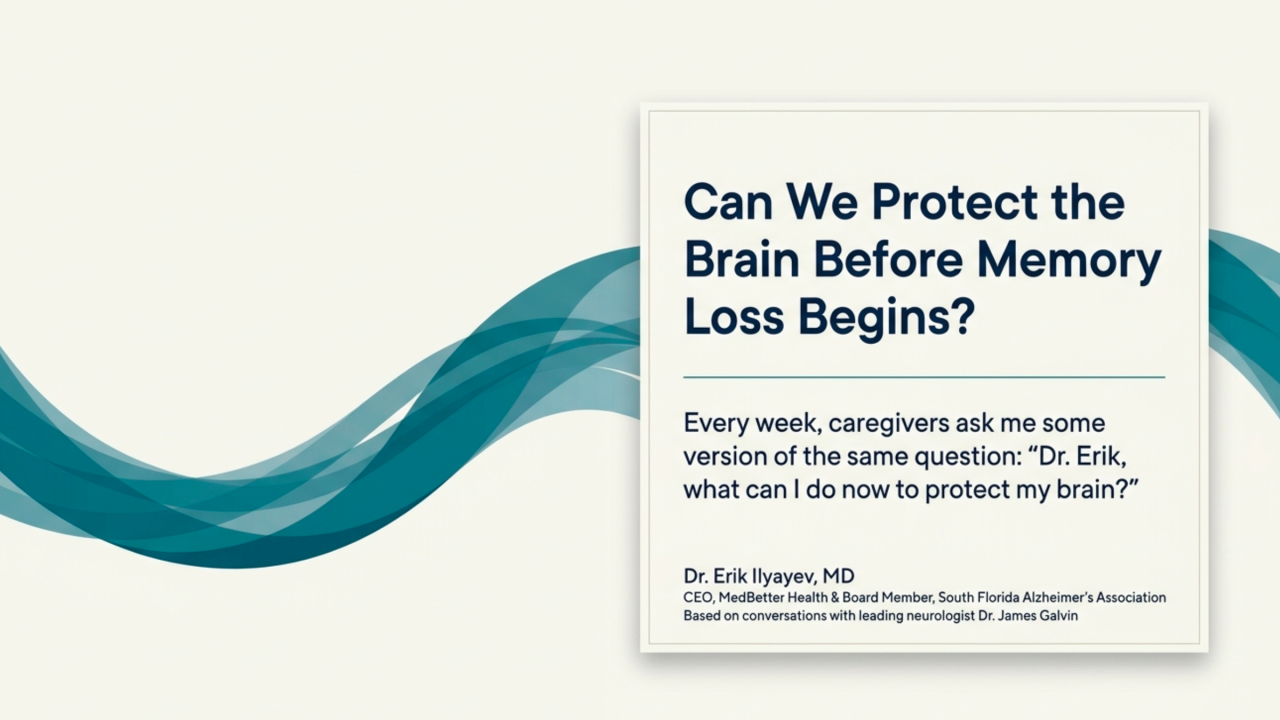
Every week, caregivers ask me some version of the same question:
“Dr. Erik, what can I do now to protect my brain?”
And I understand why people ask it.
Because when families hear the words Alzheimer’s disease, dementia, memory loss, or cognitive decline, most people immediately think about medication.
They ask about pills.
They ask about vitamins.
They ask about supplements.
They ask about what can be taken after the problem has already started.
And listen, those conversations matter. Medical evaluation matters. Treatment conversations matter. Diagnosis matters. But today, I want to start somewhere different.
I want to start upstream.
There is an example I use with my team all the time.
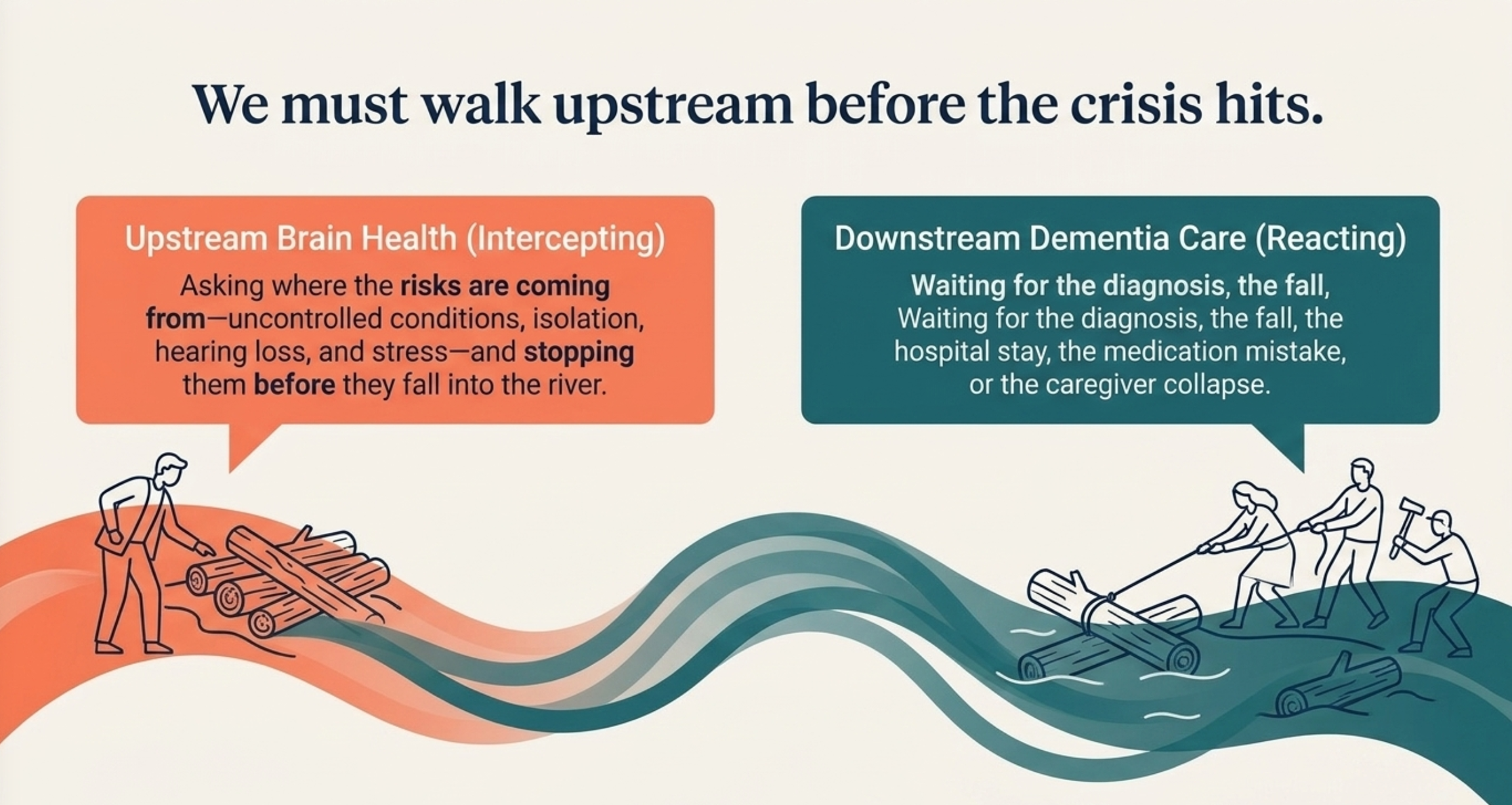
Imagine logs falling down a river. Every day, people are standing downstream, pulling the logs out, cleaning up the river, and reacting to the mess. They keep working harder and harder, but nobody walks upstream to ask the obvious question:
Where are these logs coming from?
Who is throwing them in?
And how do we stop them before they keep falling?
That is how I think about brain health.
Too often, we wait until the crisis is already here. The diagnosis. The fall. The hospital stay. The medication mistake. The caregiver collapse. Then everyone starts reacting.
But dementia care and brain health cannot only be downstream work.
We also have to ask upstream questions.
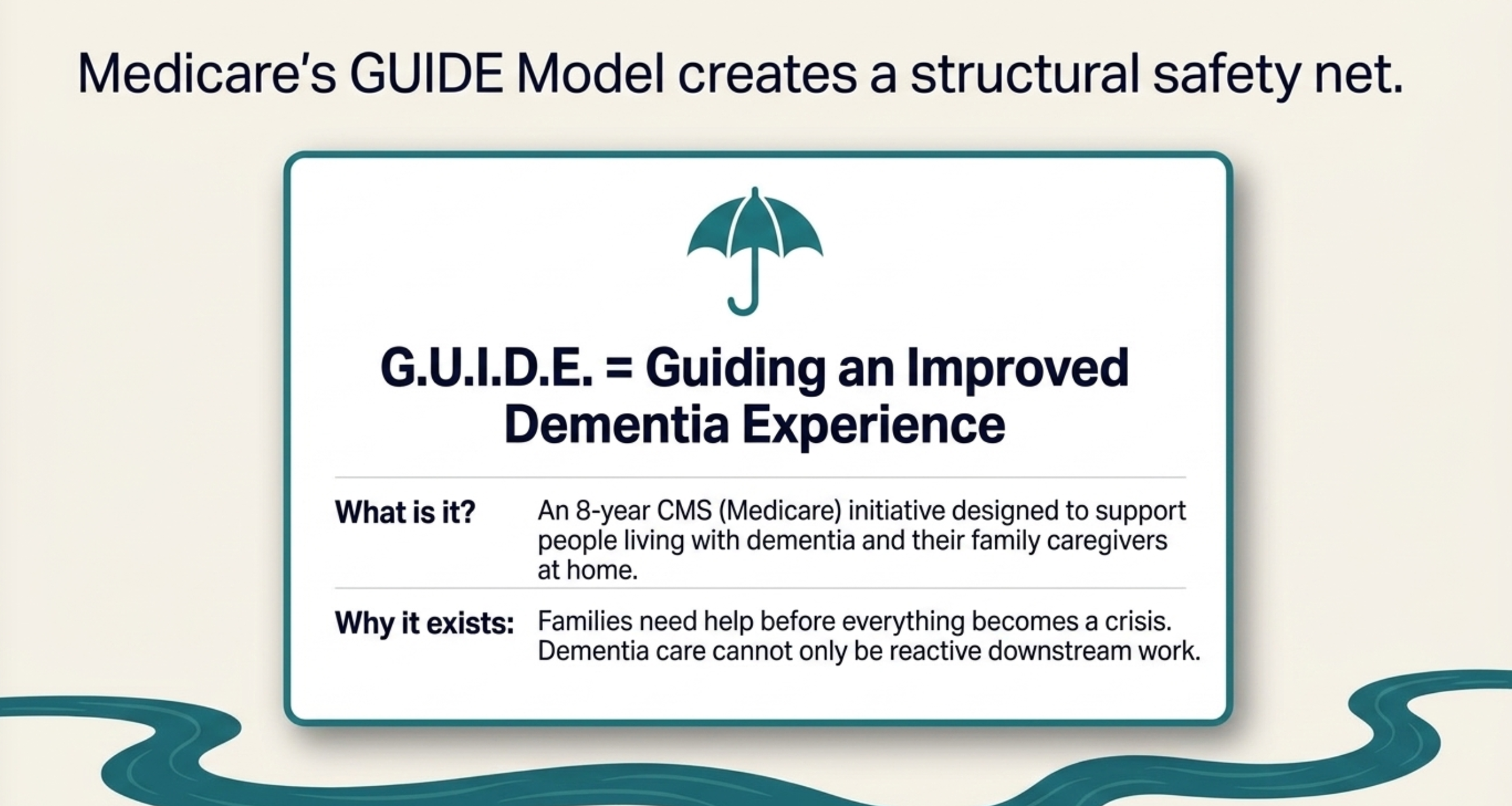
My name is Dr. Erik Ilyayev. I’m a dementia care physician, a board member of the South Florida Alzheimer's Association® , and the CEO of MedBetterHealth.org — one of the organizations selected by Medicare to participate in the GUIDE Model, an 8-year CMS initiative designed to support people living with dementia and the family caregivers caring for them at home.
Recently, I had the privilege of speaking with Dr. James Galvin on Straight Talk with Dr. Erik. Dr. Galvin is one of the leading voices in neurology and brain health, and in this part of our conversation, we talked about prevention, resilience, and what families can actually do before memory problems become advanced.
And I want to be careful with the language here.
Prevention does not mean a guarantee.
It does not mean one diet, one vitamin, one supplement, or one exercise routine eliminates dementia risk.
But there are steps that may support brain health, reduce risk, build resilience, and potentially delay the onset of disease.
And in Alzheimer’s disease, time matters.
THE MYTH OF THE MAGIC PILL
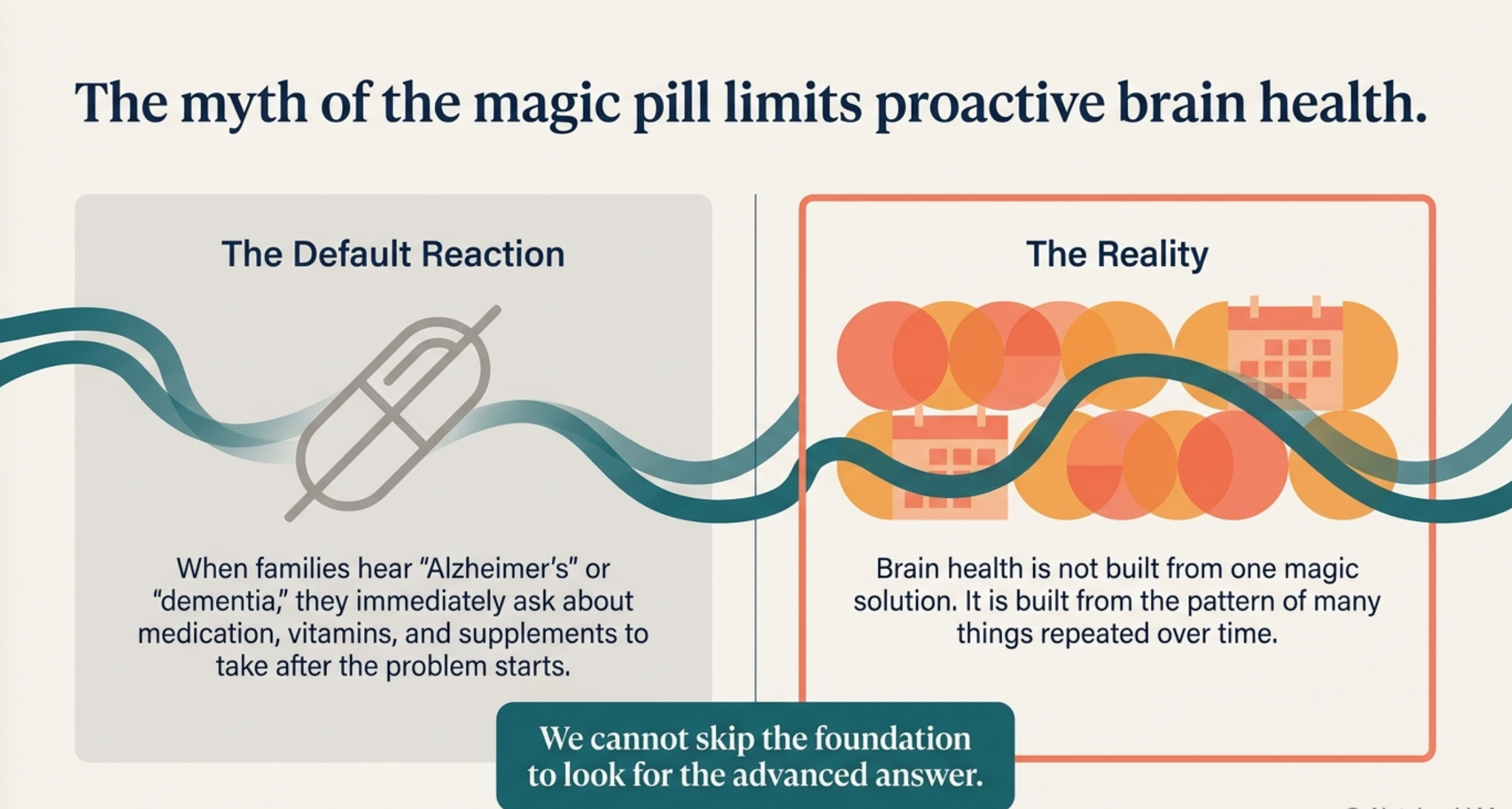
When people talk about brain health, many immediately ask:
“What medication can I take?”
“What vitamin should I use?”
“What supplement protects memory?”
I understand that instinct.
Families want something clear. They want something simple. They want something they can buy, swallow, and trust.
But brain health is not built from one magic solution.
It is built from the pattern of many things repeated over time.
That is important.
Because if we only look for the advanced answer, we can skip the foundation.
We can ignore blood pressure.
We can ignore diabetes.
We can ignore cholesterol.
We can ignore hearing loss.
We can ignore isolation.
We can ignore stress.
We can ignore movement.
We can ignore sleep.
We can ignore caregiver exhaustion.
And then we are surprised when the brain is struggling inside a body that has been under pressure for years.
So before we ask, “What pill fixes this?” we need to ask:
“What foundation are we building?”
THE POWER OF DELAY
Dr. Galvin brought up something that should make every family pause.
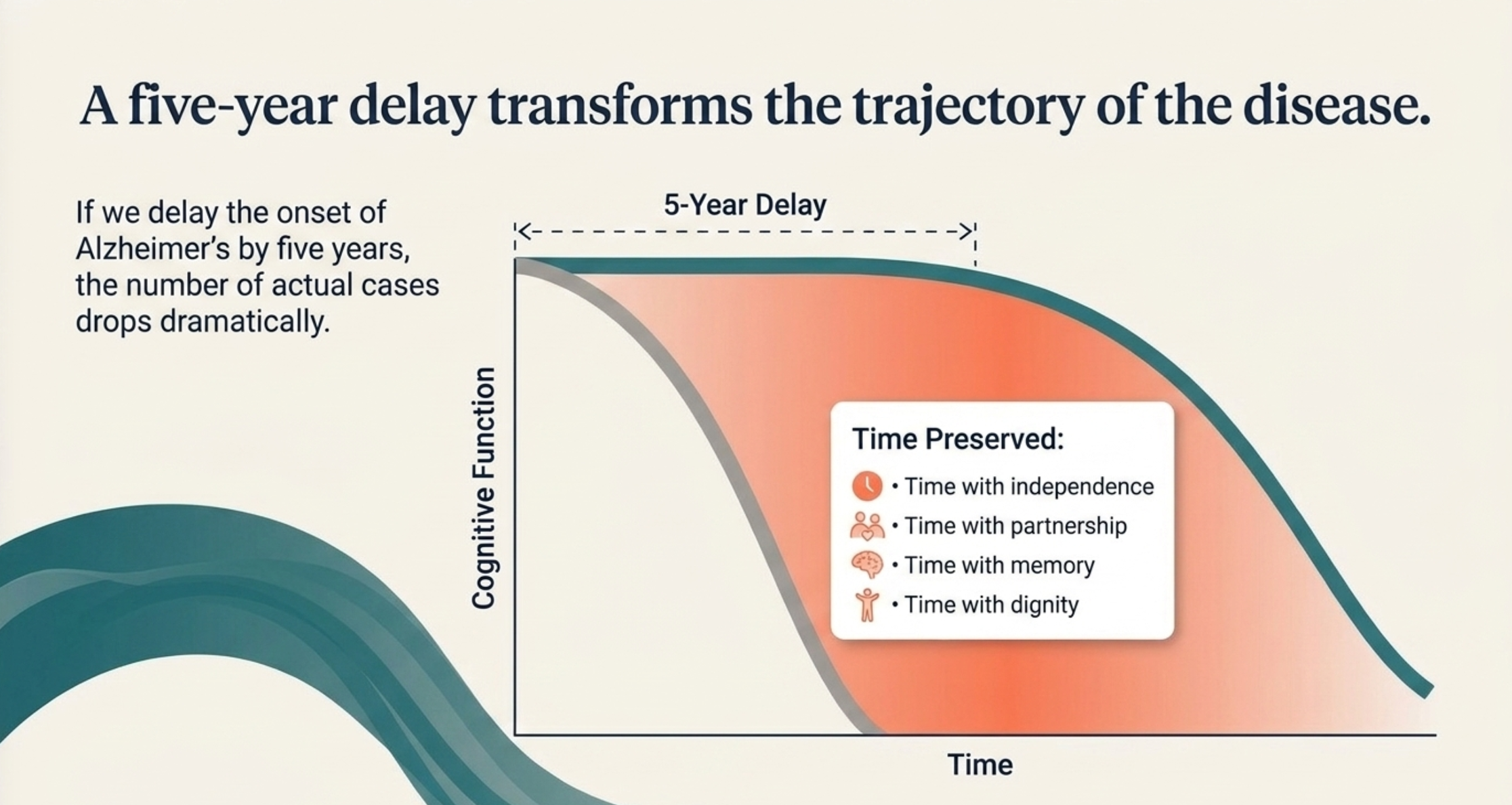
If we could delay the onset of Alzheimer’s disease by five years, the number of actual Alzheimer’s cases could be cut dramatically.
That is not a small idea.
Because Alzheimer’s disease generally affects people later in life. So if someone can live five more years with a healthier brain and never develop symptoms during that time, that matters.
For the person, that could mean more years of independence.
For the spouse, that could mean more years of partnership before the caregiving burden becomes overwhelming.
For the adult children, that could mean more time with Mom or Dad as themselves.
For the healthcare system, that could mean fewer families entering crisis at the same time.
This is why prevention cannot be treated like a side conversation.
It is not just about avoiding disease.
It is about preserving time.
Time with memory.
Time with function.
Time with independence.
Time with family.
Time with dignity.
CONTROL THE MEDICAL CONDITIONS FIRST
One of the first things Dr. Galvin emphasized was simple, but important:
If you have medical conditions, control them.
That means diabetes.
Heart disease.
Cholesterol.
Blood pressure.
And the other medical issues that affect the body over time.
Why does that matter?
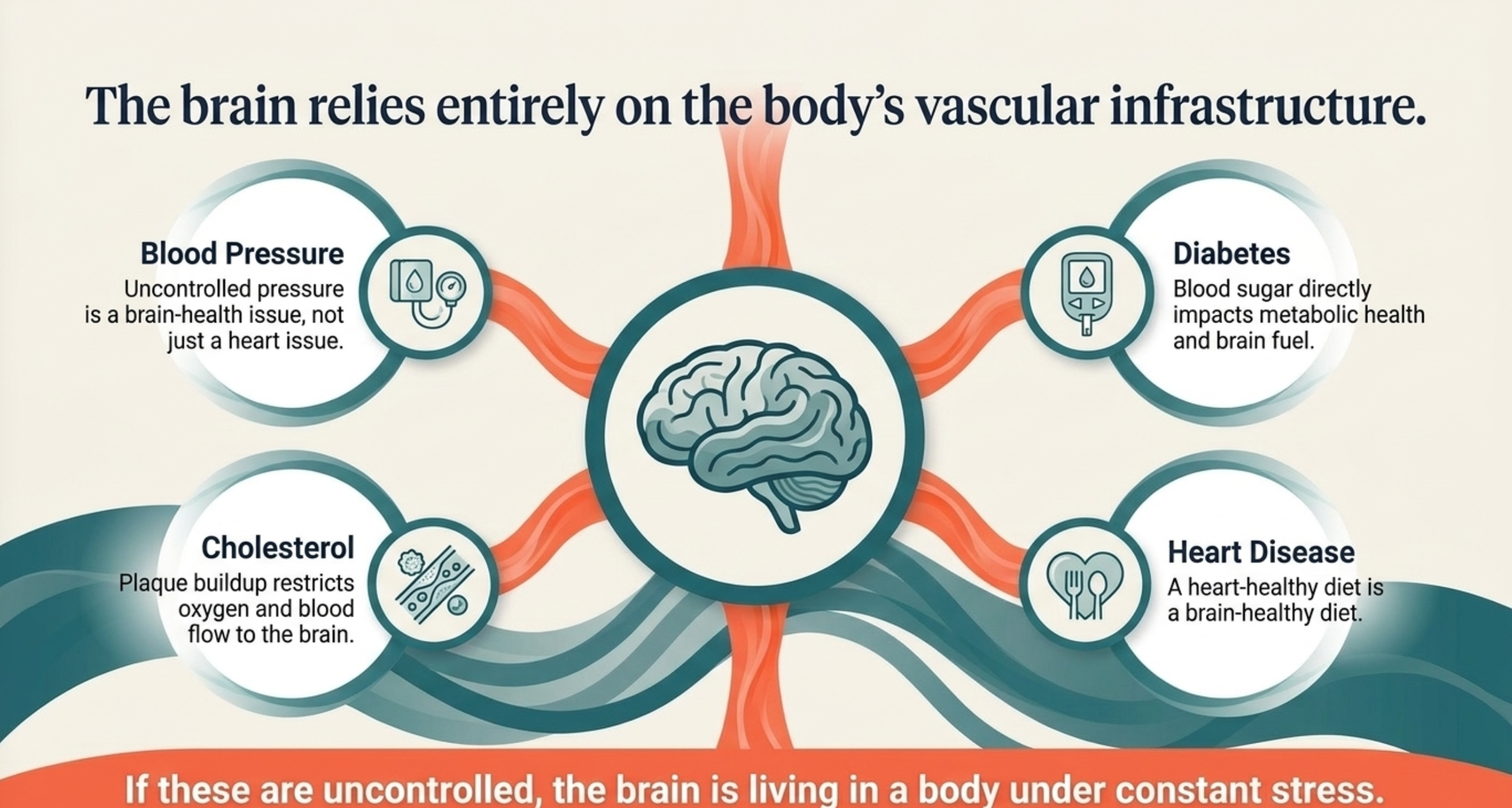
Because the brain is not separate from the rest of the body.
The brain depends on blood flow. It depends on oxygen. It depends on metabolic health. It depends on the vascular system. It depends on the same body that carries it every day.
So when diabetes is poorly controlled, that is not only a blood sugar issue.
When blood pressure is uncontrolled, that is not only a heart issue.
When cholesterol is unmanaged, that is not only a lab issue.
These are brain-health issues too.
Families sometimes want the advanced answer before they have addressed the basics. They want to know which supplement to buy, which new treatment is coming, which vitamin can protect memory.
But we cannot skip the foundation.
If the medical conditions are uncontrolled, the brain is living in a body that is under stress.
That is not where we want to start.
A HEART-HEALTHY LIFE IS A BRAIN-HEALTHY LIFE
Dr. Galvin said something that families should remember:
A heart-healthy diet is a brain-healthy diet.
That does not mean we need to turn this into a complicated food list.
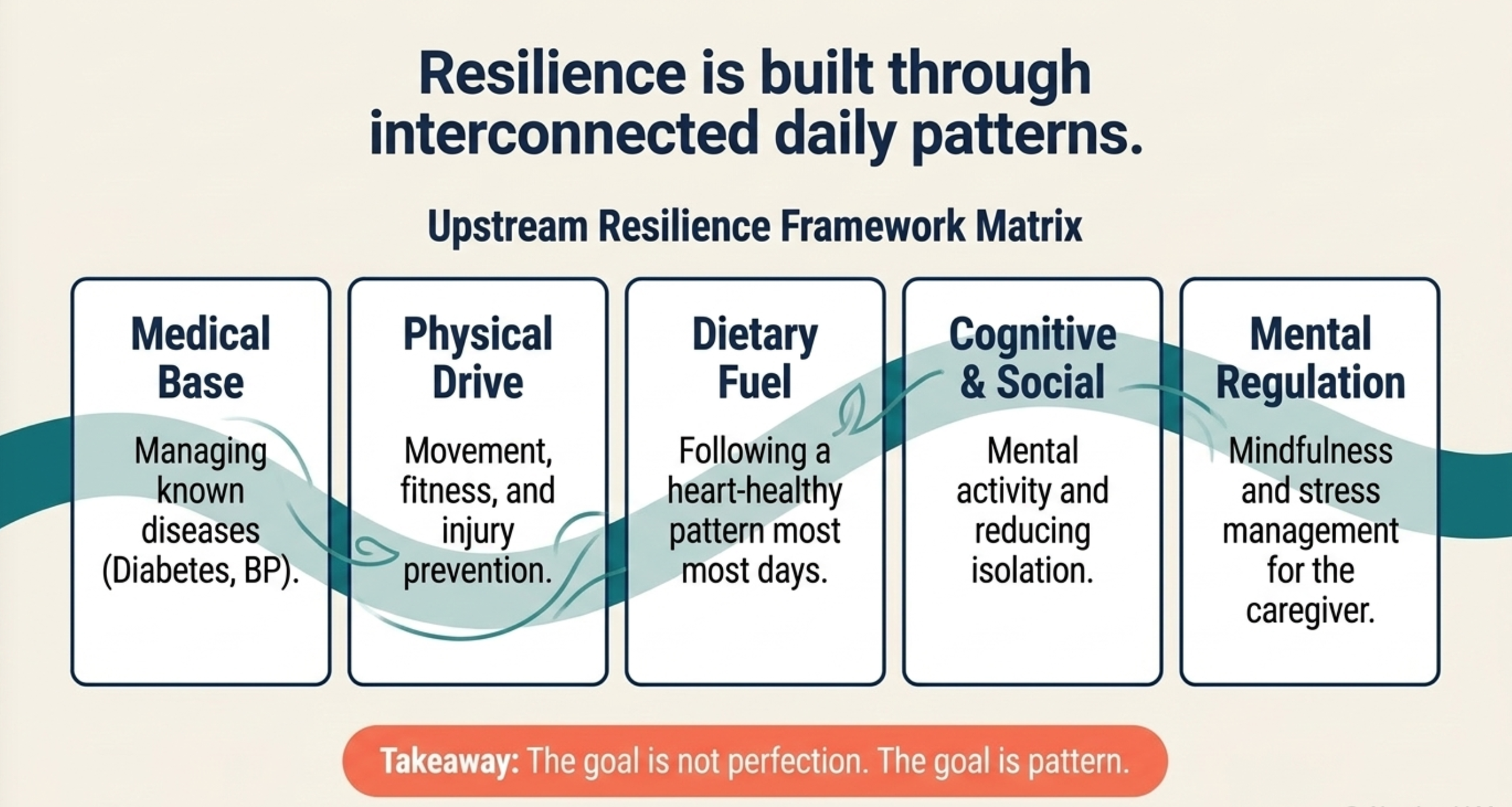
The point is not perfection.
The point is pattern.
How are we eating most days?
Are we moving?
Are we staying mentally active?
Are we socially engaged?
Are we managing the diseases we already know about?
Are we protecting the body that has to protect the brain?
The basics are not glamorous, but they matter.
Mental activity matters.
Physical fitness matters.
Social engagement matters.
A healthy diet matters.
And what I like about this framing is that it does not put all the pressure on one magic solution.
Brain health is not built from one thing.
It is built from the pattern of many things repeated over time.
That is where families need to focus.
Not panic.
Not guilt.
Pattern.
MINDFULNESS AND THE WEIGHT OF STRESS
Another piece Dr. Galvin brought up was mindfulness.
And I think this is important because many families do not connect stress with brain health.
When people hear “mindfulness,” they may think it sounds soft or abstract.
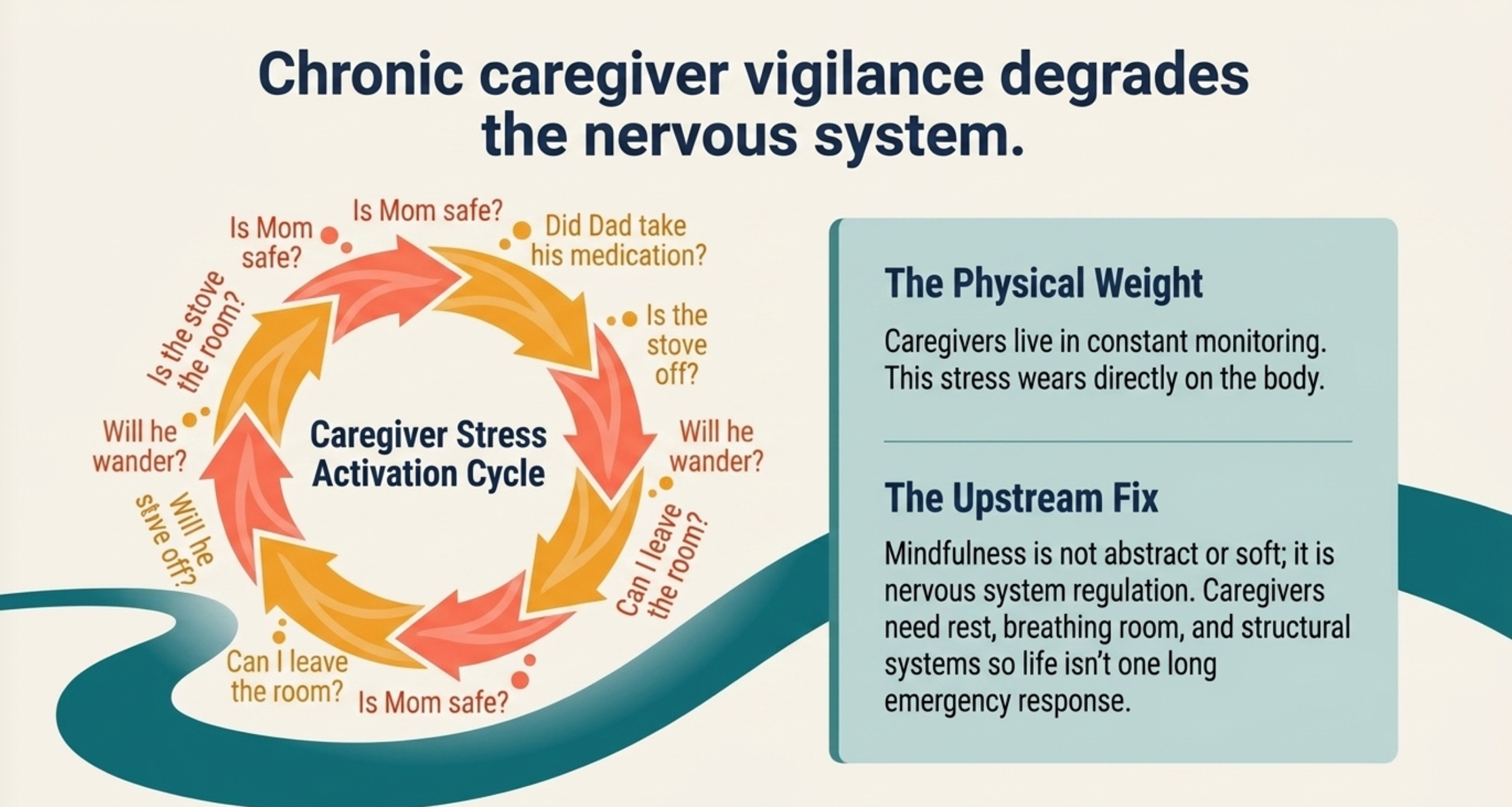
But in real life, mindfulness means being present. It means not letting the weight of the world sit on your body all day long. It means learning how to regulate the nervous system instead of living in constant alarm.
That matters for everyone.
But it especially matters for caregivers.
Because caregivers often live in a state of constant monitoring.
Is Mom safe?
Did Dad take his medication?
Is the stove off?
Will she sleep tonight?
Will he wander?
Can I go to the store?
Can I answer this phone call?
Can I leave the room?
That kind of stress wears on the body.
And when we talk about dementia care, we cannot only talk about the person living with dementia. We have to talk about the caregiver’s brain too.
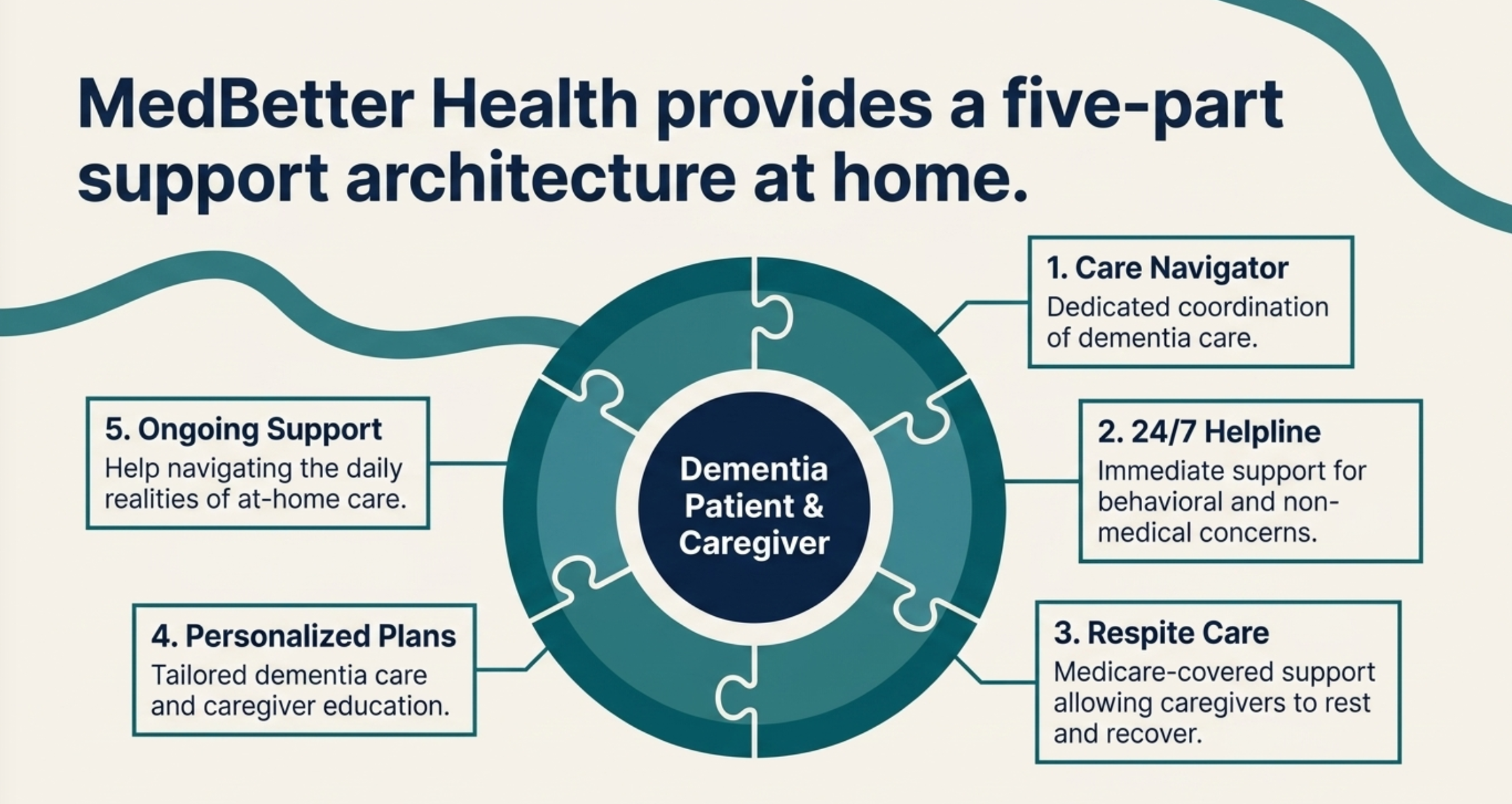
Caregivers need support.
Caregivers need rest.
Caregivers need breathing room.
Caregivers need systems around them so their entire life does not become one long emergency response.
That is not weakness.
That is brain health.
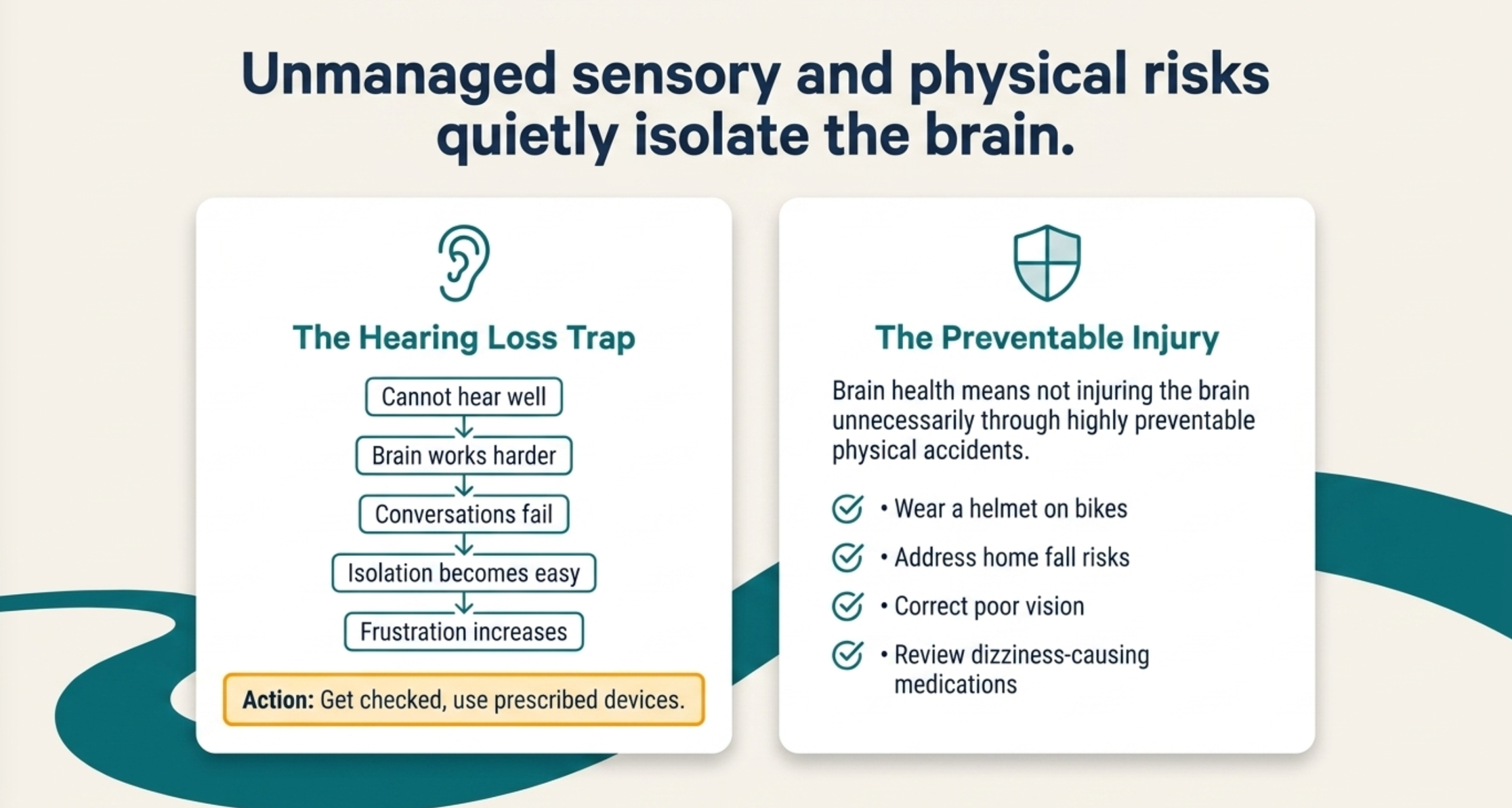
HEARING LOSS IS NOT A SMALL ISSUE
One of the points Dr. Galvin mentioned that families often overlook is hearing loss.
Many people do not get their hearing checked. And even when they know they have hearing problems, they may not wear their hearing aids.
But hearing loss is not just an inconvenience.
When a person cannot hear well, the brain has to work harder to interpret the world. Conversations become harder. Social engagement becomes harder. Isolation becomes easier. Frustration increases. Misunderstandings increase.
And if we are talking about protecting the brain, we cannot ignore hearing.
This is one of those upstream issues that families often miss.
A person may look like they are withdrawing.
They may look like they are not paying attention.
They may look like they are confused.
But sometimes, they simply are not hearing clearly.
So if we are serious about brain health, hearing matters.
Get it checked.
Use the devices if they are prescribed.
Do not let untreated hearing loss quietly push someone further away from the world.
PROTECT THE BRAIN FROM INJURY
Dr. Galvin also mentioned something very practical:
Wear the helmet.
That may sound simple, but it is part of the same larger principle.
Protect the brain from preventable injury.
If you are riding a bike, wear a helmet.
If someone is at fall risk, take fall prevention seriously.
If the home is unsafe, make changes before the injury.
If vision is poor, address it.
If balance is worsening, speak with the medical team.
If medications are causing dizziness or confusion, ask for a review.
Brain health is not only about memory exercises and healthy food.
It is also about not injuring the brain unnecessarily.
Some prevention is very practical.
Do not wait until after the fall.
Do not wait until after the head injury.
Do not wait until after the hospital visit.
Go upstream.
THE POINTER STUDY: STRUCTURE MATTERS
Now let’s talk about the POINTER study.
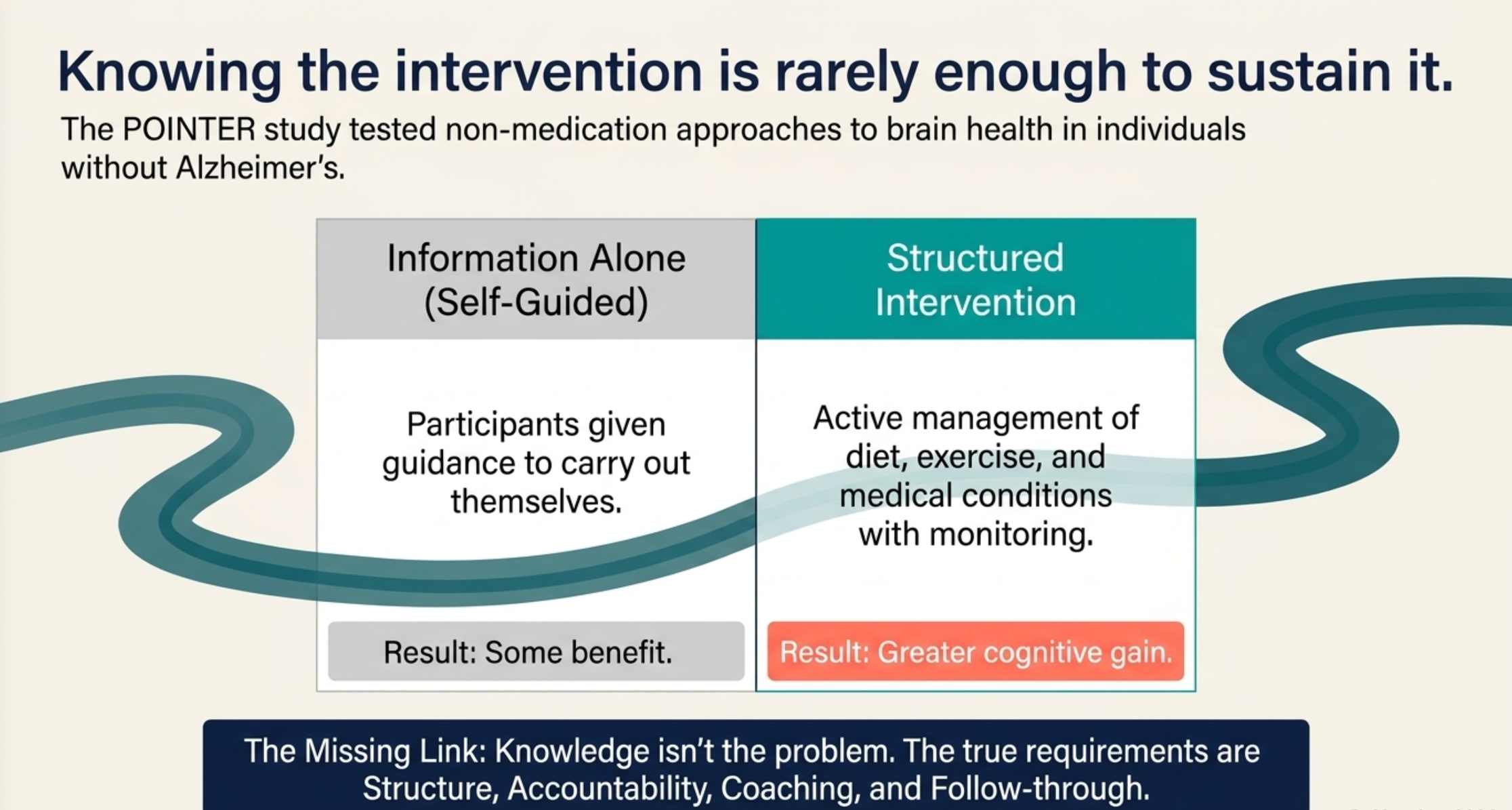
This is important because it looked at non-medication approaches to brain health in a structured way.
Dr. Galvin explained that the study included people who did not have Alzheimer’s disease. Participants were divided into groups. One group received self-guided information. They were given guidance and had to carry it out themselves.
Another group received a more active intervention.
That intervention included managing medical conditions, exercise, cognitive activities, and healthy diet, with monitoring and support.
At the end, both groups showed some benefit, but the more active intervention showed greater gain.
And that should teach us something very important.
Information alone is not always enough.
Most people already know they should move more, eat better, stay mentally active, and take care of their medical conditions.
The problem is not always knowledge.
The problem is structure.
Accountability.
Coaching.
Follow-through.
Support.
Someone asking:
Did you do this?
How are you doing?
What needs to be adjusted?
What is realistic for you?
That is where the opportunity is.
Because a self-guided plan can help some people. But a structured plan may help people actually follow through.
PERSONALIZATION MATTERS TOO
Dr. Galvin also made another important point.
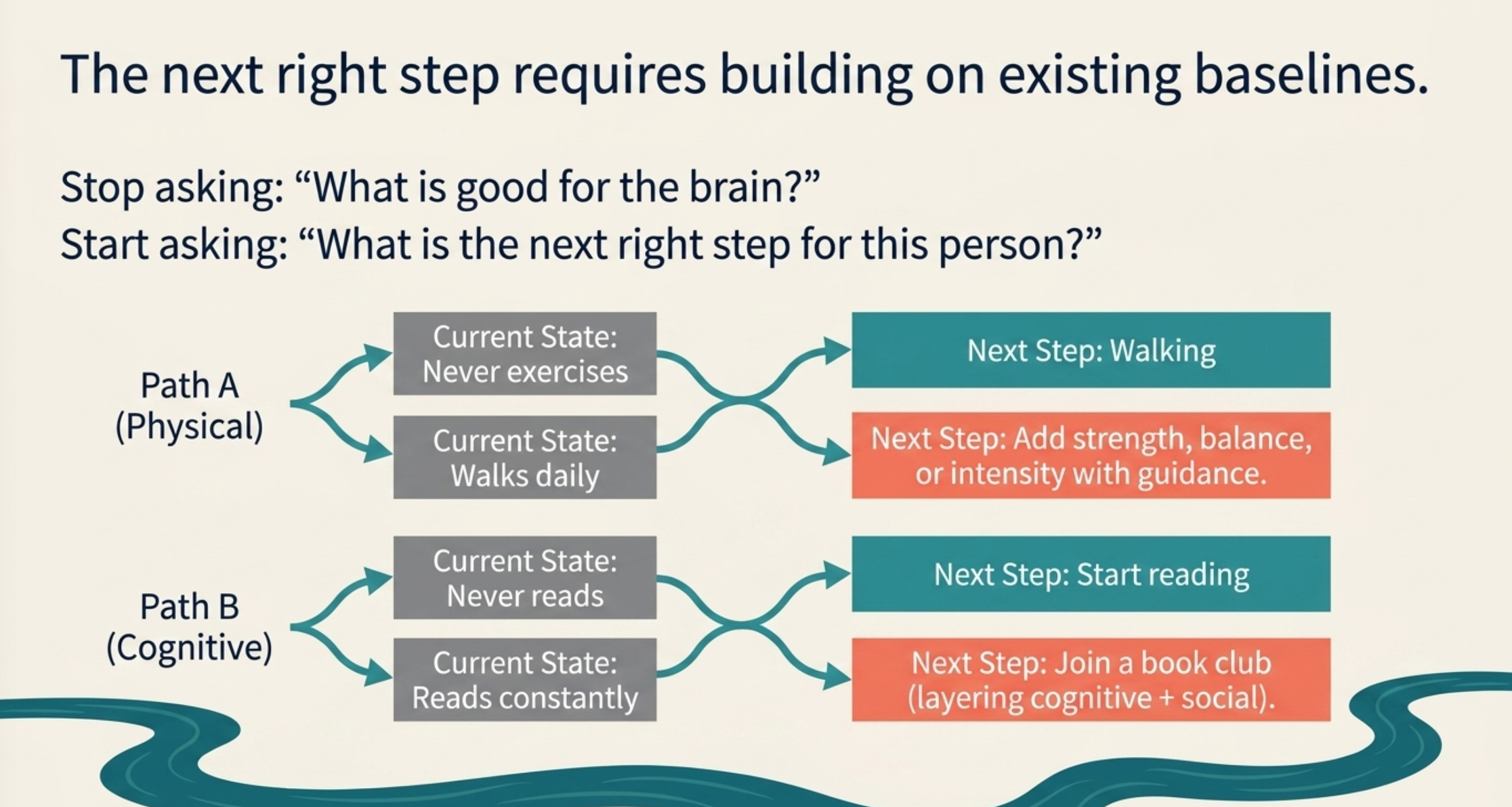
The next step is personalization.
Because not every person needs the same intervention.
If someone has never exercised, walking may be the next step.
But if someone already walks every day, doing the same walk may not add much more. Maybe the next step is increasing intensity safely, adding strength training, improving balance, or adding a different physical challenge with professional guidance.
If someone never reads, reading may be a good start.
But if someone already reads all the time, maybe the next step is joining a book club. Now the activity becomes cognitive and social.
That is the idea.
Do not just ask:
“What is good for the brain?”
Ask:
“What is the next right step for this person?”
Because the goal is not to copy someone else’s plan.
The goal is to build resilience in a way that fits your life, your risks, your medical conditions, your abilities, and your starting point.
That is much more realistic.
And it is much more useful.
NON-MEDICATION APPROACHES ARE NOT “NOTHING”
One mistake people make is thinking that if something is not a medication, it is not powerful.
That is not true.
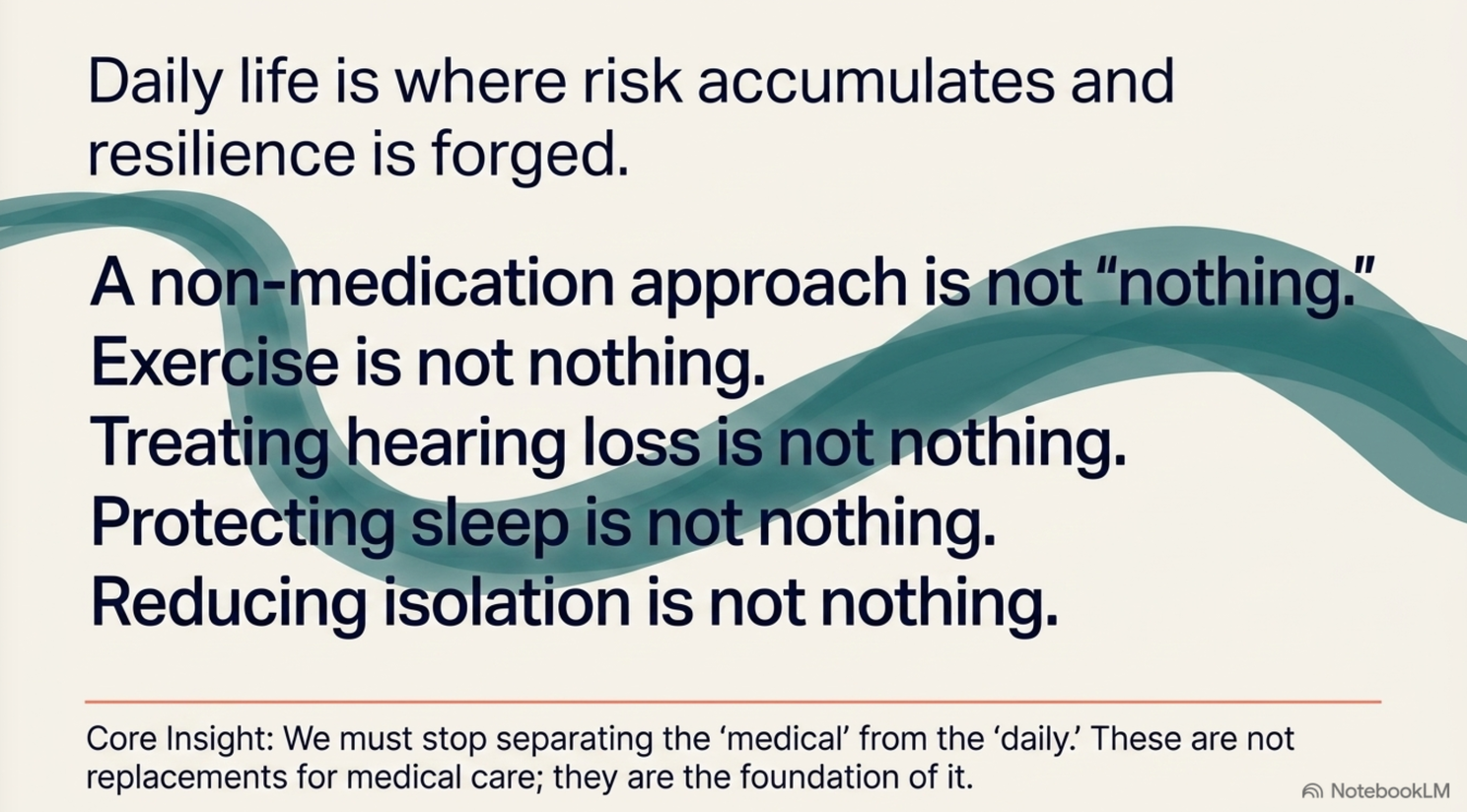
A non-medication approach can still be meaningful.
Exercise is not “nothing.”
Managing diabetes is not “nothing.”
Treating hearing loss is not “nothing.”
Staying socially engaged is not “nothing.”
Protecting sleep is not “nothing.”
Reducing isolation is not “nothing.”
Cognitive activity is not “nothing.”
Mindfulness is not “nothing.”
These are not replacements for medical care.
They are part of the care.
And when we are talking about brain health, we need to stop separating the medical from the daily.
Because daily life is where risk builds.
And daily life is where resilience can be built too.
WHAT I WANT FAMILIES TO REMEMBER
If you are thinking about brain health, here is what I want you to remember.
Do not wait until the crisis to start asking upstream questions.
Control the medical conditions you already know about. Diabetes, blood pressure, cholesterol, heart disease, and other chronic conditions matter for the brain.
Stay mentally active, physically fit, and socially engaged.
Do not ignore hearing loss.
Protect the brain from injury.
Take stress seriously.
Build healthy patterns around food, movement, sleep, connection, and medical care.
And do not think information alone is always enough.
If you need structure, get structure.
If you need accountability, get accountability.
If you need support, get support.
The goal is not perfection.
The goal is direction.
Because brain health is not one dramatic decision.
It is the pattern you repeat, the risks you address, and the support you build before the crisis arrives.
Slide deck note
Extra visual from this issue

Common questions
Quick answers from this issue
Can We Protect the Brain Before Memory Loss Begins?
Every week, caregivers ask me some version of the same question: “Dr. Erik, what can I do now to protect my brain?” And I understand why people ask it.
What should caregivers try first?
Write down what changed, when it started, and what was happening right before it. Reduce noise, slow the conversation down, and use one simple step at a time. Share the pattern with the family, care team, or clinician so everyone responds consistently.
When should families call a clinician?
Call a clinician promptly if the change is sudden, severe, unsafe, tied to a fall, fever, pain, dehydration, medication change, hallucinations, paranoia, or new confusion. Call emergency services for immediate danger.