
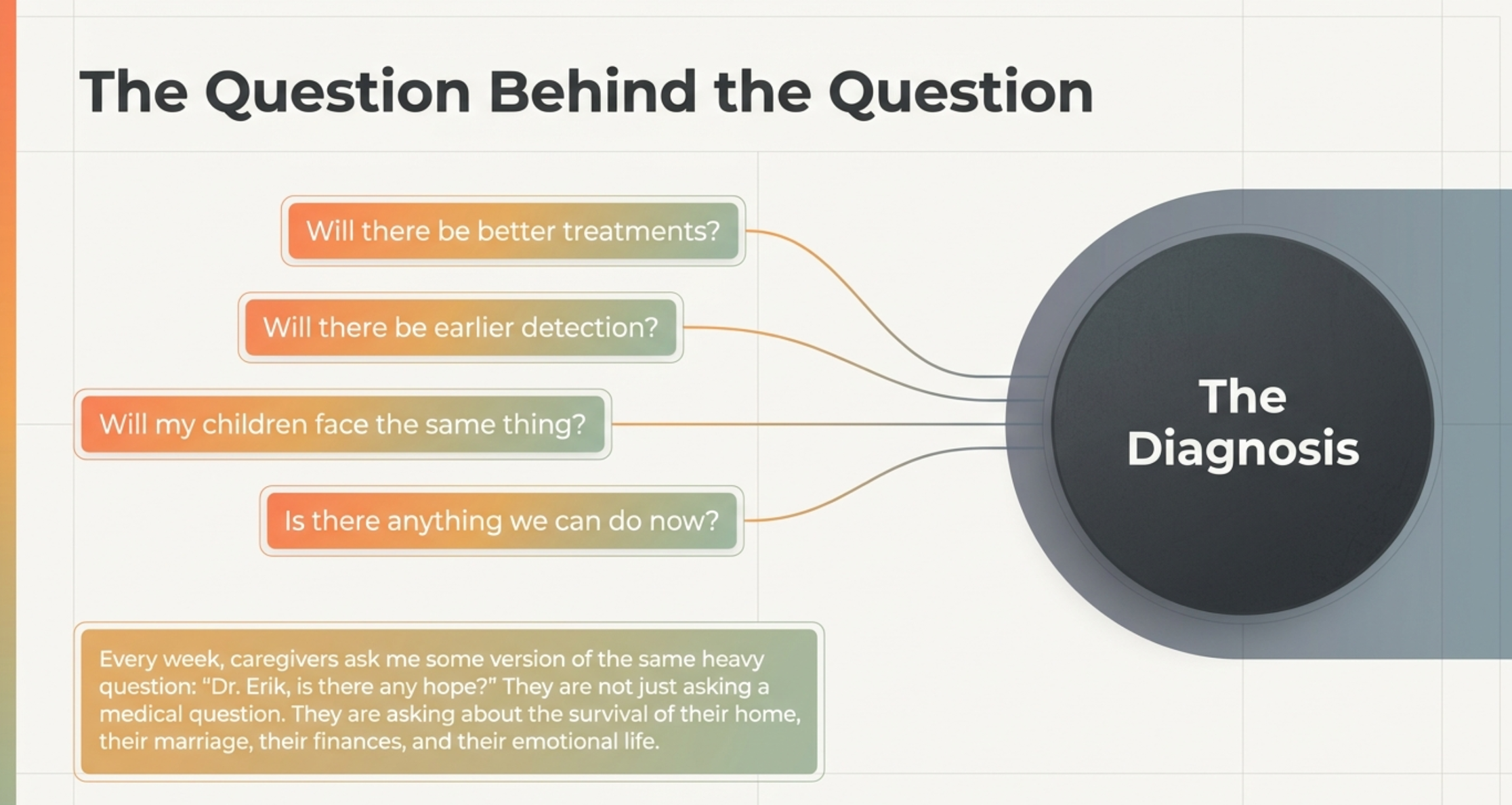
Every week, caregivers ask me some version of the same question:
“Dr. Erik, is there any hope?”
And I understand why families ask it.
Because dementia can feel heavy.
A diagnosis changes the home. It changes the marriage. It changes the parent-child relationship. It changes the caregiver’s schedule, sleep, stress, finances, and emotional life.
So when families ask about the future, they are not asking a simple medical question.
They are asking:
“Will there be better treatments?”
“Will there be earlier detection?”
“Will people one day survive Alzheimer’s disease?”
“Will my children and grandchildren face the same thing?”
“Is there anything we can do now?”
Recently, I had the privilege of speaking with Dr. James Galvin on Straight Talk with Dr. Erik. Dr. Galvin is one of the leading voices in neurology and brain health, and near the end of our conversation, I asked him a very direct question:
What gives you the most hope in the field of brain health, cognitive health, and dementia?
His answer was not hype.
It was not a miracle promise.
It was not, “One medication is going to solve everything.”
His answer was this:
We need to focus more on brain health instead of only brain disease.
We need to live a life of prevention instead of a life of reaction.
And that is where I want to take this issue.
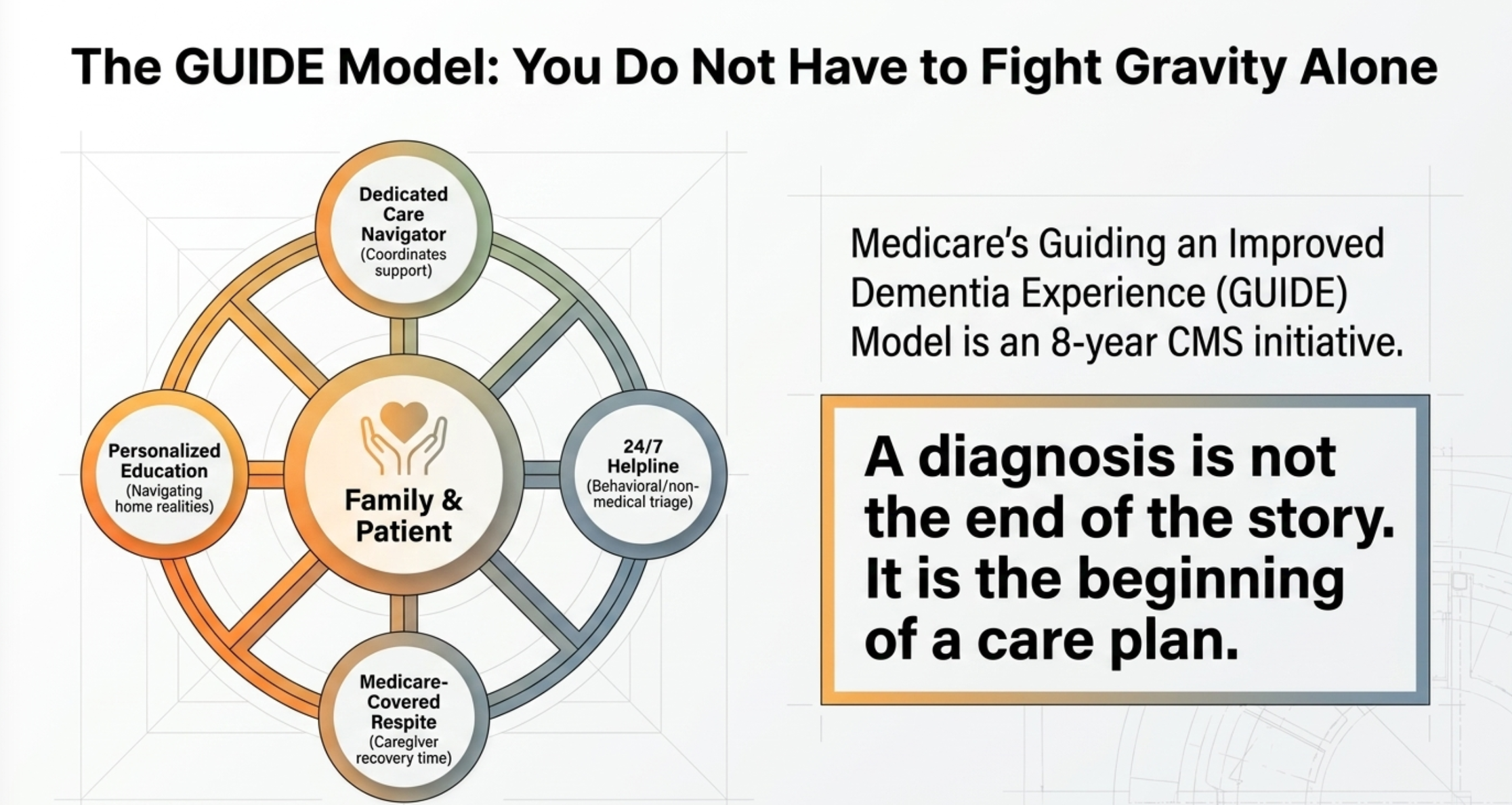
My name is Dr. Erik Ilyayev. I’m a dementia care physician, a board member of the South Florida Alzheimer's Association® , and the CEO of MedBetterHealth.org — one of the organizations selected by Medicare to participate in the GUIDE Model, an 8-year CMS initiative designed to support people living with dementia and the family caregivers caring for them at home.
In this issue, I want to talk about hope. Not fake hope. Not false hope. Real hope.
The kind of hope that comes from prevention, research, earlier action, caregiver education, and understanding that brain health is something we should think about long before the crisis arrives.
THE FUTURE IS NOT ONLY TREATING DISEASE
When we talk about dementia, most people immediately think about disease.
Alzheimer’s disease.
Lewy body dementia.
Vascular dementia.
Memory loss.
Medication.
Diagnosis.
Progression.
Caregiver burnout.
And yes, all of that matters.
But Dr. Galvin made a point that every family should understand:
The future cannot only be about treating brain disease after it has already caused damage.
The future has to be about brain health.
That is a different mindset.
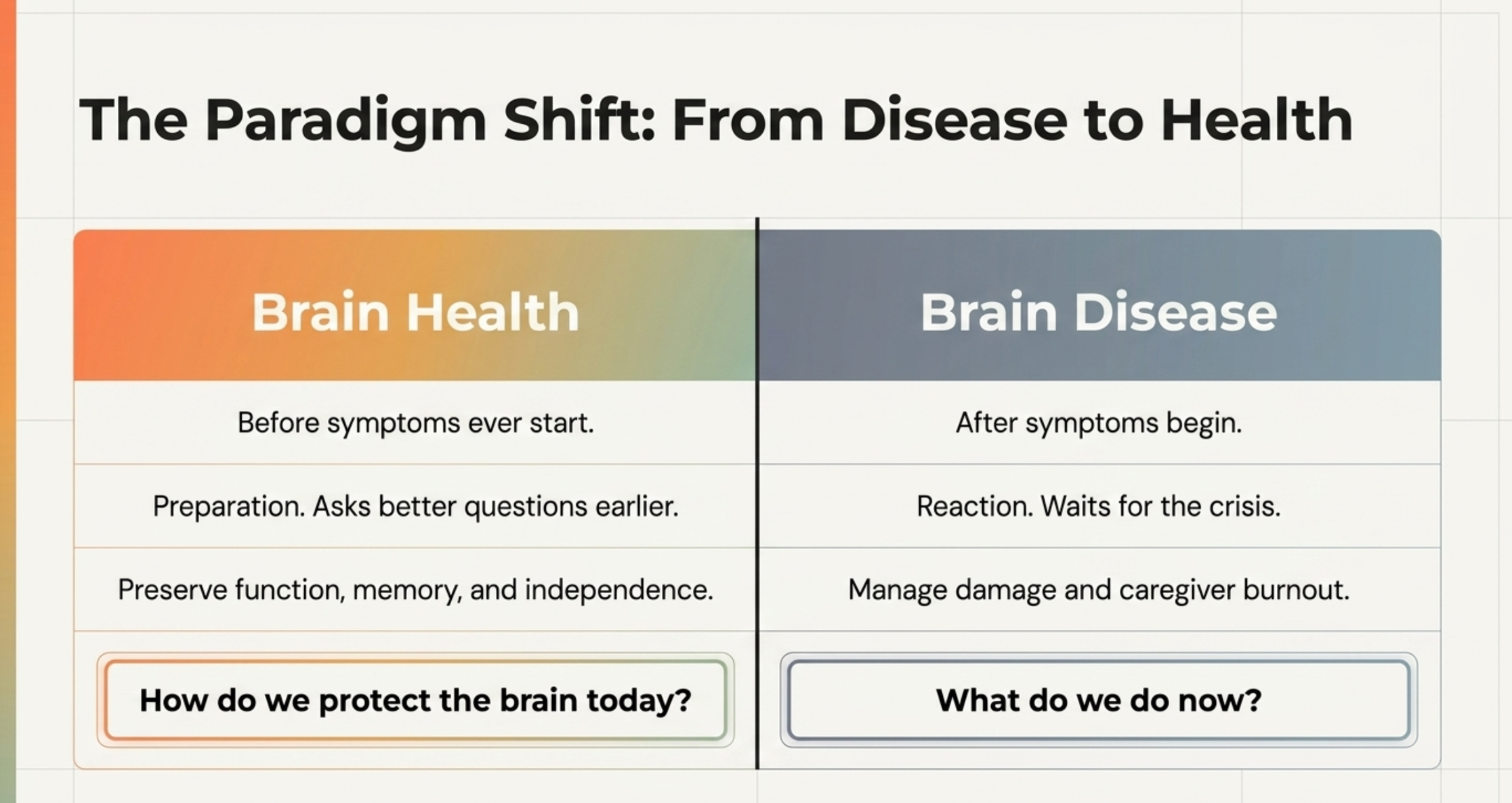
Brain disease asks:
“What do we do after symptoms begin?”
Brain health asks:
“What can we do before symptoms ever start?”
Brain disease reacts.
Brain health prepares.
Brain disease waits for the crisis.
Brain health asks better questions earlier.
And this is not just a medical idea. This is a family idea. This is a public health idea. This is a caregiving idea.
Because if we wait until the brain is already showing significant symptoms, we may already be late.
That does not mean we stop caring for people who are already living with dementia.
Never.
We care for them with dignity, structure, support, compassion, and the best medical care available.
But we also have to ask:
How do we help the next person avoid getting there?
HEALTHSPAN, NOT JUST LIFESPAN
Dr. Galvin used a word that I think families should pay attention to:
Healthspan.
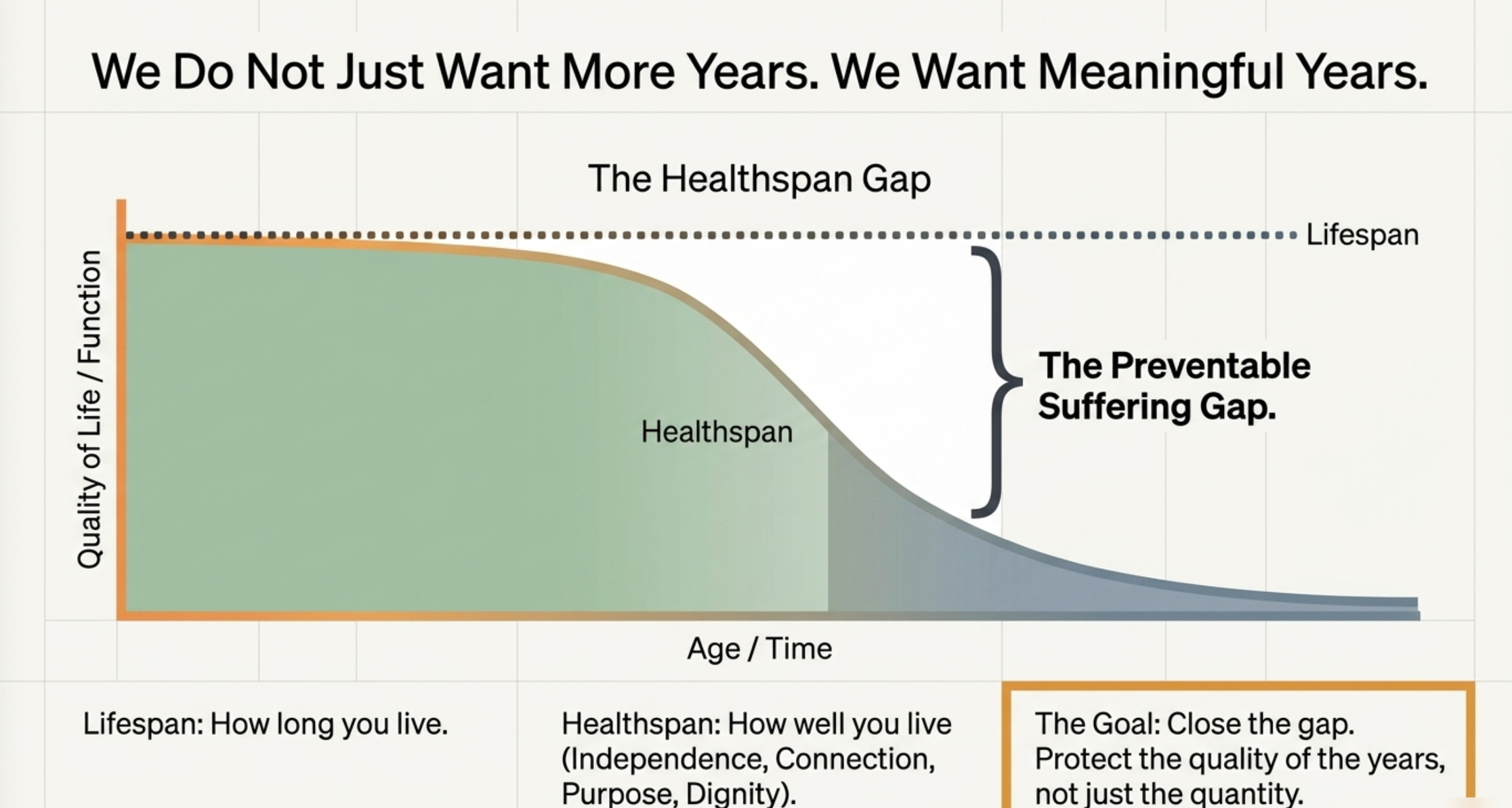
Lifespan means how long you live.
Healthspan means how well you live.
And there is a big difference.
Nobody wants to simply live longer if those extra years are filled with preventable suffering, isolation, disability, and loss of function.
Families do not only want more years.
They want meaningful years.
Years with memory.
Years with independence.
Years with connection.
Years with purpose.
Years where the person can still participate in life, relationships, decision-making, and dignity.
That is why brain health matters.
The goal is not just to add years to life.
The goal is to protect the quality of those years.
And when we talk about dementia, that distinction matters deeply.
Because the family is not only asking, “How long?”
They are asking, “What kind of life?”
THE FUTURE MAY BE PREVENTION
One of the most hopeful parts of this conversation was the idea that research is pushing earlier and earlier.
Dr. Galvin explained that researchers are now studying people who do not yet have symptoms but do have amyloid in the brain. The idea is to see whether removing amyloid before symptoms begin could help prevent people from ever developing the disease.
That is a major shift.
For years, families thought of Alzheimer’s disease as something we only recognized after memory loss became obvious.
But what if the future moves earlier?
What if the goal becomes identifying risk before function is lost?
What if we can intervene before a person loses independence?
What if, instead of only treating disease after damage has occurred, we can prevent symptoms from ever developing?
That is where hope lives.
But I want to be careful.
This is research.
This is not something families should misinterpret as, “We can reverse Alzheimer’s disease today.”
That is not what we are saying.
What we are saying is that the field is moving toward earlier detection, earlier intervention, and prevention-focused thinking.
And that matters.
Because if I had to choose between treating dementia after it begins and helping someone never develop the disease in the first place, I would choose prevention every time.
WHY REVERSAL IS HARD
Families often ask:
“Will we ever reverse Alzheimer’s disease?”
And I understand why.
At Alzheimer’s events, we talk about future survivors. We imagine a day when people who were diagnosed can return to the life they had before. We leave space for that hope because hope matters.
But Dr. Galvin gave a very honest answer.
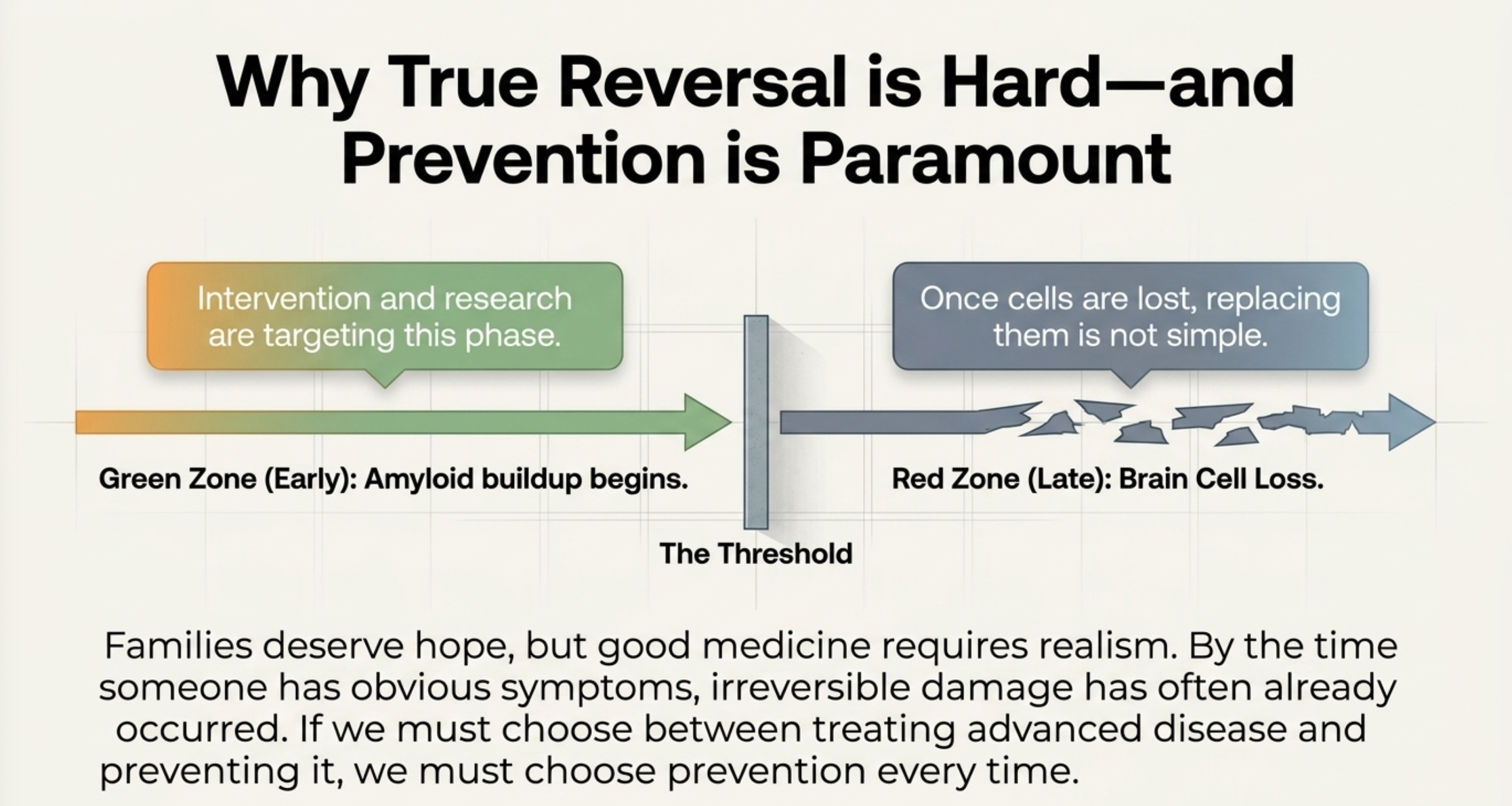
By the time someone has symptoms, a lot of damage may already have happened in the brain.
Brain cells may already be lost.
And once brain cells are lost, replacing them is not simple.
This is why prevention and earlier intervention are so important.
The question is not only:
“How do we reverse advanced disease?”
The question is:
“How do we stop people from reaching that point?”
That is not pessimism.
That is realism.
And good medicine needs realism.
Families deserve hope, but they also deserve honesty.
We should absolutely keep fighting for better treatments. We should keep supporting research. We should keep improving diagnosis. We should keep building better systems of care.
But while the science advances, families should not wait passively.
There are brain-health steps we can take now.
START EARLIER THAN YOU THINK
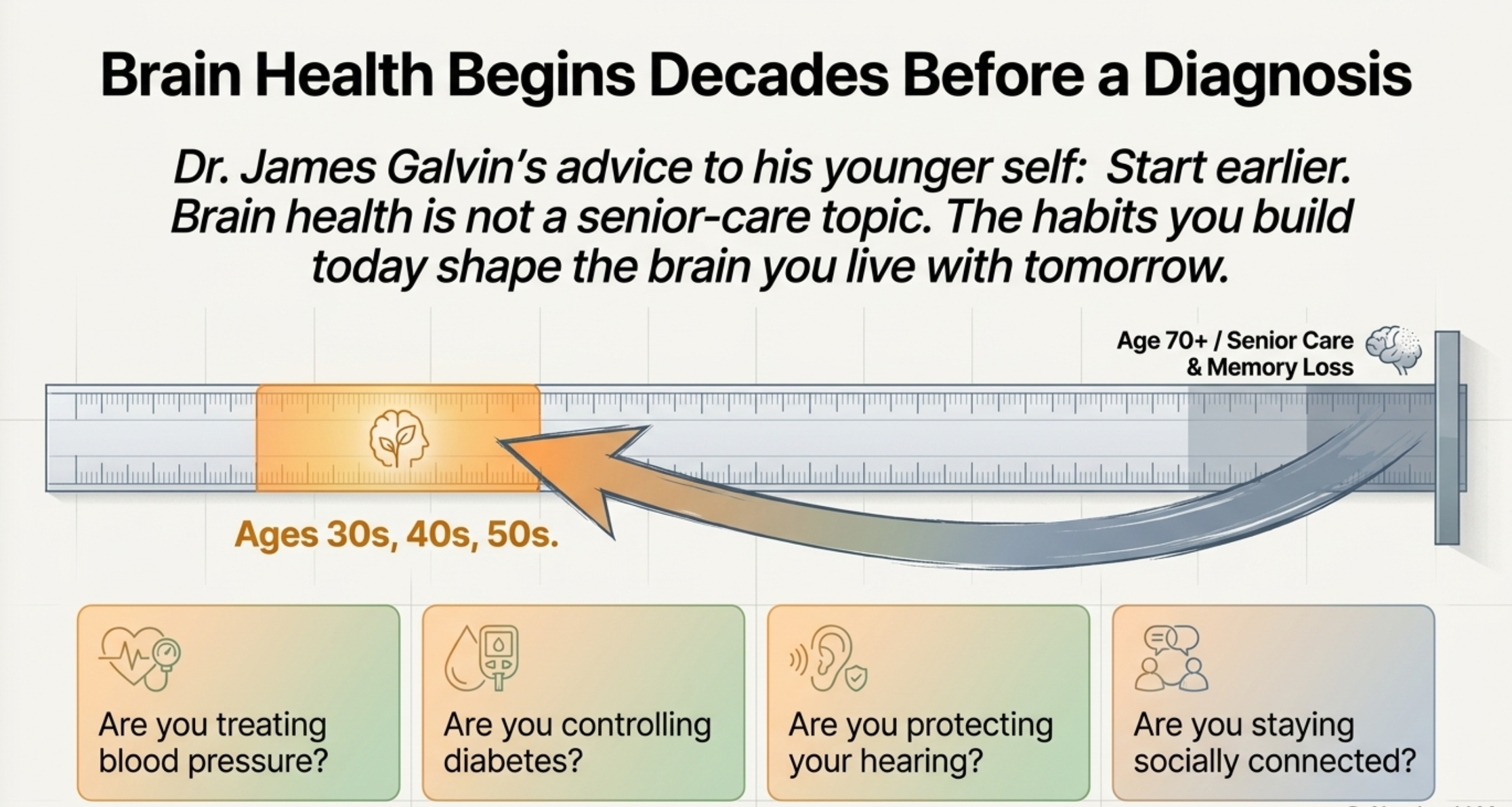
One of the most personal parts of the conversation came when Dr. Galvin talked about what he would tell his younger self.
His answer was simple:
Start earlier.
He talked about the habits that help build a better brain — movement, better nutrition, sleep, meditation, and taking care of the body — and said he wishes he had started those patterns earlier in life.
That should make every one of us pause.
Because many people wait until their 50s, 60s, or 70s to start thinking about brain health.
But brain health is not something we should begin only after a diagnosis.
It should begin decades earlier.
How are we sleeping?
How are we eating?
Are we moving?
Are we managing stress?
Are we protecting hearing?
Are we treating blood pressure?
Are we controlling diabetes?
Are we managing cholesterol?
Are we staying socially connected?
Are we challenging the brain?
Are we building a life that supports healthspan?
These are not glamorous questions.
But they are important questions.
And if you are younger and reading this, please do not think dementia prevention is only a senior-care topic.
The habits you build now may shape the brain you live with later.
SLEEP IS NOT OPTIONAL
I want to spend a moment on sleep because this one hits a lot of people.
Dr. Galvin mentioned that he now sleeps eight hours a night and that he did not always do that.
And I think many people can relate.
We treat sleep like something optional.
We work late.
We scroll late.
We wake up early.
We tell ourselves we are being productive.
But the body keeps score.
And the brain keeps score too.
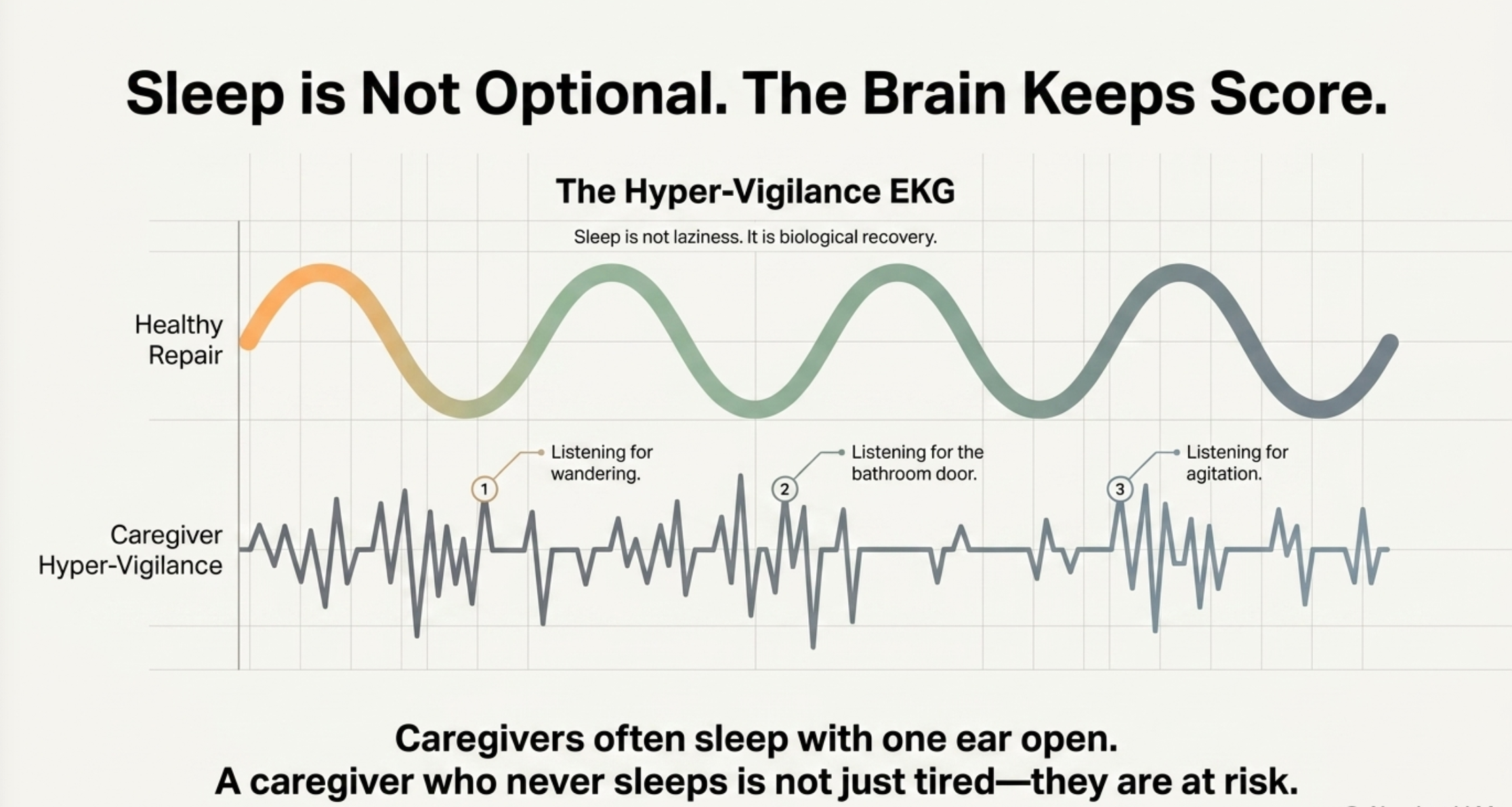
Sleep is not laziness.
Sleep is repair.
Sleep is recovery.
Sleep is part of brain health.
If you are routinely sleeping four or five hours, living on stress, caffeine, and emergency mode, eventually your body may pay for that.
And for caregivers, this is even harder.
Caregivers often sleep with one ear open.
They listen for wandering.
They listen for the bathroom door.
They listen for agitation.
They listen for movement.
They listen for danger.
That is not real rest.
So when we talk about brain health, we cannot only talk about the person living with dementia. We also have to talk about the caregiver’s health.
Because a caregiver who never sleeps is not just tired.
They are at risk.
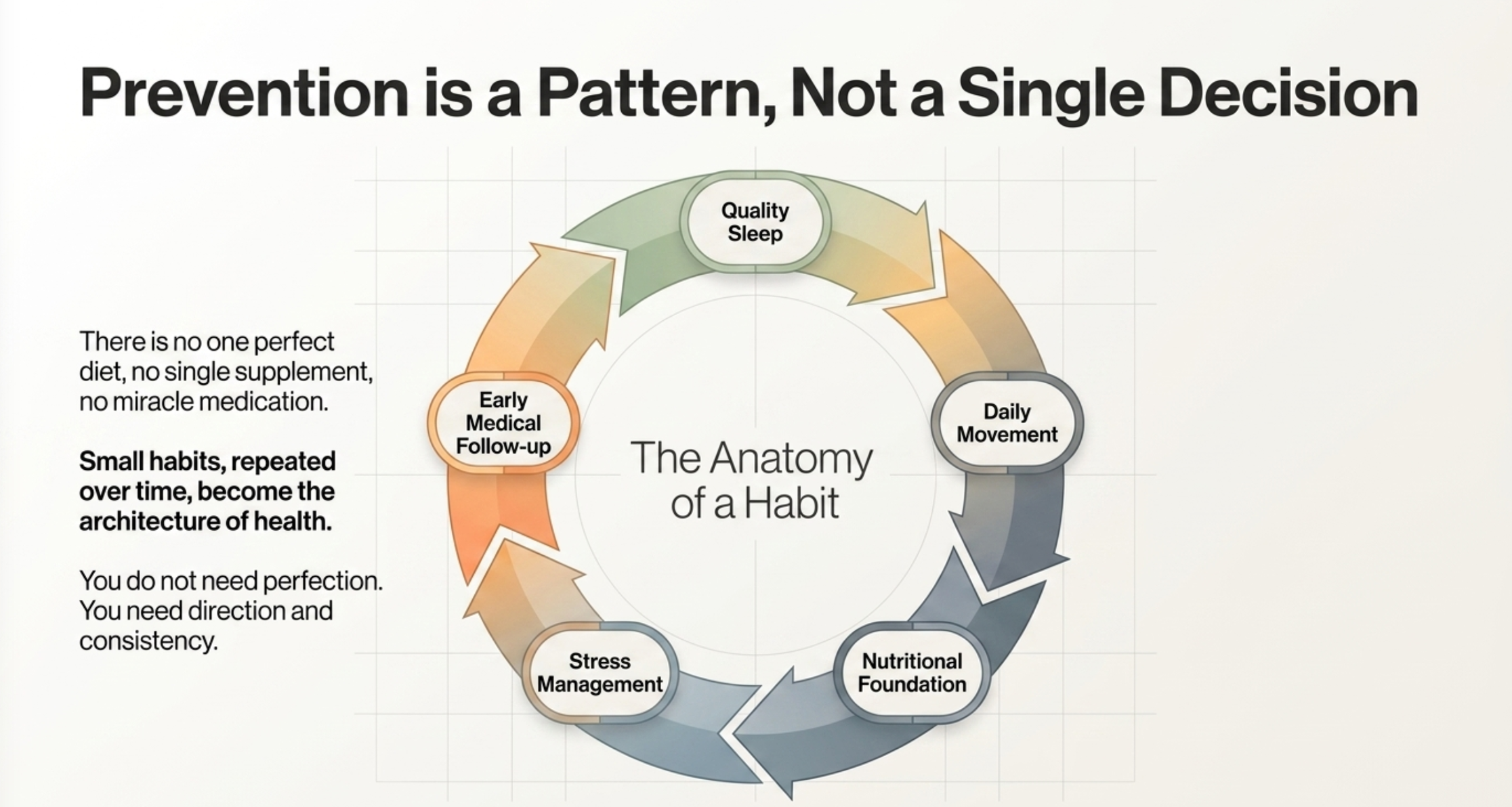
PREVENTION IS NOT ONE BIG DECISION
Prevention is not one dramatic decision.
It is not one perfect diet.
It is not one supplement.
It is not one medication.
It is not one workout.
It is the pattern.
The pattern of how you sleep.
The pattern of how you move.
The pattern of how you eat.
The pattern of whether you treat medical conditions early.
The pattern of whether you stay connected or isolated.
The pattern of whether you manage stress or let stress manage you.
The pattern of whether you ask for help before crisis.
Small habits repeated over time become the architecture of health.
And I know people hear this and think:
“Dr. Erik, I already know I should do these things.”
Yes.
Most people know.
But knowing is not the same as doing.
That is why structure matters.
Dr. Galvin made changes later in life and described real effort: exercise, better sleep, better nutrition, meditation, and a healthier routine.
That is the lesson.
You do not need perfection.
You need direction.
You need consistency.
And sometimes, you need accountability.
ACCOUNTABILITY MATTERS
I mentioned in the conversation that I started working out and found an accountability partner.
Why?
Because when nobody is watching, it is easy to negotiate with yourself.
“I’ll do it tomorrow.”
“I’m too busy.”
“I’m tired.”
“This week is crazy.”
“I’ll start Monday.”
And then Monday becomes next month.
This is why accountability matters.
Not just for exercise.
For brain health.
For caregiver health.
For routines.
For medical follow-up.
For sleep.
For support.
For lifestyle change.
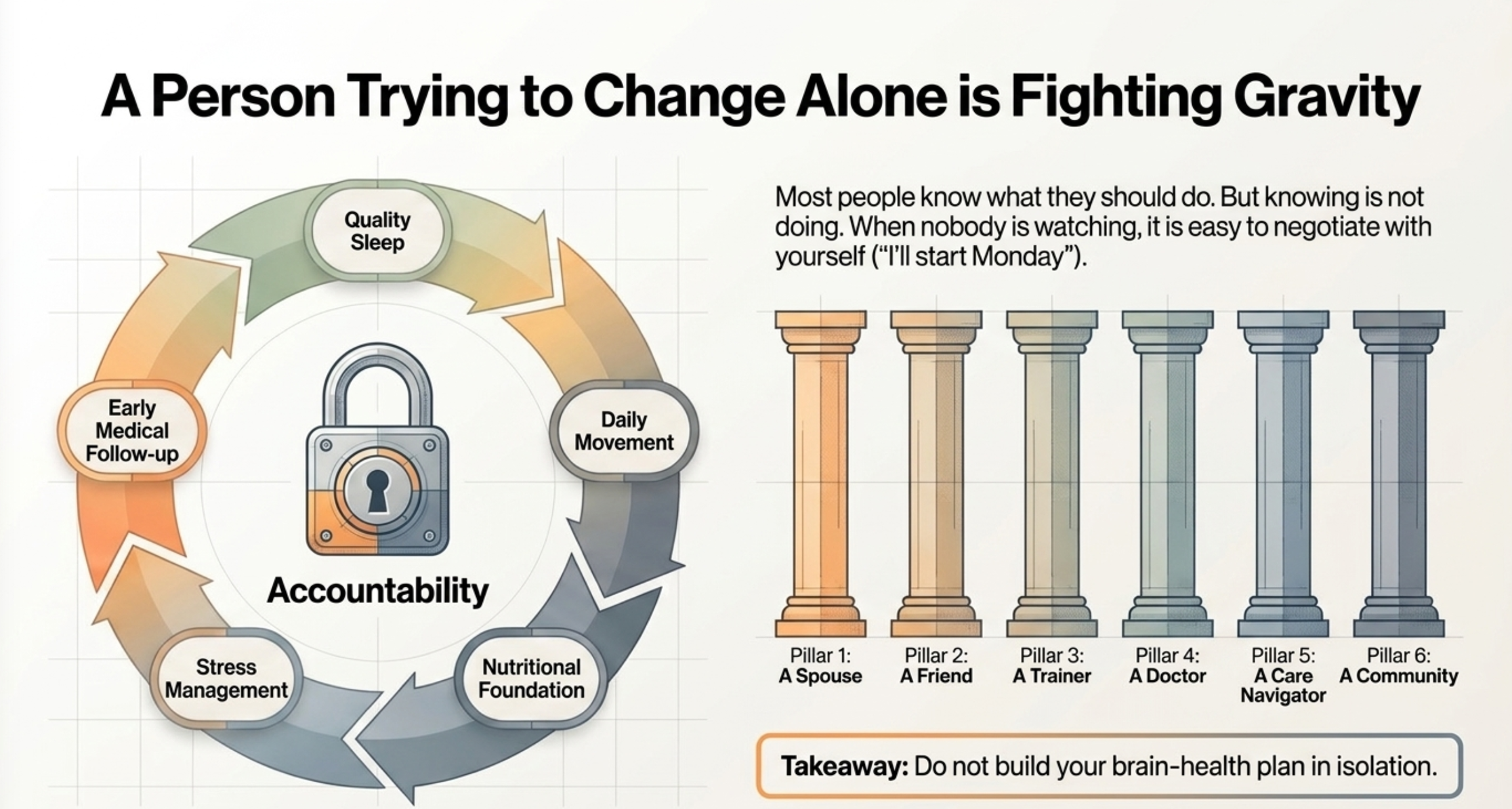
A person trying to change alone is fighting gravity.
But a person with support has a better chance of following through.
That may mean a spouse.
A friend.
A trainer.
A support group.
A doctor.
A care navigator.
A community.
The point is simple:
Do not build your brain-health plan in isolation.
Support helps behavior become real.
THE IMPACT OF EDUCATION
Near the end of the conversation, I shared something personal.
I was out with my family when someone recognized me and came over to thank me for the caregiver education videos we had posted.
He talked about situations like refusing to shower, refusing medication, and confusion around dementia versus delirium. He said the education helped him think differently and ask better questions.
That moment stayed with me.
Because sometimes we do not realize how far education travels.
A video.
A conversation.
A newsletter.
A support group.
A practical explanation.
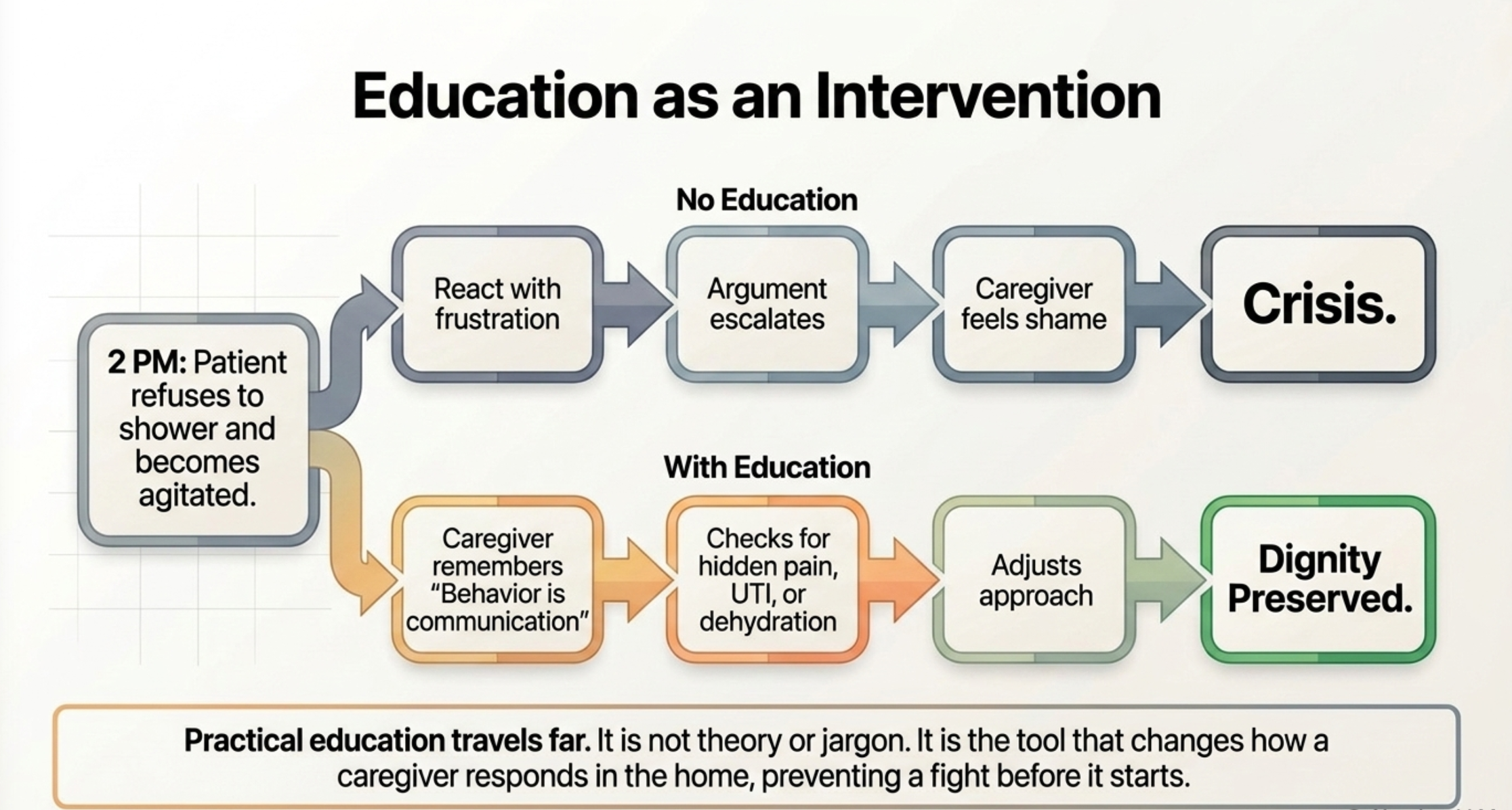
A simple phrase like, “Behavior is communication.”
A reminder to check for infection, dehydration, medication changes, pain, or delirium.
These things matter.
They may change the way a caregiver responds at 2 PM.
They may change whether someone calls the doctor.
They may change whether a caregiver feels alone.
They may prevent a fight.
They may prevent shame.
They may prevent a crisis.
That is why I do this.
That is why Straight Talk with Dr. Erik exists.
Because dementia families need clear education that they can actually use in the home.
Not theory.
Not jargon.
Not fear.
Practical guidance.
WHAT GIVES ME HOPE
So what gives me hope?
Research gives me hope.
Earlier detection gives me hope.
The possibility of preventing symptoms before they begin gives me hope.
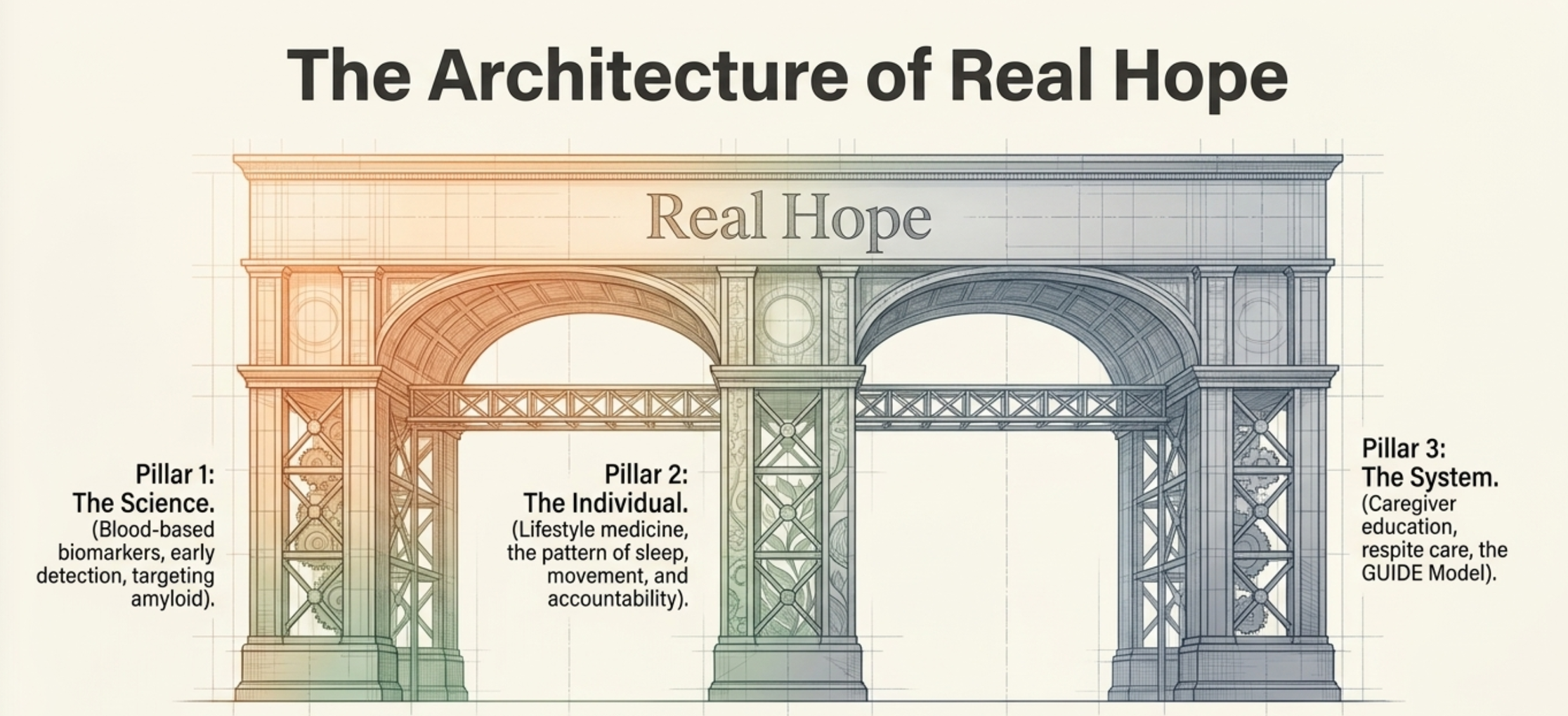
Blood-based biomarkers, when used appropriately, give me hope.
New treatment pathways give me hope.
Lifestyle medicine gives me hope.
Caregiver education gives me hope.
The GUIDE Model gives me hope.
But most of all, families give me hope.
Because every day, I see caregivers who are exhausted and still showing up.
I see spouses learning a new language of care.
I see adult children trying to protect dignity.
I see professionals building better systems.
I see families asking better questions.
I see people refusing to accept that dementia care has to be confusing, lonely, and reactive.
That is hope.
Hope is not pretending dementia is easy.
Hope is building a better response.
WHAT I WANT FAMILIES TO REMEMBER
If you are thinking about the future of dementia care, here is what I want you to remember.
The future is not only about treating brain disease.
It is about building brain health.
It is about prevention instead of reaction.
It is about healthspan, not just lifespan.
It is about asking earlier questions.
It is about protecting sleep, movement, nutrition, connection, hearing, stress, and chronic disease management.
It is about supporting caregivers before they collapse.
It is about using research wisely, not turning every breakthrough into a miracle promise.
And it is about remembering that even while we wait for the future of science, there are choices families can make today.
Not perfect choices.
Better choices.
One step at a time.
That is how change begins.
Slide deck note
Extra visual from this issue

Common questions
Quick answers from this issue
What Gives Me Hope About the Future of Dementia Care?
Every week, caregivers ask me some version of the same question: “Dr. Erik, is there any hope?” And I understand why families ask it.
What should caregivers try first?
Write down what changed, when it started, and what was happening right before it. Reduce noise, slow the conversation down, and use one simple step at a time. Share the pattern with the family, care team, or clinician so everyone responds consistently.
When should families call a clinician?
Call a clinician promptly if the change is sudden, severe, unsafe, tied to a fall, fever, pain, dehydration, medication change, hallucinations, paranoia, or new confusion. Call emergency services for immediate danger.