

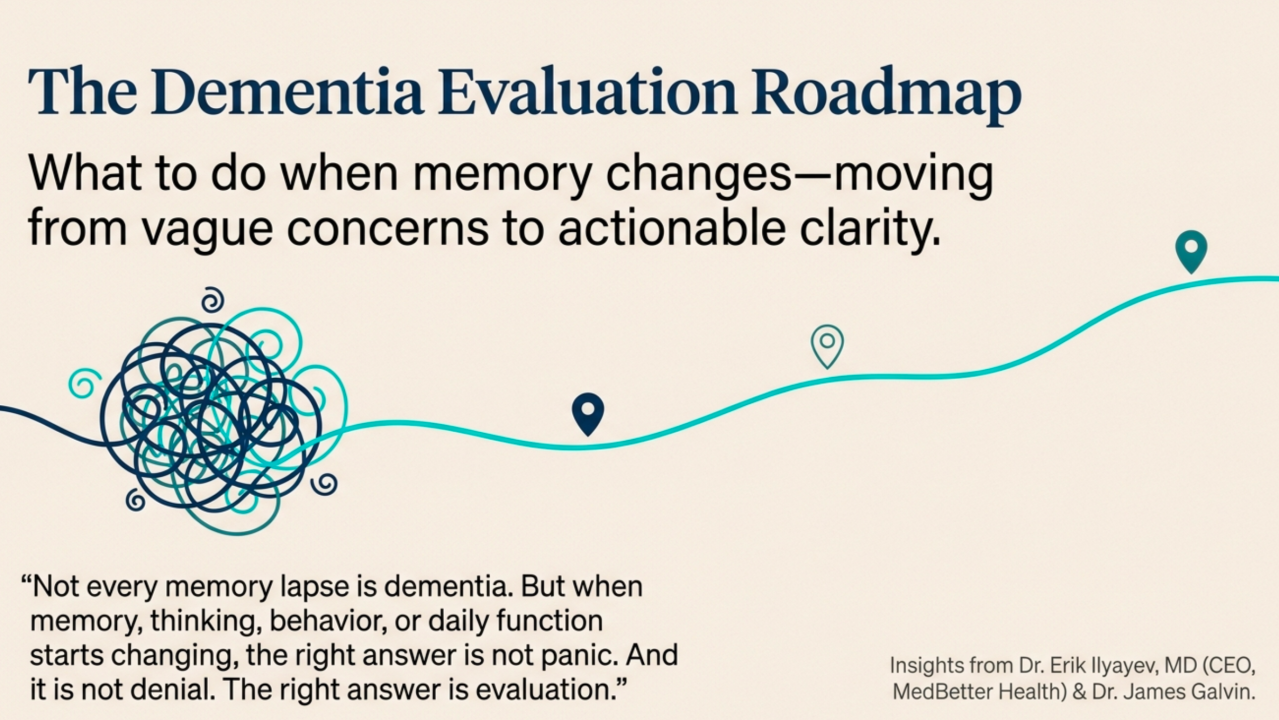
Every week, caregivers ask me some version of the same question:
“Dr. Erik, how do we actually know if this is dementia?”
And I understand why families ask it.
Because memory changes can be confusing.
One person says, “It’s just aging.”
Another person says, “Maybe it’s dementia.”
Someone else says, “Maybe it’s Alzheimer’s.”
And the family is left trying to figure out whether they should worry, wait, push for testing, or trust that everything is normal.
But here is the problem:
Memory changes should not be brushed off casually.
Not every memory lapse is dementia. But when memory, thinking, behavior, or daily function starts changing, the right answer is not panic and it is not denial.
The right answer is evaluation.
Recently, I had the privilege of speaking with Dr. James Galvin on Straight Talk with Dr. Erik. Dr. Galvin is one of the leading voices in neurology and brain health, and in this part of our conversation, we talked about something every family should understand:
What is the proper way to evaluate someone when dementia is a concern?
My name is Dr. Erik Ilyayev. I’m a dementia care physician, a board member of the South Florida Alzheimer's Association® , and the CEO of MedBetterHealth.org — one of the organizations selected by Medicare to participate in the GUIDE Model, an 8-year CMS initiative designed to support people living with dementia and the family caregivers caring for them at home.
Because in dementia care, vague concern is not enough.
Families need a roadmap.
THE FIRST STEP: NOTICE THE CHANGE
Before we talk about tests, we have to talk about how memory changes are first noticed.
There are usually three ways this begins.
The person may notice something themselves.
A spouse, adult child, or caregiver may notice something.
Or the clinician may notice something indirectly.
Each one matters.
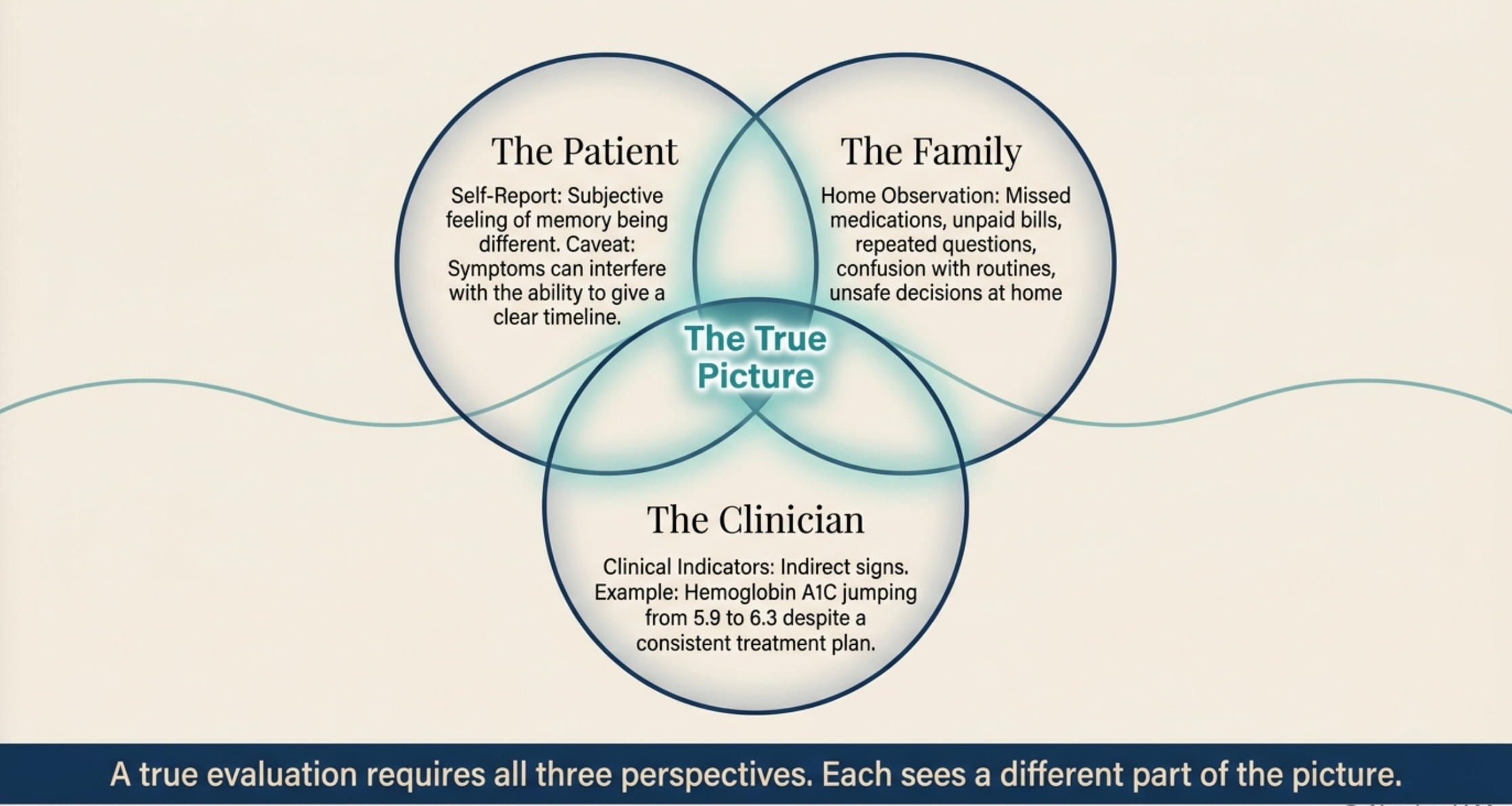
The person may say, “My memory feels different.” But people with memory problems may not always be the best storytellers about what is happening, because the symptom itself can interfere with the ability to give a clear timeline.
The family may notice things the doctor never sees in the office: missed medications, unpaid bills, repeated questions, confusion with routines, personality changes, difficulty following familiar tasks, or unsafe decisions at home.
And sometimes the clinician notices something indirectly.
Dr. Galvin gave a very practical example. A patient with diabetes may have been well controlled for years, but suddenly their numbers start worsening. Their hemoglobin A1C goes from 5.9 to 6.3 even though the treatment plan has been consistent.
Why?
Maybe the person is missing medications. Maybe they cannot track the regimen anymore. Maybe the first clue is not “I forgot where I put my keys.” Maybe the first clue is that the person can no longer manage a medical routine they used to manage.
That is why the patient, the family, and the clinician all matter.
Each one sees a different part of the picture.
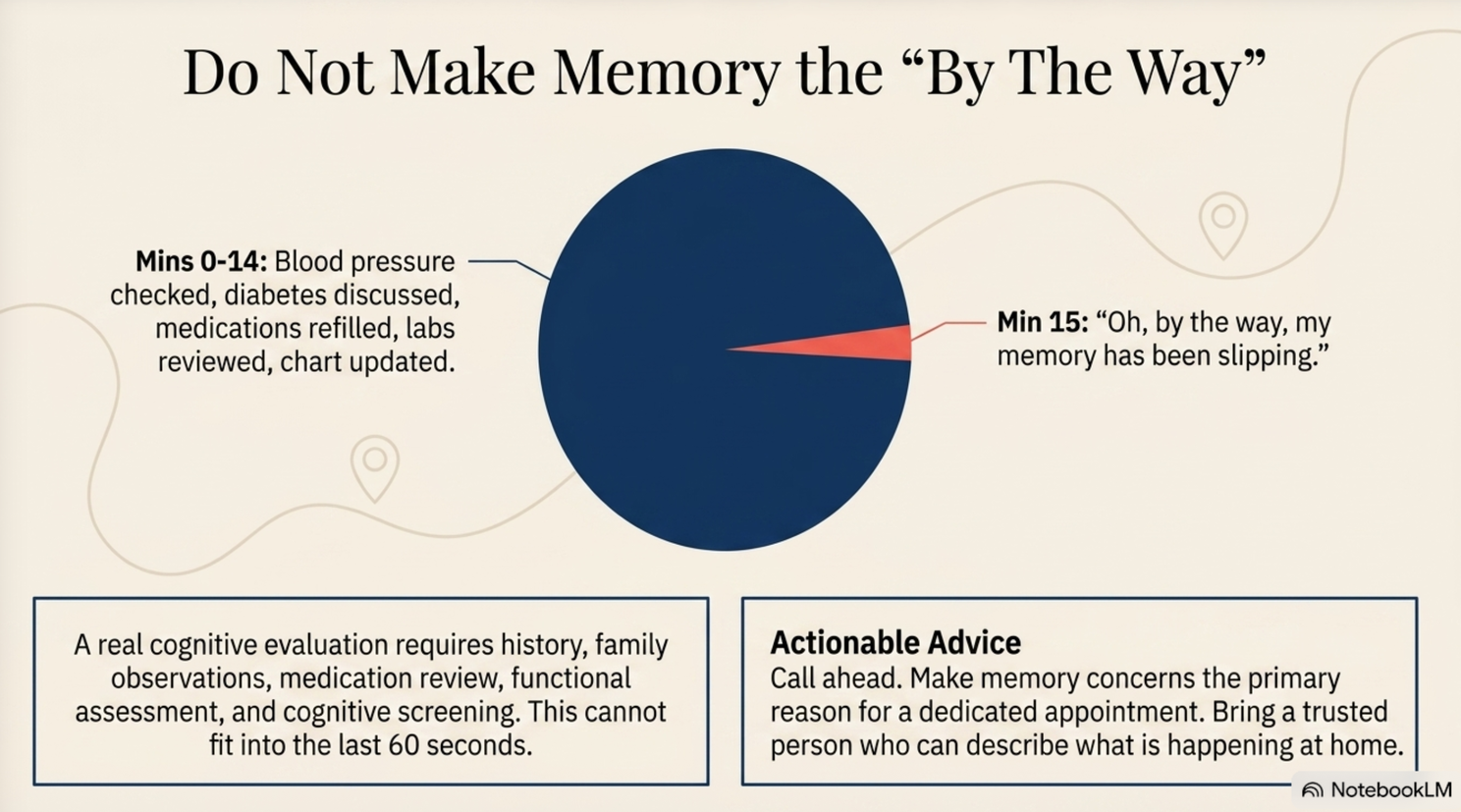
DO NOT MAKE MEMORY LOSS THE “BY THE WAY”
One of the biggest mistakes families make is bringing up memory at the end of a routine doctor visit.
The blood pressure has already been checked. Diabetes has been discussed. Medications have been refilled. Lab results have been reviewed. The chart has been updated. The visit is almost over.
Then someone says:
“Oh, by the way, my memory has been slipping.”
That is the wrong moment.
Not because the concern is unimportant.
Because it is too important to squeeze into the last minute of a routine visit.
A real cognitive evaluation takes time. The clinician needs history, a timeline, family observations, medication review, functional assessment, cognitive screening, and sometimes follow-up testing.
That does not fit into the last 60 seconds.
So if you are worried about memory changes, make it the reason for the visit. Call ahead and say, “We need an appointment to discuss memory concerns and cognitive changes.” Bring a spouse, adult child, caregiver, or trusted person who can describe what is happening at home.
That is not overreacting.
That is smart care.
THE NORMAL AGING TRAP
Now I want to slow down on this point because it is very important.
Families hear this all the time:
“Oh, it’s just normal aging.”
And sometimes, yes, aging can make things slower. It may take longer to remember a name. It may take longer to remember what you had for breakfast. It may take longer to balance a checkbook. It may take longer to retrieve information.
But the key is this:
You can still do it.
That is the distinction.
Taking longer is different from losing the ability to function.
If a person eventually remembers the name, eventually remembers the meal, eventually completes the task, that can be one thing. But if they are no longer able to manage medications, pay bills, follow a familiar recipe, keep track of appointments, manage diabetes, or drive safely to familiar places, that is different.
That should not be dismissed as “just aging.”
Memory loss that interferes with function is caused by something.
It may not be Alzheimer’s disease. It may not even be dementia. It could be poorly controlled diabetes. It could be medication side effects. It could be thyroid disease. It could be vitamin deficiency. It could be depression, sleep problems, infection, or another medical issue.
But it deserves evaluation.
THE QUICK SCREEN IS ONLY THE ENTRY POINT
The first formal step is often a screening test.
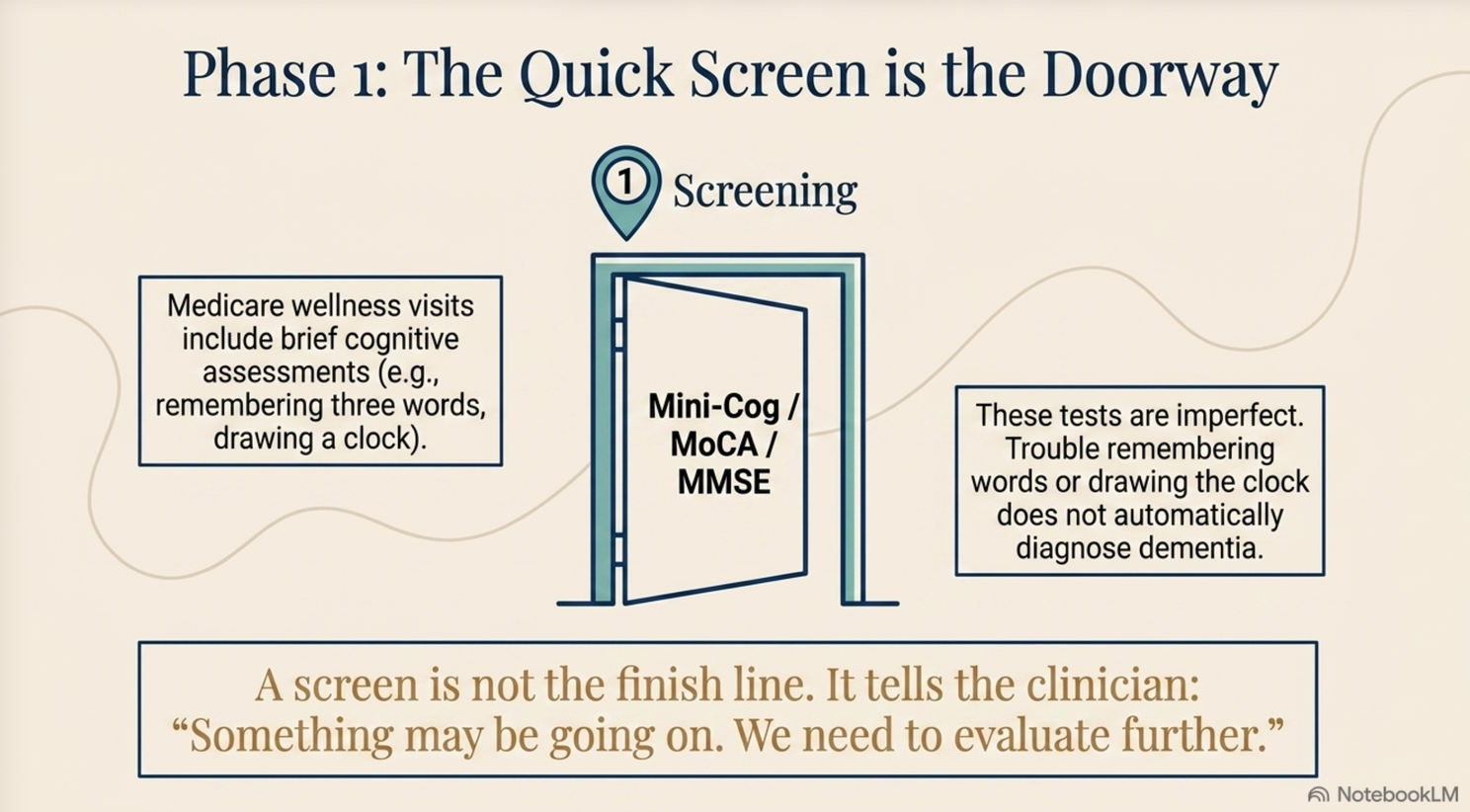
Medicare wellness visits are supposed to include some form of cognitive assessment. The problem is that the exact method is not always prescribed clearly. In real life, a person may be asked, “How is everything?” They say, “Fine,” and the box gets checked.
That is not enough when there is a real concern.
There are brief tools clinicians can use. One example Dr. Galvin discussed is the Mini-Cog. It is simple: the person is asked to remember three words, draw a clock, and then recall the words.
It does not take long.
It is not perfect.
But it can be a useful entry screen.
If someone has trouble remembering the words or drawing the clock from memory, that does not automatically diagnose dementia. It tells the clinician, “Something may be going on. We need to evaluate further.”
That is the right way to think about screening.
A screen is not the finish line.
It is the doorway.
If the screen raises concern, then the next step may include more detailed cognitive testing, such as a MoCA, MMSE, or another tool the clinician prefers. None of these tests are perfect by themselves. But they help identify whether there is a cognitive problem that needs more investigation.
THE NEUROLOGIC EXAM MATTERS
After screening, the neurologic exam matters.
Why?
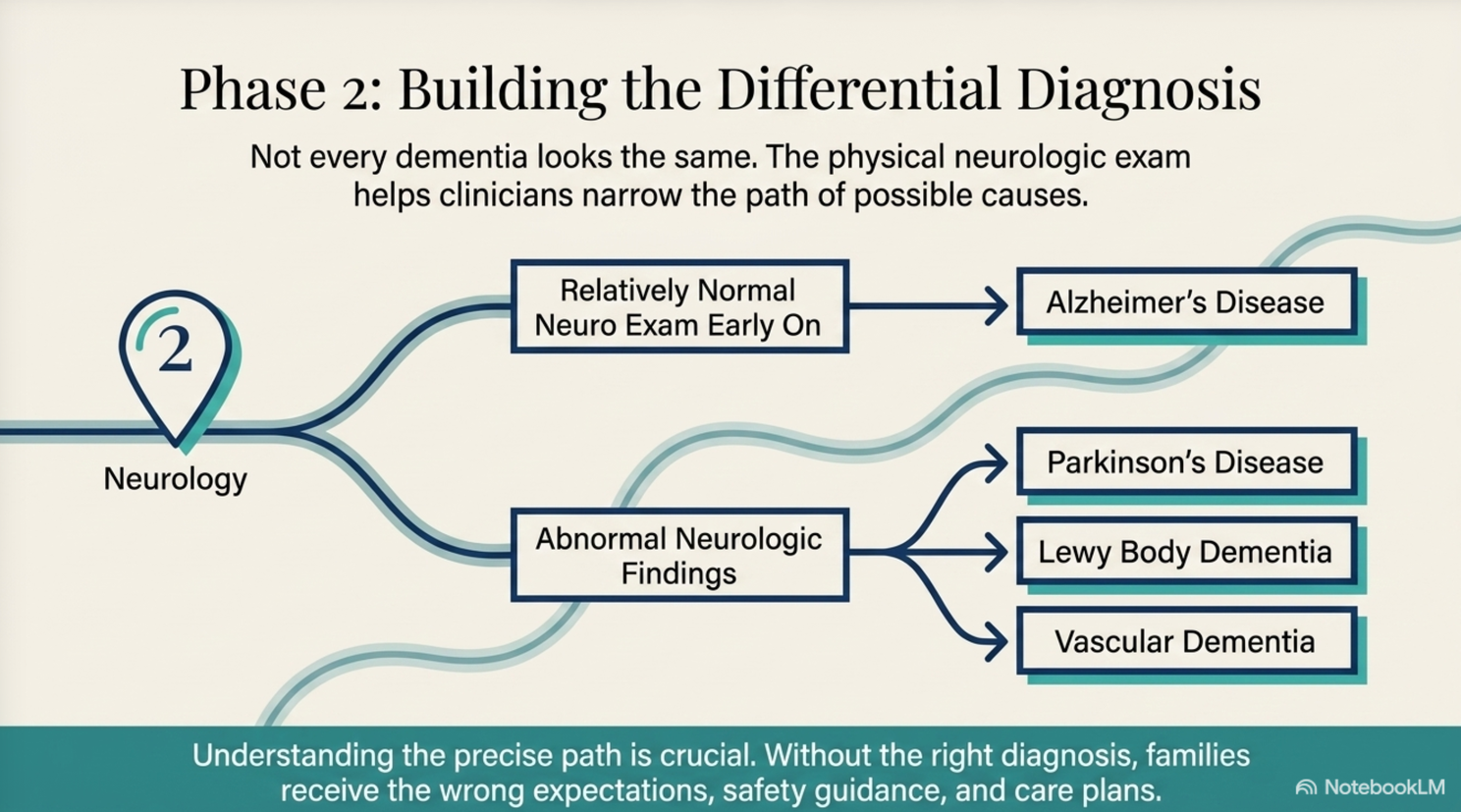
Because not every dementia looks the same.
Some diseases may have a relatively normal neurologic exam early on. Others may show abnormal findings.
Dr. Galvin explained that Alzheimer’s disease often has a relatively normal neurologic exam, while conditions such as Parkinson’s disease, Lewy body dementia, or vascular dementia may have abnormal neurologic findings.
That matters because the exam helps the clinician build a differential diagnosis.
That is just a medical way of saying:
“What are the possible causes?”
Is this Alzheimer’s disease?
Is this Lewy body disease?
Is this vascular disease?
Is this Parkinson’s-related?
Is this something else?
The exam helps narrow the path.
And in dementia care, the path matters.
Because if you do not know what you are dealing with, the family may receive the wrong expectations, the wrong safety guidance, and the wrong care plan.
LABS ARE NOT OPTIONAL DETAILS
The next part of the evaluation is looking for treatable or reversible contributors.
This is where laboratory testing matters.
Dr. Galvin talked about checking things like a complete metabolic panel, hemoglobin A1C, thyroid function, and vitamin levels.
Why?
Because abnormalities in these areas can affect cognition.
If blood sugar is poorly controlled, cognition can suffer. If thyroid function is abnormal, memory and thinking can be affected. If vitamin levels are low, that may contribute to symptoms. If metabolic issues are present, the brain may not function the way it should.
And some of these problems may be treatable.
That does not mean fixing a lab automatically fixes every memory problem.
But it means we should not skip the basics.
A family should not be told “dementia” without asking whether reversible or treatable contributors have been considered.
That is not being difficult.
That is responsible.
WHY DIABETES MATTERS TO THE BRAIN
I want to highlight diabetes because Dr. Galvin made a point families need to hear.
After age, diabetes may be one of the major risk factors for developing diseases like Alzheimer’s disease.
And unlike age, diabetes is treatable.
Now, does better blood sugar control erase all memory problems?
No.
But people with poorly controlled blood sugars and elevated hemoglobin A1C may perform worse on cognitive testing than people whose sugars are better controlled.
So when we talk about memory, we cannot only talk about the brain in isolation.
We have to talk about the whole body.
Blood sugar matters.
Blood pressure matters.
Cholesterol matters.
Sleep matters.
Medications matter.
Vitamins matter.
Thyroid function matters.
The brain is not floating separate from the rest of the person.
It is connected to the entire medical picture.
THE BRAIN IMAGE
The next part is imaging.
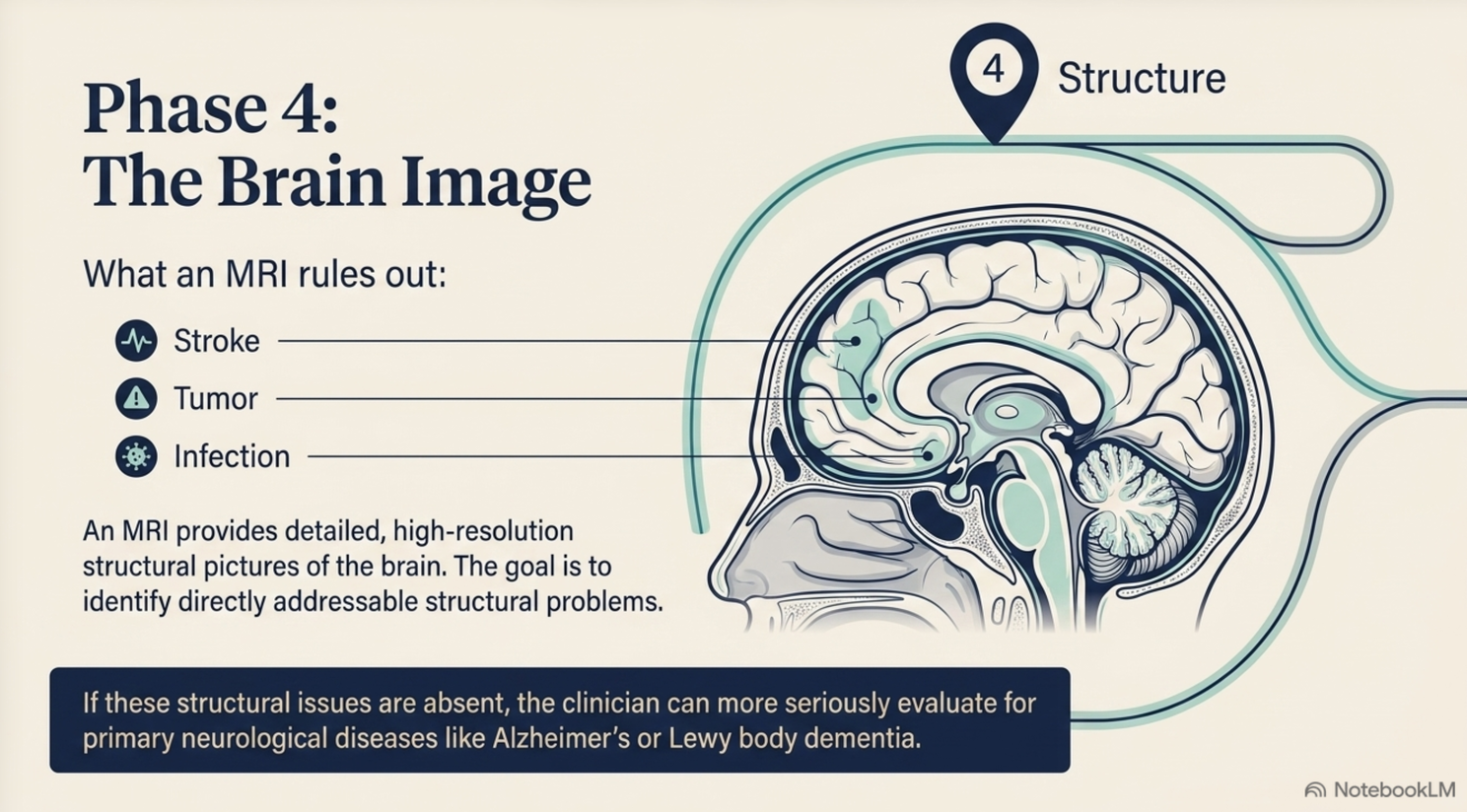
Dr. Galvin explained that an MRI is usually the best picture of the brain because it gives more detail and a thinner resolution than many other types of imaging.
Why do we take a picture of the brain?
Because we are looking for structural problems.
Stroke.
Tumor.
Infection.
Other findings that may be more directly addressable.
If those are not present, that helps the clinician think more seriously about primary neurological diseases such as Alzheimer’s disease or Lewy body dementia.
Again, this does not mean every person needs the exact same test in the exact same way. Imaging decisions should be made by qualified clinicians based on the person’s situation.
But the principle matters:
A proper evaluation does not stop at “you seem forgetful.”
It asks what is happening inside the full clinical picture.
BLOOD-BASED BIOMARKERS ARE CHANGING THE CONVERSATION
We are also entering a new era with blood-based biomarkers.
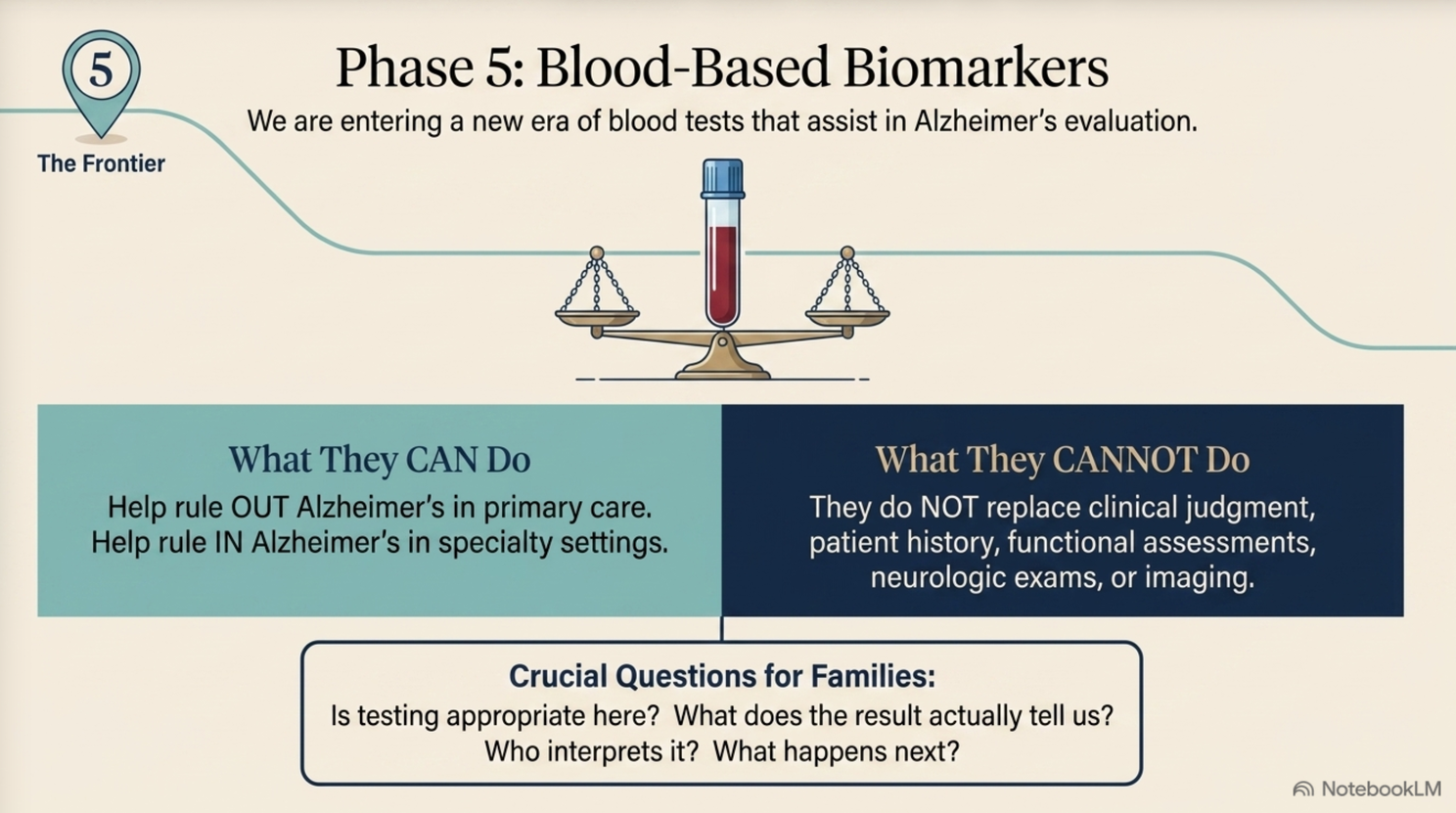
Dr. Galvin mentioned that there are now blood tests available that can help in Alzheimer’s evaluation. Some may be used in the primary care setting to help rule out Alzheimer’s disease. Others may be used in specialty settings to help rule in Alzheimer’s disease.
This is important, but we have to be careful.
These tests are not something families should interpret on their own.
They do not replace a full medical evaluation.
They do not replace clinical judgment, history, functional assessment, neurologic exam, labs, imaging, or specialist involvement when appropriate.
But they are becoming part of the conversation.
And that means families need to ask better questions:
“Is blood-based biomarker testing appropriate in this situation?”
“What does this test actually tell us?”
“What does it not tell us?”
“Who should interpret it?”
“What happens next depending on the result?”
That is how families become informed without becoming careless.
THE LOGS IN THE RIVER
There was another image I brought up in the conversation that I think matters.
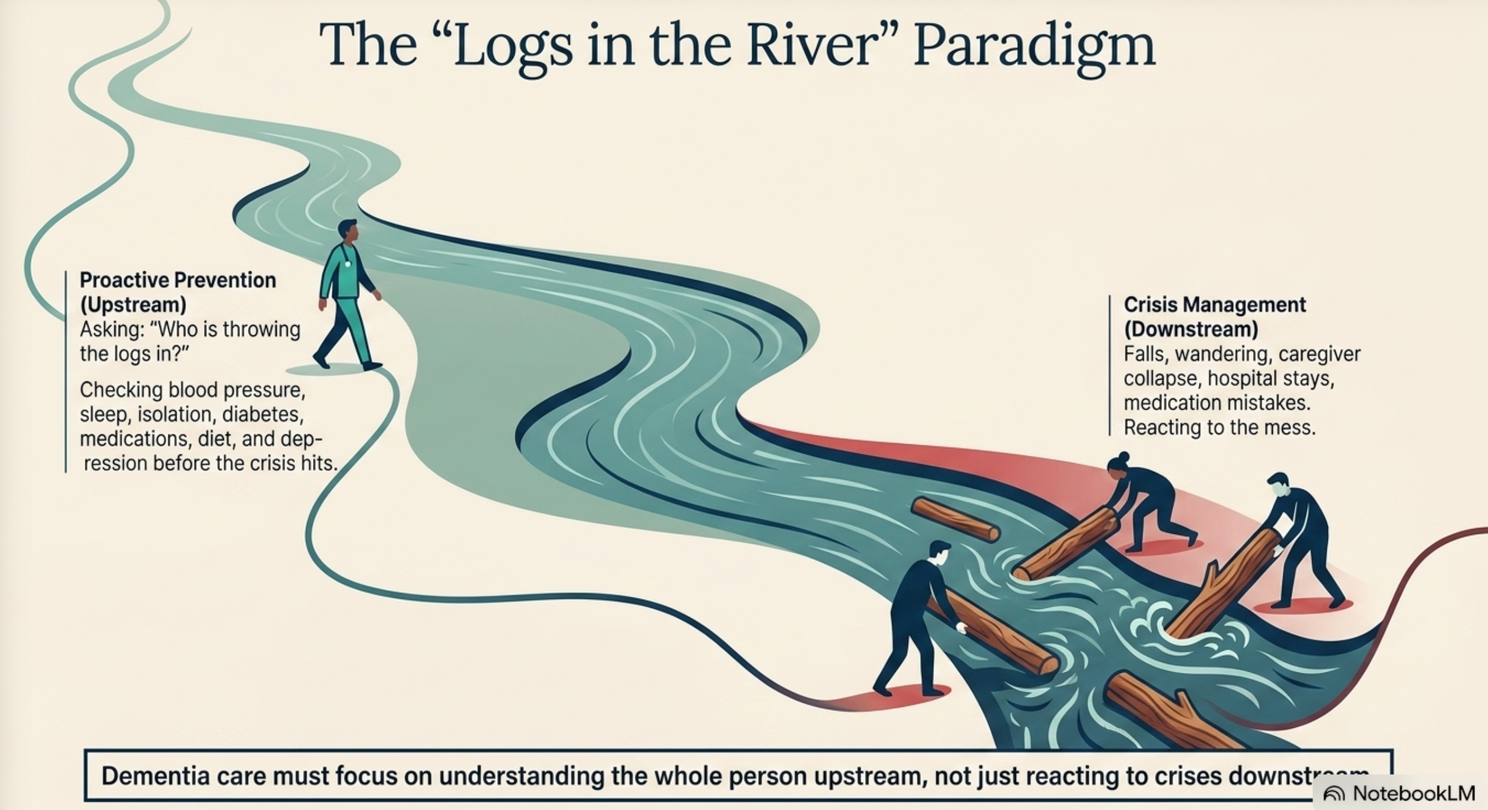
Imagine logs falling down a river.
Every day, people are standing at the bottom pulling the logs out, cleaning the river, and reacting to the mess.
But nobody goes upstream to ask:
Where are the logs coming from?
Who is throwing them in?
How do we stop them before they keep falling?
That is how I think about prevention.
Too often, families wait until the crisis arrives. The fall. The hospital stay. The wandering episode. The medication mistake. The caregiver collapse.
Then everyone reacts.
But dementia care also has to ask upstream questions.
How is blood sugar?
How is blood pressure?
How is sleep?
What medications may be affecting thinking?
Is depression present?
Is there infection?
Is there isolation?
Is the caregiver exhausted?
Is the person eating well?
Is the person moving?
Are there risks we could identify earlier?
Prevention is not only about one medication, one vitamin, or one test.
It is about understanding the whole person earlier.
WHAT FAMILIES SHOULD BRING TO THE DOCTOR
If you are worried about memory changes, do not walk into the appointment with only a vague concern.
Write things down.
Not just:
“Mom is forgetful.”
Be specific.
“She missed her medications three times this week.”
“She paid the same bill twice.”
“She left food on the stove.”
“She got lost driving to a familiar store.”
“She cannot follow a recipe she has made for years.”
“She keeps asking the same question every few minutes.”
“She is no longer managing her diabetes the way she used to.”
Those examples matter because they show function.
And dementia is not only about memory.
It is about function.
A person may still be charming in the office. They may smile. They may answer simple questions. They may appear socially intact. They may say, “I’m fine.”
But the family sees the real pattern at home.
That information matters.
Bring it.
WHAT I WANT FAMILIES TO REMEMBER
If you are worried about memory changes, here is what I want you to remember.
Do not dismiss functional change as “just aging.”
Taking longer to remember something can happen with age. Losing the ability to manage familiar daily tasks is different.
Do not make memory concerns the last-minute “by the way” at a routine visit. Make it the reason for a dedicated appointment.
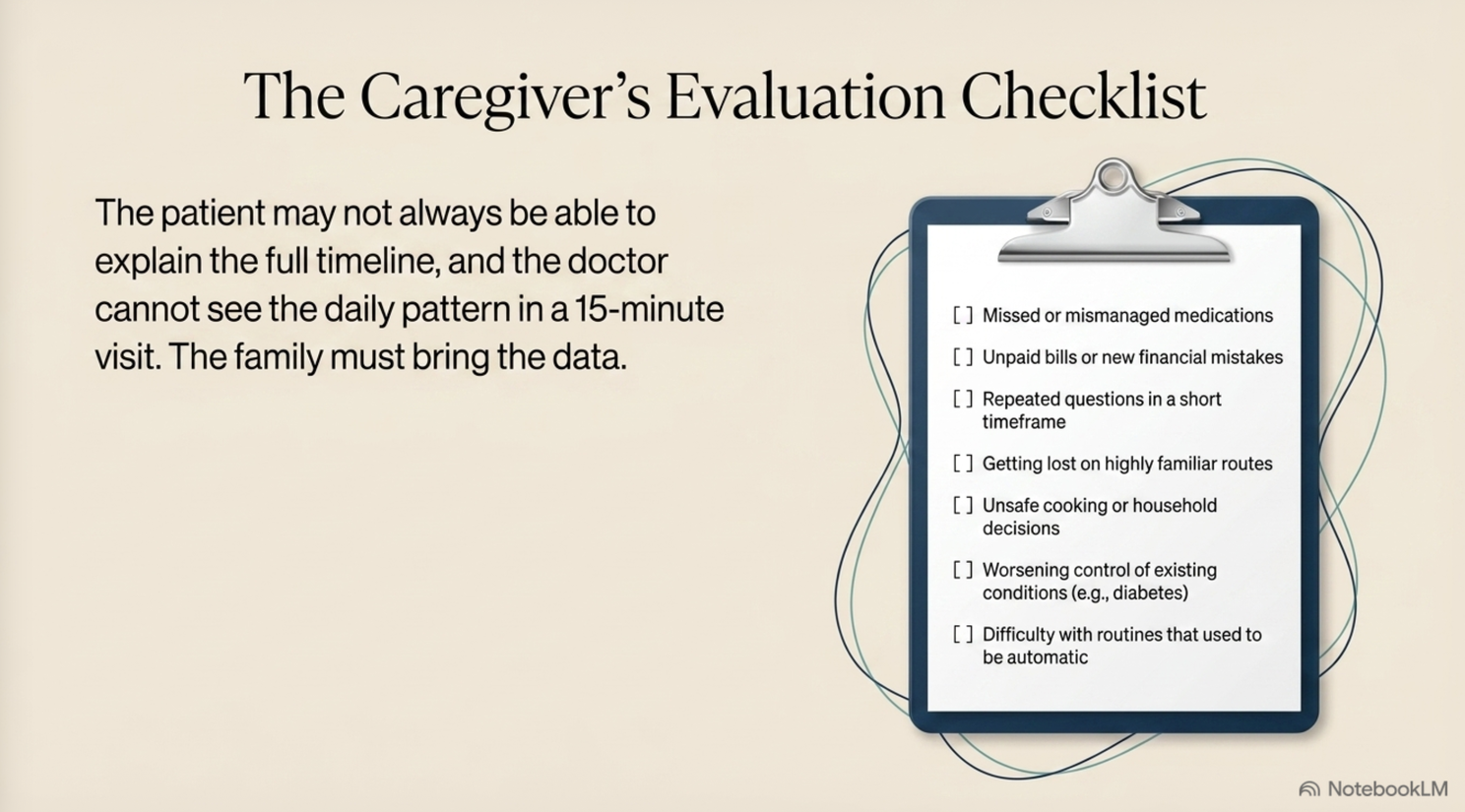
Bring a person who sees what is happening at home. The patient may not always be able to explain the full timeline, and the doctor may not see the daily pattern in a short office visit.
Write down specific examples. Missed medications. Unpaid bills. Repeated questions. Unsafe cooking. Worsening diabetes control. Getting lost on familiar routes. Difficulty with routines that used to be automatic.
Ask for a proper evaluation. That may include screening, more detailed cognitive testing, a neurologic exam, labs, imaging, and discussion of whether additional testing or referral is appropriate.
And most importantly, ask what is causing the symptoms.
Because dementia is not the end of the question.
It is the beginning.

Common questions
Quick answers from this issue
What Is the Right Way to Evaluate Memory Loss?
Every week, caregivers ask me some version of the same question: “Dr. Erik, how do we actually know if this is dementia?” And I understand why families ask it.
What should caregivers try first?
Write down what changed, when it started, and what was happening right before it. Reduce noise, slow the conversation down, and use one simple step at a time. Share the pattern with the family, care team, or clinician so everyone responds consistently.
When should families call a clinician?
Call a clinician promptly if the change is sudden, severe, unsafe, tied to a fall, fever, pain, dehydration, medication change, hallucinations, paranoia, or new confusion. Call emergency services for immediate danger.