

Every week, caregivers ask me some version of the same question:
“Dr. Erik, what is the difference between dementia and Alzheimer’s disease?”
And I understand why families are confused.
One person says memory loss.
Another person says dementia.
Another person says Alzheimer’s disease.
A doctor may say, “Your loved one has dementia,” and the family walks out thinking they finally have the answer.
But here is the problem:
Dementia is not the final answer.
Dementia is the description of the problem.
It tells us that memory, thinking, judgment, behavior, or daily function has changed enough to interfere with everyday life. But it does not tell us why that change is happening.
And in medicine, the “why” matters.
Recently, I had the privilege of speaking with Dr. James Galvin on Straight Talk with Dr. Erik. Dr. Galvin is one of the leading voices in neurology and brain health, and we started with one of the most important questions families need to understand:
What is the difference between dementia and Alzheimer’s disease?
My name is Dr. Erik Ilyayev. I’m a dementia care physician, a board member of the South Florida Alzheimer's Association® , and the CEO of MedBetterHealth.org — one of the organizations selected by Medicare to participate in a groundbreaking new program designed to change how America cares for people living with dementia.
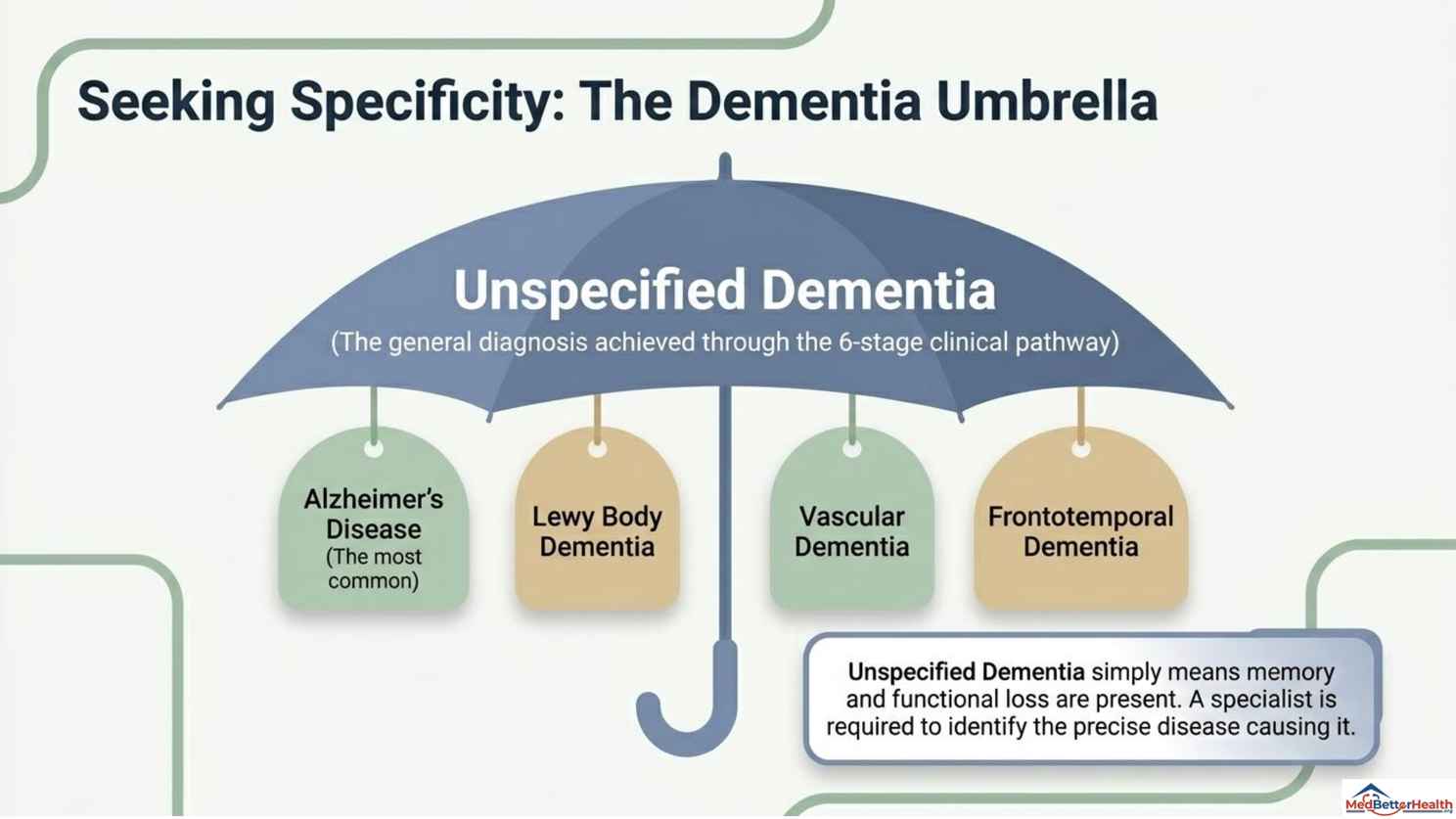
DEMENTIA IS THE UMBRELLA, NOT THE ROOT CAUSE
Let’s start simple.
Dementia is a general term.
It describes a change in someone’s memory or other thinking abilities that interferes with everyday activities.
That is the definition.
But dementia does not tell us the cause.
There are over 150 different causes of dementia. Some are genetic. Some are not. Some are reversible. Some are not. Some progress quickly. Some progress slowly.
That is why the specific diagnosis matters.
Alzheimer’s disease is the most common cause of dementia, but it is not the only cause.
So the sentence I want every family to remember is this:
All Alzheimer’s is dementia, but not all dementia is Alzheimer’s.
That distinction matters because different causes can require different clinical thinking, different treatment paths, different expectations, and different caregiver education.
If the family only hears the word “dementia,” they may think the conversation is over.
But medically, that should be where the investigation begins.
THE CAR ANALOGY
Dr. Galvin used a simple analogy that I think every family can understand.
Ask a room full of people:
“How many of you own a car?”
Most hands go up.
Then ask:
“What kind of car do you drive?”
One person says Toyota. Another says Ford. Another says Mercedes.
They are all cars.
But they are not the same car.
A Tesla and a gas-powered car are both cars, but if something goes wrong, the fix may be completely different. One does not need an oil change. The other does.
The category is not enough.
You need to know what kind of car it is.
The same idea applies to dementia.
“Dementia” is the category.
Alzheimer’s disease is one possible cause.
But the family still needs to know:
What type of dementia are we talking about?
What do we believe is causing the symptoms?
What evidence supports that?
What does that mean for treatment, planning, safety, and care?
Not because families need to become doctors.
But because the care plan depends on the cause.
WHY PRECISION CHANGES CARE
A vague diagnosis leads to vague care.
A more specific diagnosis gives families direction.
If someone has Alzheimer’s disease, that may lead to one kind of treatment conversation, one kind of progression discussion, and one kind of caregiver education.
If the cognitive changes are coming from another cause, the plan may be different.
That is the point.
When the cause is different, the response may be different.
So the question is not only:
“Does my loved one have dementia?”
The better question is:
“What is causing the dementia symptoms?”
Because if we do not answer that, we may be treating the wrong problem.
And in dementia care, the wrong problem can send the whole family down the wrong road.
THE 40% PROBLEM
Here is where the healthcare system has a real challenge.
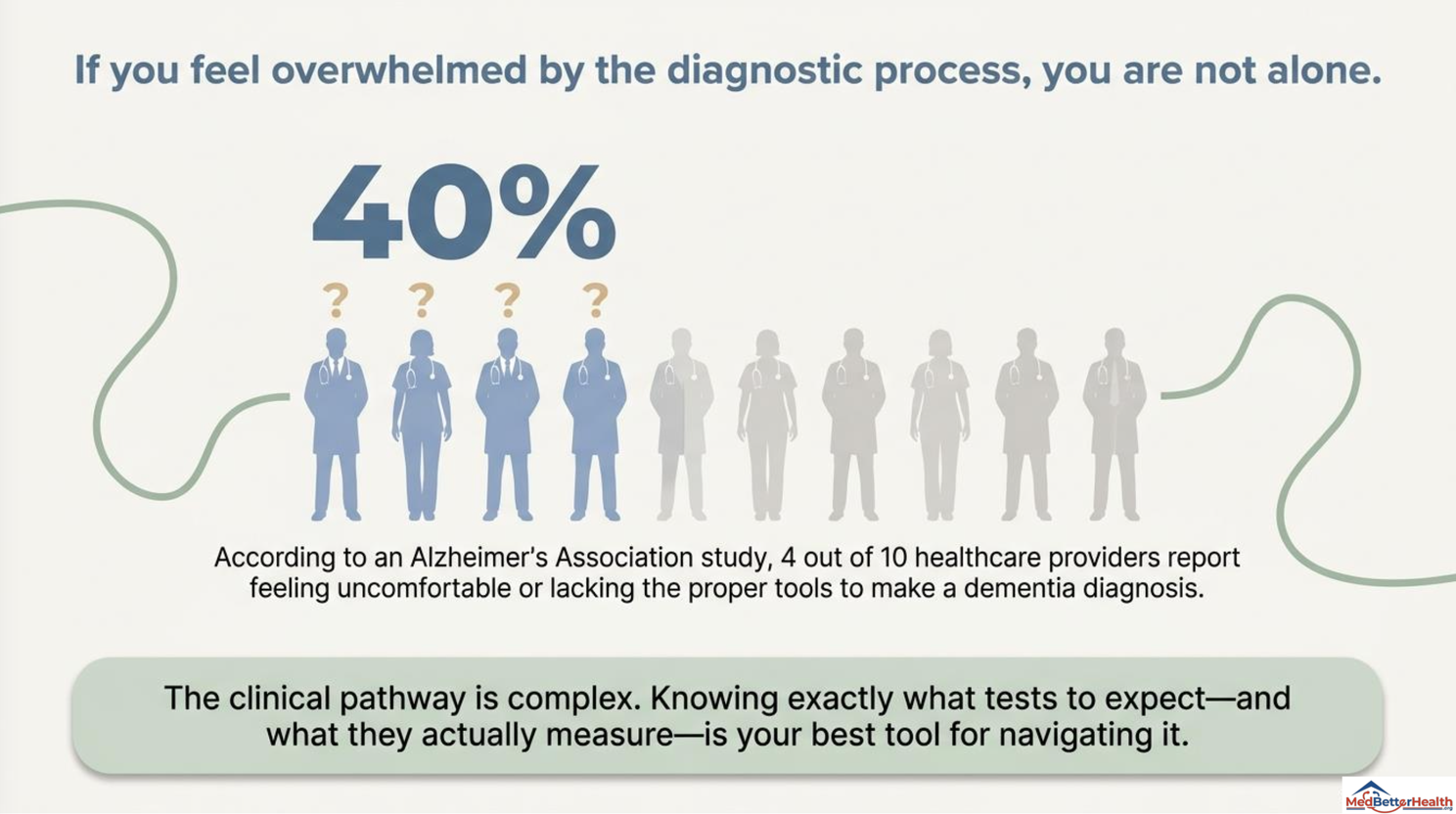
One statistic that stood out to me is that 40% of clinicians, providers, doctors, and nurse practitioners say they do not feel comfortable, or lack the tools, to make a dementia diagnosis.
That should make every family pause.
Because if a significant number of clinicians feel uncomfortable making the diagnosis, how many people are being missed?
How many are being told, “It’s just normal aging”?
How many families are waiting until symptoms become more advanced before anyone takes the concern seriously?
And I want to be fair here.
This is not because doctors do not care.
Medicine is hard right now. Primary care doctors are dealing with blood pressure, diabetes, cholesterol, heart disease, medication refills, lab results, insurance issues, electronic health records, and waiting rooms full of complex patients.
But the result is still the result.
Memory concerns can be delayed.
Cognitive changes can be minimized.
Families can leave without a clear plan.
And in dementia care, lost time matters.
THE THREE WAYS MEMORY CHANGES GET NOTICED
One of the most practical parts of this conversation was how dementia is first noticed.
There are usually three observation channels.
The patient may notice something.
The family may notice something.
The clinician may notice something.
But each channel has limitations.
The patient may feel something is wrong, but people with memory problems may not always be the best storytellers of what is happening. The symptom itself can interfere with the person’s ability to explain the timeline clearly.
The family may see the daily changes that do not show up in a short office visit.
Missed medications.
Unpaid bills.
Repeated questions.
Trouble managing appointments.
Confusion with routines.
Personality changes.
Difficulty following a familiar task.
The clinician may notice indirect clues.
For example, a patient with diabetes who was well controlled for years may suddenly have worsening numbers. Maybe their hemoglobin A1C rises from 5.9 to 6.3 even though the treatment plan has been consistent.
Why?
Maybe the person is missing medications.
Maybe they cannot track the regimen anymore.
Maybe the first measurable clue is not a memory complaint, but a breakdown in disease self-management.
That is why the patient, the family, and the clinician all matter.
Each one sees a different part of the picture.
THE “BY THE WAY” TRAP
Here is what happens too often.
A person goes to the doctor for a routine visit.
Blood pressure is checked.
Diabetes is discussed.
Medications are refilled.
The chart is updated.
The visit is almost over.
The doctor is getting ready to leave.
And then someone says:
“Oh, by the way, my memory has been slipping.”
That is the wrong moment for a serious cognitive concern.
Not because the concern is unimportant.
Because it is too important to squeeze into the last minute of a routine visit.
A dementia evaluation requires time.
The clinician needs history. A timeline. Specific examples. Medication review. Functional assessment. Family input. Cognitive screening. Possibly follow-up.
That cannot be done properly in the last 60 seconds of a routine visit.
So if you are worried about memory changes, do not make it the “by the way” at the end.
Make it the reason for the visit.
Call ahead and schedule a dedicated appointment for memory concerns or cognitive decline.
Tell the office why you are coming.
Bring the spouse, adult child, caregiver, or trusted person who can describe what is happening at home.
That is not overreacting.
That is smart care.
THE NORMAL AGING DISMISSAL
Not every memory lapse is dementia.
I want to be very clear about that.
Everyone forgets a name sometimes. Everyone misplaces keys. Everyone walks into a room and forgets why they went there.
That can happen.
But when memory changes interfere with daily function, that is different.
If medications are being missed, that is different.
If bills are unpaid, that is different.
If the person is repeating the same question constantly, that is different.
If diabetes or blood pressure control worsens because the person cannot follow the regimen, that is different.
If the person gets lost driving somewhere familiar, that is different.
If a spouse or adult child says, “This is not who they used to be,” that deserves attention.
The answer may not be dementia.
But it should not be dismissed casually.
The right answer is evaluation.
Not panic.
Not denial.
Evaluation.
WHAT FAMILIES SHOULD BRING TO THE DOCTOR
If you are worried about memory changes, do not walk into the appointment with only a vague concern.
Write things down.
Not just:
“Mom is forgetful.”
Be specific.
“She missed her medications three times this week.”
“She paid the same bill twice.”
“She left food on the stove.”
“She got lost driving to a familiar store.”
“She cannot follow a recipe she has made for years.”
“She keeps asking the same question every few minutes.”
“She is no longer managing her diabetes the way she used to.”
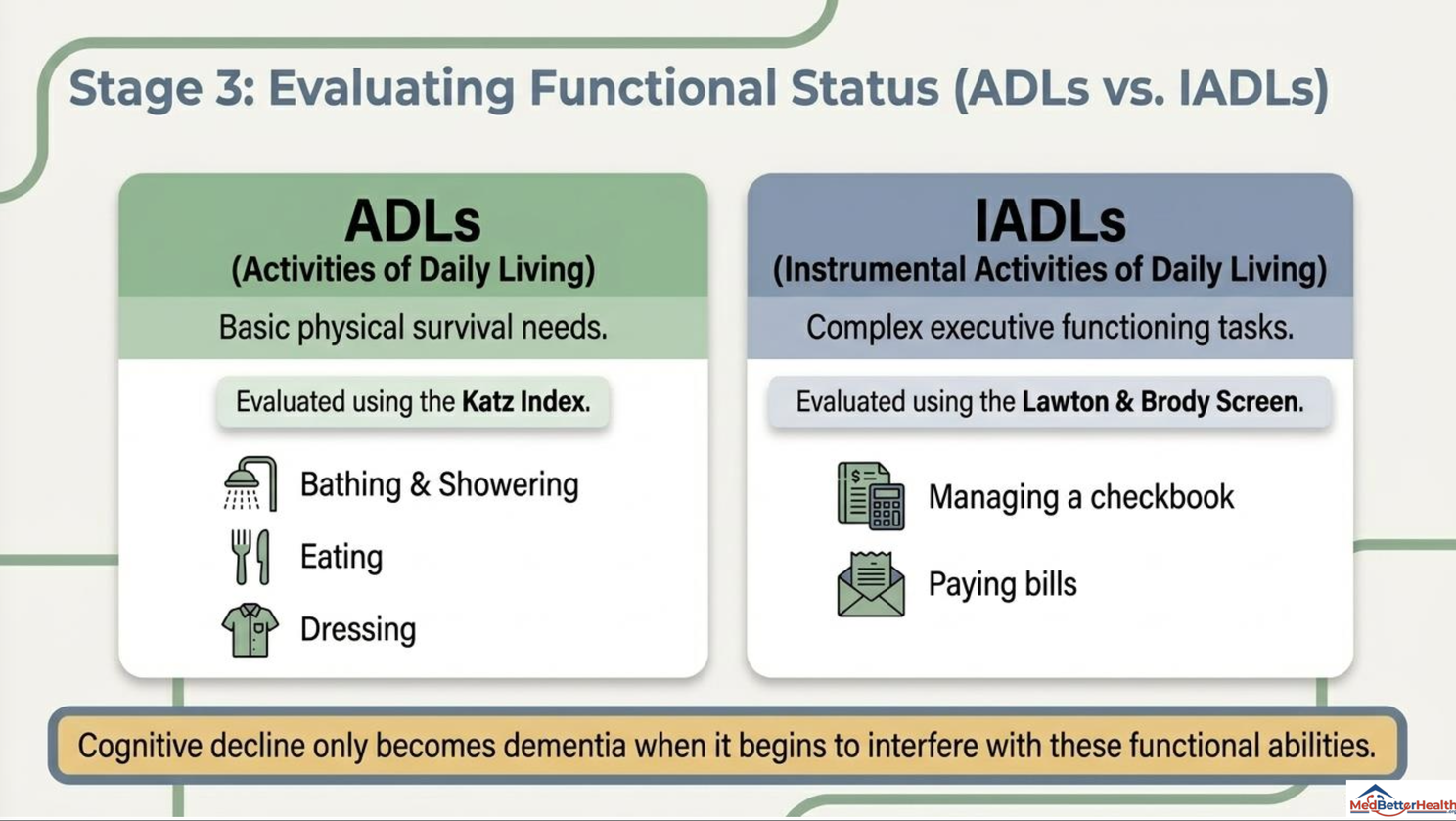
Those examples matter because they show function.
And dementia is not only about memory.
It is about function.
A person may still be charming in the office. They may smile. They may answer simple questions. They may appear socially intact. They may say, “I’m fine.”
But the family sees the real pattern at home.
That information matters.
Bring it.
WHAT I WANT CAREGIVERS TO REMEMBER
If you are caring for someone with memory changes, I want you to remember this:
Dementia is not the final diagnosis.
It is the beginning of the question.
What is causing it?
How fast is it progressing?
What has changed functionally?
Could anything be reversible?
What type of dementia is suspected?
What workup is needed?
What should the family do next?
And if your concern is dismissed as “just normal aging,” but you know something is changing, keep asking.
You are not being difficult.
You are advocating.
You see what happens at home. You see the missed medications. You see the unpaid bills. You see the repeated questions. You see the changes that may not appear during a short office visit.
That information is not just family opinion.
It is clinical data.
Write it down.
Bring it to the visit.
Ask for a dedicated evaluation.
Ask for specificity.
Because families should not be left with vague labels when the care plan depends on the root cause.
Slide deck note
Extra visual from this issue

Common questions
Quick answers from this issue
Is Dementia the Diagnosis — or the Beginning of the Question?
Every week, caregivers ask me some version of the same question: “Dr. Erik, what is the difference between dementia and Alzheimer’s disease?” And I understand why families are confused.
What should caregivers try first?
Write down what changed, when it started, and what was happening right before it. Reduce noise, slow the conversation down, and use one simple step at a time. Share the pattern with the family, care team, or clinician so everyone responds consistently.
When should families call a clinician?
Call a clinician promptly if the change is sudden, severe, unsafe, tied to a fall, fever, pain, dehydration, medication change, hallucinations, paranoia, or new confusion. Call emergency services for immediate danger.