

Every week, caregivers ask me some version of the same question:
“Dr. Erik, what are we supposed to do now?”
And that question usually comes right after the diagnosis.
A spouse has just been told their partner has dementia. An adult child has just heard that Mom or Dad is no longer simply “forgetful.” A family walks out of the doctor’s office with a diagnosis, maybe a medication, maybe a follow-up appointment, and very often very little practical guidance about what daily life is going to look like now.
And that is where the system often fails families.
Because dementia does not only change memory.
It changes the entire family ecosystem.
It changes routines. It changes roles. It changes communication. It changes decision-making. It changes the marriage. It changes the parent-child relationship. It changes what a normal day looks like. It changes what a trip to the grocery store feels like. It changes what “help” means.
And if the caregiver is not educated from day one, the family is forced to learn through crisis.
That is not fair.
My name is Dr. Erik Ilyayev. I’m a dementia care physician, a board member of the South Florida Alzheimer's Association® , and the CEO of MedBetterHealth.org — one of the organizations selected by Medicare to participate in a groundbreaking new program designed to change how America cares for people living with dementia.
In this issue, I want to walk you through what every family should begin understanding immediately after a dementia diagnosis: why the caregiver’s role changes, why acceptance is not the same as giving up, why routine matters, why adult day programs and support groups can be life-changing, and why caring for the caregiver is not optional.
Because if the caregiver collapses, the entire care plan collapses.
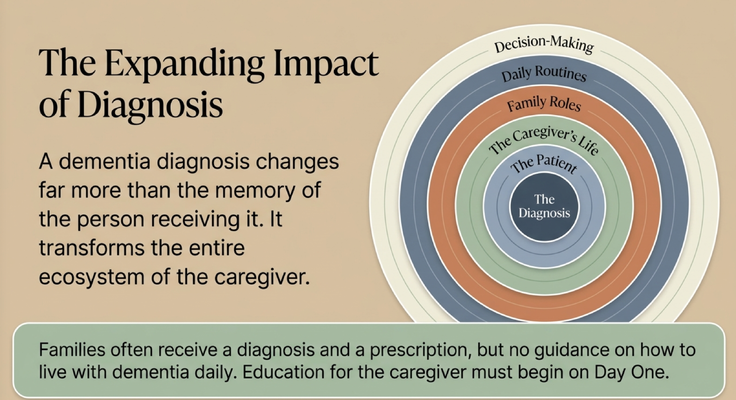
A DIAGNOSIS CHANGES THE WHOLE HOUSE
One of the biggest mistakes we make in dementia care is treating the diagnosis as if it belongs only to the person receiving it.
Of course, the person living with dementia is the patient. They are the one experiencing the brain disease. They are the one whose memory, judgment, sequencing, language, and behavior may change over time.
But the caregiver’s life changes too.
If a husband was always the one who handled the finances, now the spouse may suddenly have to understand every bill, every account, every insurance document, and every appointment. If a wife was always the one who cooked, managed the home, or organized the family calendar, now the spouse may have to learn tasks they never had to manage before. If an adult child is caring for a parent, the family order reverses in a way that feels emotionally unnatural.
And this is not just about logistics.
It is grief.
It is identity.
It is role loss.
It is the painful realization that the relationship may still be filled with love, but it cannot function by the same rules anymore.
Families often try to preserve the old structure as long as possible. They keep asking the person living with dementia to make the same decisions, tolerate the same routines, handle the same responsibilities, and process the same explanations.
But dementia changes capacity.
And when capacity changes, the caregiver’s role has to change too.
That transition is painful. But delaying it can create more conflict, more danger, and more suffering.
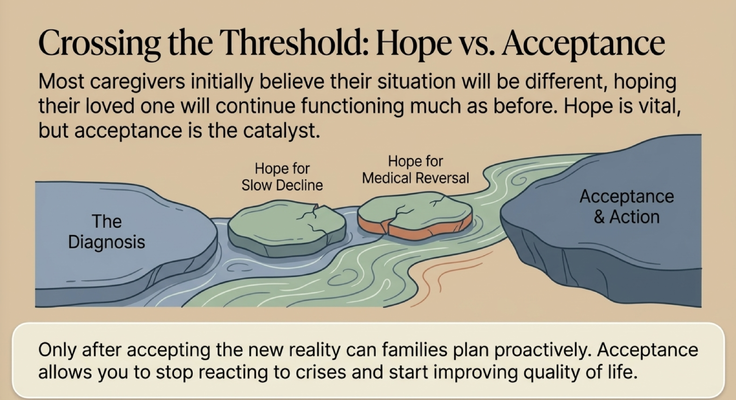
CROSSING THE THRESHOLD: HOPE AND ACCEPTANCE
Hope matters in dementia care.
I never want to take hope away from a family.
Hope for good days matters. Hope for connection matters. Hope for better support matters. Hope for meaningful time together matters. Hope for medical progress matters. Hope for dignity matters.
But hope cannot be the same thing as denial.
A lot of families initially believe their situation will be different. They say, “Maybe Mom will stay the same for years.” “Maybe Dad will not need much help.” “Maybe my spouse can still make these decisions.” “Maybe we do not need daycare.” “Maybe we do not need a support group.” “Maybe we can keep life exactly as it was.”
I understand why families think this way.
Acceptance is hard.
But acceptance is not giving up. Acceptance is the point where the family stops waiting for the old reality to come back and starts building a safer reality around the person they love.
Acceptance allows you to plan. It allows you to simplify. It allows you to stop arguing with symptoms. It allows you to bring in help earlier. It allows you to protect the caregiver before exhaustion becomes a crisis.
The goal is not to surrender to dementia.
The goal is to stop pretending dementia has not changed the rules.
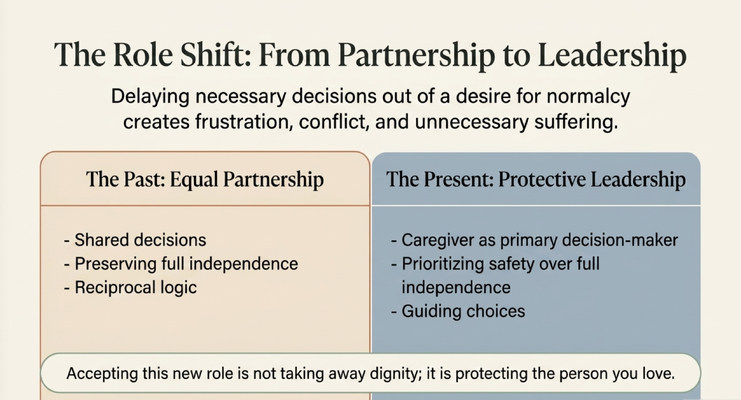
THE ROLE SHIFT: FROM PARTNERSHIP TO PROTECTIVE LEADERSHIP
This is one of the hardest truths for spouses and adult children.
The relationship may have been a partnership for decades.
A husband asked his wife. A wife asked her husband. A child listened to the parent. The family had roles. The house had rhythms. The decisions were shared.
Then dementia enters the home.
Now the caregiver is trying to preserve dignity while also protecting safety. And sometimes those two things feel like they are in conflict.
The person living with dementia may say, “I do not want to go to an adult day program.” “I do not need help.” “I do not want anyone in the house.” “I can still drive.” “I paid the bills.” “There is nothing wrong with me.”
And the caregiver, out of respect, may keep waiting for agreement.
But there are moments in dementia care where waiting for full agreement can become unsafe.
That does not mean we disrespect the person. It does not mean we strip away dignity. It does not mean we stop listening.
It means the caregiver has to begin practicing protective leadership.
Protective leadership says:
“I still respect you. I still love you. I still want you involved where possible. But I also understand that this disease may affect your ability to judge risk, understand needs, and make certain decisions safely.”
That is not control for the sake of control.
That is care.
And for many caregivers, this role shift is one of the deepest emotional challenges of the entire journey.
WHY CHAOS BECOMES A THREAT
Families often believe they are helping by keeping the person living with dementia “busy.”
They take them to the grocery store. Then the pharmacy. Then the doctor. Then lunch. Then a different store. Then another appointment. Then a family visit.
The caregiver thinks:
“I got them out of the house. I kept them active. That should help.”
But sometimes, by the end of the day, the person living with dementia becomes agitated, angry, restless, confused, or exhausted.
And the caregiver wonders why.
Here is the problem: activity is not the same as therapeutic structure.
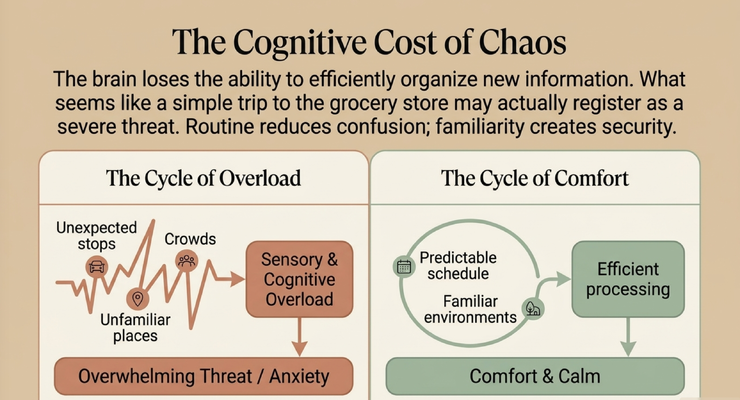
A trip to a large store may feel simple to you. But for a person living with dementia, it can feel like a maze. Bright lights. Crowds. Long aisles. Noise. Unfamiliar turns. Too many decisions. Too many objects. Too much movement.
The brain has to organize all of that.
And dementia reduces the brain’s ability to efficiently organize new information.
So what looks like a simple errand to the caregiver may register as a severe threat to the person living with dementia.
That is why routine matters.
Familiar environments reduce cognitive load. Predictable schedules reduce anxiety. Repetition creates safety. Structure gives the brain less to interpret.
This is why the goal is not simply to keep someone “busy.”
The goal is to create the right kind of engagement.
THE COMMUNICATION SHIFT
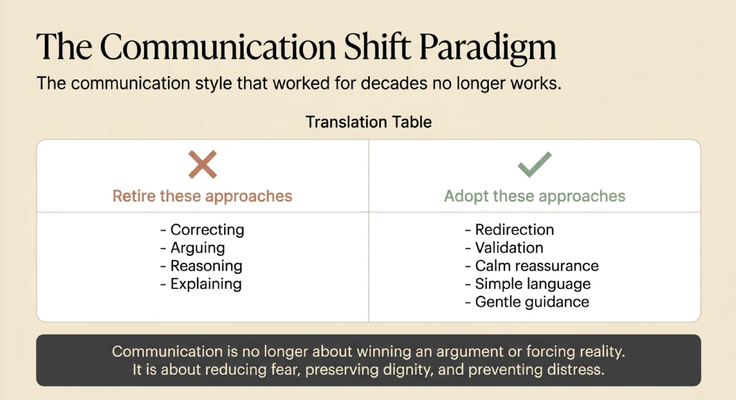
The communication style that worked for decades may no longer work.
Before dementia, a caregiver could explain, reason, correct, debate, and expect the other person to follow the logic.
But dementia changes how the brain processes language, memory, emotion, and reality.
So if the person says, “I already ate,” and the caregiver says, “No, you did not,” the facts may be correct, but the interaction may still fail.
If the person says, “I do not need help,” and the caregiver starts listing every mistake from the last week, the facts may be correct, but the person may feel attacked.
If the person asks the same question ten times and the caregiver says, “I already told you,” the facts may be correct, but the person may feel embarrassed, frightened, or scolded.
In dementia care, being right is not always the same as being effective.
The communication shift is this:
Retire constant correcting, arguing, reasoning, and over-explaining.
Adopt redirection, validation, calm reassurance, simple language, and gentle guidance.
That does not mean you agree with every false belief. It does not mean you ignore safety. It means you stop making every moment a courtroom.
Communication is no longer about winning the argument or forcing reality.
It is about reducing fear, preserving dignity, and preventing distress.
SMALL CHANGES CAN CHANGE THE WHOLE DAY
Sometimes families are looking for one major solution.
A medication.
A facility.
A new doctor.
A breakthrough.
And sometimes those things matter.
But dementia care is also full of small interventions that can change daily life more than families expect.
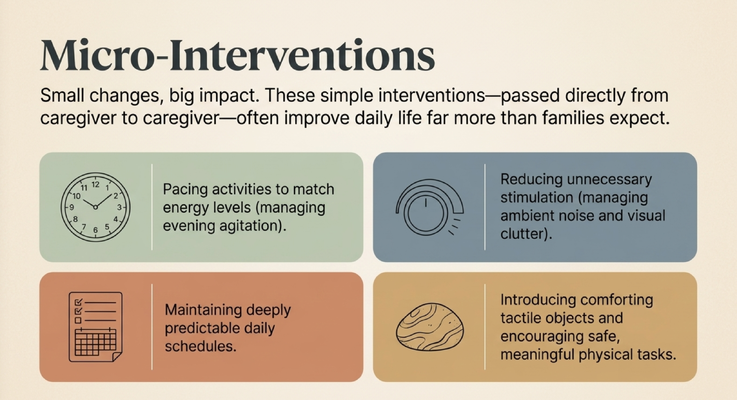
If evenings are difficult, pace activities earlier in the day. Do not save the hardest tasks for the lowest-capacity time. If the house becomes overstimulating, reduce noise and visual clutter. If the person becomes anxious, create a predictable daily schedule. If their hands are restless, offer a safe tactile object or meaningful physical task. If sundowning starts, turn on lights before the room gets dark, not after the fear begins.
These are not small because they are unimportant.
They are small because they are practical.
Caregivers need practical.
They do not only need lectures about plaques, tangles, and brain biology. They need to know what to do at 4 PM when the house starts falling apart. They need to know what to say when Dad refuses the day program. They need to know how to respond when Mom asks the same question again. They need to know how to build routine, reduce overload, and preserve dignity.
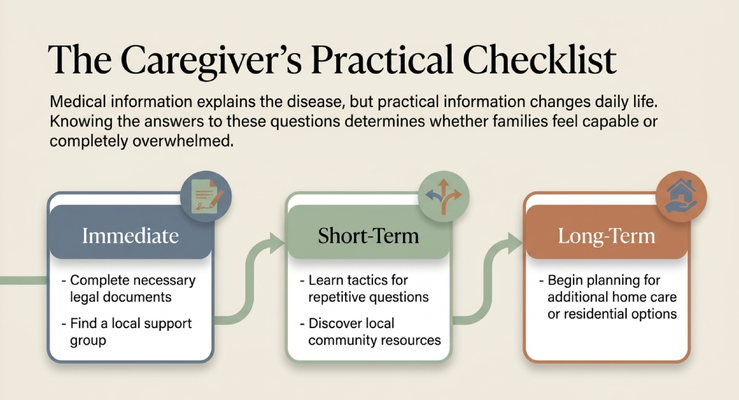
Medical information explains the disease.
Practical information changes daily life.
RETHINKING ADULT DAY PROGRAMS
A lot of families resist adult day programs at first.
They imagine a bleak institution. They worry their loved one will refuse. They say, “My spouse would never go.” “My father is not old.” “My mother will think something is wrong with her.” “I do not want to force them.”
I understand that resistance.
But we need to reframe what a quality adult day program can be.
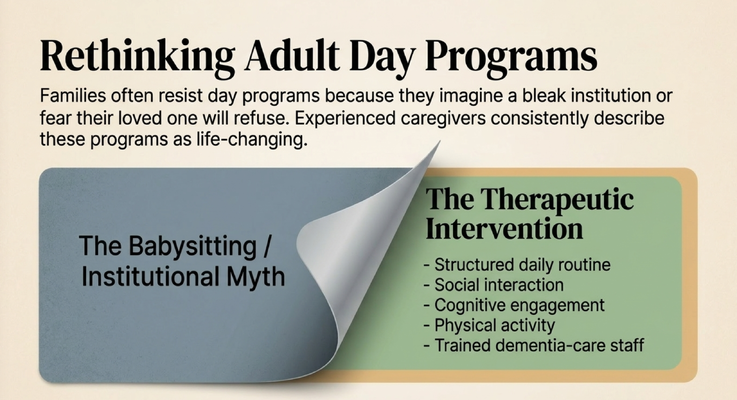
It is not babysitting.
It can be therapeutic structure.
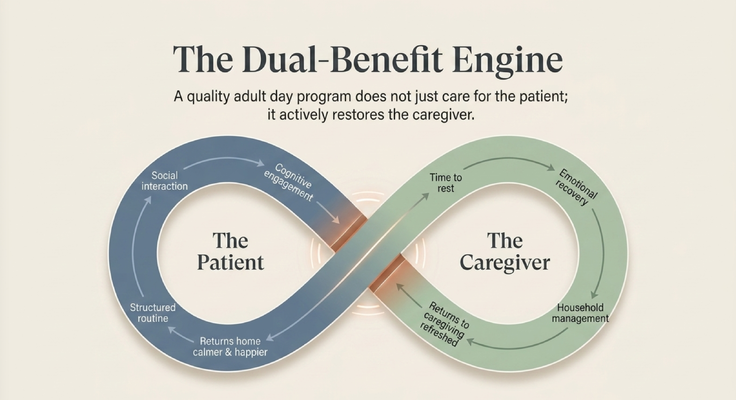
A good program can provide routine, social interaction, cognitive engagement, physical activity, familiar rhythm, and trained dementia-care staff. It gives the person living with dementia a world they can participate in, with people who understand how to guide them.
And it also gives the caregiver something just as important:
Time to breathe.
Time to rest.
Time to make dinner.
Time to take care of the house.
Time to go to an appointment.
Time to sit quietly without being on alert every second.
This is the dual benefit.
The person living with dementia may return home calmer, engaged, and tired in a healthy way. The caregiver may return to caregiving with more emotional capacity.
That matters.
Because a caregiver cannot pour from an empty cup for years.
THE DUAL BENEFIT: PATIENT AND CAREGIVER
A quality dementia program should never be evaluated only by what it does for the person living with dementia.
We also have to ask what it does for the caregiver.
Does it create a predictable routine?
Does it reduce isolation?
Does it provide safe engagement?
Does it reduce agitation at home?
Does it give the caregiver time to recover?
Does it allow the caregiver to manage household tasks without constant interruption?
Does it help the caregiver return to the relationship with more patience?
Because if the caregiver is depleted, the home becomes fragile.
I have said this many times: the caregiver is not extra. The caregiver is part of the care plan.
If the caregiver is sleep-deprived, anxious, isolated, depressed, resentful, overwhelmed, or physically breaking down, the person living with dementia is also at risk.
That does not mean the caregiver is failing.
It means the caregiver needs support.
And responsible caregiving includes recognizing when support is needed.
RECOGNIZING CAREGIVER BURNOUT
Caregiver burnout does not always announce itself clearly.
Many caregivers hide it.
They tell relatives, “Everything is fine.”
They tell friends, “We are managing.”
They smile in public.
They protect the dignity of the person living with dementia.
They do not want people to know how hard it has become.
And inside, they are exhausted.
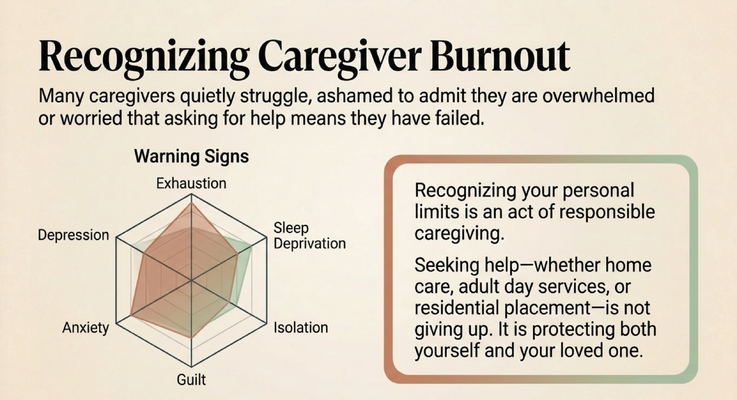
They are sleep-deprived. They are anxious. They are depressed. They are isolated. They feel guilty. They feel trapped. They may feel ashamed that they need help. They may worry that asking for help means they have failed.
But asking for help is not failure.
Recognizing your personal limits is responsible caregiving.
Sometimes the right support is a home care aide. Sometimes it is adult day services. Sometimes it is respite. Sometimes it is a support group. Sometimes it is psychiatric or emotional support for the caregiver. Sometimes, when safety and caregiver capacity have truly reached the limit, residential placement has to be discussed.
That is not abandonment.
That is protecting both people.
A caregiver who is beyond capacity can become frightened of their own exhaustion. They may become angry. They may snap. They may feel impulses they are ashamed to admit. These are serious warning signs, and they should be treated seriously.
If you are a caregiver and you feel like you are reaching a breaking point, that is not the time to hide.
That is the time to ask for help.
WHAT CAREGIVERS NEED ON DAY ONE
When a family receives a dementia diagnosis, they need more than a medication and a return appointment.
They need a roadmap.
Immediately, they need to know what legal documents may be necessary, including healthcare proxy, power of attorney, advance directives, and other state-specific planning tools. These should be discussed with qualified legal and healthcare professionals.
They need to find a support group. Not later. Early.
They need to learn practical tactics for repetitive questions, resistance, confusion, sundowning, agitation, and communication changes.
They need to identify local resources: adult day programs, respite options, home care agencies, dementia-trained professionals, transportation resources, community programs, and crisis supports.
They need to begin thinking about long-term care honestly. Not because placement is inevitable tomorrow. But because waiting until the crisis can leave families with fewer choices and more guilt.
This is what I wish every family understood:
A dementia diagnosis should trigger caregiver education immediately.
Not after the first fall.
Not after the first wandering episode.
Not after the first hospital admission.
Not after the caregiver has already collapsed.
Day one.
THE MEDICAL SYSTEM HAS TO SEE THE CAREGIVER
There is another piece here that matters.
Clinicians have to see the caregiver.
Too often, the appointment focuses only on the person living with dementia. The clinician asks the patient questions the patient may not be able to answer accurately. The caregiver sits there with the real story, but nobody fully asks.
The caregiver knows what happens at home.
The caregiver knows whether the person is sleeping.
The caregiver knows whether they are eating.
The caregiver knows whether they are wandering.
The caregiver knows whether they are refusing care.
The caregiver knows whether the day program is working.
The caregiver knows whether the home is falling apart.
So when we talk about dementia care, we cannot treat the caregiver as a side note.
The caregiver is part of the disease experience.
The caregiver is part of the treatment environment.
The caregiver is part of the safety plan.
And the caregiver’s health is a clinical issue.
That means doctors, neurologists, primary care teams, care navigators, home care agencies, adult day programs, and community organizations all need to reinforce the same message:
You need support.
You need education.
You need routine.
You need respite.
You need a plan.
And you should not be expected to carry dementia alone.
WHAT I WANT CAREGIVERS TO REMEMBER
If you are caring for someone living with dementia, here is what I want you to remember.
You are not failing because this is hard.
It is hard because dementia changes the whole family system.
You may have to become the primary decision-maker before you feel ready. You may have to change the way you communicate. You may have to stop asking for agreement on things that are no longer safe to leave open. You may have to introduce day programs, home care, respite, or support groups before your loved one fully understands why they are needed.
That does not mean you are taking away dignity.
It means you are protecting the person you love.
But you also have to protect yourself.
If you are exhausted, isolated, depressed, anxious, sleep-deprived, or afraid of your own frustration, please take that seriously. You are not weak. You are human. And dementia caregiving can overwhelm even the strongest families.
Get support early.
Join a support group.
Learn the practical skills.
Explore adult day programs.
Build routine.
Ask for respite.
Talk to the care team.
Talk to your doctor if your own mental health is suffering.
And do not wait until you are already in crisis to admit that you need help.

Common questions
Quick answers from this issue
What Should Families Do Right After a Dementia Diagnosis?
Every week, caregivers ask me some version of the same question: “Dr. Erik, what are we supposed to do now?” And that question usually comes right after the diagnosis.
What should caregivers try first?
Write down what changed, when it started, and what was happening right before it. Reduce noise, slow the conversation down, and use one simple step at a time. Share the pattern with the family, care team, or clinician so everyone responds consistently.
When should families call a clinician?
Call a clinician promptly if the change is sudden, severe, unsafe, tied to a fall, fever, pain, dehydration, medication change, hallucinations, paranoia, or new confusion. Call emergency services for immediate danger.