

Every week I hear from caregivers who say: "Dr. Erik, my dad hit me today. He's been yelling, he's been agitated, he refuses to do anything. I don't know what to do anymore. Is this just the dementia?"
It is one of the most painful and most misunderstood parts of caring for someone with dementia.
And the answer most caregivers get — "it's just the disease" — is not only incomplete. It is wrong. And it leads families to reach for medication when they don't need to.
My name is Dr. Erik Ilyayev. I'm a dementia care physician, a board member of the South Florida Alzheimer's Association, and the CEO of MedBetter Health — one of the organizations selected by Medicare to participate in a groundbreaking new program designed to change how America cares for people living with dementia.
In this issue, I want to walk you through the framework I use with every family I work with — what behavioral changes actually are, where they come from, and the specific tools you can use starting today.
THE CORE MINDSET: BEHAVIOR IS COMMUNICATION
Before anything else, I need you to shift how you think about this.
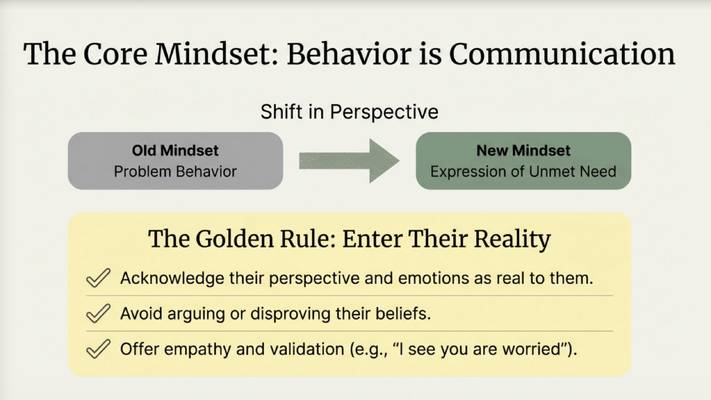
Most caregivers see agitation, aggression, or refusal as a behavioral problem. Something to be corrected. Something to be managed. And when it gets bad enough, something to be medicated.
I want you to think about it differently. Behavior is communication.
Your person living with dementia cannot always find the words to tell you what they need, what they are feeling, or what is frightening them. So instead of words, they give you a behavior. Think about a baby. When a baby is hungry, they don't ask for food. They cry. They become agitated. They cannot communicate in language — so they communicate in behavior. Your loved one is doing the same thing.
Once you accept that, everything changes. You stop trying to correct the behavior and start looking for what it is communicating.
THE ABC FRAMEWORK
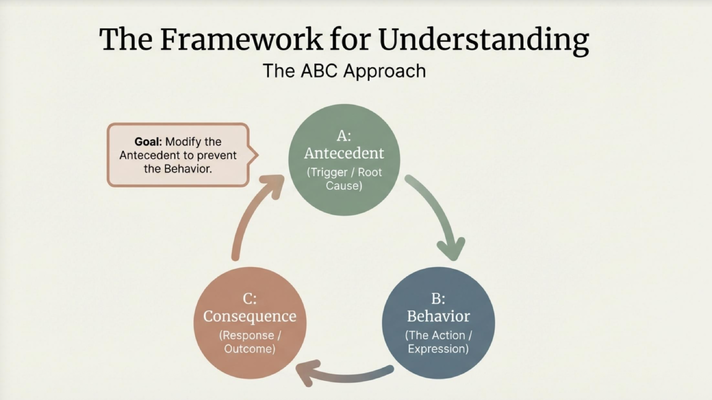
The tool I use to understand behavioral changes is called the ABC method. It is simple, and it works.
The A stands for Antecedent — the trigger. The root cause. Something happened before the behavior that set it off.
The B stands for Behavior — the action or expression. The yelling. The hitting. The refusal. The pacing.
The C stands for Consequence — the response or outcome. What happens next.
The goal is not to manage the B. The goal is to identify and modify the A. Find the trigger, eliminate the trigger, and the behavior stops. That is the entire framework.
WHAT ARE THE TRIGGERS? INTERNAL FACTORS
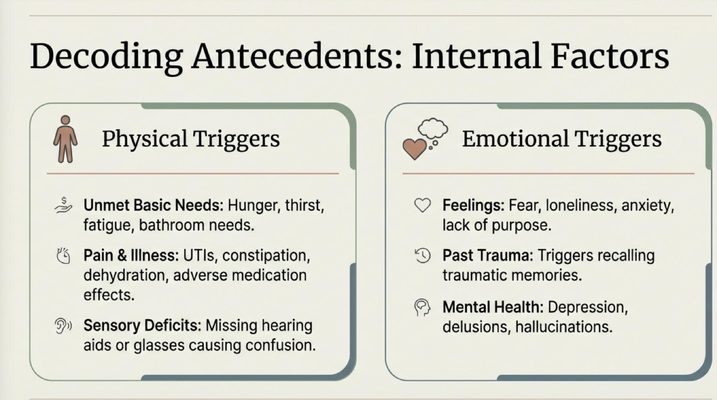
There are two categories of triggers: internal and external.
Internal triggers are physical and emotional. On the physical side: unmet basic needs — hunger, thirst, needing the bathroom, fatigue. Pain and illness — UTIs, constipation, dehydration, adverse medication effects. And sensory deficits — if your dad's hearing aid batteries died and no one replaced them, he is suddenly cut off from the world around him. That alone can trigger severe behavioral changes.
On the emotional side: feelings of fear, loneliness, and lack of purpose. Here is something I want you to know — research shows that a lack of purpose significantly accelerates dementia progression. A person sitting idle with nothing meaningful to do will deteriorate faster and act out more. And then there is mental health — depression, delusions, hallucinations. All of these are internal triggers that drive behavioral changes every single day.
WHAT ARE THE TRIGGERS? ENVIRONMENTAL AND INTERACTION FACTORS
External triggers are about the world around your loved one.
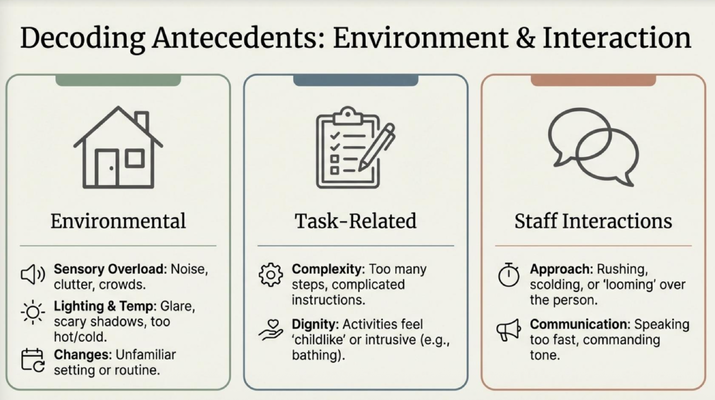
A home with sensory overload — noise, clutter, the TV on all day, a temperature that is too hot or too cold, lighting that creates shadows — these are all antecedents. Think about a sleeping baby. You lower your voice. You reduce the stimulation. Because you know that too much input will cause distress. The same principle applies here.
Task-related triggers matter too. If you are giving your loved one too many instructions at once, or asking them to do something that feels childlike or humiliating, they will resist — and that resistance will look like aggression.
And then there are interaction triggers. Rushing them. Speaking too fast. Coming in loud and frustrated because you are already late to an appointment. Your loved one cannot process what you are saying — but they can read your energy. Your face, your tone, your body language — all of it is an antecedent. Before you ask what is wrong with them, ask what you are communicating to them.
WHAT YOU ARE ACTUALLY SEEING
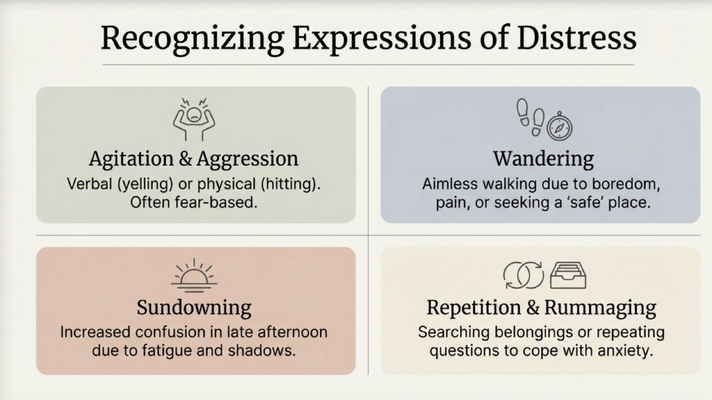
The behavioral expressions that come out of these triggers fall into four categories.
Agitation and aggression — yelling, hitting, sudden outbursts. Almost always fear-based. When you see this, do not react to the behavior. Find the antecedent.
Wandering — aimless walking driven by boredom, pain, or a search for somewhere that feels safe. We have covered this in depth in a previous issue.
Sundowning — increased confusion in the late afternoon and evening, which we covered in our last issue as well.
Repetition and rummaging — asking the same question over and over, searching through belongings, going through drawers. This is almost always anxiety. They are looking for something that will make them feel safe and certain. The answer is not to stop them. The answer is to address the anxiety underneath it.
PREVENTION: BUILDING A FOUNDATION OF COMFORT
Most behavioral episodes can be prevented. Here is how.
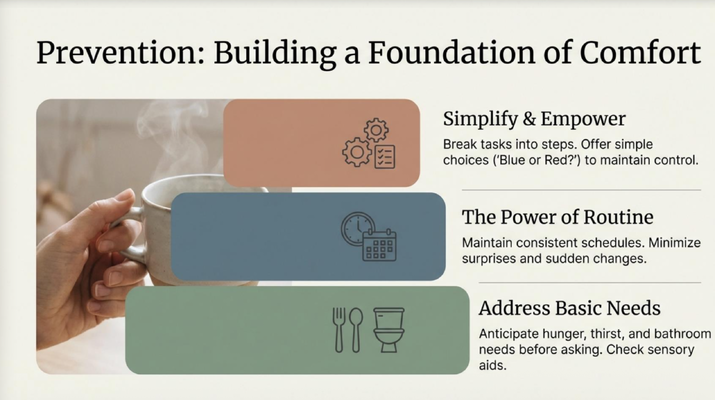
First, simplify and empower. Break every task into the smallest possible steps. Instead of "get dressed," start with "here is your shirt." Give simple choices — not open-ended questions. "Do you want the blue shirt or the red shirt?" gives them control without overwhelming them. Control is everything. A person with dementia who feels they have lost control of their life will fight to get it back through behavior.
Second, the power of routine. Predictability reduces anxiety. If breakfast is at 8, exercise is at 9, and the walk is at 1 every single day without exception — the brain starts to feel safe. Surprises and sudden changes are major triggers. Eliminate them wherever you can.
Third, go back to basics. Before you assume it is a behavioral issue, ask: are they hungry? Are they thirsty? Do they need the bathroom? Check the hearing aids. Check the glasses. These are the most overlooked triggers in dementia care — and the easiest to fix.
ENGAGING THE SENSES TO SOOTHE
When prevention is not enough and you are in the middle of an episode, the senses are your most powerful tools.
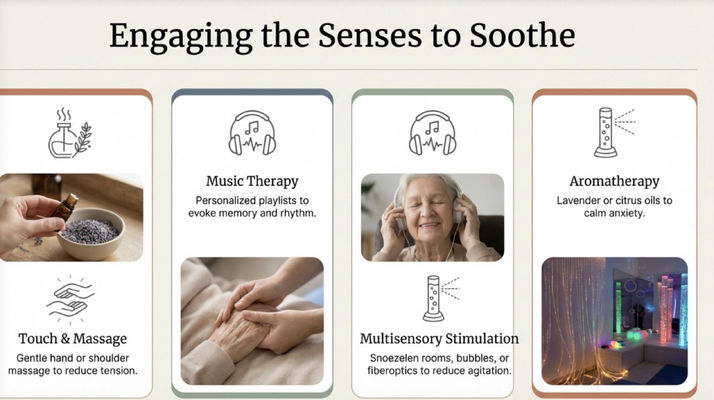
Touch and massage therapy — gently approaching your loved one, asking permission, and offering a hand to hold or a shoulder to touch can de-escalate a situation that no words could reach. Always ask first. It is about giving them control.
Music therapy is one of the most powerful interventions available. And it has to be personalized. If your dad grew up on Frank Sinatra and Tony Bennett, that is the music that reaches him. The moment that familiar melody comes on, something in the brain lights up that dementia cannot fully extinguish. Five minutes ago he was agitated. Now he is smiling. That is music therapy.
Aromatherapy using citrus or lavender oils to calm anxiety is increasingly supported by research. Familiar scents connected to positive memories are particularly effective.
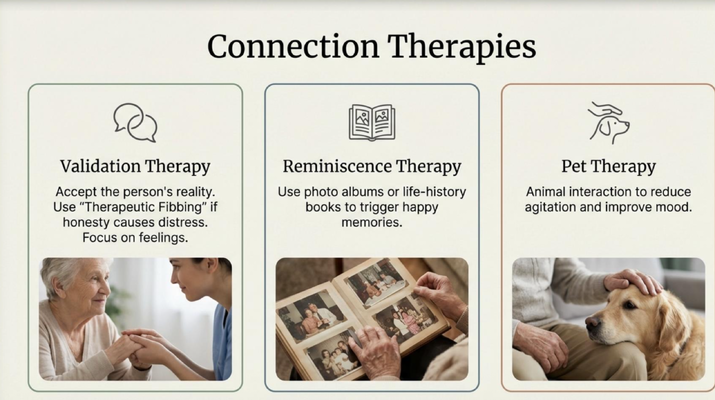
CONNECTION THERAPIES
Validation therapy is the most important communication tool I can give you. Never argue with your person living with dementia. Never try to correct their reality.
If mom says she sees her father in the room, do not say "that's not possible, your father passed away forty years ago." That is her reality. Correcting it does not help her — it frightens and humiliates her. Instead: validate. "Yes, tell me about him. What was he like?" Enter her reality. Acknowledge her feelings. This is not lying. This is compassion.
Reminiscence therapy — pulling out old photo albums, playing music from their past, revisiting stories and memories — activates parts of the brain that dementia spares longer than others. It creates connection and reduces agitation.
Pet therapy, when appropriate, can be remarkable. If your loved one was not afraid of animals, a calm, gentle dog or cat can reduce agitation and bring genuine joy. Know your person. If they were ever afraid of dogs, a dog is a trigger, not a therapy.
The Invisible Weight: Caregiver Exhaustion
Managing behavioral changes every single day — the yelling, the hitting, the endless repetition, the aggression that comes from someone you love — takes a toll that most people outside of caregiving cannot understand. Many caregivers I speak to feel like they are failing. Like they are doing something wrong. Like they are running out of patience and out of time.
You are not failing. You are carrying something incredibly heavy, often entirely alone.
You should not have to do this alone. And thanks to a new Medicare program, you don't have to.

Common questions
Quick answers from this issue
"Why Is Mom Being So Aggressive?" — What Behavioral Changes in Dementia Really Mean, and What To Do About Them
Every week I hear from caregivers who say: "Dr. Erik, my dad hit me today. He's been yelling, he's been agitated, he refuses to do anything. I don't know what to do anymore. Is this just the dementia?" It is one of the most painful and most misunderstood parts of caring for someone with dementia. And the answer most caregivers get — "it's just the disease" — is not only incomplete. It is wrong.
What should caregivers try first?
Write down what changed, when it started, and what was happening right before it. Reduce noise, slow the conversation down, and use one simple step at a time. Share the pattern with the family, care team, or clinician so everyone responds consistently.
When should families call a clinician?
Call a clinician promptly if the change is sudden, severe, unsafe, tied to a fall, fever, pain, dehydration, medication change, hallucinations, paranoia, or new confusion. Call emergency services for immediate danger.