

"Why Does She Get So Agitated Every Evening?" — What Sundowning Really Is, and How to Stop It
Every week I hear from caregivers who say: "Dr. Erik, my mom is completely fine all day — but the moment the sun starts going down, everything falls apart. She gets confused, she starts pacing, she gets aggressive. What's happening to her?"
It's one of the most consistent patterns in dementia care. And one of the least understood.
Sundowning is not random. It is not the disease simply "getting worse." It is a predictable, biological response — and once you understand what is driving it, you can interrupt it. Often without a single medication.
My name is Dr. Erik Ilyayev. I'm a dementia care physician, a board member of the South Florida Alzheimer's Association, and the CEO of MedBetter Health — one of the organizations selected by Medicare to participate in a groundbreaking new program designed to change how America cares for people living with dementia.
In this issue, I want to walk you through what sundowning actually is, what is happening in the brain when it occurs, and the specific interventions — environmental and behavioral — that can stop it.
SUNDOWNING — What You're Actually Seeing
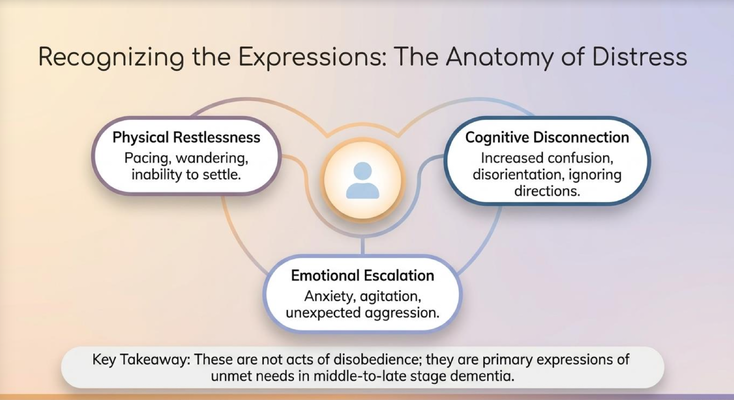
The term "sundowning" describes a pattern of increased confusion, agitation, and behavioral changes that begins in the late afternoon or early evening and worsens after dark. It is not a standalone diagnosis — it is a symptom cluster, and it shows up most commonly in the middle to late stages of dementia.
The three things you will almost always see:
- Physical restlessness — pacing, wandering, inability to sit still or settle
- Emotional escalation — sudden anxiety, agitation, aggression that seems to come from nowhere
- Cognitive disconnection — increased confusion, disorientation, ignoring directions they would normally follow
These are not acts of defiance. They are not personality changes. They are distress signals from a brain that is running out of resources to cope with the day.
WHY IT ALWAYS HAPPENS AT THE SAME TIME
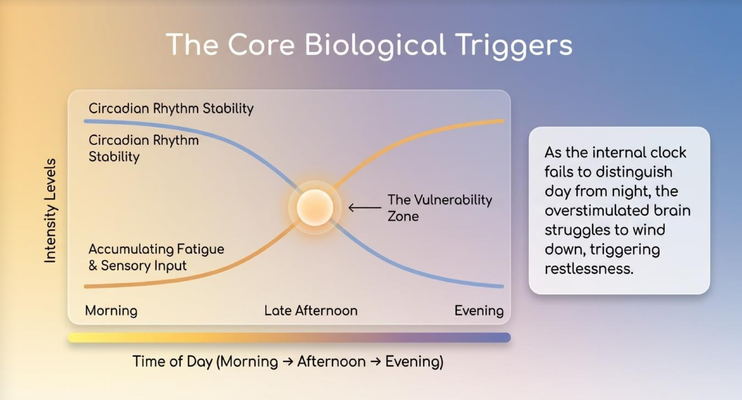
Every person has a circadian rhythm — an internal clock that governs when we sleep, when we wake, and how alert we feel throughout the day. In a healthy brain, that clock stays stable. In a brain affected by dementia, it becomes fragmented, unpredictable, and unreliable.
Now layer in what happens naturally across any given day: fatigue accumulates, and the brain continuously processes sensory input — every sound, every conversation, every visual stimulus. By late afternoon, two things collide at once. The circadian rhythm is at its most unstable. The brain is at its most depleted.
That intersection is what I call the Vulnerability Zone. It happens at roughly the same time every day because the biology is the same every day. The brain simply cannot hold things together past that point — and what you see is sundowning.
THE ROLE OF LIGHT
This one surprises most families. Light is not a minor factor in sundowning — it is one of the primary environmental catalysts.
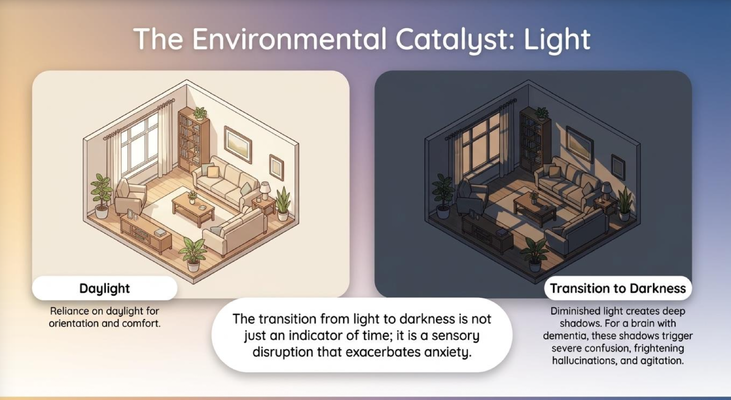
Before artificial lighting existed, the human body had one circadian regulator: the sun. It came up, it went down, the body followed. A healthy brain can compensate for the disruption that screens and indoor lighting create. A brain with dementia cannot.
When daylight fades and shadows begin forming in the room, your loved one is not simply seeing a dimmer space. They may be seeing confusion and threat. Shadows on the wall can look like people. A reflection in a dark window can look like a stranger standing in the room. This is not imagination — it is a misfiring brain under conditions it can no longer process. And it directly triggers the fear and agitation you see every evening.
WHAT ELSE IS MAKING IT WORSE
Before you assume it is purely the disease progressing, look for secondary triggers. The most common ones I see:
- Medications — certain medications interfere with sleep or destabilize mood. Caffeine late in the day is also a significant disruptor for someone living with dementia — far more than it would be for you or me.
- Hidden physical discomfort — pain, hunger, needing the bathroom. A person who cannot clearly articulate what they are feeling will often express it through behavior.
- Psychological factors — underlying anxiety or depression that intensifies in the evening hours.
- Changes in routine — moving to a new room, a new facility, or even a shift in the household schedule can spike nighttime disorientation immediately.
- Staffing transitions — when a familiar caregiver is replaced by someone new, that change alone can be enough to trigger an episode.
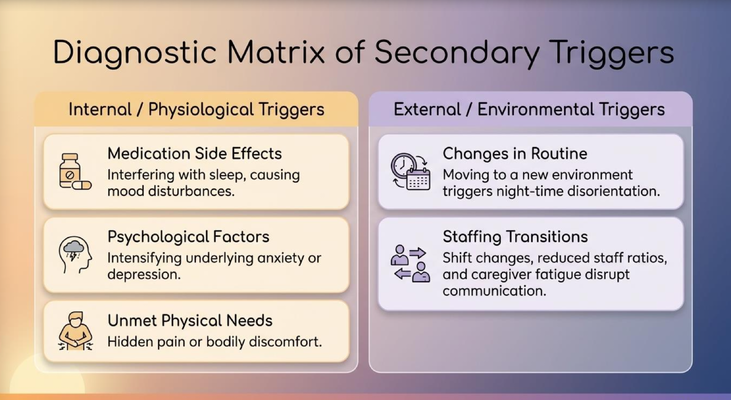
Before adjusting medications or escalating care, ask: what changed?
WHAT YOU CAN DO TODAY
There are two categories of intervention: environmental and rhythmic. Used together, consistently, they can significantly reduce or eliminate sundowning without medication. The key word is consistently. This is not a one-week fix. Give it 30 to 60 days before you evaluate results.
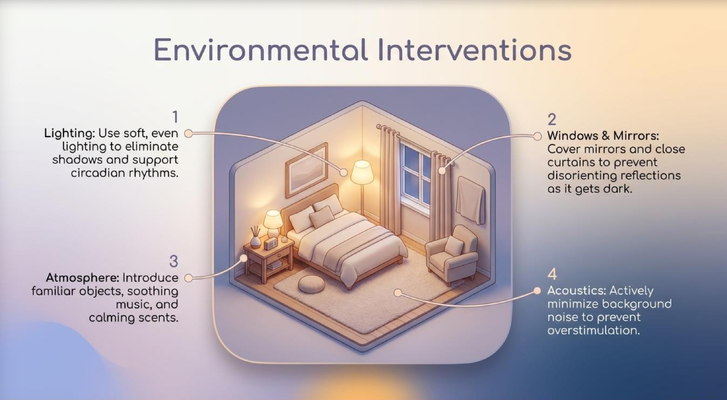
Environmental Interventions
The first thing I tell every caregiver: walk your loved one's room at dusk and look for shadows. Any shadow that forms — in a corner, on the wall, under furniture — is a potential trigger. Eliminate them.
- Lighting — use soft, even lighting throughout the room at night. No dark corners. No harsh contrasts.
- Windows and mirrors — close the curtains before it gets dark. Cover mirrors at night. Reflections after dark are deeply disorienting and can register as strangers in the room.
- Atmosphere — bring in familiar objects, a favorite scent, soft music. The brain anchors to the familiar when everything else feels uncertain.
- Sound — minimize background noise. No loud TV, no competing conversations. Sensory overload accelerates the Vulnerability Zone.
Routine and Rhythm
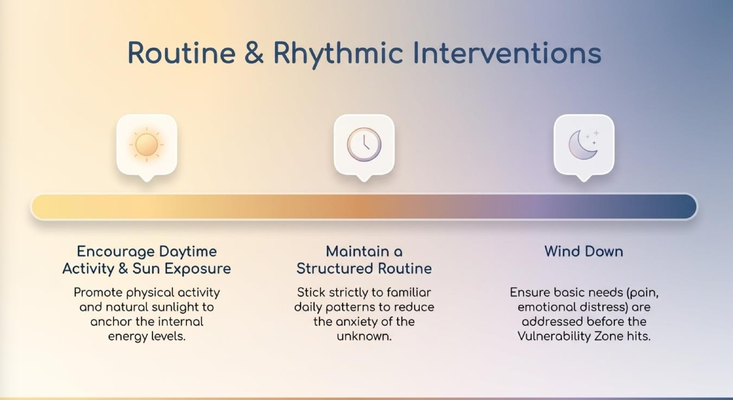
- Every morning, open the blinds at the same time. Natural sunlight is the single most powerful circadian rhythm reset available to you. Use it.
- Encourage physical activity and time outside during the day — this anchors energy levels and helps the body wind down naturally by evening.
- Build a wind-down sequence and repeat it every single night without deviation. Same time. Same room. Soft music on a timer. Lights dimmed. Curtains closed. Quiet. When the brain starts anticipating that sequence, the circadian rhythm begins to stabilize.
When you call the doctor, the reflex is often to prescribe a sleeping pill. But if you build this framework and give it 60 days of consistency, you may not need one. That is not optimism — that is what the data supports. And it is what we teach caregivers inside the GUIDE Model every day.
The Invisible Weight: Caregiver Exhaustion
Managing sundowning every single evening — bracing for it, talking someone down from it, resetting after it — wears you down in a way that is hard to describe to someone who has not lived it. Many caregivers I speak to are running on empty by 6 PM.
You should not have to do this alone. And thanks to a new Medicare program, you don't have to.

Common questions
Quick answers from this issue
SUNDOWNING
"Why Does She Get So Agitated Every Evening?" — What Sundowning Really Is, and How to Stop It Every week I hear from caregivers who say: "Dr. Erik, my mom is completely fine all day — but the moment the sun starts going down, everything falls apart. She gets confused, she starts pacing, she gets aggressive. What's happening to her?" It's one of the most consistent patterns in dementia care.
What should caregivers try first?
Write down what changed, when it started, and what was happening right before it. Reduce noise, slow the conversation down, and use one simple step at a time. Share the pattern with the family, care team, or clinician so everyone responds consistently.
When should families call a clinician?
Call a clinician promptly if the change is sudden, severe, unsafe, tied to a fall, fever, pain, dehydration, medication change, hallucinations, paranoia, or new confusion. Call emergency services for immediate danger.