

I want to start this issue a little differently.
Usually, I use The Dementia Times to answer a specific caregiver question:
“Why is Mom refusing to shower?”
“Why does Dad get worse at night?”
“Why did everything change after the hospital?”
“Why is my loved one accusing me of stealing?”
But today, I want to answer a different question:
Why does the structure of a dementia care organization matter so much?
Because when you are a caregiver, you may not be thinking about company values, operating systems, internal culture, team accountability, or unit economics.
You are thinking:
Who is going to answer the phone when I am overwhelmed?
Who is going to help me understand what is happening to my loved one?
Who is going to help me when Mom refuses care?
Who is going to explain the GUIDE Model in a way I can actually understand?
Who is going to call me back?
Who is going to care enough to stay with the problem?
That is where values stop being words on a wall.
That is where values become care.
My name is Dr. Erik Ilyayev. I’m a dementia care physician, a board member of the South Florida Alzheimer's Association®, and the CEO of MedBetterHealth.org — one of the organizations selected by Medicare to participate in a groundbreaking new program designed to change how America cares for people living with dementia.
In this issue, I want to explain why MedBetterHealth is thriving in the GUIDE Model, why core values matter in dementia care, and why the families we serve should feel the values in every phone call, every care plan, every care navigator interaction, and every moment of support.
THE GUIDE MODEL IS TRANSFORMING DEMENTIA CARE
The GUIDE Model is one of the most important changes happening in dementia care right now.
GUIDE stands for Guiding an Improved Dementia Experience. It is designed to support people living with dementia and the family caregivers caring for them at home.
And if you have heard me talk about it before, you know how strongly I believe in this model.
But recently, I heard something that made me stop and think.
Some organizations in the GUIDE Model space, including large and well-funded organizations, have started pulling back, pausing, or no longer accepting patients. I am not here to judge them. I do not know the full details, and I am sure many of them are good organizations trying to solve a hard problem.
But it made me ask a very direct question:
Why are we thriving?
Why are families responding so strongly?
Why are caregivers telling us this program has changed their lives?
Why are we seeing such strong satisfaction?
And the answer I keep coming back to is this:
It is not only the program.
It is the operating system behind the program.
It is the values.
Because in dementia care, the system is only as strong as the people carrying it out.
A Medicare model can create the structure. But the actual experience depends on whether the organization lives the mission every day.
THE MOMENT THAT REMINDED ME WHY THIS MATTERS
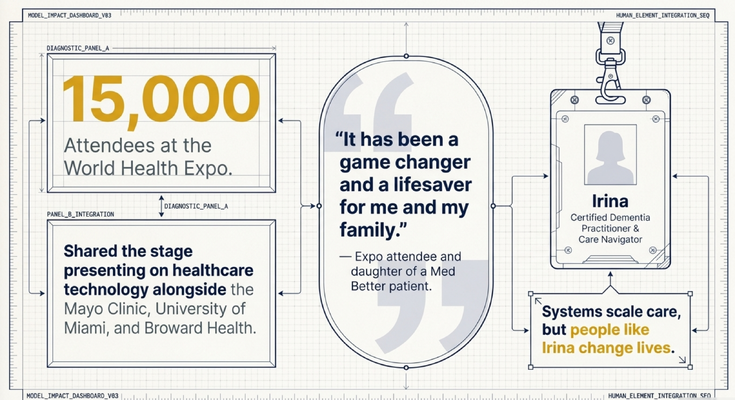
I was recently at the World Health Expo, where approximately 15,000 people were in attendance. I had the privilege of sharing the stage in a healthcare technology discussion alongside leaders from organizations including Broward Health, the University of Miami, Mayo Clinic, and Miami-Dade County.
It was an incredible room.
But the moment that stayed with me happened after the stage.
A woman came up to me and said, “Dr. Erik, my mom is in your GUIDE Model program. And honestly, it has been a game changer and a lifesaver for me and my family.”
Then she mentioned one of our care navigators, Irina.
Irina is a Certified Dementia Practitioner and Care Navigator on our team. And this daughter said that Irina changed her life.
That is what matters.
Not the stage.
Not the title.
Not the logo.
Not the size of the room.
The daughter.
The caregiver.
The family.
The person living with dementia.
That is the whole point.
Systems scale care, but people like Irina change lives.
THE MEDBETTER HEALTH OPERATING SYSTEM
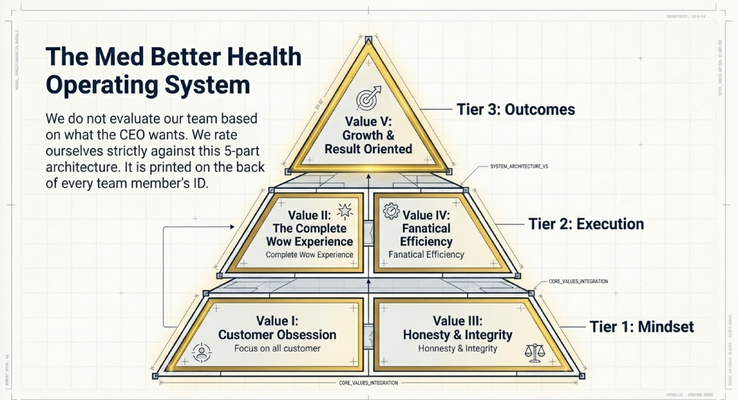
At MedBetter Health, we do not evaluate our team based on what I personally want as the CEO.
We evaluate ourselves against the values.
These values are printed on the back of our ID badges. We talk about them. We use them. We hold ourselves accountable to them.
Because if values are only mentioned once at orientation, they are not values.
They are decoration.
Real values have to show up in daily decisions.
They have to show up when a caregiver is frustrated.
They have to show up when someone forgets a task.
They have to show up when a patient needs help.
They have to show up when the process is difficult.
They have to show up when nobody is watching.
Our operating system is built around five values:
Client and patient obsession.
The complete wow experience.
Honesty, integrity, and trustworthiness.
Fanatical efficiency and systematic detail.
Growth and results.
Those are not corporate slogans to me.
They are the architecture of how dementia care should be delivered.
VALUE I: CLIENT AND PATIENT OBSESSION
The first value is client and patient obsession.
Not mild interest.
Not customer service when convenient.
Obsession.
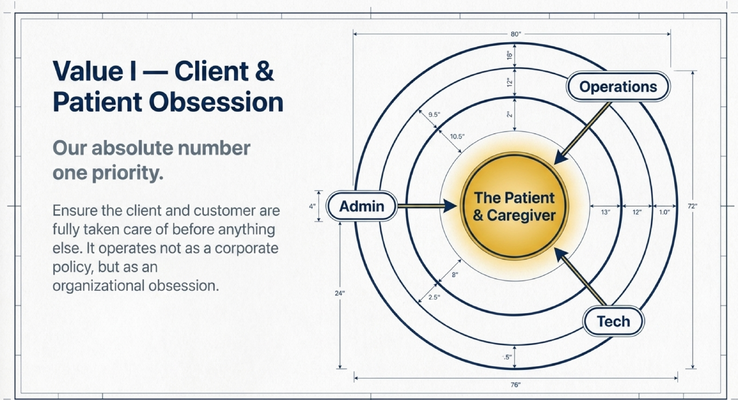
The patient and caregiver have to be at the center.
Operations should point toward them.
Administration should point toward them.
Technology should point toward them.
Clinical navigation should point toward them.
Every department, every process, every team member should be asking the same question:
Is this helping the patient and caregiver?
Because dementia care is not simple.
A caregiver may call because their loved one is refusing a shower.
Another may be overwhelmed after a hospital discharge.
Another may be confused about medications.
Another may need respite.
Another may not understand why their loved one is hallucinating at night.
Another may be dealing with guilt, exhaustion, and fear.
If the organization is not obsessed with the patient and caregiver, those families feel it.
They feel it in delayed calls.
They feel it in generic answers.
They feel it when nobody follows up.
They feel it when they are treated like a case instead of a family.
That is not acceptable.
The person living with dementia and the caregiver are not part of the system.
They are the reason the system exists.
VALUE II: THE COMPLETE WOW EXPERIENCE
The second value is the complete wow experience.
Now, when I say “wow,” I do not mean fancy.
I do not mean superficial.
I do not mean polished language.
I mean the caregiver feels:
“They actually answered.”
“They actually listened.”
“They actually followed through.”
“They actually understood what I was dealing with.”
“They actually helped me when I did not know what to do.”
That is the complete wow experience.
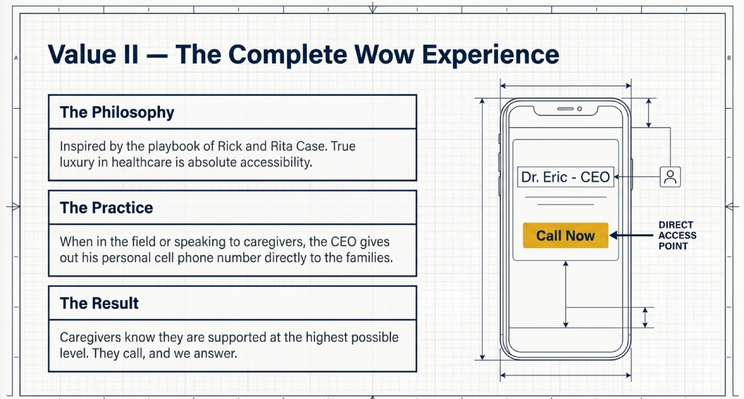
I learned this idea from the Rick and Rita Case philosophy of accessibility and service. Rick Case was known for giving people direct access. That stuck with me.
So when I am in the field, when I am speaking with caregivers, when I am at events, I give out my personal cell phone number.
Why?
Because I want to know what the caregiver is experiencing.
I want to know if our system is working.
I want to know if the family feels supported.
I want to know if we are actually delivering what we say we deliver.
In dementia care, access matters.
Because caregiving does not happen only during neat office hours.
It happens when the family is tired.
It happens when the daughter is crying in the car.
It happens when the spouse is trying to understand why everything changed after discharge.
It happens when the caregiver is wondering if they can keep going.
The complete wow experience is not about impressing people.
It is about showing them they are not alone.
VALUE III: HONESTY, INTEGRITY, AND TRUSTWORTHINESS
The third value is honesty, integrity, and trustworthiness.
This one is very simple.
Do not lie.
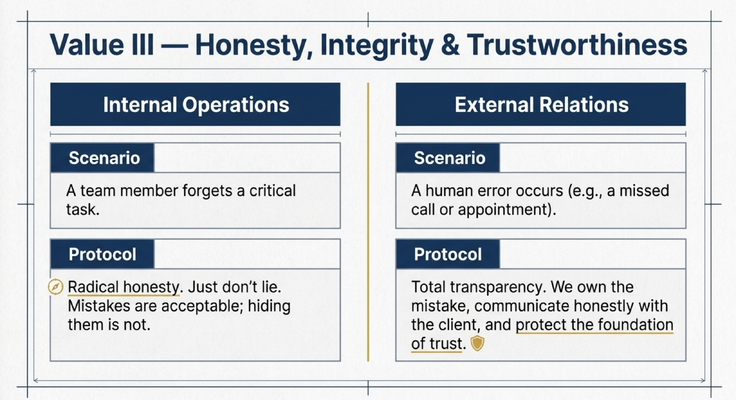
If someone forgets something, say it.
If a mistake happens, own it.
If a call was missed, do not hide it.
If an appointment was not handled correctly, be transparent.
We are human. Mistakes can happen.
But hiding mistakes destroys trust.
And in dementia care, trust is everything.
Families are already vulnerable. They are inviting us into one of the most difficult chapters of their lives. They are trusting us with someone they love. They are trusting us to help them navigate Medicare, care coordination, behaviors, respite, and home-based support.
That trust cannot be taken lightly.
Inside the organization, honesty matters between team members.
Outside the organization, honesty matters with families.
If something went wrong, we say it.
If something needs to be corrected, we correct it.
If a caregiver needs the truth, we give it to them in a respectful and human way.
Because trust is not built by pretending everything is perfect.
Trust is built by being honest when things are not.
VALUE IV: FANATICALLY EFFICIENT AND SYSTEMATICALLY DETAILED
The fourth value is fanatical efficiency and systematic detail.
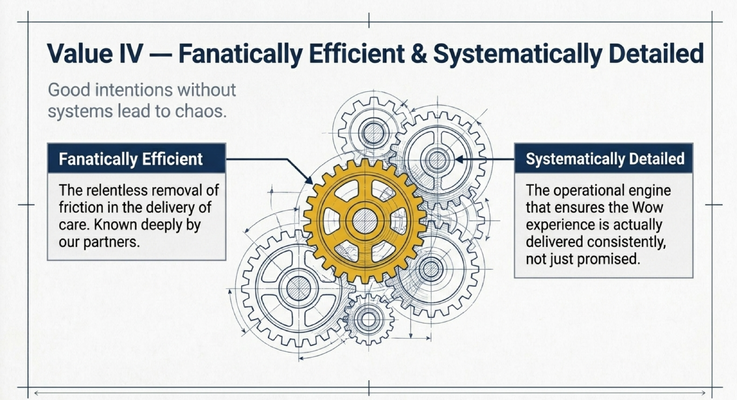
Good intentions are not enough.
I want to say that again.
Good intentions are not enough.
You can care deeply and still create chaos if you do not have systems.
A caregiver does not only need compassion.
They need follow-through.
They need documentation.
They need the right person calling at the right time.
They need the care navigator to know what happened before.
They need the next step.
They need the appointment tracked.
They need the home care connection made.
They need the information not to fall through the cracks.
That requires efficiency.
That requires detail.
And if you work with MedBetter Health as a partner, you know this about us.
We move.
We follow up.
We track.
We build systems.
We remove friction.
We do not want families to suffer because of avoidable operational chaos.
In dementia care, details matter.
A missed medication detail can matter.
A missed follow-up can matter.
A missed caregiver concern can matter.
A missed hospital discharge issue can matter.
A missed behavioral escalation can matter.
The work is human, but the system must be disciplined.
VALUE V: GROWTH AND RESULTS
The fifth value is growth and results.
This is where I always say:
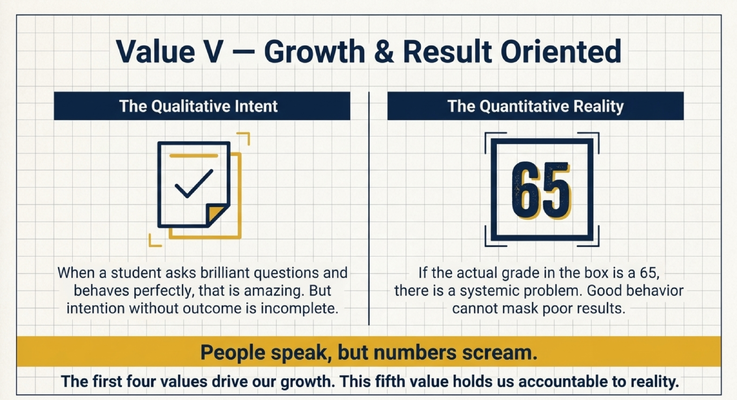
People speak, but numbers scream.
I use this example with my son.
If my child comes home and says, “Dad, the teacher wrote all these wonderful things about me. I ask great questions. I behave well. I participate.”
That is beautiful.
But then I look at the grade, and it says 65.
Now we have to deal with reality.
The nice comments matter, but the outcome still matters.
Healthcare works the same way.
It is not enough for us to say:
“We care.”
“We try hard.”
“We have good intentions.”
“We want to help.”
That matters, but we also have to ask:
Are families actually being helped?
Are caregivers satisfied?
Are people getting connected?
Are calls being answered?
Are care plans being created?
Are problems being solved?
Are we growing in a way that allows us to support more people?
Are we improving?
Are we measuring what matters?
Growth without values can become dangerous.
But values without outcomes can become incomplete.
The first four values drive the growth.
The fifth value holds us accountable to reality.
WHEN THE COMPANY THRIVES, THE CAREGIVER SHOULD FEEL IT
Here is the bigger point.
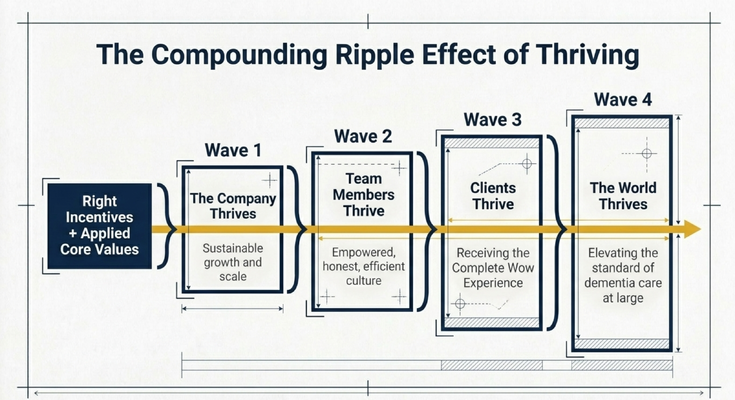
When a company thrives for the right reasons, the team members should thrive.
When the team members thrive, the clients should thrive.
When the clients thrive, the standard of care rises.
That is the ripple effect.
But this only works if the incentives are set up correctly.
If the incentive is only growth, the caregiver can get lost.
If the incentive is only volume, the patient can become a number.
If the incentive is only speed, quality can suffer.
But if the organization is built on the right values, growth can become a vehicle for better care.
The company grows so the team can grow.
The team grows so families can be served better.
Families receive better support, and the standard of dementia care improves.
That is the vision.
Not growth for ego.
Growth for impact.
WHAT THIS MEANS FOR CAREGIVERS
If you are a caregiver reading this, you may be thinking:
“Dr. Erik, this is interesting, but what does it mean for me?”
It means you should expect more from the systems around you.
You should expect someone to answer.
You should expect clarity.
You should expect honesty.
You should expect follow-through.
You should expect care coordination that does not make you feel more confused than when you started.
You should expect a team that understands that dementia caregiving is not just a clinical issue.
It is emotional.
It is practical.
It is exhausting.
It is family-based.
It is happening inside the home.
And you should not have to navigate it alone.
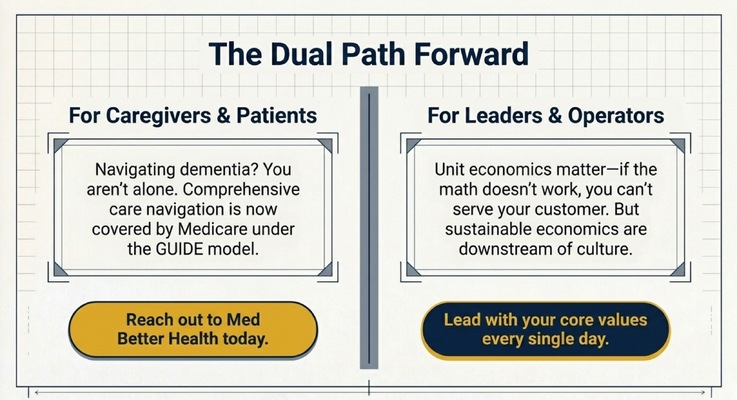
The GUIDE Model exists because dementia families need structured support.
But the model only works when organizations bring the right values to it.
That is the difference.
WHAT THIS MEANS FOR LEADERS AND OPERATORS
If you are a CEO, COO, operator, home care agency owner, healthcare leader, or anyone building an organization that serves vulnerable people, I want you to hear this clearly:
Unit economics matter.
If the math does not work, the business cannot survive.
And if the business cannot survive, you cannot serve the people you say you want to serve.
But sustainable economics are downstream of culture.
You cannot build a great care organization on slogans.
You build it on daily behavior.
What do you reward?
What do you tolerate?
What do you measure?
What do you talk about every day?
What happens when someone makes a mistake?
What happens when a caregiver is unhappy?
What happens when the process breaks?
What happens when the team is overwhelmed?
That is the real culture.
Core values are not something you print on a card and forget.
You have to talk about them every day, with every situation, with your team.
Because the values are not the poster.
The values are the operating system.

Common questions
Quick answers from this issue
Why Do Core Values Matter in Dementia Care?
I want to start this issue a little differently. Usually, I use The Dementia Times to answer a specific caregiver question: “Why is Mom refusing to shower?”
What should caregivers try first?
Write down what changed, when it started, and what was happening right before it. Reduce noise, slow the conversation down, and use one simple step at a time. Share the pattern with the family, care team, or clinician so everyone responds consistently.
When should families call a clinician?
Call a clinician promptly if the change is sudden, severe, unsafe, tied to a fall, fever, pain, dehydration, medication change, hallucinations, paranoia, or new confusion. Call emergency services for immediate danger.