
Every week, caregivers ask me some version of the same question:
“Dr. Erik, what is the future of dementia care?”
And I understand why families ask it.
If you love someone living with dementia, you want to know what is coming.
You want to know whether there are new treatments.
You want to know whether medication can help.
You want to know whether your loved one may qualify.
You want to know what the risks are.
And you want someone to explain it in plain English, not in a way that makes you feel like you accidentally walked into a medical conference without a badge.
Recently, I had the privilege of speaking with Dr. James Galvin on Straight Talk with Dr. Erik. Dr. Galvin is one of the leading voices in neurology and brain health, and in this part of our conversation, we talked about one of the biggest changes in Alzheimer’s treatment:
New anti-amyloid infusion medications.
And I want to start with the most important point.
These medications are not for everyone.
They are not casual treatments.
They are not something families should start without a careful evaluation.
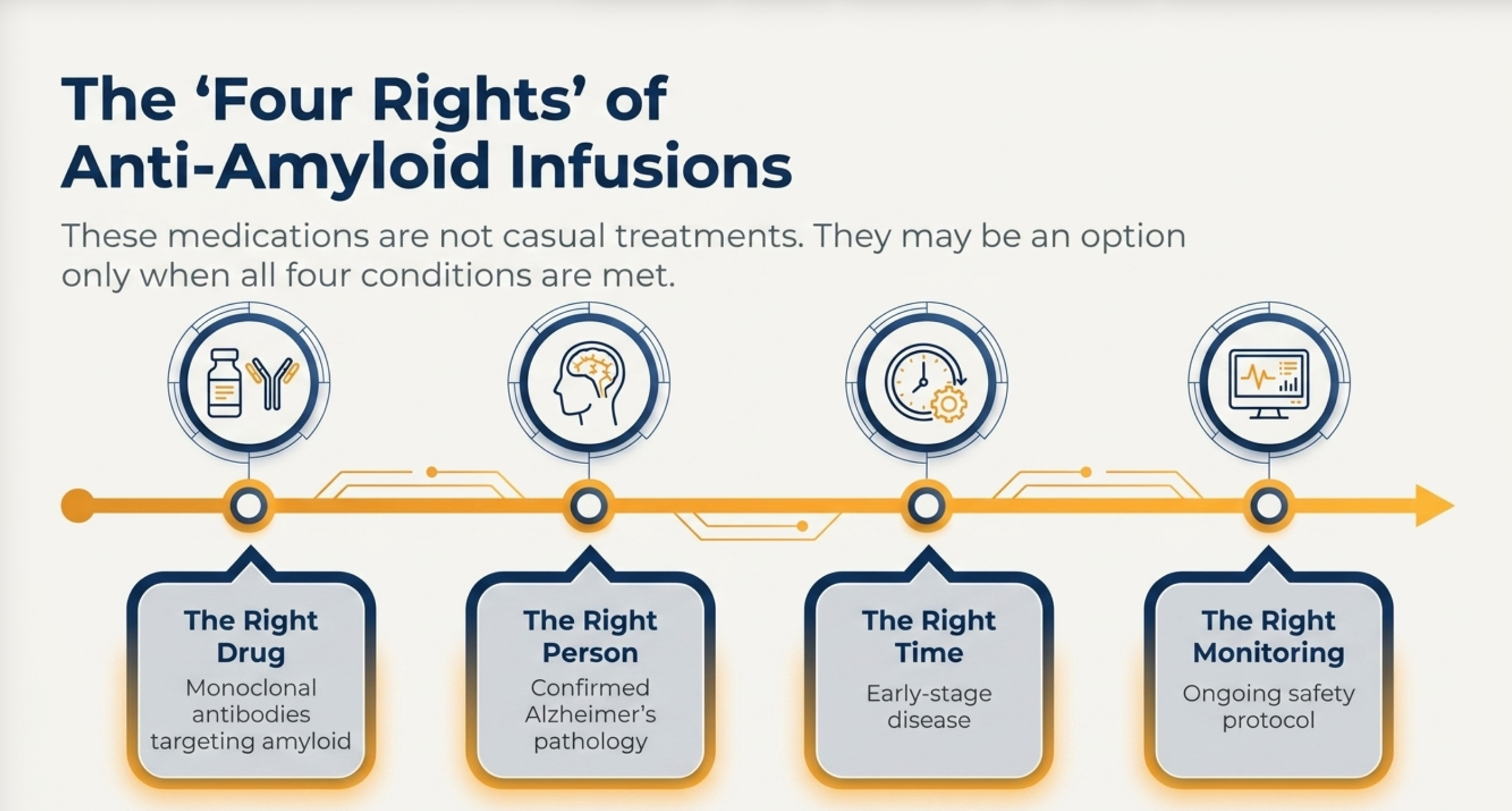
They may be an option for the right person at the right stage, with the right diagnosis, the right risk discussion, and the right monitoring.
That is the key.
The right person.
The right drug.
The right time.
The right monitoring.
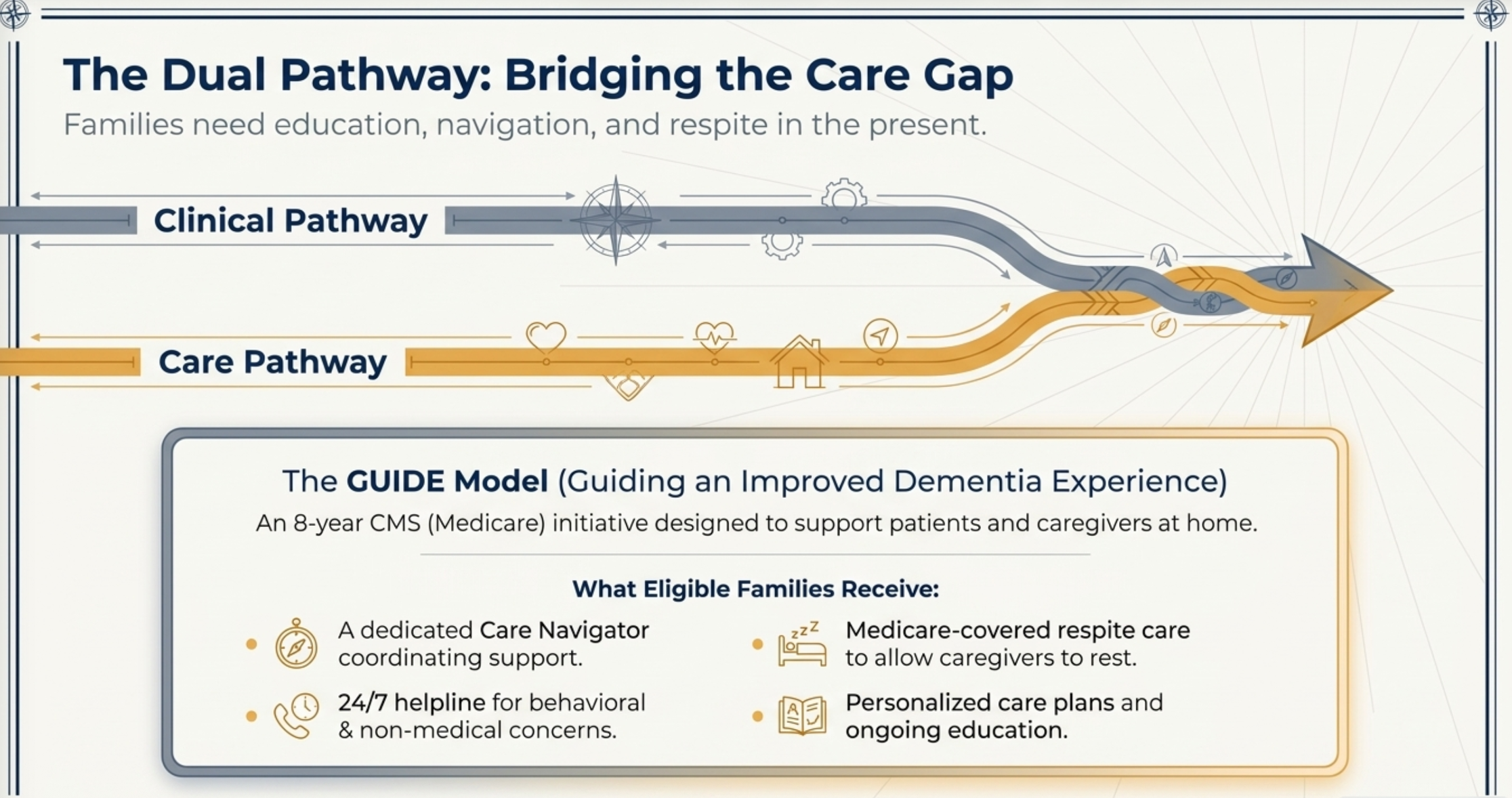
My name is Dr. Erik Ilyayev. I’m a dementia care physician, a board member of the South Florida Alzheimer's Association® , and the CEO of MedBetterHealth.org — one of the organizations selected by Medicare to participate in the GUIDE Model, an 8-year CMS initiative designed to support people living with dementia and the family caregivers caring for them at home.
In this issue, I want to explain what families need to understand about the newer Alzheimer’s infusion medications, who they may be considered for, why the evaluation before treatment matters, and why this decision has to be made carefully with the patient, family, and medical team.
THE TREATMENT LANDSCAPE HAS CHANGED
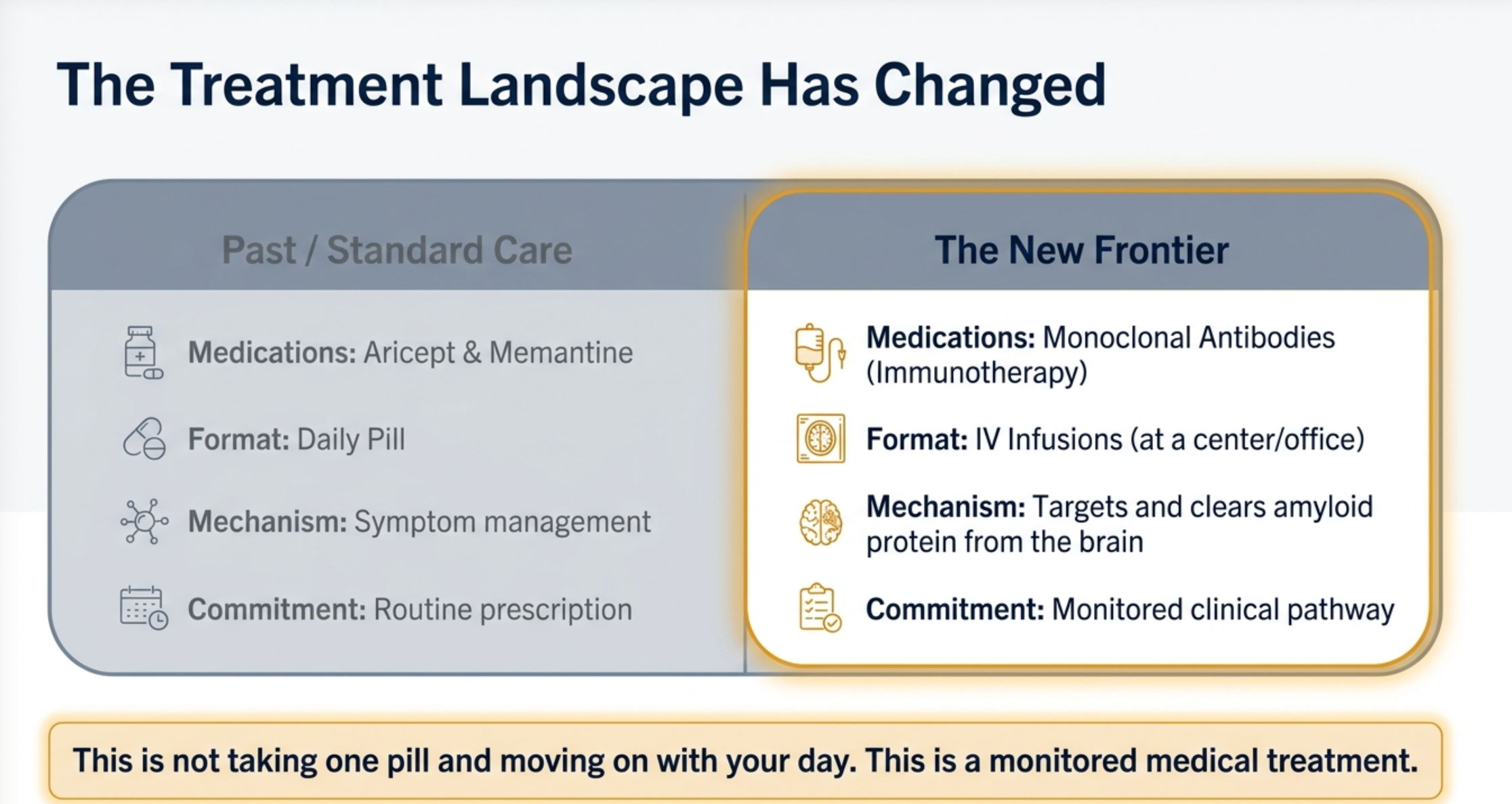
For many years, families heard about medications such as Aricept and memantine.
Those medications were part of the dementia-care conversation for a long time.
Then, more recently, new medications entered the discussion.
These newer treatments are monoclonal antibodies.
That means they are a type of immunotherapy.
Dr. Galvin explained that these antibodies target amyloid protein and help clear amyloid from the brain.
That is different from the older medication conversations many families are used to hearing.
But different does not automatically mean simple.
These treatments require a serious process.
They are usually given through IV infusion, often at an infusion center or doctor’s office. There may also be maintenance options in some situations, but families should not assume the treatment is quick, easy, or casual.
This is not taking one pill and moving on with your day.
This is a monitored medical treatment.
And that matters.
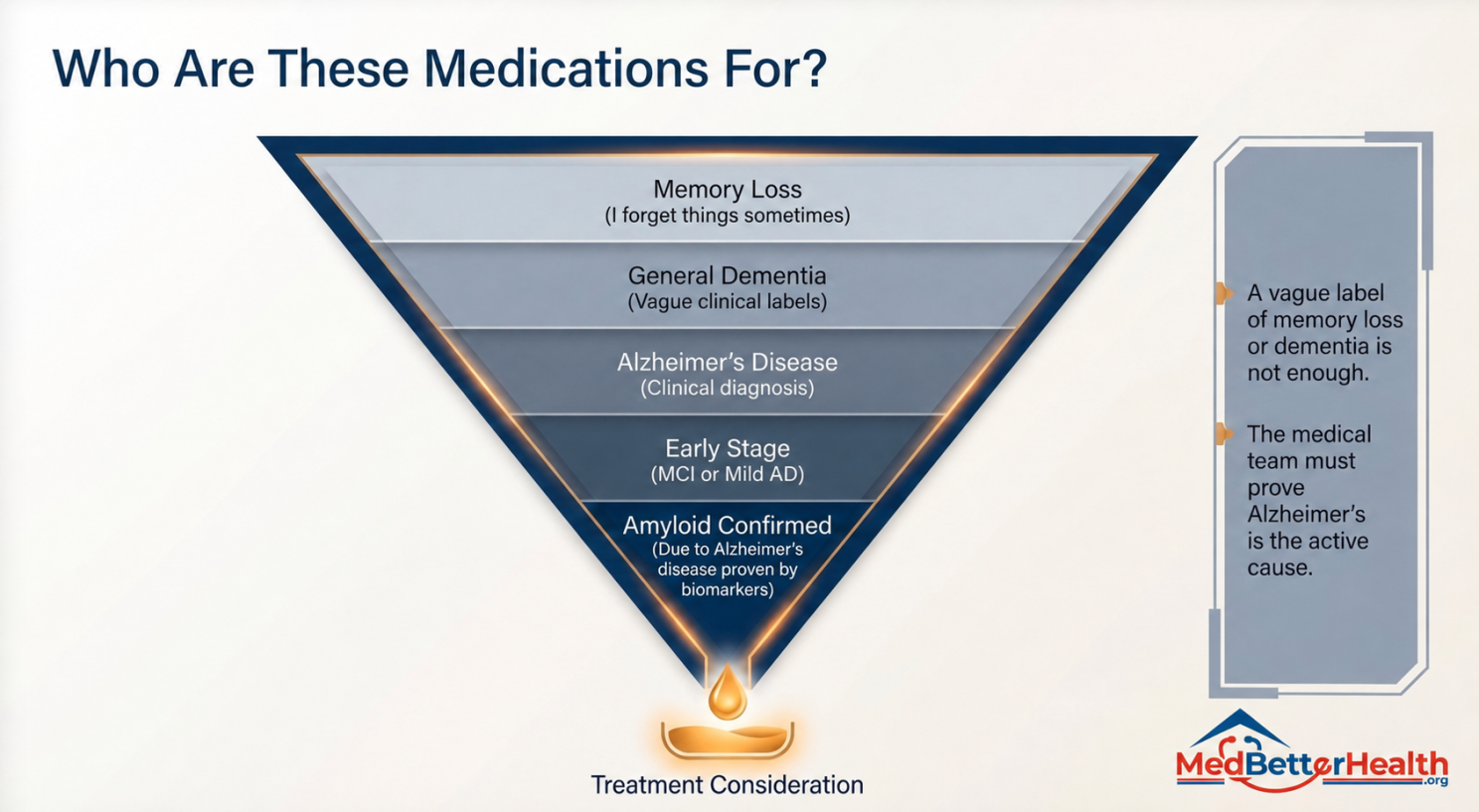
WHO ARE THESE MEDICATIONS FOR?
One of the most important questions is:
Who may be considered for these medications?
Dr. Galvin explained that these medications are indicated for people with early-stage Alzheimer’s disease.
That includes mild Alzheimer’s disease and mild cognitive impairment due to Alzheimer’s disease.
That phrase matters:
Due to Alzheimer’s disease.
Not just “I forget things sometimes.”
Not just “I am worried.”
Not just “I have dementia.”
The person needs evidence that Alzheimer’s disease is actually present in the brain, which may involve biomarkers such as PET scan, spinal fluid testing, or blood-based biomarker testing when appropriate.
The person also needs symptoms that match.
This is why diagnosis matters so much.
If we do not know what is causing the cognitive problem, we cannot responsibly decide whether an Alzheimer’s treatment is appropriate.
A vague label is not enough.
“Dementia” is not enough.
Even “memory loss” is not enough.
The medical team has to determine whether this is truly Alzheimer’s disease, whether it is early enough, and whether the person meets criteria to even consider treatment.
MILD COGNITIVE IMPAIRMENT VS. MILD ALZHEIMER’S DISEASE
Families often hear these phrases and wonder what they mean.
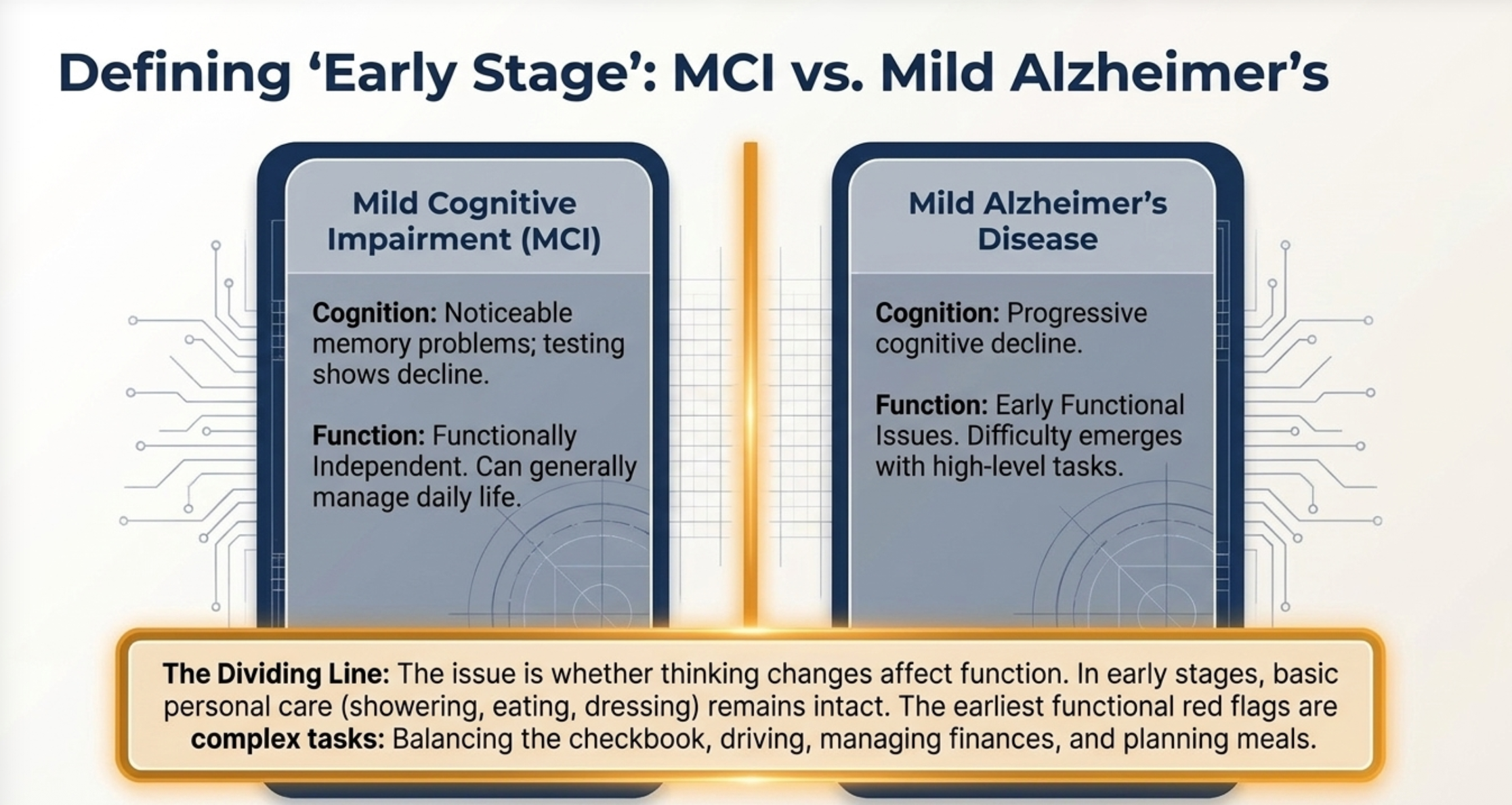
Mild cognitive impairment, or MCI, means the person has cognitive changes, but they are still functionally independent.
They may notice memory problems.
The family may notice changes.
Testing may show cognitive decline.
But the person can still generally manage daily life independently.
Mild Alzheimer’s disease is different.
Now the person has more difficulty with function.
But in the early stage, this may not mean they need help with showering, eating, or dressing.
Dr. Galvin explained that early functional issues are often higher-level tasks.
Balancing the checkbook.
Driving.
Managing finances.
Planning meals.
Handling more complex daily routines.
That is the divider families need to understand.
The issue is not only memory.
The issue is whether thinking changes are affecting function.
And in early disease, those functional changes may show up in complex tasks before basic personal care.
THE BIOMARKER PIECE
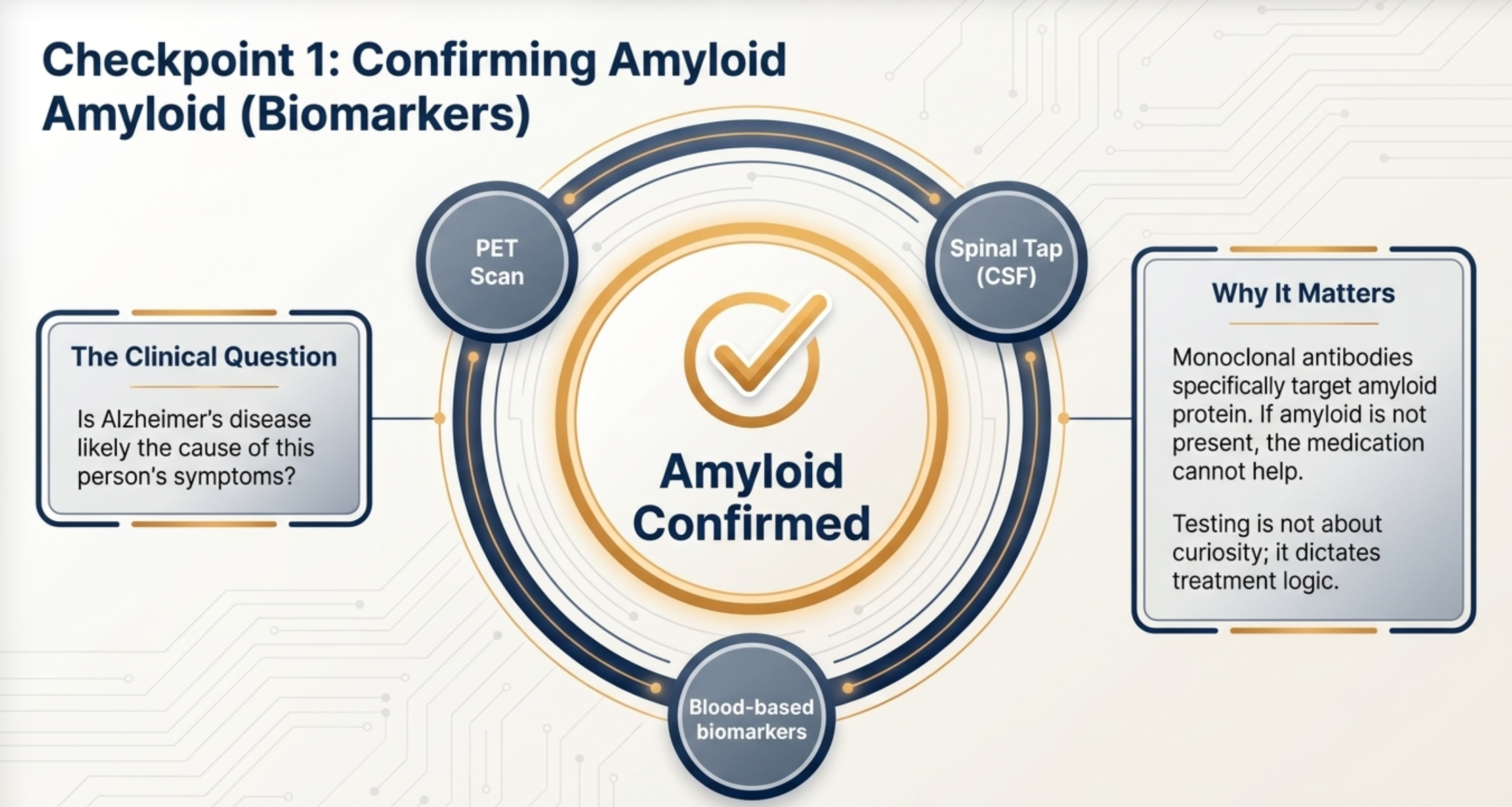
Before these treatments are even considered, clinicians need to show that Alzheimer’s disease is present.
Dr. Galvin explained that this may be done through biomarkers.
That could include a PET scan.
It could include a spinal tap.
It could include blood-based biomarkers when appropriate.
The point is that the treatment decision depends on confirming the disease process.
Why?
Because these medications target amyloid.
So if Alzheimer’s disease is not the cause of the symptoms, then the treatment may not make sense.
This is why the blood-test conversation from the previous episode matters.
Testing is not about curiosity.
It is about answering a specific clinical question.
Is Alzheimer’s disease likely to be the cause of this person’s symptoms?
If yes, and if the person is at the right stage, then the medical team may discuss whether treatment is appropriate.
But the biomarker is not the whole care plan.
It is one step in a much larger process.
THE MRI BEFORE TREATMENT
Another critical step is MRI.
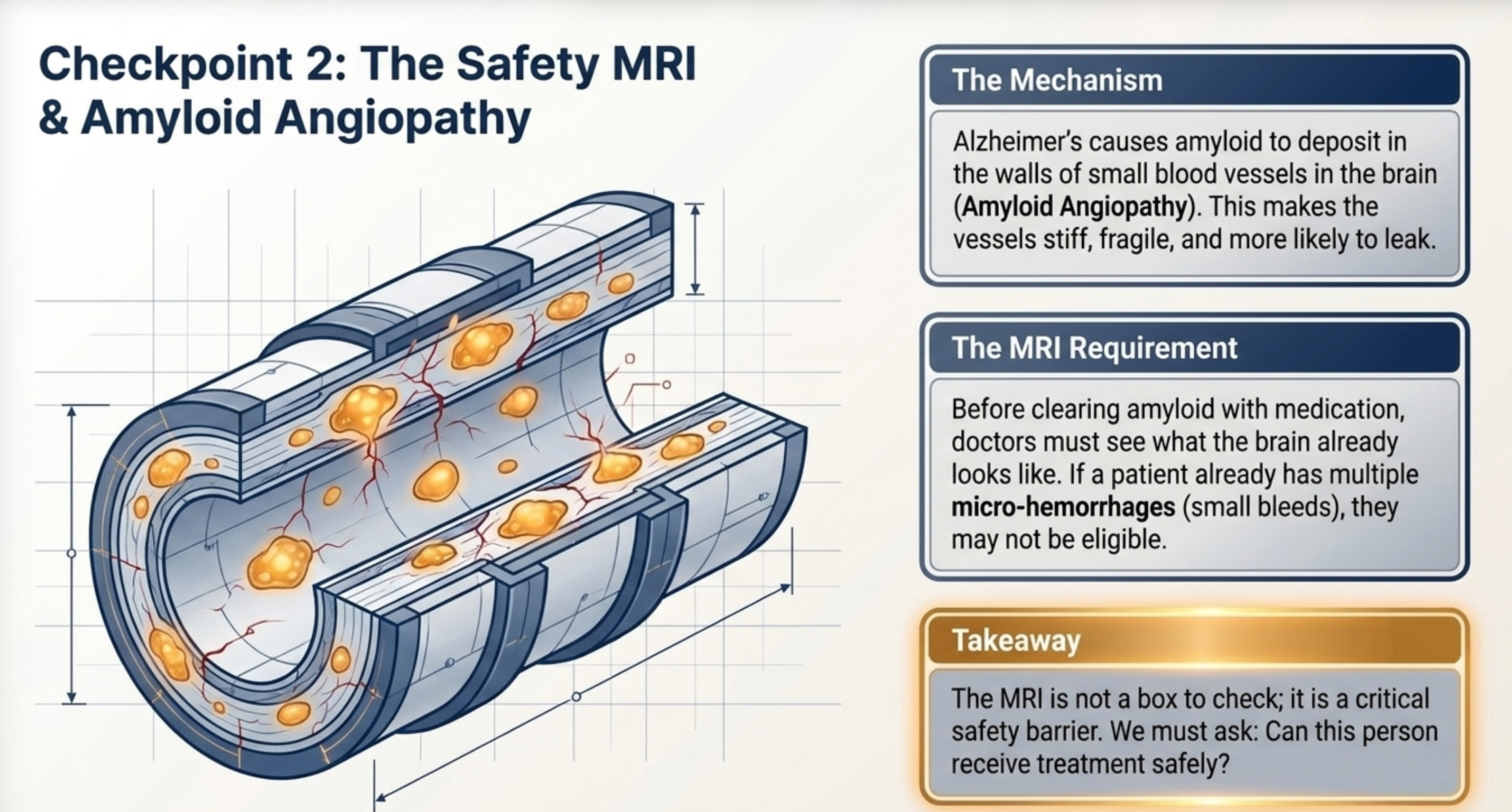
Dr. Galvin explained that an MRI is needed before infusion treatment.
Why?
Because one of the important risks with these medications involves small bleeds in the brain.
And Alzheimer’s disease itself can be associated with small bleeds because amyloid can deposit in the walls of small blood vessels, making them stiff, fragile, and more likely to leak.
That condition is called amyloid angiopathy.
So before treatment, the medical team needs to know what the brain already looks like.
If a person already has many microhemorrhages, they may not be eligible for infusion treatment.
That is why MRI is not just a box to check.
It is part of risk assessment.
The goal is not only to ask:
“Can this treatment help?”
The goal is also to ask:
“Can this person receive this treatment safely enough to proceed?”
That is the part families must understand.
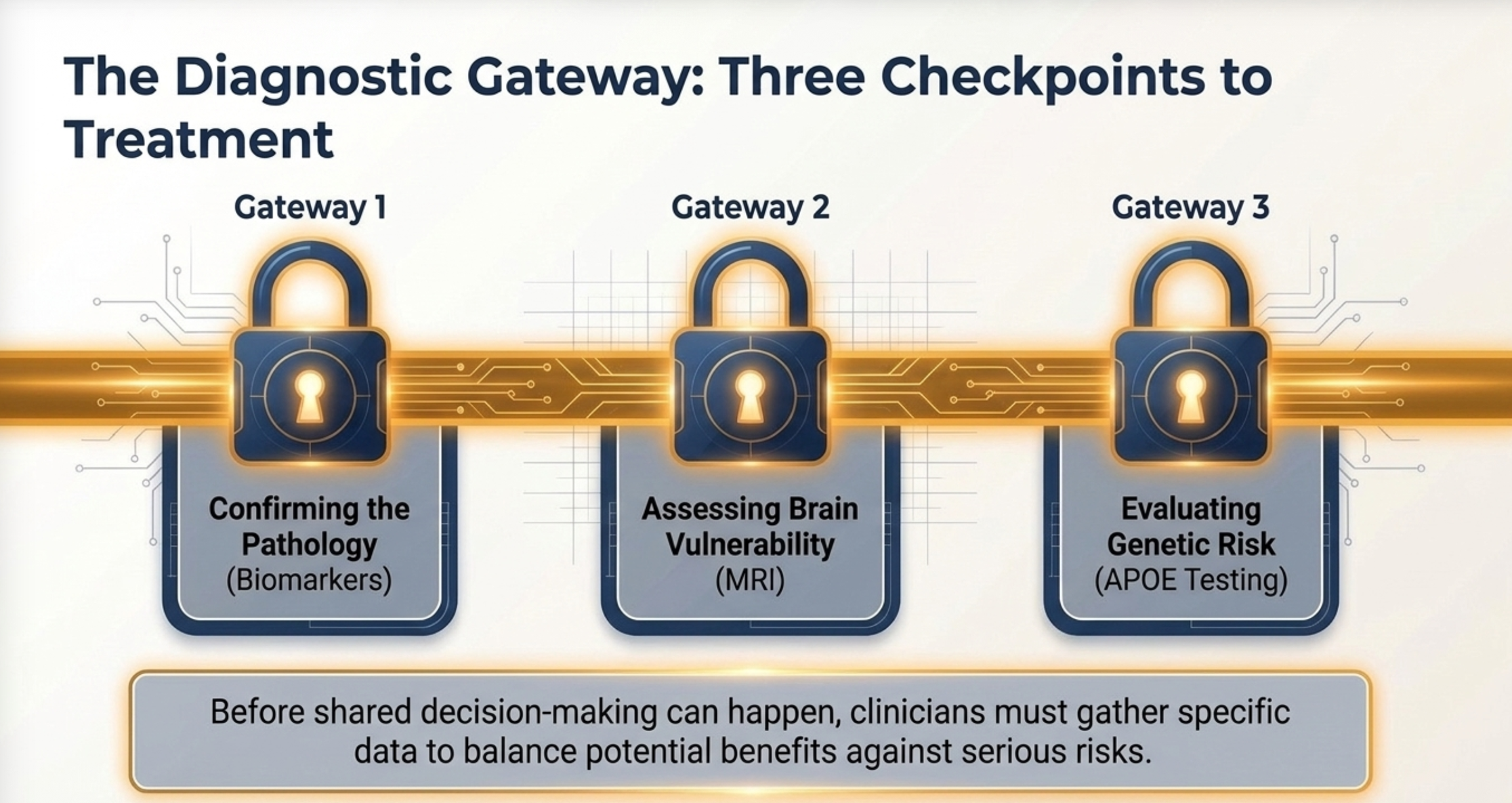
THE APOE GENETIC TEST
Dr. Galvin also discussed APOE genotype testing.
This helps clinicians talk about the person’s risk of side effects.
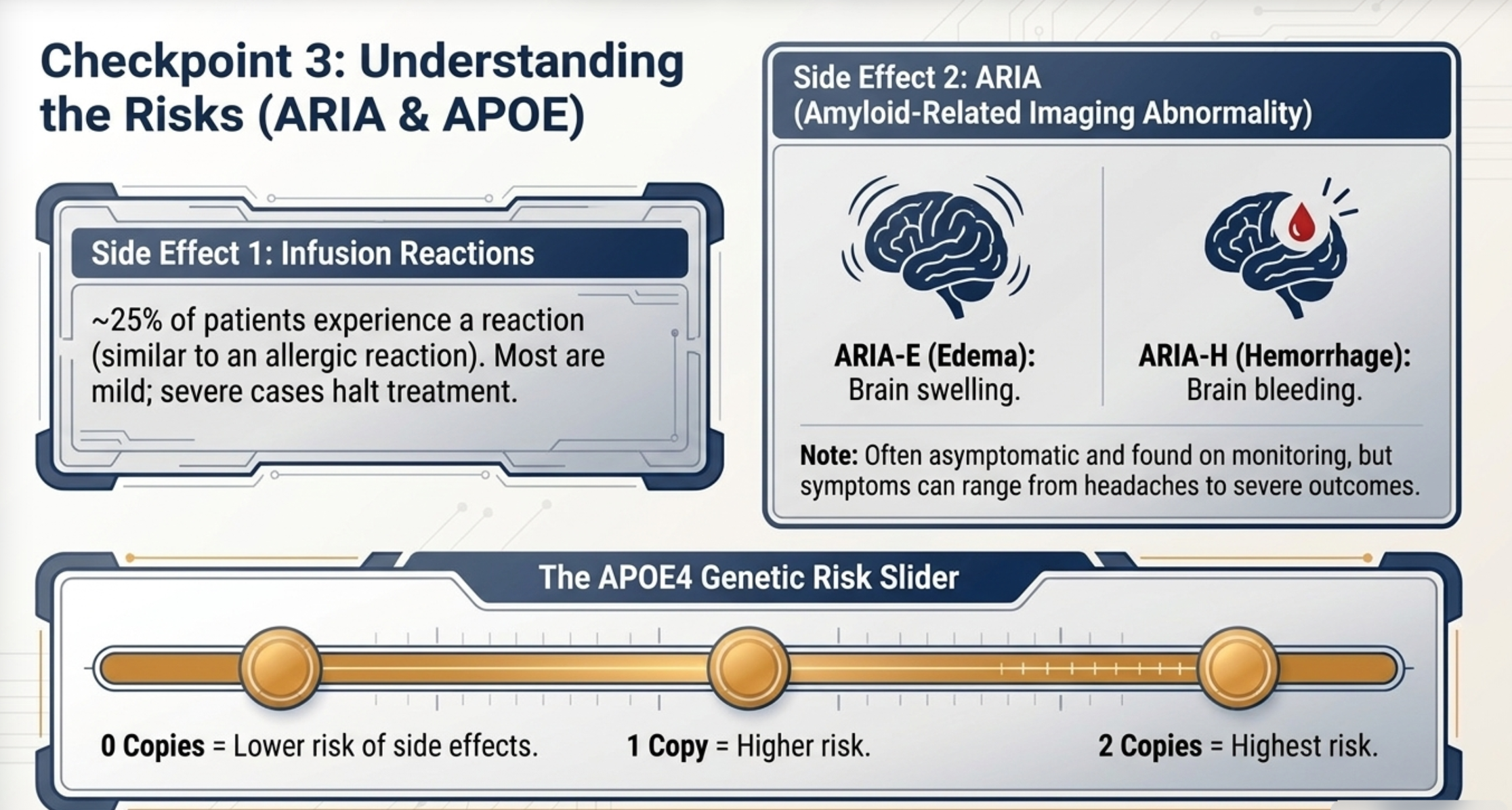
If a person does not carry the APOE4 allele, they may have a lower risk of certain side effects.
If they carry one copy, the risk is higher.
If they carry two copies, the risk is higher still.
This does not mean a family should interpret genetic testing alone.
It does not mean one result automatically tells the whole story.
It means the medical team uses this information as part of the risk discussion.
And again, this is why these treatments are not casual.
Before treatment, there is work to do.
Confirm the diagnosis.
Confirm the stage.
Review the MRI.
Review the genotype.
Review other exclusion criteria.
Review the risks.
Review the benefits.
Review whether the person and family understand the commitment.
This is a serious shared decision.
Not a sales pitch.
Not a miracle promise.
Not “everyone should do this.”
A careful medical decision.
THE SIDE EFFECTS FAMILIES NEED TO UNDERSTAND
Dr. Galvin described three main side effects families should understand.
The first is infusion reaction.
About 25% of people may have an infusion reaction, which can be similar to an allergic reaction to the medication.
Most of the time, it may be mild.
But for some people, it can be significant enough that they cannot be infused again.
The other two side effects fall under something called ARIA.
ARIA stands for amyloid-related imaging abnormality.
There are two main forms.
ARIA-E refers to edema, or swelling.
ARIA-H refers to hemorrhage, or bleeding.
These are seen on imaging, usually MRI.
Many times, these findings may be asymptomatic, meaning the person does not feel anything and the issue is found on monitoring. But symptoms can occur, and Dr. Galvin explained that the range can be broad, from headache to very serious outcomes.
That does not mean the severe outcomes are common.
But because they are possible, monitoring matters.
This is why the medical team cannot simply give the infusion and hope for the best.
WHY MONITORING MATTERS
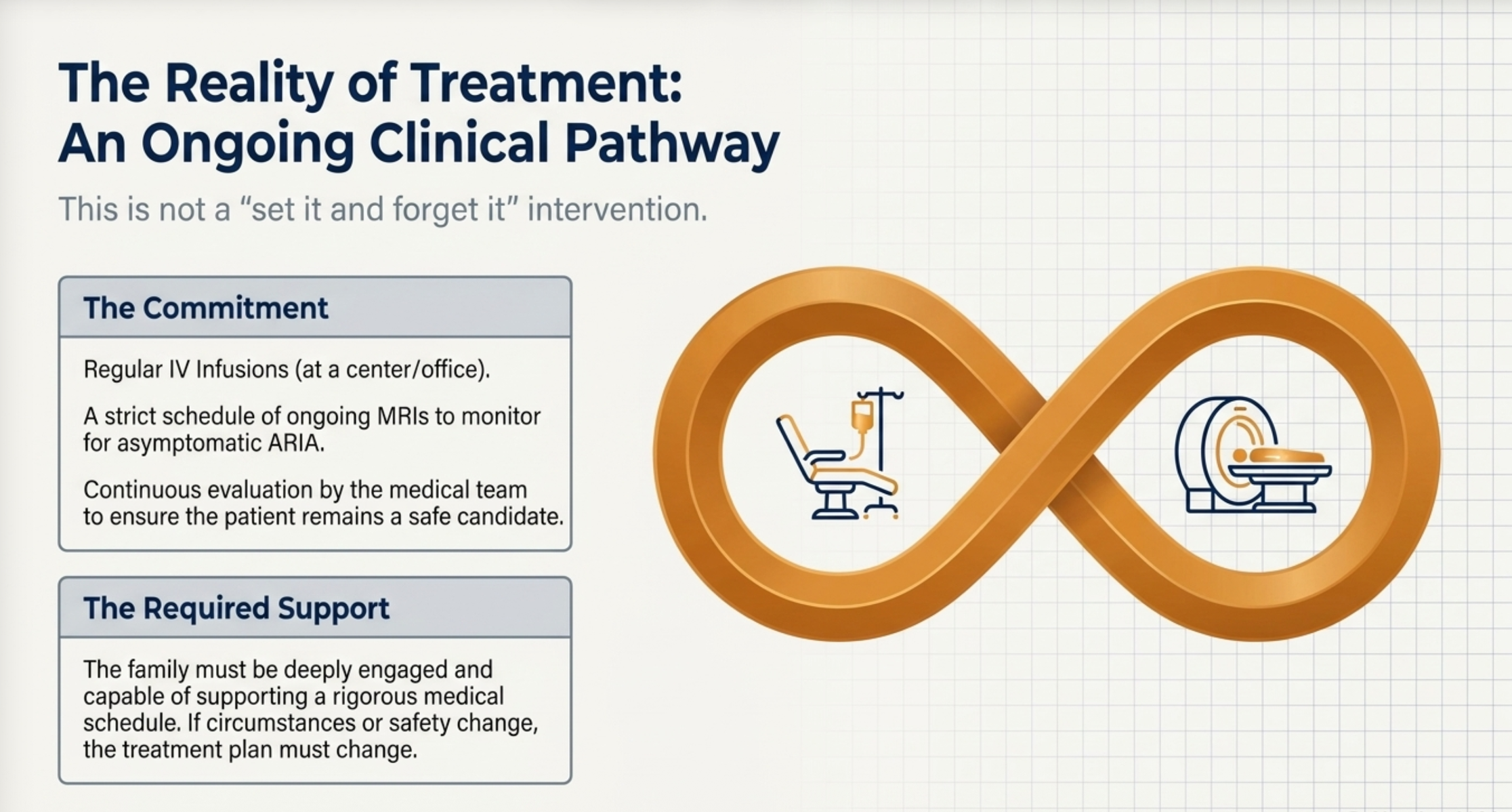
If a person receives these treatments, they need ongoing monitoring.
Dr. Galvin explained that there is a set schedule for MRIs.
That monitoring is meant to look for ARIA and other safety concerns.
This is part of why the decision requires commitment.
The patient has to understand the process.
The family has to be engaged.
The provider has to monitor closely.
The team has to make sure the person is still the right candidate, getting the right treatment, at the right time, with the right follow-up.
And if something changes, the plan may need to change.
This is not a “set it and forget it” treatment.
It is an ongoing clinical pathway.
SHARED DECISION-MAKING
The phrase that matters here is shared decision-making.
The patient should be involved.
The family should be engaged.
The provider should educate, assess risk, explain benefits and limitations, and monitor closely.
Nobody should be pushed into this.
Nobody should be scared away without a real discussion either.
The decision should be based on:
The diagnosis.
The stage of disease.
The biomarkers.
The MRI.
The APOE result.
The person’s health history.
The risks.
The potential benefits.
The family’s ability to support the treatment schedule and monitoring.
The person’s values and goals.
Some people may decide the potential benefit is worth the risk and the process.
Some people may decide it is not right for them.
Both deserve respect when the decision is informed.
That is the point.
Education first.
Then decision.
WHAT I WANT FAMILIES TO ASK
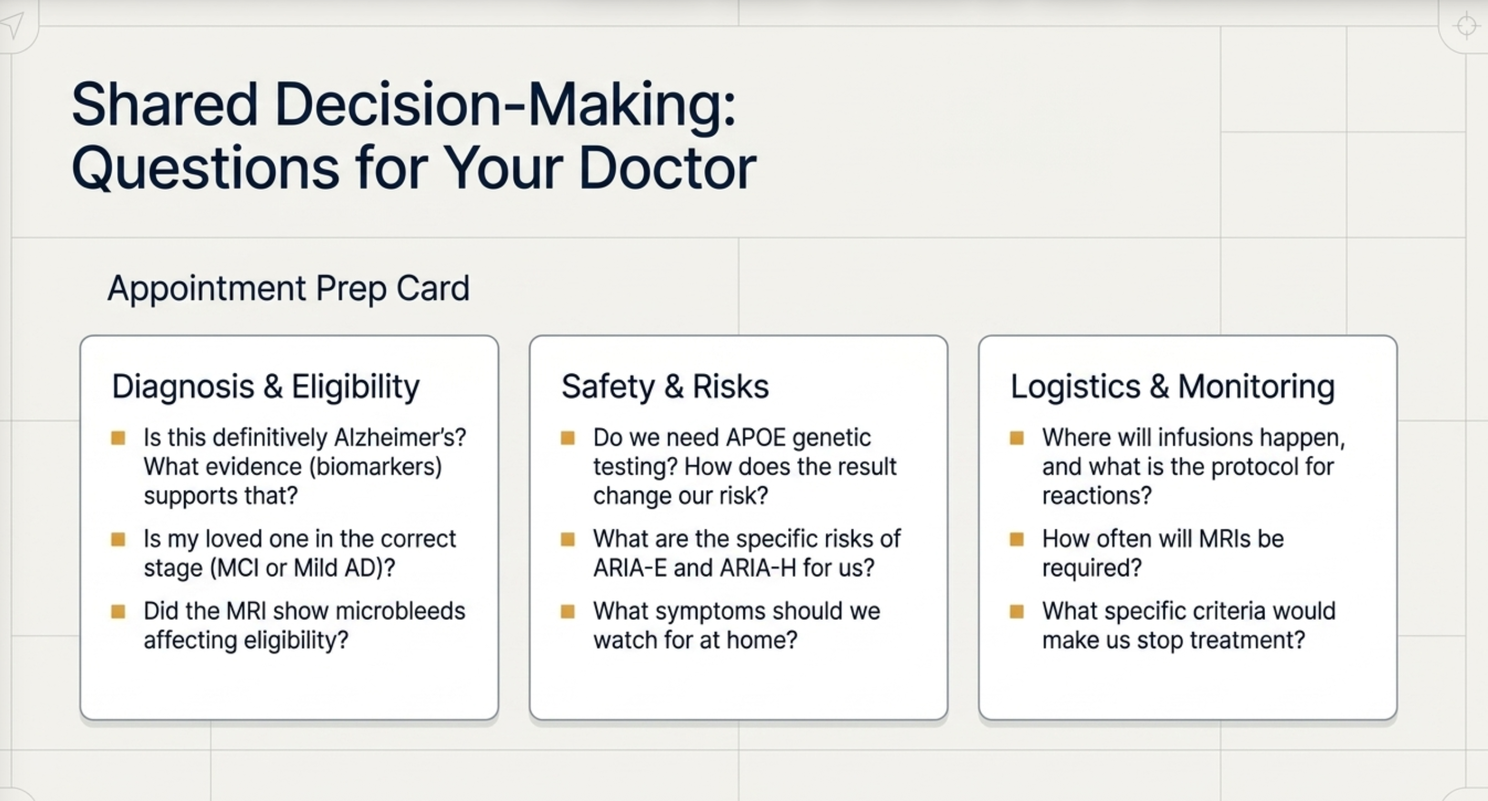
If your loved one is being considered for one of these newer Alzheimer’s treatments, I want you to ask specific questions.
Ask:
“Is this definitely Alzheimer’s disease?”
“What evidence supports that?”
“Is my loved one in the stage where this treatment may be considered?”
“What biomarker testing has been done?”
“What did the MRI show?”
“Are there microbleeds or other findings that affect eligibility?”
“Do we need APOE genetic testing?”
“How does the APOE result change the risk discussion?”
“What are the possible benefits?”
“What are the possible side effects?”
“What is ARIA?”
“How often will MRIs be needed?”
“What symptoms should we watch for?”
“Where will infusions happen?”
“What happens if there is an infusion reaction?”
“What would make us stop treatment?”
“What is the monitoring plan?”
These questions are not rude.
They are responsible.
Because a treatment this serious should never be started with vague understanding.
WHAT I WANT FAMILIES TO REMEMBER
If you are hearing about new Alzheimer’s infusion medications, here is what I want you to remember.
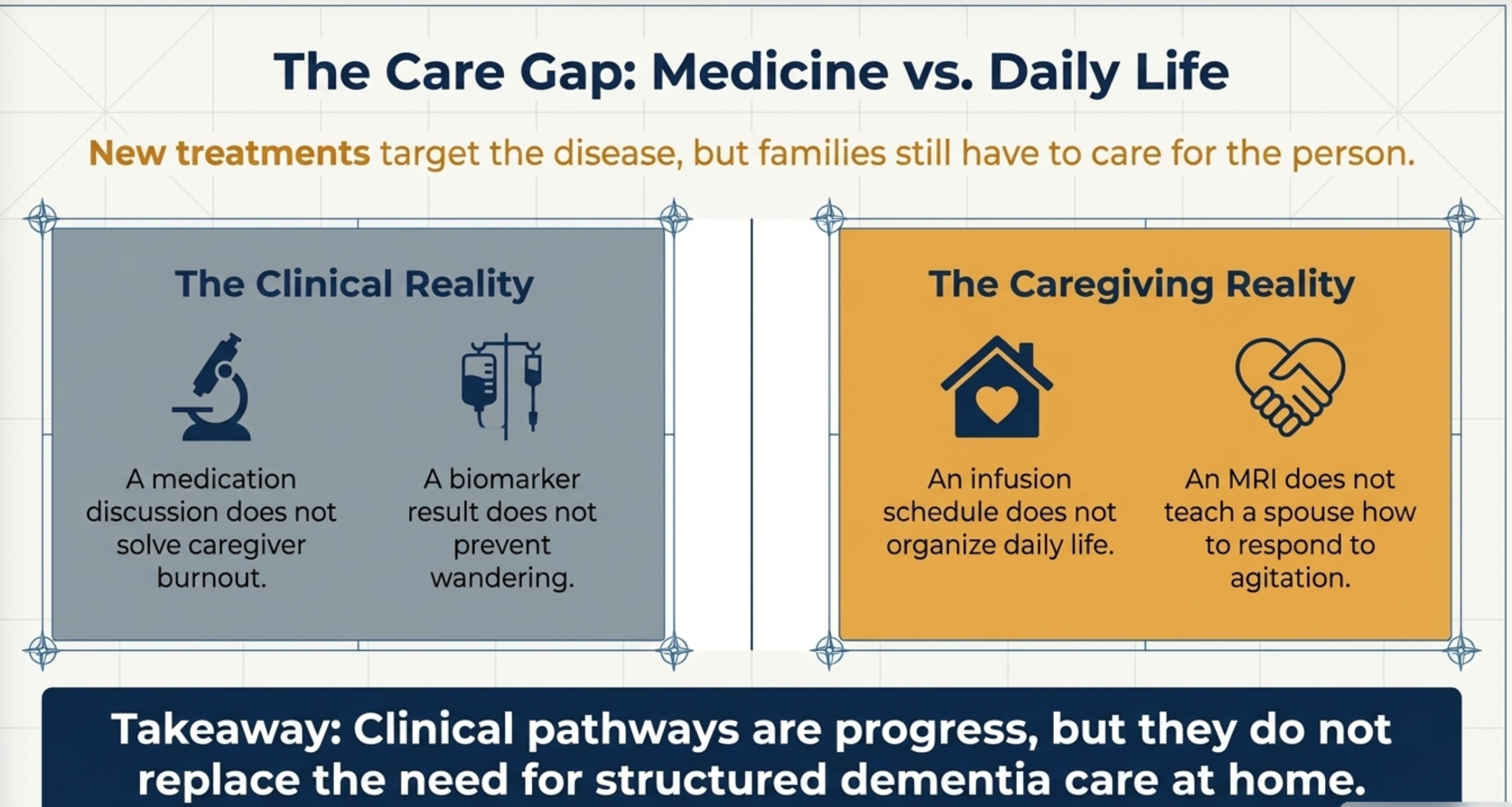
These treatments represent real progress.
They are part of the future of Alzheimer’s care.
But they are not for every person with memory loss.
They are not for every person with dementia.
They are not for advanced dementia.
They are meant for specific patients with early-stage Alzheimer’s disease or mild cognitive impairment due to Alzheimer’s disease, after the appropriate evaluation.
The diagnosis has to be specific.
The stage has to be right.
The MRI matters.
The APOE result matters.
The side effects matter.
The monitoring matters.
The family’s ability to support the process matters.
And the patient’s values matter.
The goal is not to chase every new treatment blindly.
The goal is to make the best decision for the right person, with the right medical team, at the right time.
That is how families should think about the future of dementia care.
Not hype.
Not fear.
Informed decision-making.
Slide deck note
Extra visual from this issue

Common questions
Quick answers from this issue
Are the New Alzheimer’s Infusions Right for Every Patient?
Every week, caregivers ask me some version of the same question: “Dr. Erik, what is the future of dementia care?” And I understand why families ask it.
What should caregivers try first?
Write down what changed, when it started, and what was happening right before it. Reduce noise, slow the conversation down, and use one simple step at a time. Share the pattern with the family, care team, or clinician so everyone responds consistently.
When should families call a clinician?
Call a clinician promptly if the change is sudden, severe, unsafe, tied to a fall, fever, pain, dehydration, medication change, hallucinations, paranoia, or new confusion. Call emergency services for immediate danger.