

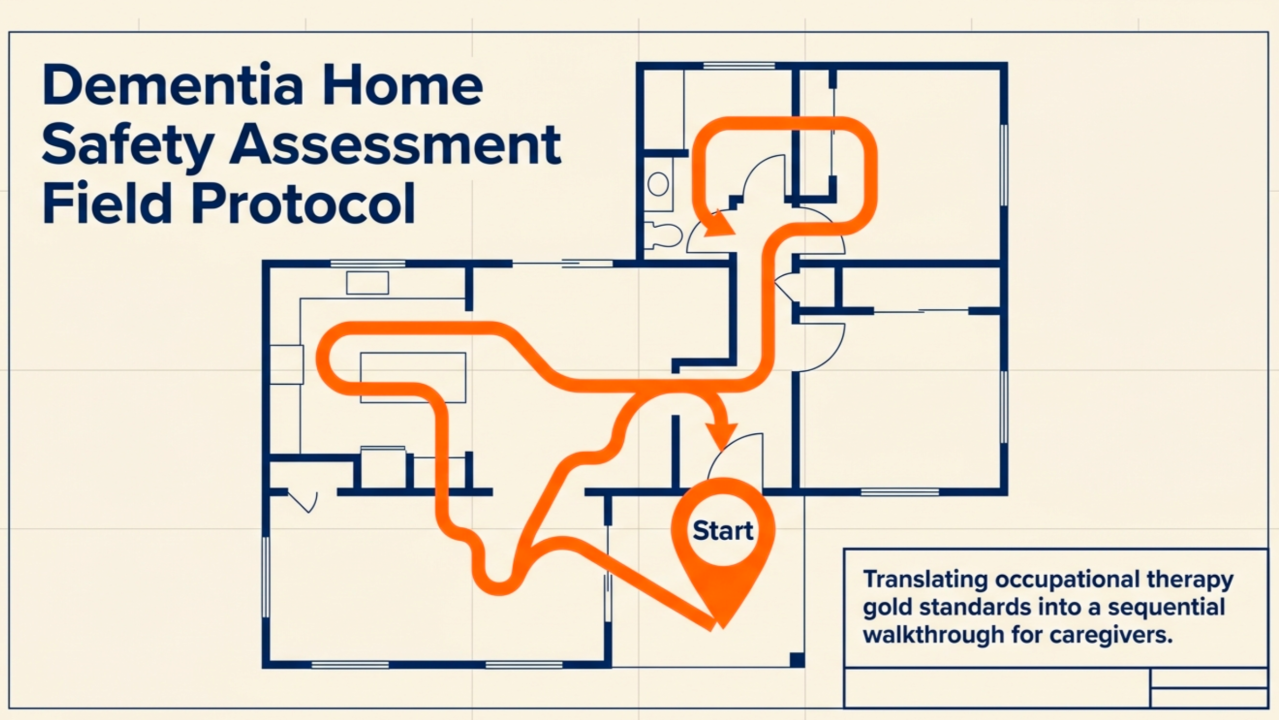
Every week, caregivers ask me some version of the same question:
“Dr. Erik, how do I know if my home is safe?”
And I understand why families ask it.
Because when someone you love is living with dementia, the home can start to feel different.
The front door becomes a concern.
The stove becomes a concern.
The bathroom becomes a concern.
The pool becomes a concern.
The medication cabinet becomes a concern.
The kitchen knives, the cleaning supplies, the rugs, the lighting, the locks, the water temperature — suddenly, normal parts of the home become possible safety risks.
And the caregiver starts thinking:
“What if my husband walks out when I am not home?”
“What if my wife falls in the bathroom?”
“What if Mom leaves the stove on?”
“What if Dad takes the wrong medication?”
“What if my loved one drinks something dangerous because they no longer recognize what it is?”
These are not paranoid questions.
These are caregiver questions.
And they matter.
My name is Dr. Erik Ilyayev. I’m a dementia care physician, a board member of the South Florida Alzheimer's Association® , and the CEO of MedBetterHealth.org — one of the organizations selected by Medicare to participate in the GUIDE Model, an 8-year CMS initiative designed to support people living with dementia and the family caregivers caring for them at home.
In this issue, I want to walk through dementia home safety in a practical way: why the stage of dementia matters, how wandering risk changes the home, why kitchen and bathroom safety need to be taken seriously, and why caregivers should not wait for a crisis before making the environment safer.
Because in dementia care, the home is not just where care happens.
The home is part of the care plan.
WHY THE HOME MATTERS SO MUCH
When families think about dementia care, they often think about doctors, medications, memory tests, neurologists, and appointments.
All of that matters.
But most dementia care does not happen in the doctor’s office.
It happens at home.
It happens in the hallway at night.
It happens in the kitchen when someone turns on the stove.
It happens in the bathroom when someone tries to stand up from the toilet.
It happens near the front door when someone decides they “need to go home,” even though they are already home.
It happens when medications are left on the counter.
It happens when a person sees a cleaning product and no longer understands what it is.
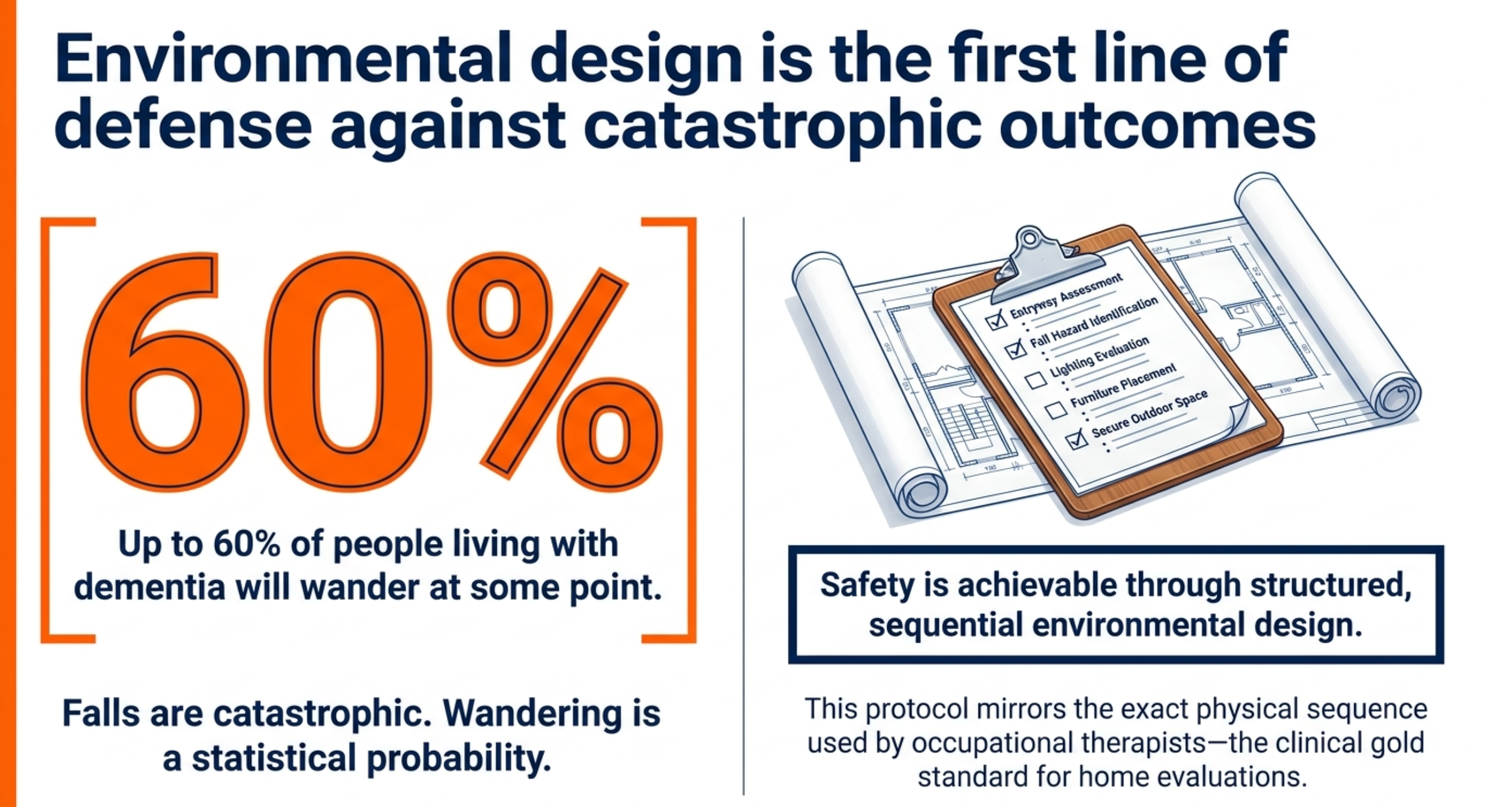
That is why environmental design matters.
The environment can either reduce risk or increase risk.
A safer home does not eliminate every danger.
But it can lower the chances of a preventable crisis.
And that is what caregivers need to understand.
Home safety is not about fear.
It is about prevention.
STAGE MATTERS
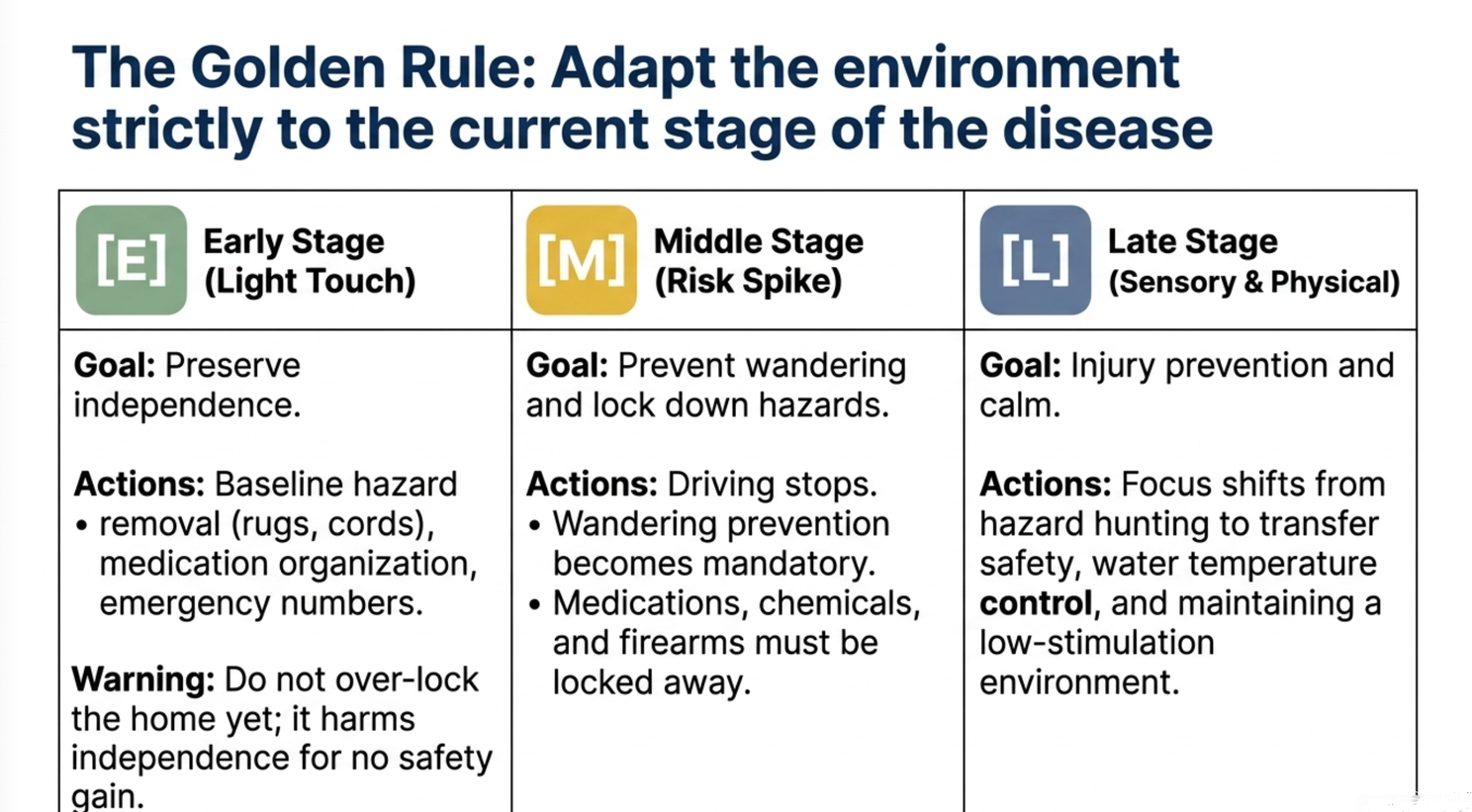
The first thing families need to understand is that home safety is not one-size-fits-all.
A person with early dementia is not the same as a person with moderate dementia.
A person with moderate dementia is not the same as a person with severe dementia.
The safety plan has to match the person’s actual abilities.
This is why staging matters.
Sometimes a family is told:
“Your loved one has dementia.”
Okay.
But what stage?
Mild?
Moderate?
Severe?
That question matters because it changes the home safety plan.
If someone is still in an earlier stage and can safely participate in certain routines, we do not want to take away every meaningful activity too soon.
Purpose matters.
Independence matters.
Dignity matters.
If Mom can still cook safely with supervision and check-ins, then the goal may not be to lock down the entire kitchen immediately.
But if Mom is leaving pots burning, forgetting the stove is on, confusing objects, or using appliances unsafely, then the safety conversation changes.
The same is true for doors, bathrooms, medications, and tools.
Safety planning should not be random.
It should be based on stage, function, risk, and what is actually happening in the home.
That is why families need more than a label.
They need a real care plan.
WANDERING IS NOT “JUST WALKING”
One of the biggest fears caregivers have is wandering.
And for good reason.
When a person living with dementia walks out of the home, they may not understand where they are going. They may not recognize the neighborhood. They may not know how to return. They may become confused, frightened, dehydrated, injured, or exposed to unsafe conditions.
So the caregiver has to ask:
Can my loved one leave through the front door?
Can they leave through the back door?
Can they access the garage?
Is there a side door?
Is there a pool?
Is there a busy road nearby?
Is there a staircase?
Is there a gate that stays unlocked?
Caregivers should not wait until the person wanders before thinking about exit safety.
By then, the family is already reacting.
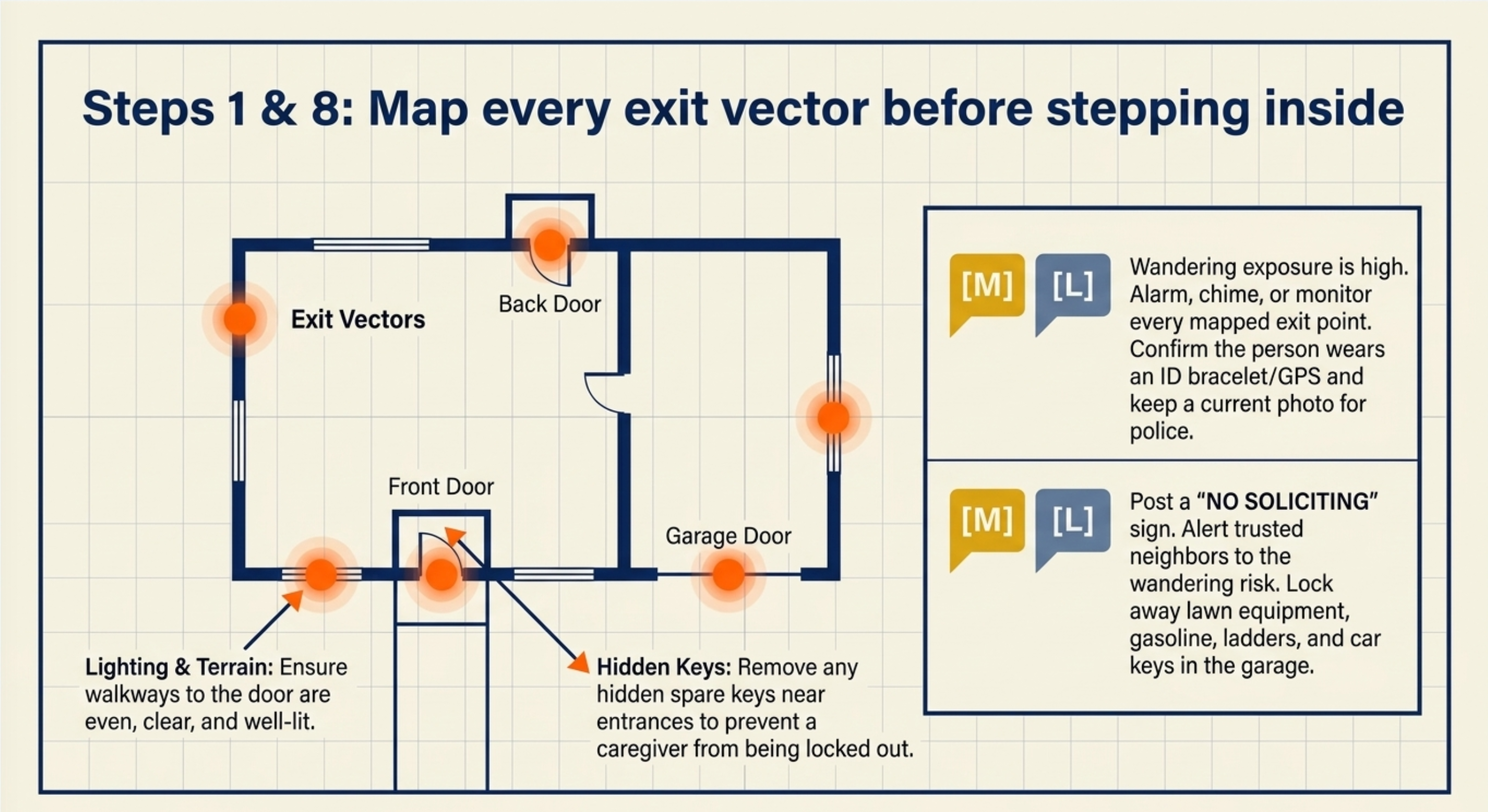
The better approach is to walk through the home before the crisis.
Look at every exit point.
Front door.
Back door.
Garage door.
Sliding door.
Side door.
Patio door.
Pool access.
And then ask:
“If my loved one became confused, could they leave without me knowing?”
That question may feel uncomfortable.
But it is necessary.
Because in dementia care, prevention is much better than panic.
CONTROLLING EXITS WITHOUT MAKING THE HOME FEEL LIKE A PRISON
Now, let me be clear.
The goal is not to make the home feel cold, harsh, or institutional.
The goal is safety with dignity.
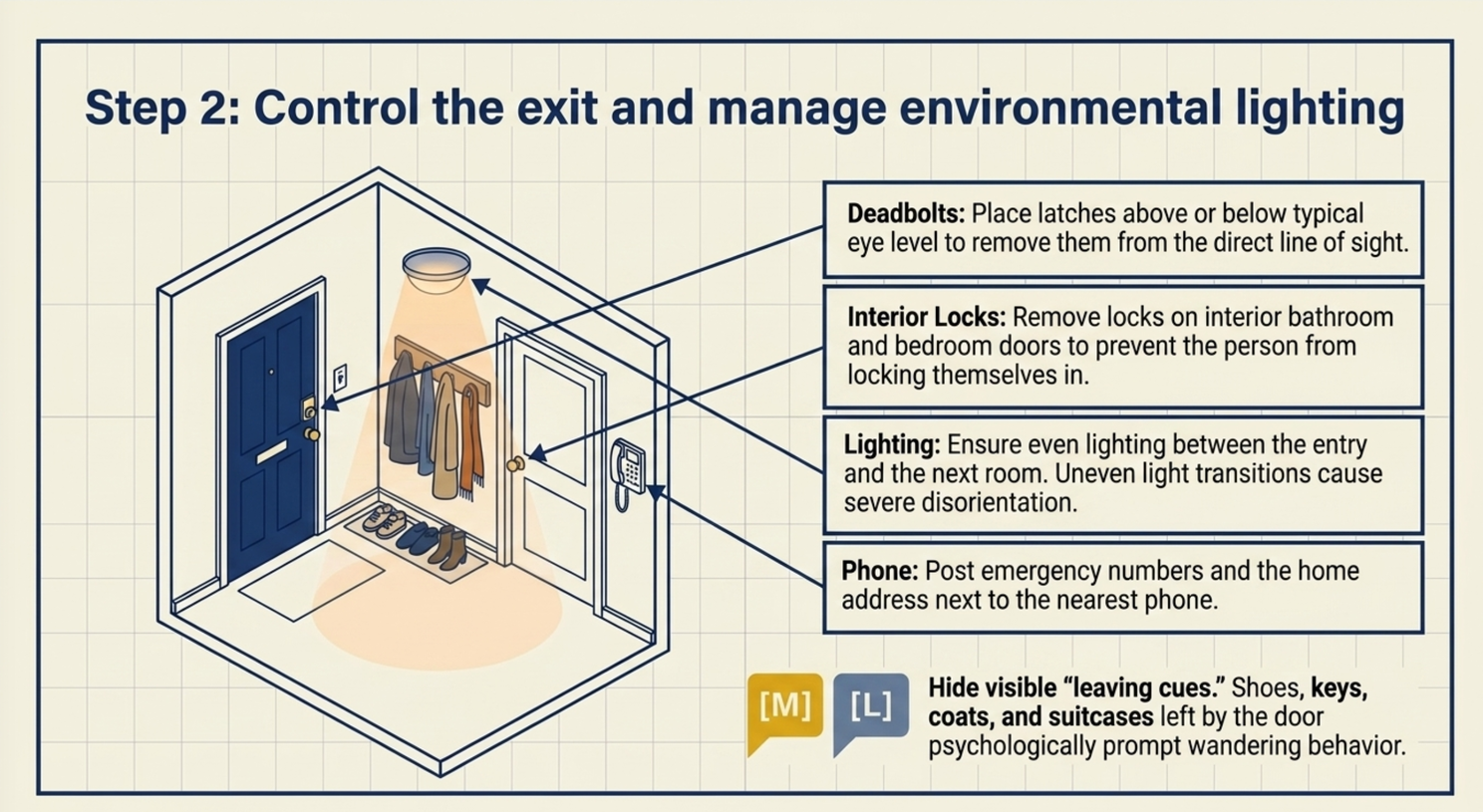
There are practical ways to reduce wandering risk.
Some families may use door alarms.
Some may use locks placed outside the person’s direct line of sight, depending on safety laws and the home situation.
Some may use visual cues, camouflage, or environmental changes.
Some may need extra supervision.
Some may need technology.
Some may need professional guidance.
But before doing anything, families should think carefully about the person’s stage, mobility, behavior patterns, local safety codes, fire safety, and emergency access.
This is not about trapping someone.
It is about preventing a dangerous exit while still keeping the home safe in an emergency.
That balance matters.
And if a family is unsure, they should speak with qualified professionals who understand dementia care, home safety, emergency access, and local requirements.
Lighting also matters in this part of the home.
Uneven light transitions can confuse a person living with dementia. Shadows, dim entryways, and sudden changes from bright to dark can increase disorientation and fall risk.
So when families think about doors and exits, they should also think about lighting.
Is the entryway clear?
Is the hallway well lit?
Is the path even?
Are shoes, bags, cords, or other objects creating a trip hazard?
Are there visible cues that may accidentally invite wandering?
A safer exit area is not only about the lock.
It is about the whole environment.
THE KITCHEN: PURPOSE AND RISK
The kitchen is one of the hardest areas for families.
Why?
Because the kitchen is not just a room.
For many people, the kitchen is identity.
It is purpose.
It is routine.
It is independence.
It is “I still make breakfast.”
It is “I still cook for my family.”
It is “I still have a role.”
So I do not want families to hear me say:
“Take everything away immediately.”
That is not the point.
If someone is in an earlier stage and can still use the kitchen safely, the goal may be check-ins, supervision, simpler tasks, and safer routines.
Maybe they can still help wash vegetables.
Maybe they can stir something with supervision.
Maybe they can set the table.
Maybe they can make a simple snack.
Maybe they can still participate in the kitchen without being left alone with unsafe appliances.
But when cooking becomes unsafe, the plan has to change.
If pots are left burning, the stove is left on, food is forgotten, fingers are being cut, or appliances are being used incorrectly, that is not a small warning sign.
That is information.
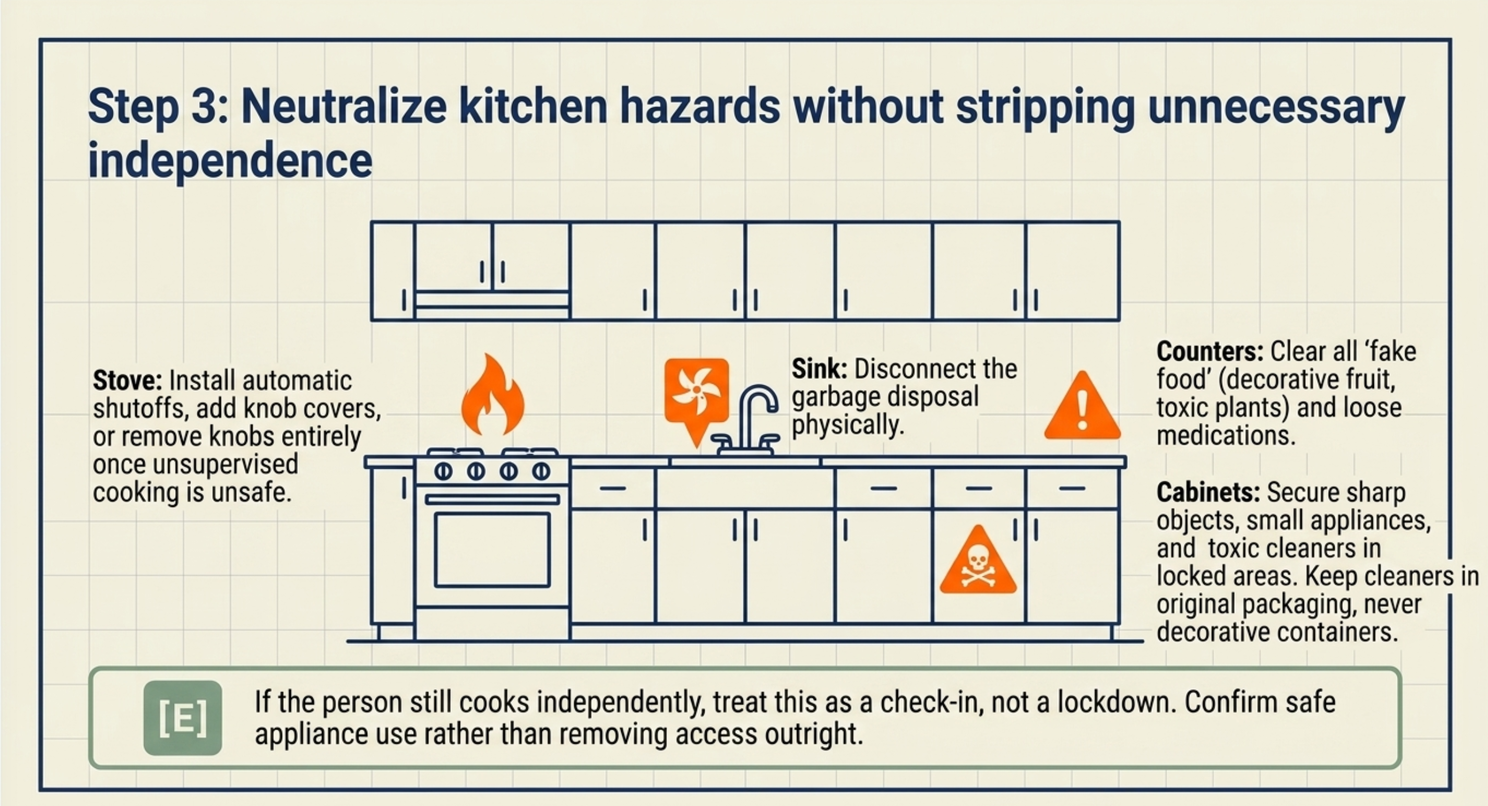
At that point, families may need to consider automatic stove shutoffs, knob covers, removing knobs, limiting unsupervised appliance use, or restructuring the kitchen routine.
Again, the goal is not punishment.
The goal is safety with dignity.
SHARP OBJECTS AND CLEANING SUPPLIES
A dementia home safety plan has to include cabinets, drawers, and counters.
Sharp knives.
Small appliances.
Cleaning products.
Toxic liquids.
Decorative food.
Loose medications.
Anything that could be mistaken, swallowed, spilled, misused, or handled unsafely.
Families have to remember:
A person living with moderate or severe dementia may not interpret objects the same way anymore.
A cleaning product may look like a drink.
Medication may look like candy.
A sharp knife may be used without understanding the risk.
A garbage disposal may become dangerous.
A toxic plant may be touched or ingested.
This is why we secure things before something happens.
Not after.
Move dangerous items out of reach.
Lock cleaning supplies.
Clear the counters.
Secure knives.
Review the drawers.
Disconnect or protect unsafe appliances when needed.
Do not assume that because something has always been in the same place, it is still safe there.
Dementia changes the person’s relationship with the environment.
The home has to adapt.
THE BATHROOM IS A HIGH-RISK ROOM
Bathrooms are one of the most dangerous rooms in the home for older adults and people living with dementia.
Why?
Water.
Tile.
Slippery floors.
Low toilets.
Bathtubs.
Poor lighting.
Nighttime confusion.
Transfer difficulty.
Privacy concerns.
Rushing.
Dizziness.
Medications.
A person may get up at night, feel disoriented, walk into the bathroom, try to sit, stand, turn, or step into the tub — and fall.
So families should look carefully at bathroom safety.
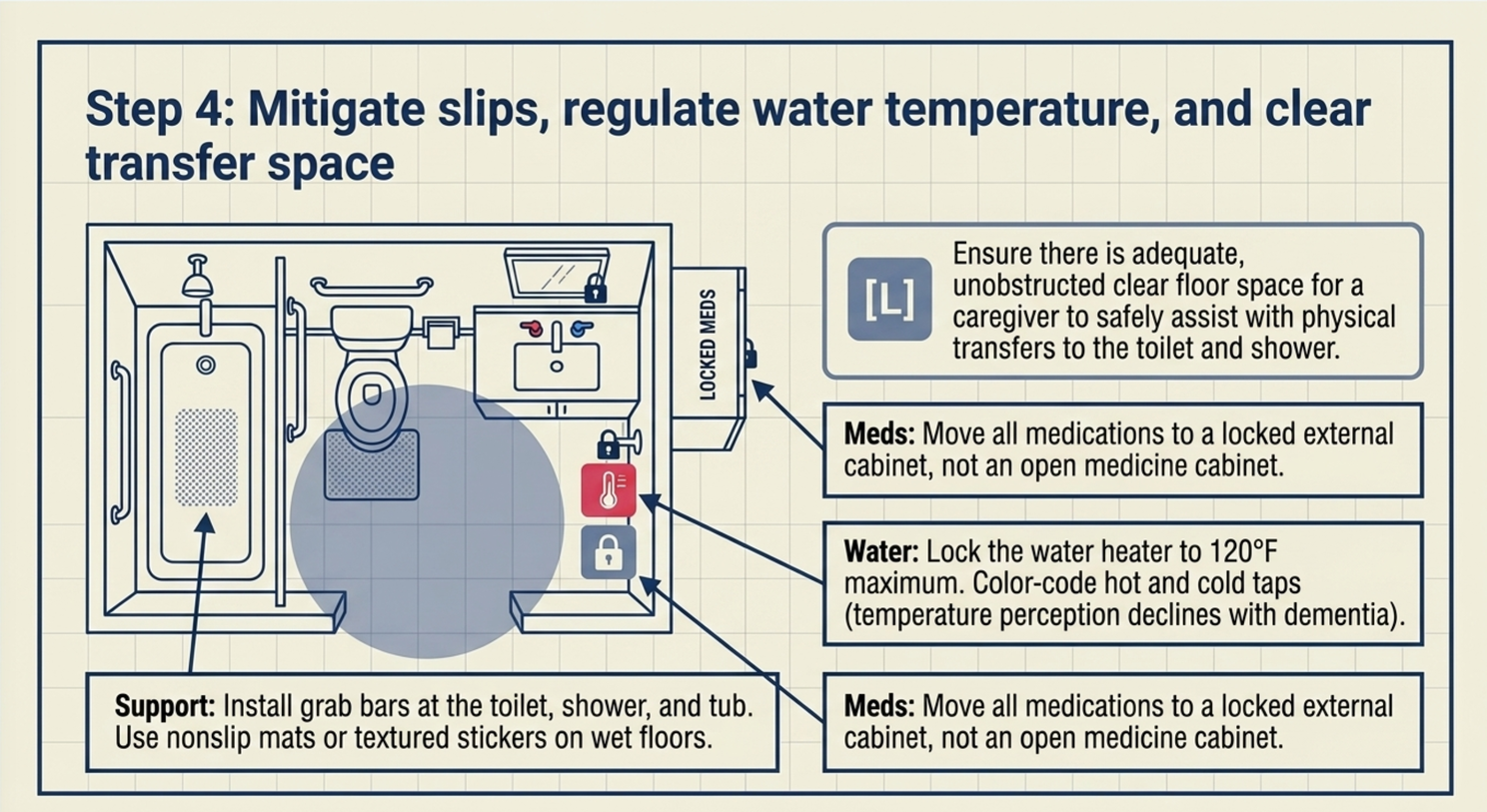
Grab bars near the toilet.
Grab bars near the shower or tub.
Non-slip mats or textured strips.
Clear floor space.
Good lighting.
A toilet height that works for the person.
A safe path from the bed to the bathroom.
A shower setup that reduces fall risk.
And another important point:
Water temperature.
Families should consider whether the water heater is set at a safe maximum temperature, because a person living with dementia may not judge hot water correctly or react quickly enough to prevent burns.
These details matter.
A bathroom fall can change everything.
So do not wait until after the fall to make the bathroom safer.
MEDICATIONS SHOULD NOT BE LEFT OUT
Medication safety is another major issue.
Many homes have pills sitting on the counter, in the bathroom cabinet, on the nightstand, in the kitchen, or in a purse.
That may have worked before dementia.
It may not be safe now.
If someone has moderate or severe dementia, they may take the wrong dose.
They may take the medication twice.
They may take someone else’s medication.
They may confuse pills with candy.
They may forget they already took something.
They may skip medication because they think they already took it.
So medications should be reviewed and secured.
Families should consider locked storage, organized dispensing systems, medication reconciliation with the medical team, and a clear plan for who manages the medications.
Medication safety is not just about remembering.
It is about preventing harm.
And if the caregiver is overwhelmed, this is one of the first areas where structure is needed.
SAFETY WITHOUT STEALING PURPOSE
One of the biggest mistakes families make is going from zero to lockdown.
They see one mistake, and suddenly the person is not allowed to do anything.
No cooking.
No walking.
No folding laundry.
No helping.
No choices.
No independence.
No purpose.
Sometimes restrictions are necessary.
But we need to be careful.
When we remove every role from a person living with dementia, we may protect the body while crushing the spirit.
So the better question is:
“What can my loved one still do safely?”
Maybe they cannot cook alone anymore.
But can they help prepare ingredients?
Maybe they cannot manage medications.
But can they still participate in a routine while the caregiver supervises?
Maybe they cannot go outside alone.
But can they take a supervised walk?
Maybe they cannot use sharp knives.
But can they fold towels, sort utensils, water a plant, or set the table?
Safety should not erase personhood.
The goal is not to take away everything.
The goal is to adapt the environment so the person can remain as safe, engaged, and dignified as possible.
THE GUIDE MODEL AND HOME SAFETY
This is also why structured dementia-care support matters.
GUIDE stands for Guiding an Improved Dementia Experience.
Through the GUIDE Model, eligible families may receive structured dementia-care support through MedBetter Health.
MedBetter Health is proud to participate in this 8-year CMS initiative designed to support people living with dementia and the family caregivers caring for them at home.
For eligible families, support may include:
A dedicated Care Navigator who coordinates dementia care and caregiver support
A 24/7 helpline for behavioral and non-medical dementia-related concerns
Medicare-covered respite care support so caregivers can rest and recover
Personalized dementia care plans and caregiver education
Ongoing support navigating the realities of dementia care at home
And this matters because dementia home safety is not always obvious.
Families may not know what to look for.
They may not know how to stage the risk.
They may not know whether the kitchen should be adapted.
They may not know whether the doors are safe.
They may not know how to balance independence and safety.
They may be exhausted and trying to make decisions alone.
A caregiver should not have to figure out every safety risk by trial and error.
By the time the lesson is learned, the harm may already have happened.
WHAT I WANT CAREGIVERS TO REMEMBER
If you are caring for someone living with dementia, here is what I want you to remember.
Your home is part of the care plan.
Wandering risk should be addressed before someone walks out.
Bathroom safety should be addressed before the fall.
Kitchen safety should be addressed before the stove is left on.
Medication safety should be addressed before the wrong dose is taken.
Cleaning supplies and sharp objects should be secured before they are mistaken or misused.
Lighting should be improved before shadows, darkness, or uneven transitions cause confusion.
And independence should be preserved where it can be preserved safely.
Do not wait for the crisis.
Walk through the home.
Ask better questions.
Adapt the environment.
Protect dignity.
And get support if you need it.
Because dementia care at home is not only about love.
It is about systems.
And families deserve systems that keep their loved one safer and keep the caregiver from carrying everything alone.
Slide deck note
Extra visual from this issue


Common questions
Quick answers from this issue
Is Your Home Safe for Someone Living With Dementia?
Every week, caregivers ask me some version of the same question: “Dr. Erik, how do I know if my home is safe?” And I understand why families ask it.
What should caregivers try first?
Write down what changed, when it started, and what was happening right before it. Reduce noise, slow the conversation down, and use one simple step at a time. Share the pattern with the family, care team, or clinician so everyone responds consistently.
When should families call a clinician?
Call a clinician promptly if the change is sudden, severe, unsafe, tied to a fall, fever, pain, dehydration, medication change, hallucinations, paranoia, or new confusion. Call emergency services for immediate danger.