

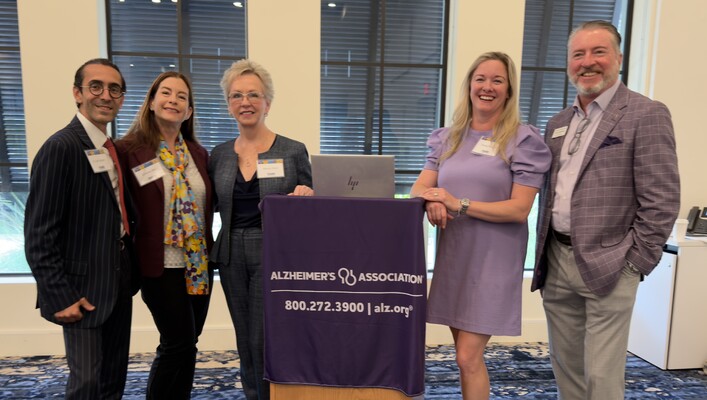
Last week I had the privilege of speaking at the Alzheimer's Association® Corporate Leaders Breakfast in South Florida. I was asked three questions in front of a room full of executives, business leaders, and community partners. The answers I gave are the same ones I give every caregiver, every family member, and every person who asks me why I do this work.
I wanted to share them with you here — because if you are reading this newsletter, these numbers affect you directly.
My name is Dr. Erik Ilyayev. I'm a dementia care physician, a board member of the South Florida Alzheimer's Association, and the CEO of MedBetter Health — one of the organizations selected by Medicare to participate in a groundbreaking new program designed to change how America cares for people living with dementia.
QUESTION 1: How Is South Florida Being Affected?
Before I got into numbers, I told the room something personal.
I want you to picture a house in New York. My grandmother, who is 93, my mom, my dad, my wife, and my six kids — all living together for 15 years. My grandmother has Alzheimer's disease. And right now, while I am here in Florida, my parents — who are 70 years old — are her primary caregivers.
That is the reality of this disease. It does not just affect the person who has it. It restructures every family around them.
Now the numbers. Because people talk — but numbers scream.
In Florida in 2020, 580,000 people were diagnosed with Alzheimer's disease. By 2025, that number had grown to 720,000. And Alzheimer's is not the only dementia. When you add the full spectrum, the scope is even larger.
Here is the one that stopped the room: a study from the Alzheimer's Association asked primary care physicians how confident they were in making a diagnosis of Alzheimer's or dementia. 40 percent said they do not have the tools or feel comfortable doing so. 40 percent. That means we are not just underfunding this disease — we are underdiagnosing it.
And the caregivers carrying this weight? In Florida alone, there are 827,000 unpaid caregivers. 66 percent of them have a chronic disease themselves. 28 percent report depression — and that number, I promise you, is at least double in reality. Because not every caregiver fills out a survey and says "I have depression."
The cost of care for a Medicare beneficiary without dementia runs between $8,000 and $12,000 a year. For a Medicare beneficiary with dementia? $32,000 a year.
That is the problem. And understanding the problem is where every solution starts.
QUESTION 2: How Is the Alzheimer's Association Actually Helping?
I told the room something that I do not say enough: joining the GUIDE Model changed how I practice medicine.
Doctors are trained to lead with logic. You have hypertension — take this medication. There is not much emotional component to that. But when I started working with dementia families, I had to shift. Because the real crisis is not always clinical. It is 10 o'clock at night, mom is yelling and confused, and a caregiver is alone in a house with no idea who to call.
That is where the Alzheimer's Association comes in — in ways most people never see.
The helpline — 1-800-272-3900 — is available 24 hours a day, 7 days a week. Free. And when you call, it is not someone reading from a script overseas. It is a trained specialist who can give you real support in the moment. Whether it is a behavioral crisis, someone who just got a diagnosis at 6pm and has nowhere to turn, or a caregiver who simply needs to talk to someone — that line exists for exactly those moments.
I know that number by heart. I give it out to every caregiver I see. Because it actually changes what happens at 10 o'clock at night.
Beyond the helpline, the Alzheimer's Association funds the research that moves this field forward. The POINTER Study — funded by the Alzheimer's Association and published in JAMA — took two groups of at-risk adults and asked a simple question: does coaching and structured lifestyle intervention actually slow cognitive decline? The answer was yes — a 35 percent decrease in progression for people who were actively coached on diet, exercise, vascular risk management, and cognitive training versus those who were simply given advice and left on their own.
That study is now being used to push Medicare and insurance companies to fund prevention — not just reaction. That is the Alzheimer's Association at work.
QUESTION 3: Why Should Companies Care About Brain Health?
This is the question I get least often — and the one I think matters most in this room.
Think about it this way. A muscle that is worked continuously without rest and without support loses its productivity. Your employees are no different. And right now, a significant portion of your workforce is managing a caregiving situation at home — often silently, often alone, and often showing up to work with a brain that was up at 3am because mom didn't sleep.
They are not calling in because they are lazy. They are calling in because no one gave them the tools to handle what they are dealing with at home.
The Alzheimer's Association has a Brain Health at Work program that gives companies a framework — a baseline assessment of where you are, a toolkit to improve, and a recognition pathway that signals to your employees and your clients that you are an organization that takes this seriously.
And here is the business case beyond the mission: if your employee knows that your company helped them navigate their mother's dementia diagnosis — you have loyalty that no bonus check can buy. They show up. They stay. They tell other people.
I serve on the Alzheimer's Association board. I do not get paid for it. It is a labor of love because I genuinely believe we can see a world without Alzheimer's. And it starts with rooms like that one — executives, physicians, and community leaders deciding together that this is worth fighting for.
The Invisible Weight: Caregiver Exhaustion
Every statistic I shared in that room represents a real person. A 70-year-old couple caring for a 93-year-old with Alzheimer's. A caregiver with their own chronic illness managing someone else's. A professional showing up to work after a night they will never get back.
You should not have to do this alone. And thanks to a new Medicare program, you don't have to.

Common questions
Quick answers from this issue
What Does It Really Take to Fight Alzheimer's in South Florida?
Last week I had the privilege of speaking at the Alzheimer's Association® Corporate Leaders Breakfast in South Florida. I was asked three questions in front of a room full of executives, business leaders, and community partners. The answers I gave are the same ones I give every caregiver, every family member, and every person who asks me why I do this work.
What should caregivers try first?
Write down what changed, when it started, and what was happening right before it. Reduce noise, slow the conversation down, and use one simple step at a time. Share the pattern with the family, care team, or clinician so everyone responds consistently.
When should families call a clinician?
Call a clinician promptly if the change is sudden, severe, unsafe, tied to a fall, fever, pain, dehydration, medication change, hallucinations, paranoia, or new confusion. Call emergency services for immediate danger.