

Every week I get asked some version of the same question: "Dr. Erik, I cannot get mom into the shower. She screams, she fights, she grabs my wrists. I've tried everything. What do I do?"
Bathing refusal is one of the most physically and emotionally exhausting challenges in dementia care. And most families are dealing with it completely alone — with no framework, no strategy, and no one to call.
This issue is different from most. I am going to walk you through a real case — a real person, a real caregiver, a real solution — step by step. Because the way you solve bathing refusal in severe dementia is not what most people think.
My name is Dr. Erik Ilyayev. I'm a dementia care physician, a board member of the South Florida Alzheimer's Association®, and the CEO of MedBetterHealth.org — one of the organizations selected by Medicare to participate in a groundbreaking new program designed to change how America cares for people living with dementia.
STEP 1: UNDERSTAND THE STAGE BEFORE YOU DO ANYTHING ELSE
The first and most important thing I tell every caregiver is this: the reason a person with mild dementia refuses to shower is completely different from the reason a person with severe dementia refuses. If you apply the wrong approach for the wrong stage, nothing is going to work.
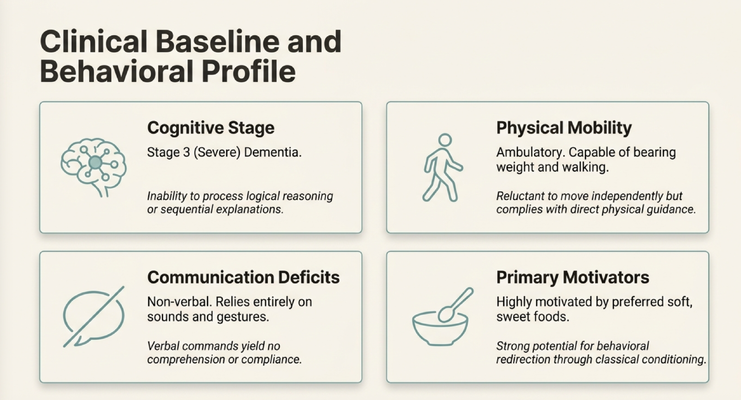
In this case, the individual had Stage 3 — severe dementia. Non-verbal. Communicating entirely through sounds and gestures. Unable to process logical explanations or sequential instructions.
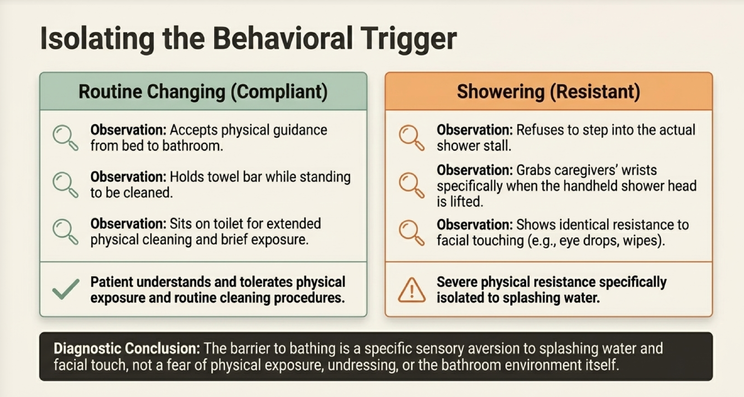
But here is what made this case interesting. This same person, when they became soiled, would get up, walk to the bathroom, hold the towel bar, and allow themselves to be cleaned without resistance.
That told me something critical: the comprehension is there. The cooperation is there. The problem is not generalized — it is specific. Something about the shower itself is the trigger. And once I know that, I can find the solution.
The diagnostic conclusion from careful observation: the resistance was isolated entirely to splashing water and the showerhead. Not the bathroom. Not being undressed. Not the caregiver. The water.
THE 5-PILLAR INTERVENTION STRATEGY
Once we identified the problem, we built a care strategy around five pillars. I am going to walk you through each one.
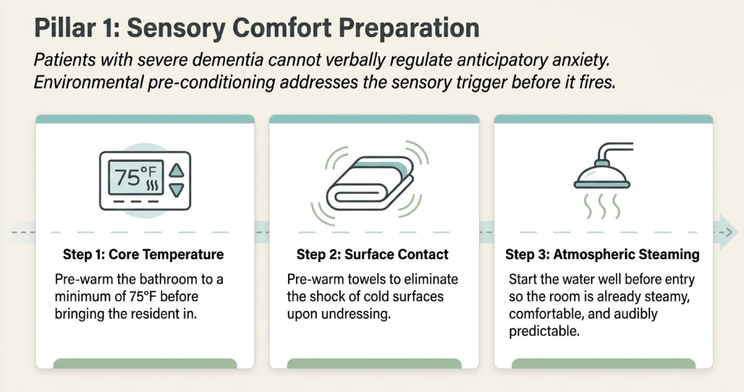
PILLAR 1: PREPARE THE ENVIRONMENT BEFORE THEY WALK IN
Most caregivers try to manage the resistance in the moment. That is too late. The resistance starts before the bathroom. The goal is to neutralize the anxiety before it fires.
Start the water running before you bring them in — so the room is already steamy, warm, and the sound of water is familiar and predictable by the time they arrive. Pre-warm the bathroom to at least 75 degrees. Cold air when you undress is a trigger. Pre-warm the towels as well. And create an atmosphere — soft music they love, familiar scents, electric candles. You are not taking them to the shower. You are taking them to the spa.
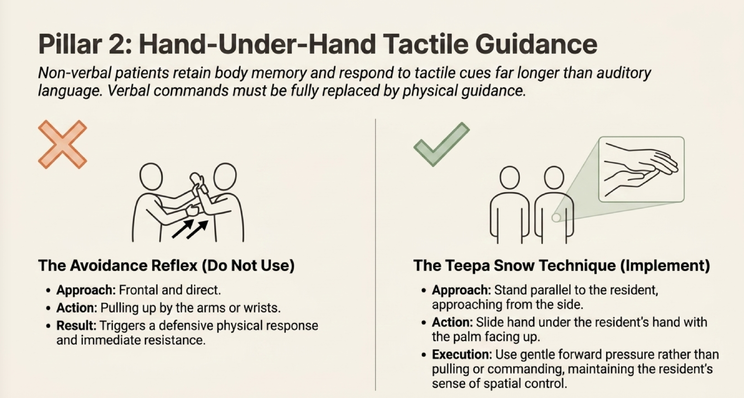
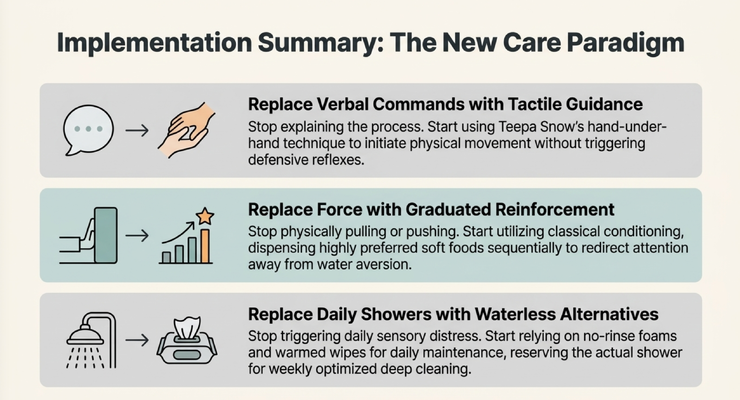
PILLAR 2: STOP PULLING — USE THE TEEPA SNOW TECHNIQUE
This is where most caregivers make the mistake that causes the worst episodes. When someone resists, the instinct is to pull them — grab their hands and guide them forward. Do not do this.
Approaching someone directly from the front, grabbing their wrists or arms, and pulling creates an immediate defensive physical response. It triggers the exact resistance you are trying to avoid.
Instead, approach from the side. Slide your hand underneath their hand with your palm facing up. Apply gentle forward pressure — not a pull. This is the hand-under-hand technique developed by Teepa Snow, one of the leading dementia care educators in the country. I highly recommend searching her name on YouTube and watching her demonstrate this directly. Familiar approach, predictable movement, no threat. The difference is remarkable.
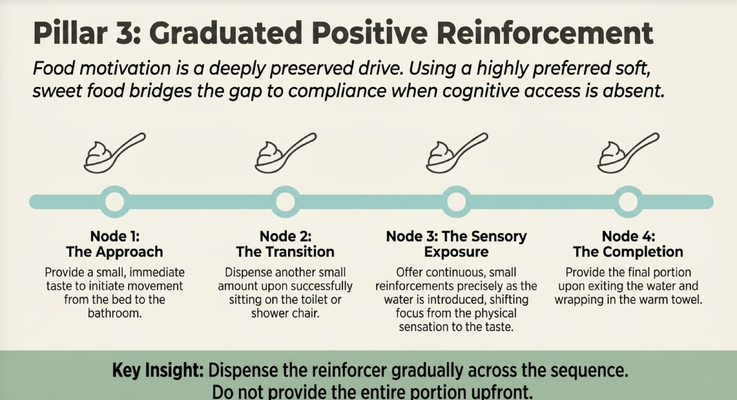
PILLAR 3: USE A MOTIVATOR — AND USE IT STRATEGICALLY
In this case, the person loves chocolate cake. Soft, sweet foods. That is the motivator — and food motivation is one of the most deeply preserved drives in the brain, even in severe dementia.
Here is how we used it. A small taste of cake when you initiate movement from the bed toward the bathroom. Another small taste when they sit on the toilet or shower chair. Another during the water exposure — offered continuously and precisely as the water is introduced, so their attention is redirected from the physical sensation to the taste they love. A final taste when they exit the water and are wrapped in the warm towel.
The key is to dispense the food gradually across the entire sequence — not all at once upfront. You are conditioning them to associate the shower experience with something they love. Every time. Same treat. Same temperature. Same music. Same routine. Over time, the brain begins to anticipate something positive instead of something threatening.
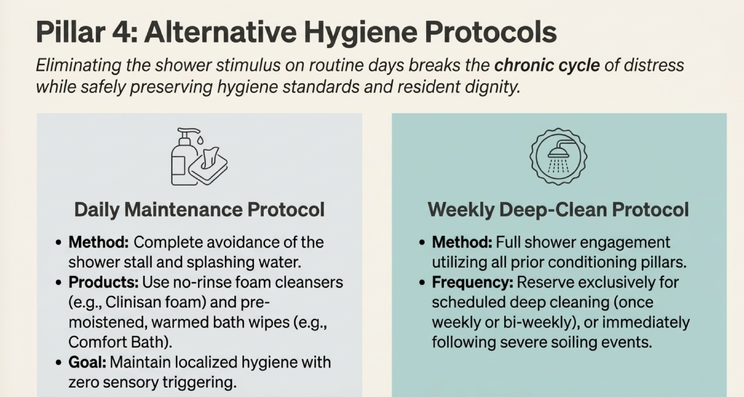
PILLAR 4: HAVE A DAILY MAINTENANCE PROTOCOL
Not every day has to be a full shower. On the days that do not require a full bath, eliminate the shower stall entirely.
Use no-rinse foam cleansers — products like Clinisan foam — and pre-moistened warmed bath wipes to maintain localized hygiene with zero sensory triggering. No splashing water. No resistance. Hygiene is maintained. Dignity is preserved.
Reserve the full shower for a scheduled weekly or bi-weekly deep clean — when all the conditioning pillars are in place, the environment is prepared, the motivator is ready, and the timing is right.
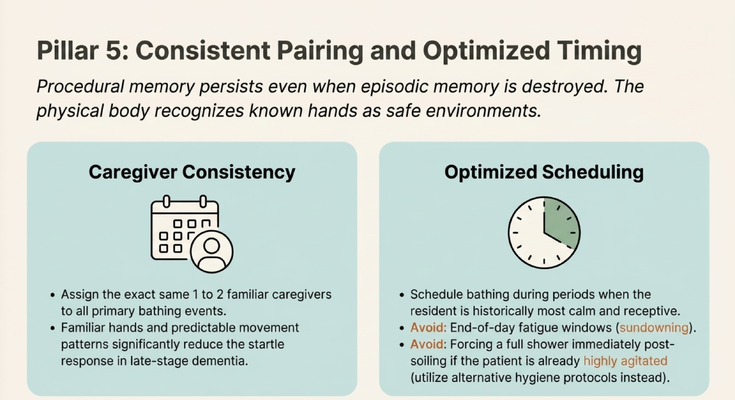
PILLAR 5: CONSISTENCY OF CAREGIVER AND TIMING
Two things that caregivers underestimate constantly — who is doing the bathing and when.
Assign the same one or two familiar caregivers to every primary bathing event. Not rotating staff. Not someone new. Someone the person knows. Someone they smile at. Even in late-stage dementia, the body recognizes familiar hands and familiar movement patterns. Familiar hands significantly reduce the startle response.
On timing — schedule bathing during the part of the day when your loved one is historically most calm. Never at the end of the day. By evening, the cognitive battery is drained, sundowning may be setting in, and the Vulnerability Zone is active. Earlier in the day — weekend mornings when you have time and calm — is the window.
And if your loved one becomes highly agitated after a soiling event, do not force a full shower in that moment. Use the alternative hygiene protocol. Restore calm first. Schedule the full shower separately.
WHAT THIS LOOKS LIKE IN PRACTICE
The day before I recorded this video, I spent 30 to 40 minutes on a Zoom call with this specific family. Myself, my Care Navigator, and the private duty agency supporting them — all in one call, all working through the exact strategy I just described.
That is what the GUIDE Model actually looks like. Not a pamphlet. Not a referral. A team around you, walking through the problem with you, following up, and providing people in your home to help when you need them.
The Invisible Weight: Caregiver Exhaustion
Bathing refusal is not just exhausting in the moment. It is the kind of thing that makes caregivers dread mornings. That creates guilt when it does not go well. That makes you feel like you are failing someone you love. You are not failing. You were never given the framework. Now you have it.
You should not have to do this alone. And thanks to a new Medicare program, you don't have to.

Common questions
Quick answers from this issue
Why Does My Loved One with Dementia Refuse to Shower — and What Can I Actually Do About It?
Every week I get asked some version of the same question: "Dr. Erik, I cannot get mom into the shower. She screams, she fights, she grabs my wrists. I've tried everything. What do I do?" Bathing refusal is one of the most physically and emotionally exhausting challenges in dementia care. And most families are dealing with it completely alone — with no framework, no strategy, and no one to call.
What should caregivers try first?
Write down what changed, when it started, and what was happening right before it. Reduce noise, slow the conversation down, and use one simple step at a time. Share the pattern with the family, care team, or clinician so everyone responds consistently.
When should families call a clinician?
Call a clinician promptly if the change is sudden, severe, unsafe, tied to a fall, fever, pain, dehydration, medication change, hallucinations, paranoia, or new confusion. Call emergency services for immediate danger.