

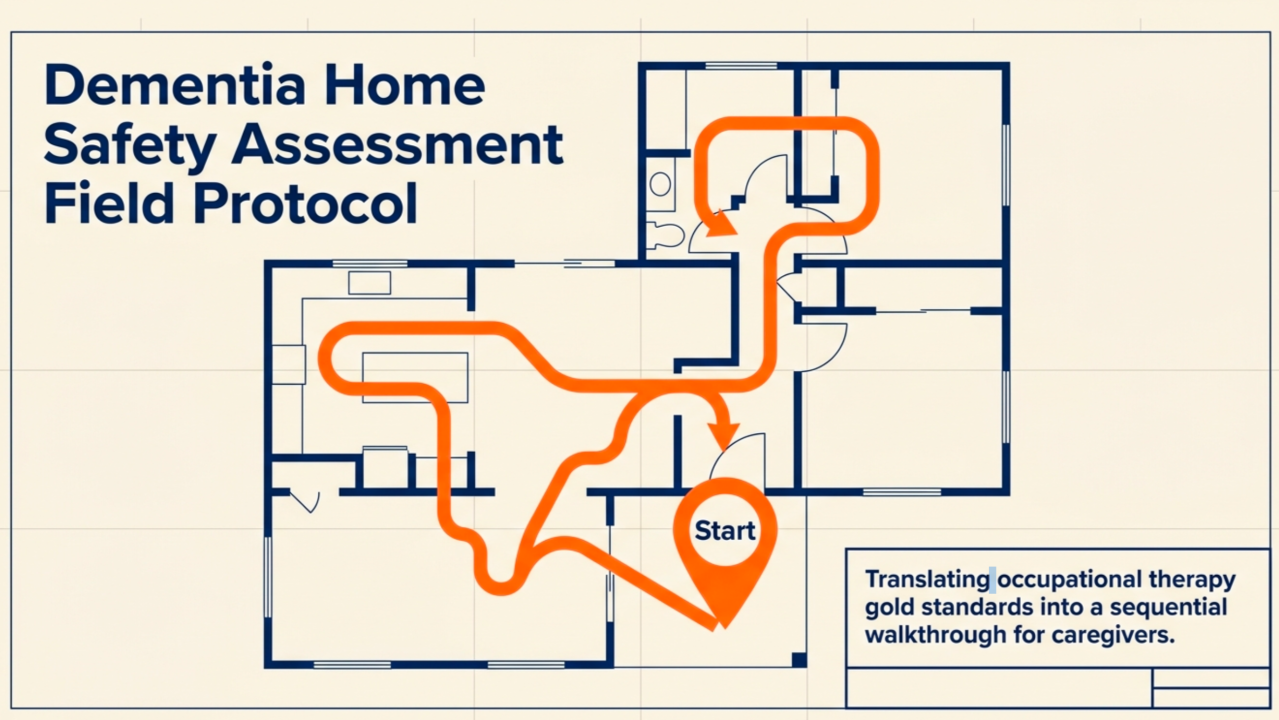
“Dr. Erik, how do I know whether my home is actually safe for my loved one?”
Caregivers ask me this all the time.
Mom lives alone.
Dad has a home health aide during the day, but he is alone at night.
Your husband is still cooking.
Your wife still walks through the backyard.
And you are trying to work, take care of your own family, manage appointments, and somehow stay ahead of every possible risk.
So you start asking yourself:
What if Dad walks out through the garage?
What if Mom forgets that the stove is on?
What if my husband takes the same medication twice?
What if my wife falls on the way to the bathroom?
These are not small questions.
Because most dementia care does not happen inside a doctor’s office.
It happens in the kitchen.
It happens near the front door.
It happens in the bathroom at 2:00 in the morning.
It happens on the stairs, beside the bed, and in the hallway when the lighting changes.
That is why I want every caregiver to understand this:
The home is part of the dementia care plan.
My name is Dr. Erik Ilyayev. I’m a dementia care physician, a board member of the South Florida Alzheimer's Association®, and the CEO of MedBetterHealth.org — one of the organizations selected by Medicare to participate in the GUIDE Model, an 8-year CMS initiative supporting people living with dementia and the family caregivers caring for them at home.
In this issue, I am going to walk you through the home the same way I want a caregiver to walk through it: one area at a time, looking for the risks that can be changed before they become emergencies.
Are you ready?
Let’s go.
THE SAFETY PLAN MUST MATCH THE STAGE
Before you start adding locks, removing appliances, or taking away activities, you need to ask an important question:
What can my loved one still do safely?
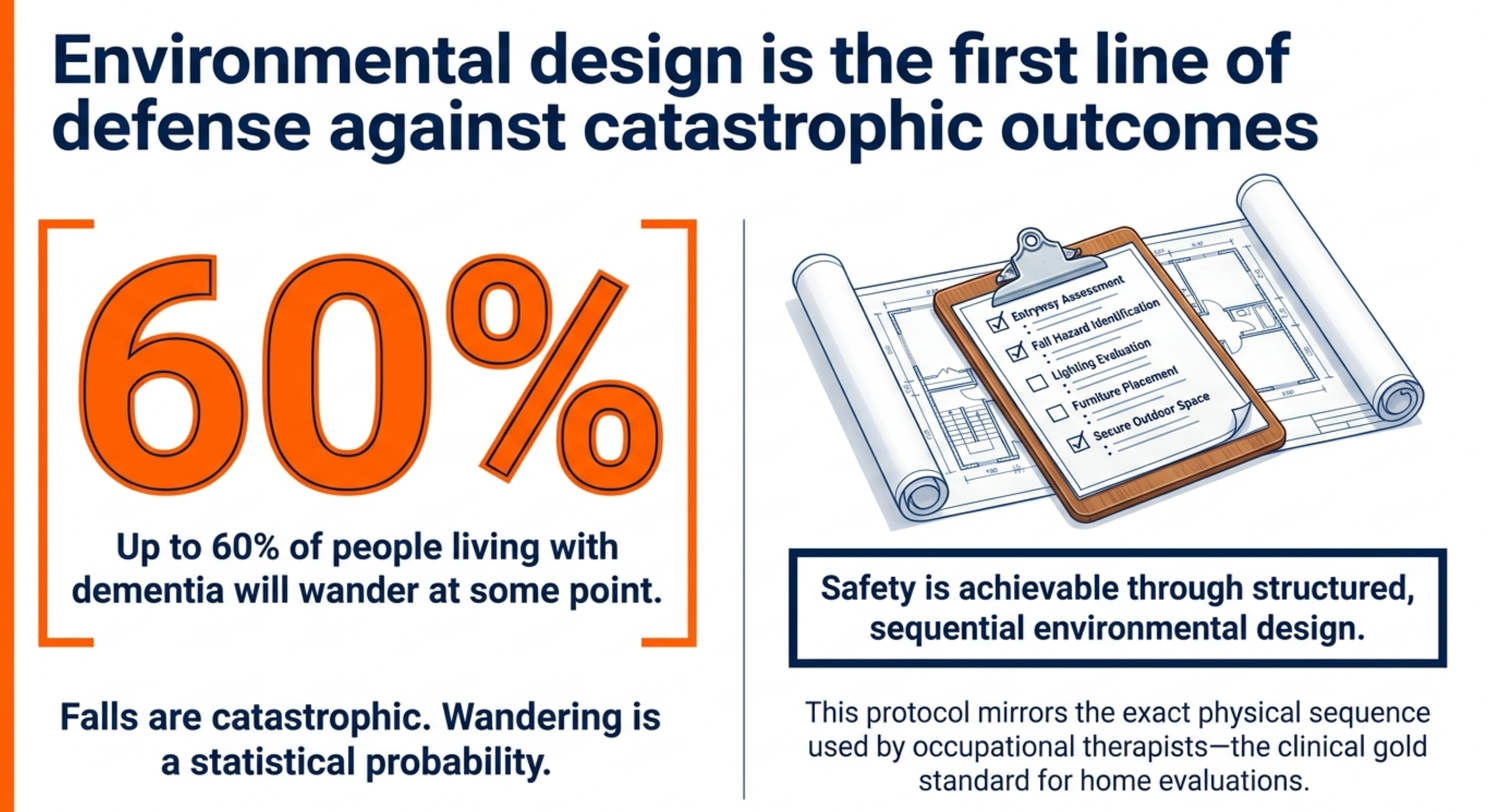
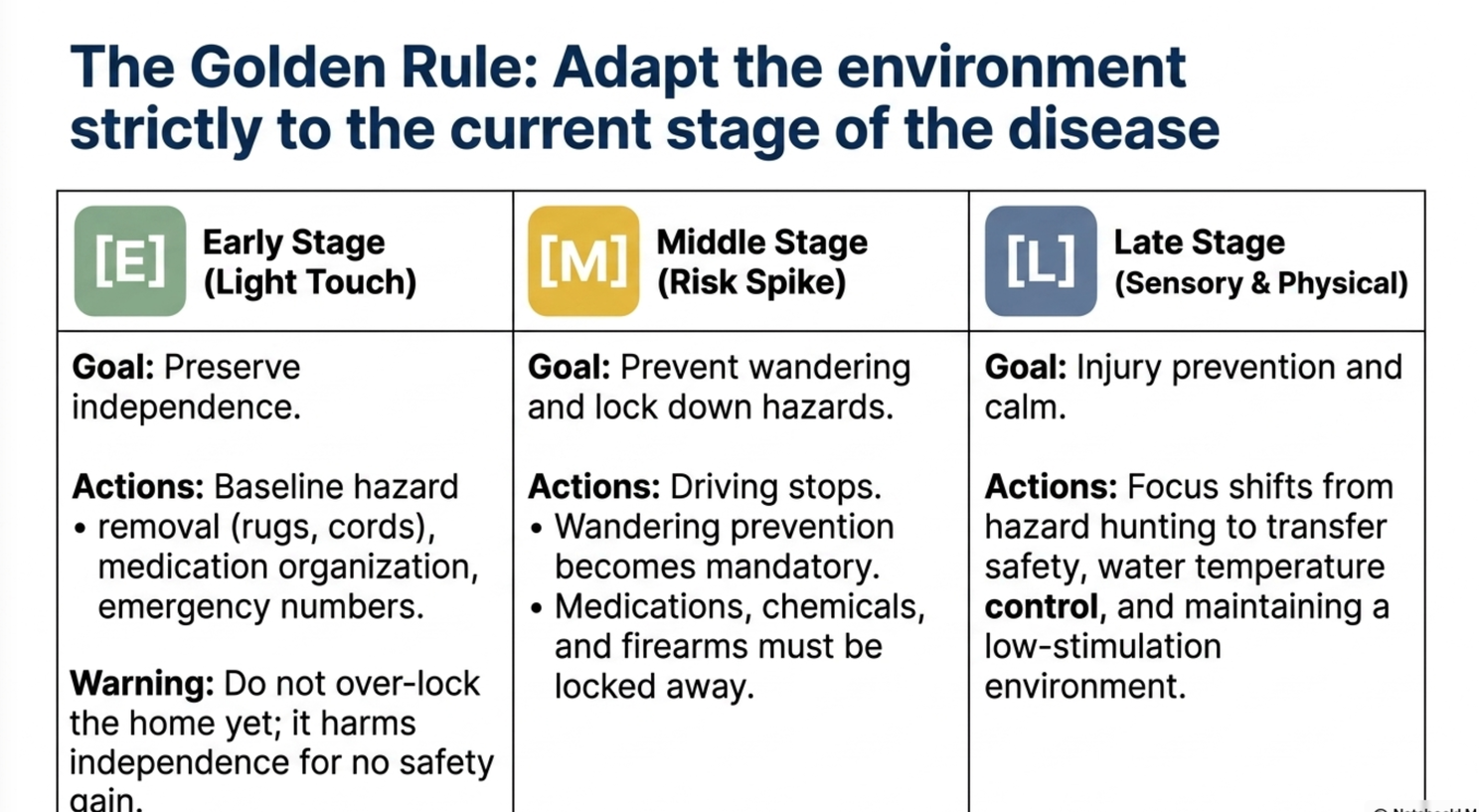
A person living with early-stage dementia does not need the same home setup as someone in a moderate or severe stage.
In an earlier stage, the goal may be a lighter touch.
Remove obvious trip hazards.
Organize medications.
Post emergency information.
Check appliances.
But preserve independence wherever it remains safe.
Do not take everything away simply because the word “dementia” entered the conversation.
In a moderate stage, the risks may become more significant.
Driving may no longer be safe.
Wandering precautions may become necessary.
Medications, toxic chemicals, firearms, knives, and unsafe appliances may need to be secured.
In a later stage, the focus may shift toward injury prevention, safe transfers, water-temperature protection, clear walking areas, and maintaining a calm environment.
The plan should follow the person’s function and actual risk—not only the diagnosis written in the chart.
Because what is appropriate today may be too restrictive today and not protective enough six months from now.
MAP EVERY WAY OUT
Now I want you to stand outside the home for a moment.
Before you even walk in, ask yourself:
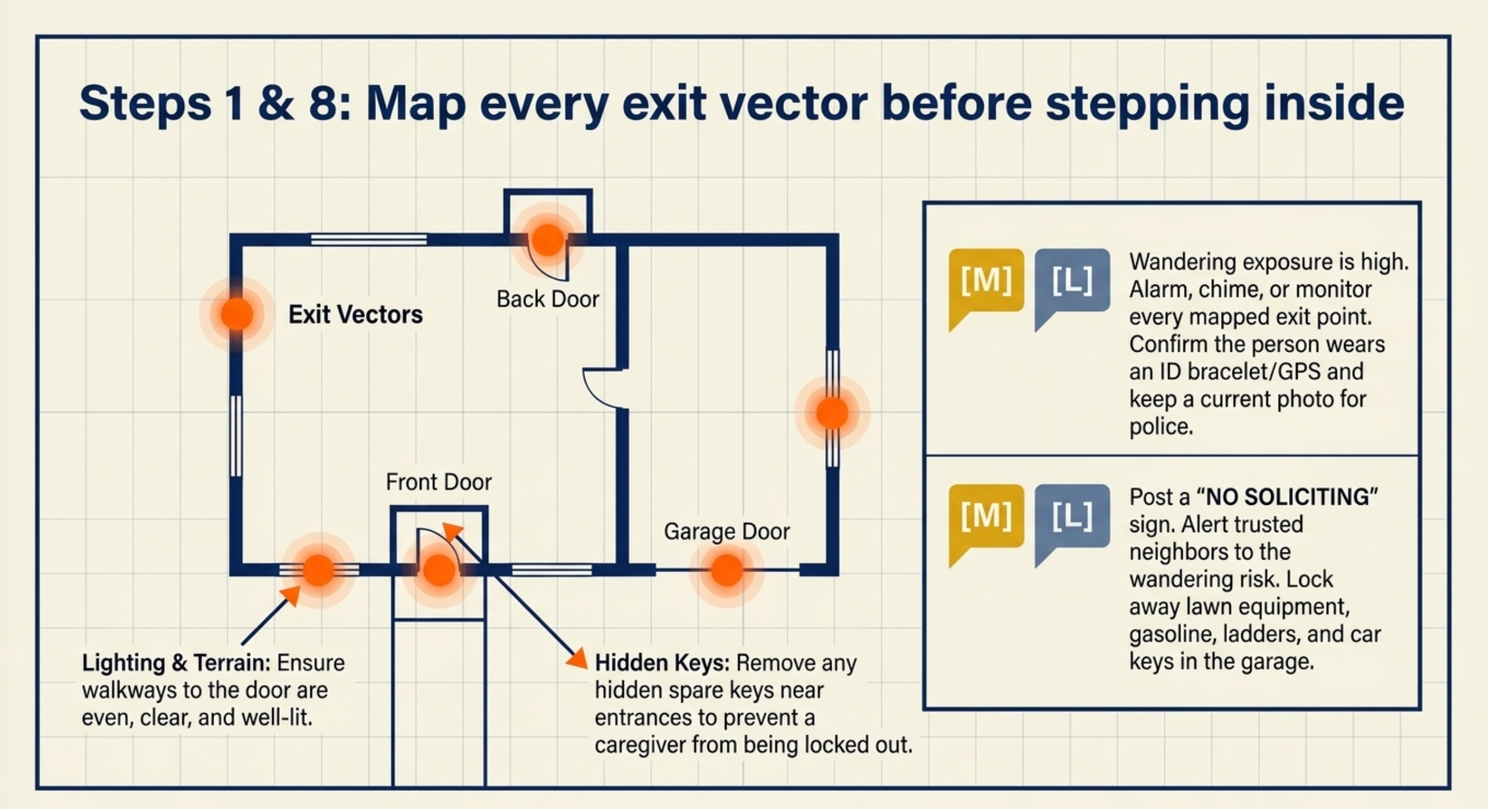
How many ways can my loved one leave?
The front door.
The back door.
The garage.
A side door.
A sliding patio door.
A backyard gate.
Maybe there is pool access.
Maybe the garage opens directly toward a busy road.
Caregivers naturally focus on the front door. But your loved one may not leave through the door you are watching.
So map every exit.
Then examine the area around each one.
Is the path well lit?
Is the ground even?
Is the door alarmed?
Would you hear it open?
Is there a camera or monitor?
Could your loved one find a hidden spare key?
Would the caregiver be accidentally locked outside?
For someone at meaningful wandering risk, families may also consider identification and location-support tools appropriate to the person, such as an ID bracelet or location-enabled device.
Keep a recent photograph readily available as part of your family’s emergency plan.
And if your loved one goes missing, do not delay contacting emergency services.
CONTROL THE EXIT WITHOUT CREATING A NEW DANGER
Now, let’s talk about locks.
The goal is not to make the home feel like a prison.
The goal is to reduce the chance of an unsafe exit while preserving emergency access.
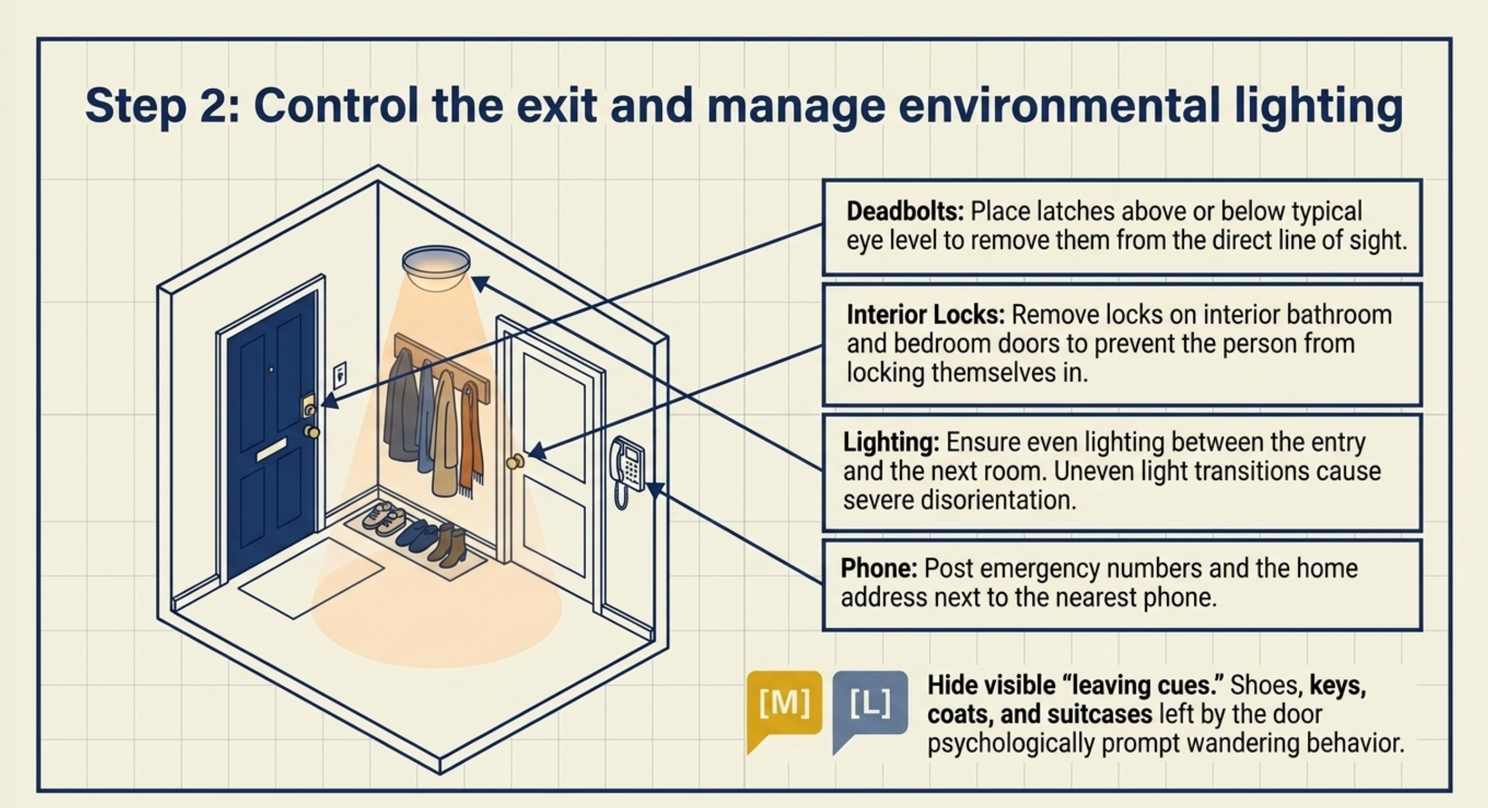
Some families place a latch outside the person’s usual line of sight. Others use door chimes, alarms, monitoring devices, visual camouflage or additional supervision.
But any locking strategy has to account for fire safety, local requirements, emergency evacuation, and the caregiver’s ability to open the door quickly.
Do not create one danger while trying to prevent another.
Interior locks also deserve attention.
Could your loved one lock themselves inside the bathroom or bedroom and become unable to get out?
Could the caregiver enter quickly in an emergency?
Those questions need to be answered before a crisis.
Then look at the lighting around the entrance.
A bright room leading into a dark hallway can be disorienting. Shadows and sharp lighting transitions may make it harder for a person living with dementia to understand the space.
Keep entryways clear and evenly lit.
Remove shoes, bags, cords, or clutter from the walking path.
Post the home address and emergency contacts where the caregiver can find them quickly.
Safety is not only the lock on the door.
It is the entire environment around it.
THE KITCHEN: DO NOT CONFUSE SAFETY WITH PUNISHMENT
The kitchen is one of the most difficult rooms for families.
Why?
Because cooking may be part of your loved one’s identity.
Mom has cooked for the family for 50 years.
Dad still makes his breakfast every morning.
So when someone says, “Lock the kitchen,” the family may feel like they are removing another piece of the person.
That is why the response must match the risk.
If your loved one still cooks safely, use check-ins and supervision rather than immediately removing every activity.
But pay attention to the clues.
Are pans being burned?
Is the stove being left on?
Is food regularly forgotten?
Are appliances being used incorrectly?
Is the person placing unsafe objects inside the microwave?
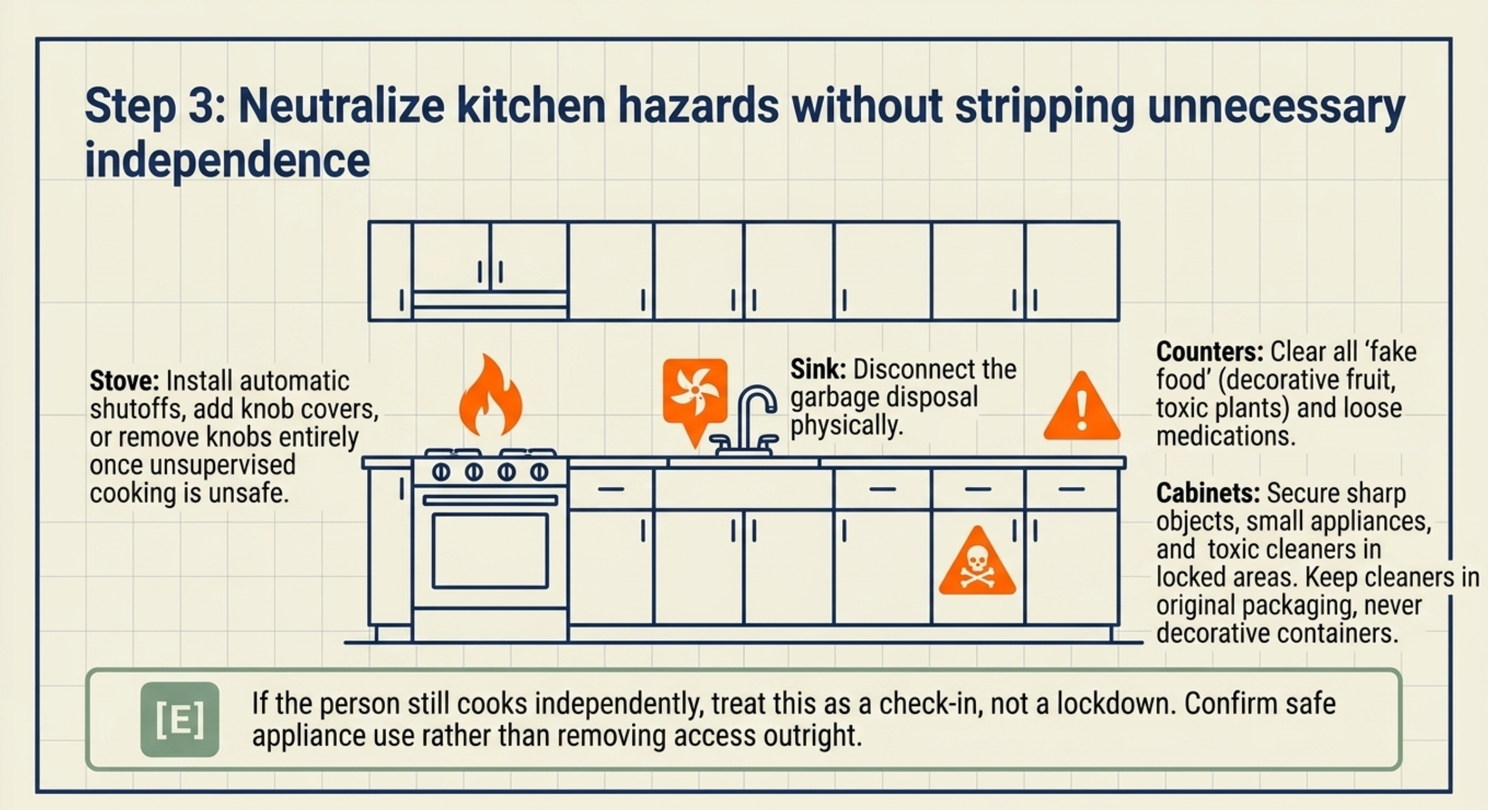
Once unsupervised cooking becomes unsafe, families may need stove-knob covers, an automatic shutoff, removal of the knobs, or another professionally appropriate safety control.
Also review the sink and garbage disposal.
Look at everything on the counter.
Decorative fruit may be mistaken for real food.
A toxic plant may be touched or ingested.
Loose medication may be taken at the wrong time.
Cleaning products may be mistaken for drinks, especially if they have been moved into decorative or unlabeled containers.
Keep cleaners in their original labeled packaging and secure them when necessary.
Secure knives, small appliances, medications and other dangerous items based on the person’s current abilities.
The goal is not to shut down the kitchen without thought.
The goal is to preserve safe participation while removing hazards the person can no longer recognize or manage.
THE BATHROOM CAN CHANGE EVERYTHING
The bathroom is one of the highest-risk rooms in the home.
Water.
Slippery surfaces.
Hard tile.
A low toilet.
A bathtub wall.
Poor nighttime lighting.
Difficulty sitting, standing or turning.
One fall in this room can lead to an emergency visit, hospitalization, loss of mobility and an entirely different level of care.
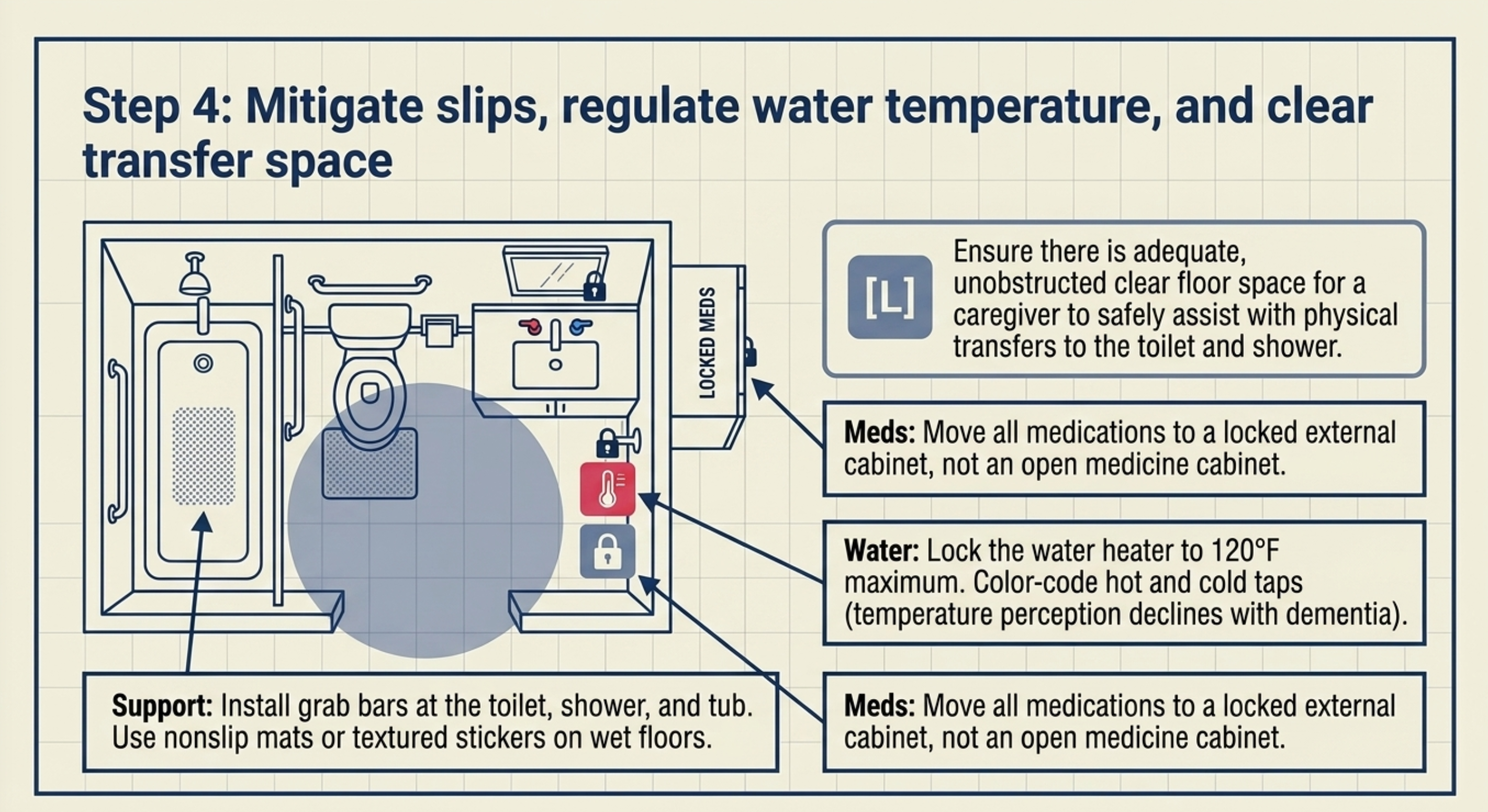
Look at the floor first.
Is there a non-slip surface in the shower or tub?
Are loose mats sliding?
Is there enough clear floor space for a caregiver to assist safely?
Are grab bars installed in appropriate locations near the toilet, shower or tub?
A towel rack is not a grab bar.
It may pull away from the wall when someone places weight on it.
Look at the toilet.
Is it too low for the person to sit and rise safely?
Would an appropriate raised seat or support equipment help?
These decisions are best individualized with a qualified occupational therapist, physical therapist or other home-safety professional when possible.
Then look at the water.
A person living with dementia may have difficulty judging temperature or responding quickly to water that is too hot.
Review the home’s hot-water safety with an appropriate professional, and use clear hot-and-cold markings if the person can still understand them.
Finally, move medications out of an open medicine cabinet when the person can no longer manage them safely.
Bathroom safety is not one grab bar.
It is the full combination of flooring, transfers, lighting, water temperature, medication access and supervision.
THE BEDROOM SHOULD SUPPORT SAFE REST AND SAFE RISING
Now walk into the bedroom.
What happens when your loved one gets out of bed?
Can they stand safely?
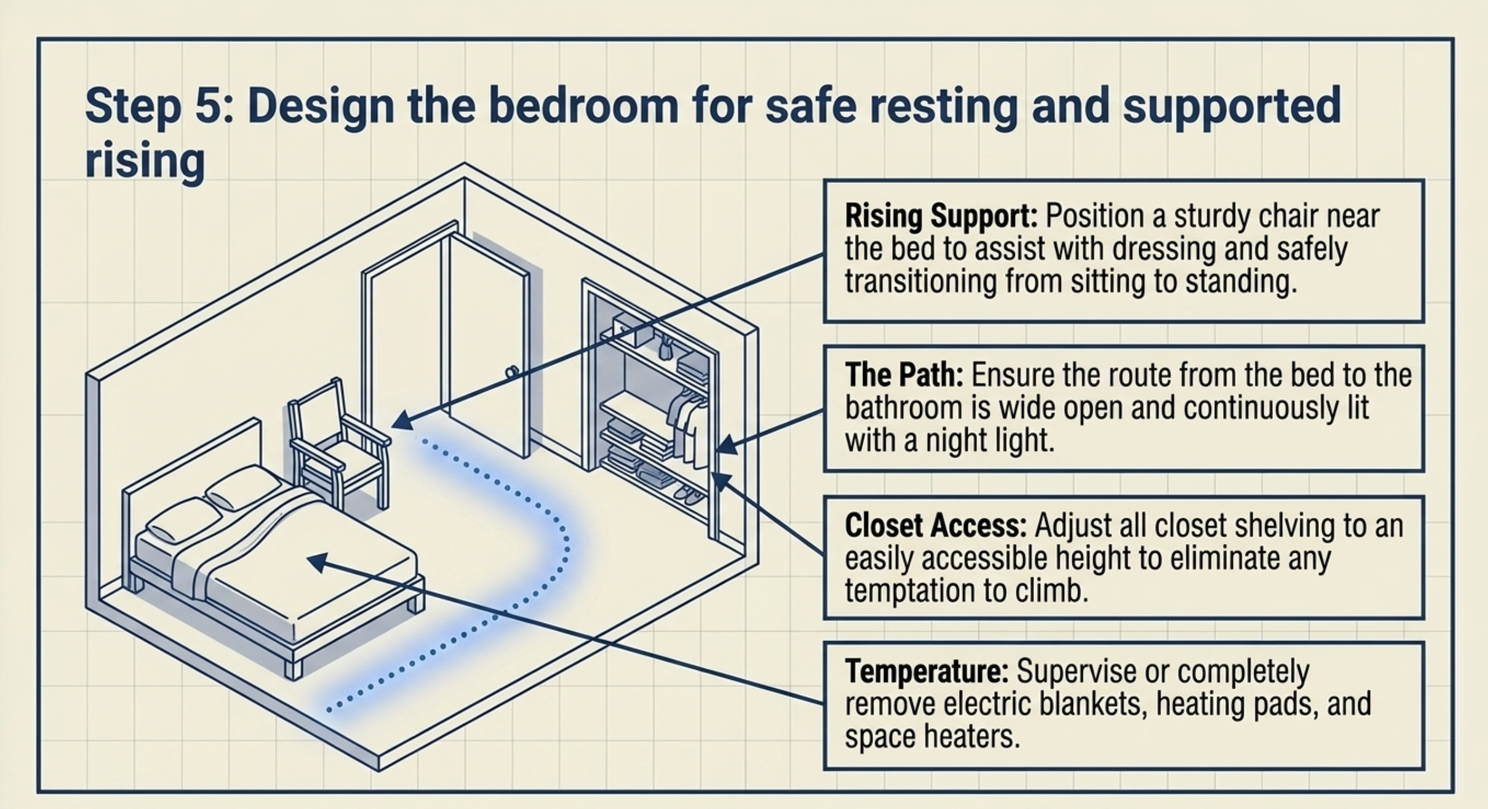
Is there a sturdy chair nearby for dressing or resting?
Is the path to the bathroom wide, clear and visible?
At night, that route should not suddenly disappear into darkness.
Consider appropriate night lighting or motion-activated lighting that helps define the pathway without creating harsh glare or confusing shadows.
Look inside the closet.
Are frequently used clothes and shoes within easy reach?
Or does the person need to climb, stretch or stand on something unstable?
Bring regularly used items down to a practical height.
Also review heating devices.
Electric blankets, heating pads and portable space heaters may become dangerous if the person forgets that they are on or cannot use them safely.
The bedroom should support sleep.
But it also has to support every transition into and out of the bed.
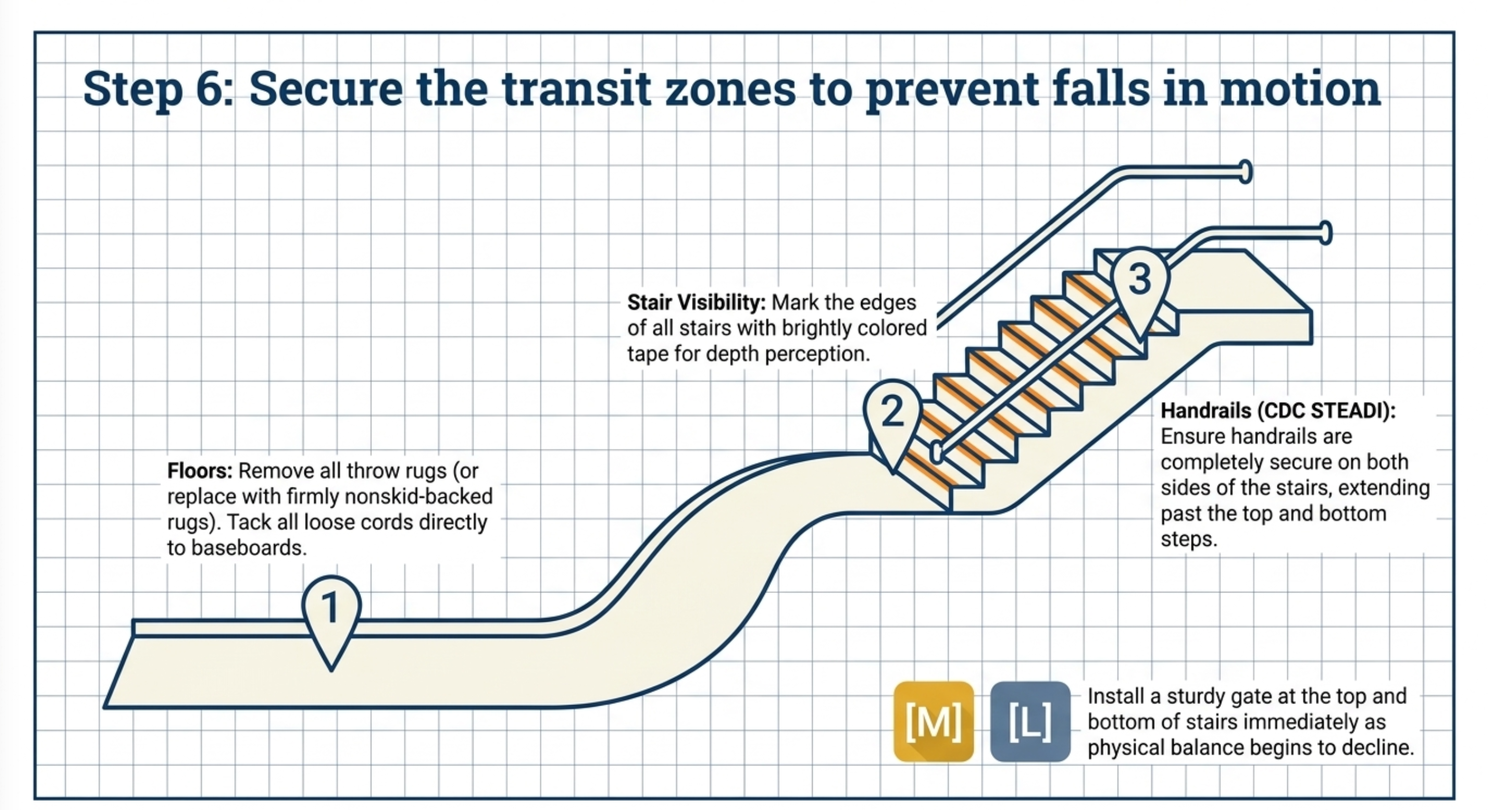
SECURE THE PATHS BETWEEN ROOMS
Many falls do not happen because of one dramatic hazard.
They happen during movement between ordinary spaces.
A loose rug.
A cord crossing the floor.
Poor depth perception on the stairs.
A handrail that stops before the final step.
Walk the routes your loved one uses most often.
Bedroom to bathroom.
Living room to kitchen.
Front door to the main seating area.
Remove or firmly secure trip hazards.
Keep cords out of the pathway.
Make sure stairs are clearly visible and adequately lit.
Handrails should be secure and positioned to provide meaningful support.
Some environmental contrast adjustments may help certain people see step edges more clearly, but any visual intervention should be tested carefully. What helps one person may confuse another.
And if balance or mobility has changed, do not rely only on a home modification.
Speak with the healthcare team about an appropriate fall-risk and mobility assessment.
THE LIVING ROOM NEEDS SPACE TO MOVE
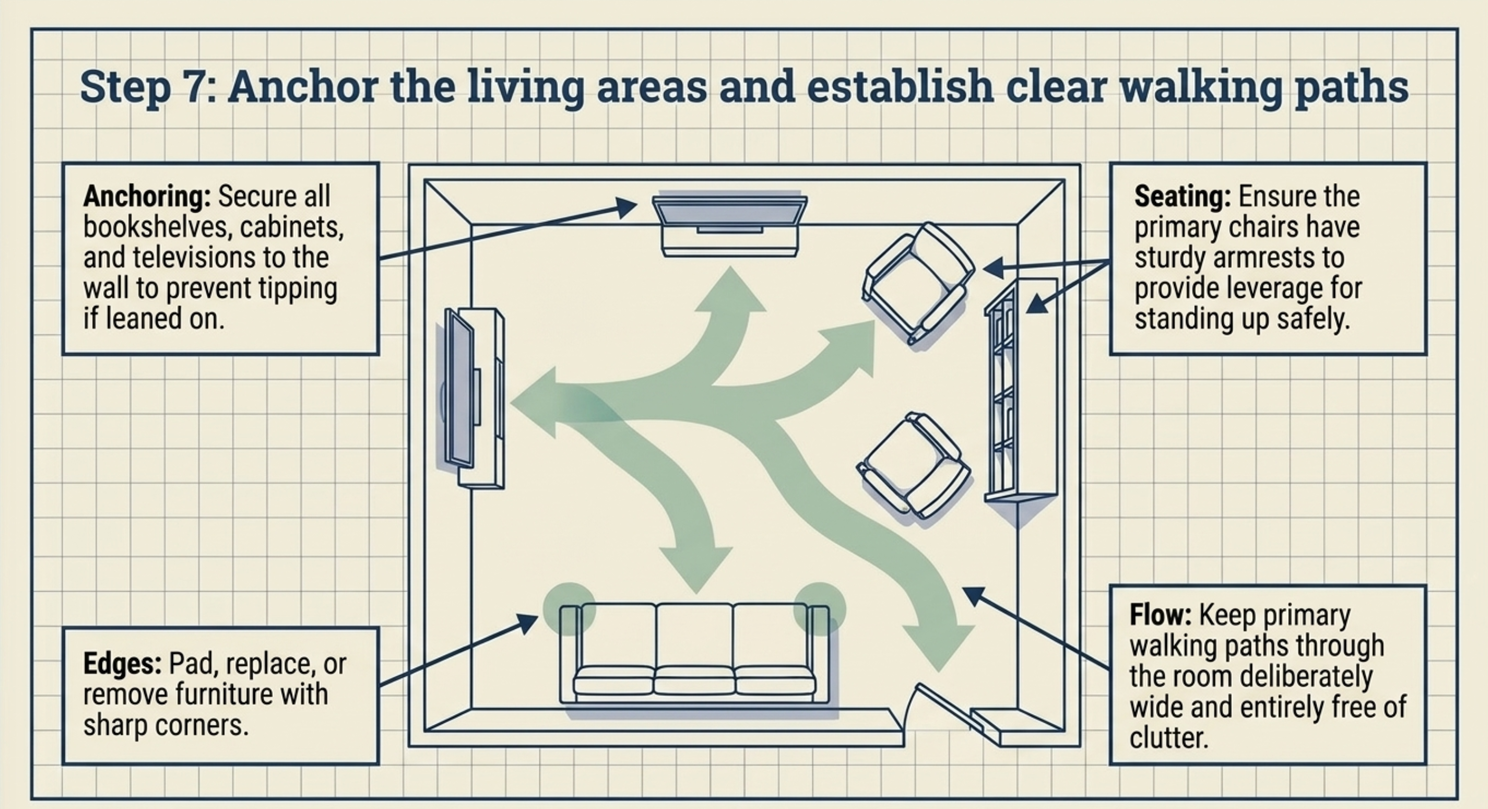
Now look at the room where everyone spends the most time.
Are the walkways wide and clear?
Are chairs positioned in a way that creates an obstacle course?
Can the person stand from their main chair using stable armrests?
Are bookshelves, televisions and cabinets anchored so they cannot tip if someone leans or pulls on them?
Are there sharp furniture corners along the walking path?
The room may look beautiful to you.
But I want you to see it through dementia eyes and through the body of someone whose balance, judgment or depth perception may be changing.
The goal is not an empty room.
The goal is a room where the person can move, sit, stand and participate with less preventable risk.
DO NOT TRY TO FIX EVERYTHING AT ONCE
At this point, you may be thinking:
“Dr. Erik, this is too much. Where do I even begin?”
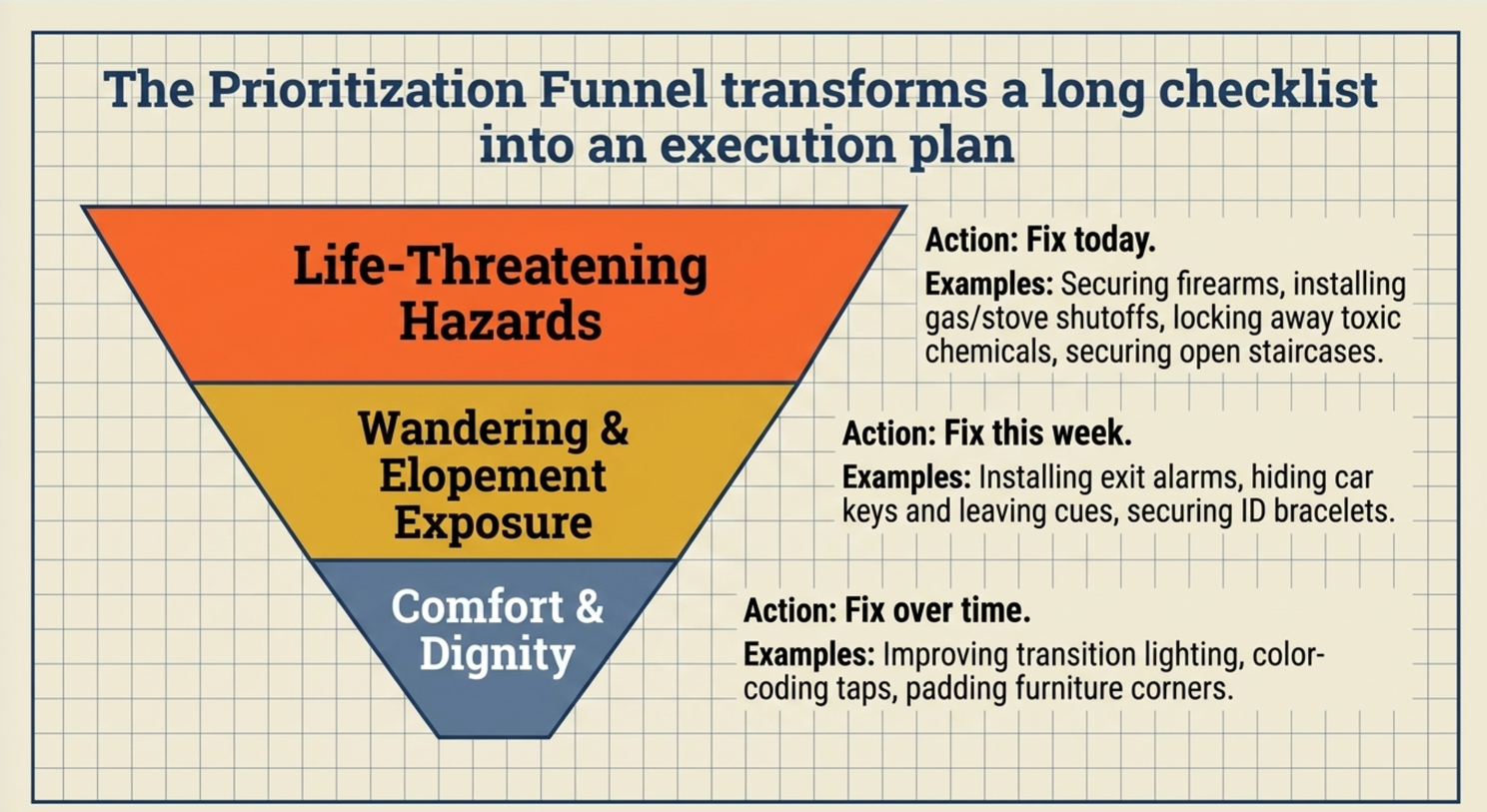
Start with the hazards that could cause the most serious harm.
Anything involving fire.
Weapons.
Toxic chemicals.
An open staircase.
Immediate access to a dangerous road or pool.
Those issues deserve immediate attention.
Next, address meaningful wandering exposure.
Exit alarms.
Accessible car keys.
Unlocked gates.
Identification planning.
Monitoring and supervision.
Then work through comfort, lighting, organization and dignity-related improvements over time.
You do not have to renovate the entire home today.
But you do need to know what cannot safely wait.
WRITE IT DOWN WHILE YOU WALK
Do not complete the walkthrough and tell yourself:
“I’ll remember everything later.”
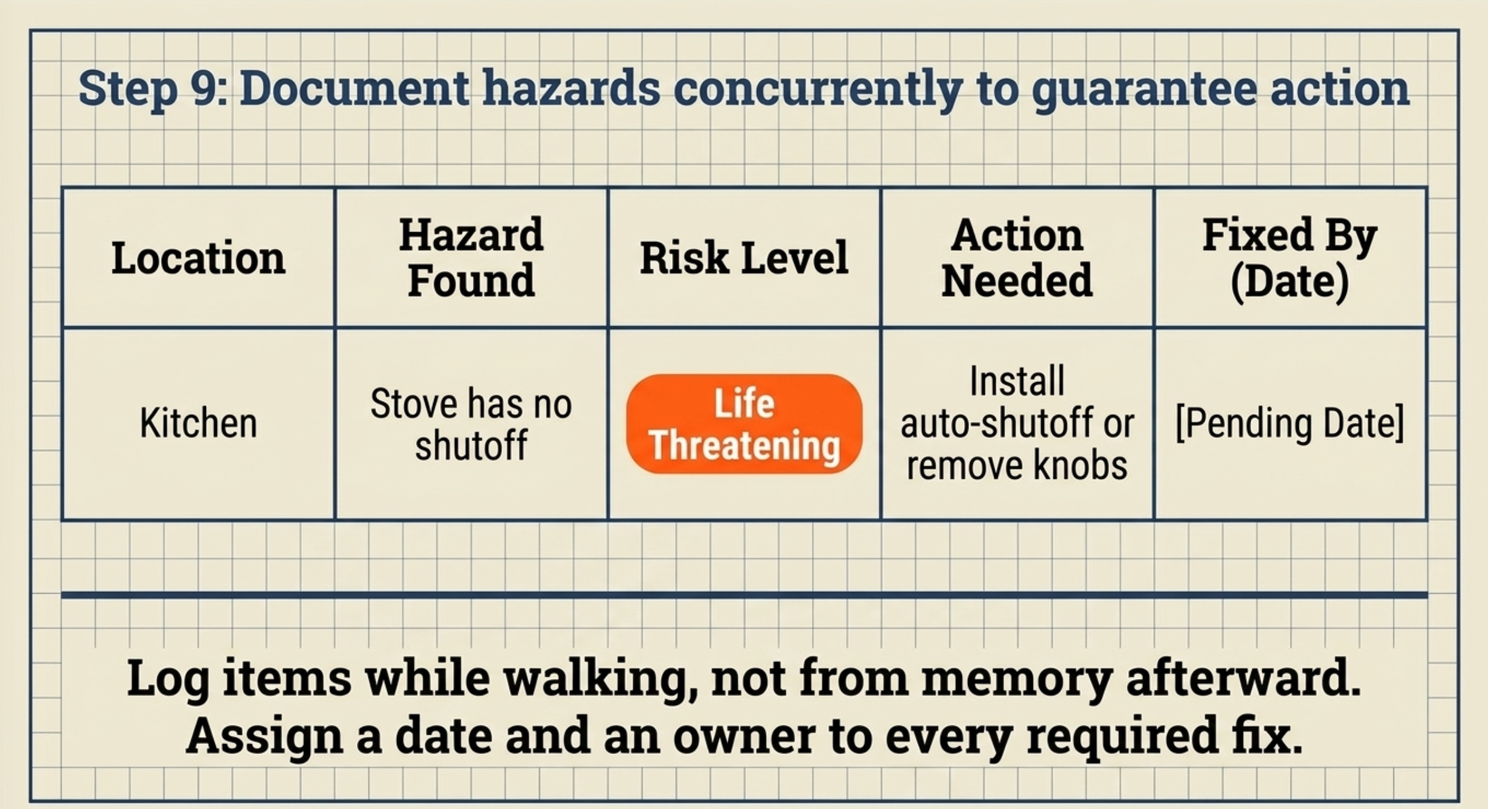
Write each hazard down when you see it.
Record:
The location.
The hazard.
The level of urgency.
The action needed.
Who is responsible.
The date by which it should be addressed.
For example:
Location: Kitchen.
Hazard: Stove has no automatic shutoff and is being left on.
Priority: Immediate safety concern.
Action: Discuss and install an appropriate stove-safety control or prevent unsupervised use.
Owner: Family caregiver.
Target date: This week.
A vague intention does not create a safer home.
A named action, assigned to a person with a deadline, has a much better chance of being completed.
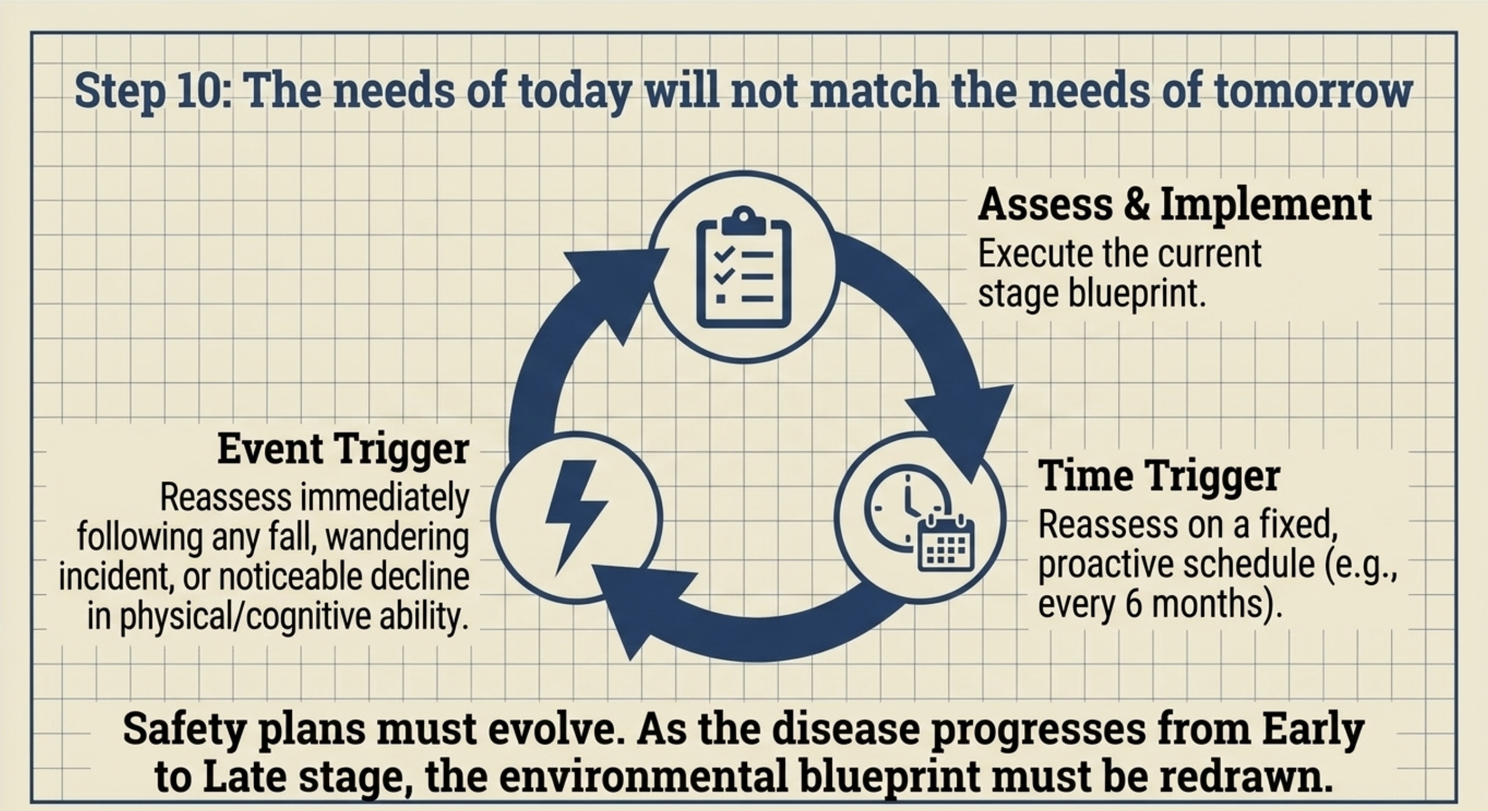
THE NEEDS OF TODAY WILL NOT MATCH THE NEEDS OF TOMORROW
A dementia home-safety plan is not completed once.
The person changes.
Mobility changes.
Vision changes.
Judgment changes.
The caregiver changes.
The home itself may change.
Reassess after a fall, wandering incident, near miss, hospitalization, medication change, or noticeable decline in physical or cognitive function.
Also revisit the plan periodically, even when there has not been an obvious emergency.
The environment that supports independence in an early stage may not provide enough protection later.
And a setup designed for a later stage may be unnecessarily restrictive for someone who still functions independently today.
The plan must evolve with the person.
WHAT I WANT CAREGIVERS TO DO TODAY
I do not want you to finish this issue, close LinkedIn and say:
“That was interesting.”
I want you to take action.
Walk through the home.
Map every exit.
Inspect the stove.
Open the cabinets.
Check where medications are stored.
Stand inside the bathroom.
Walk from the bed to the toilet with the lights off, then ask whether that route is truly safe.
Look at the stairs.
Test the handrails.
Check the rugs.
Look at the cords.
Stand in the main living area and identify the clearest walking path.
Then write down what you found.
Start with the issue that could cause the most serious harm.
Do not try to do everything today.
But do something today.
Because the best time to address a wandering risk is before the door opens.
The best time to address a stove hazard is before the fire.
The best time to install the right bathroom support is before the fall.
Your home does not have to be perfect.
It needs to keep evolving with the person you love.
Slide deck note
Extra visual from this issue


Common questions
Quick answers from this issue
Is Your Home Ready for the Next Stage of Dementia?
“Dr. Erik, how do I know whether my home is actually safe for my loved one?” Caregivers ask me this all the time. Mom lives alone.
What should caregivers try first?
Write down what changed, when it started, and what was happening right before it. Reduce noise, slow the conversation down, and use one simple step at a time. Share the pattern with the family, care team, or clinician so everyone responds consistently.
When should families call a clinician?
Call a clinician promptly if the change is sudden, severe, unsafe, tied to a fall, fever, pain, dehydration, medication change, hallucinations, paranoia, or new confusion. Call emergency services for immediate danger.