

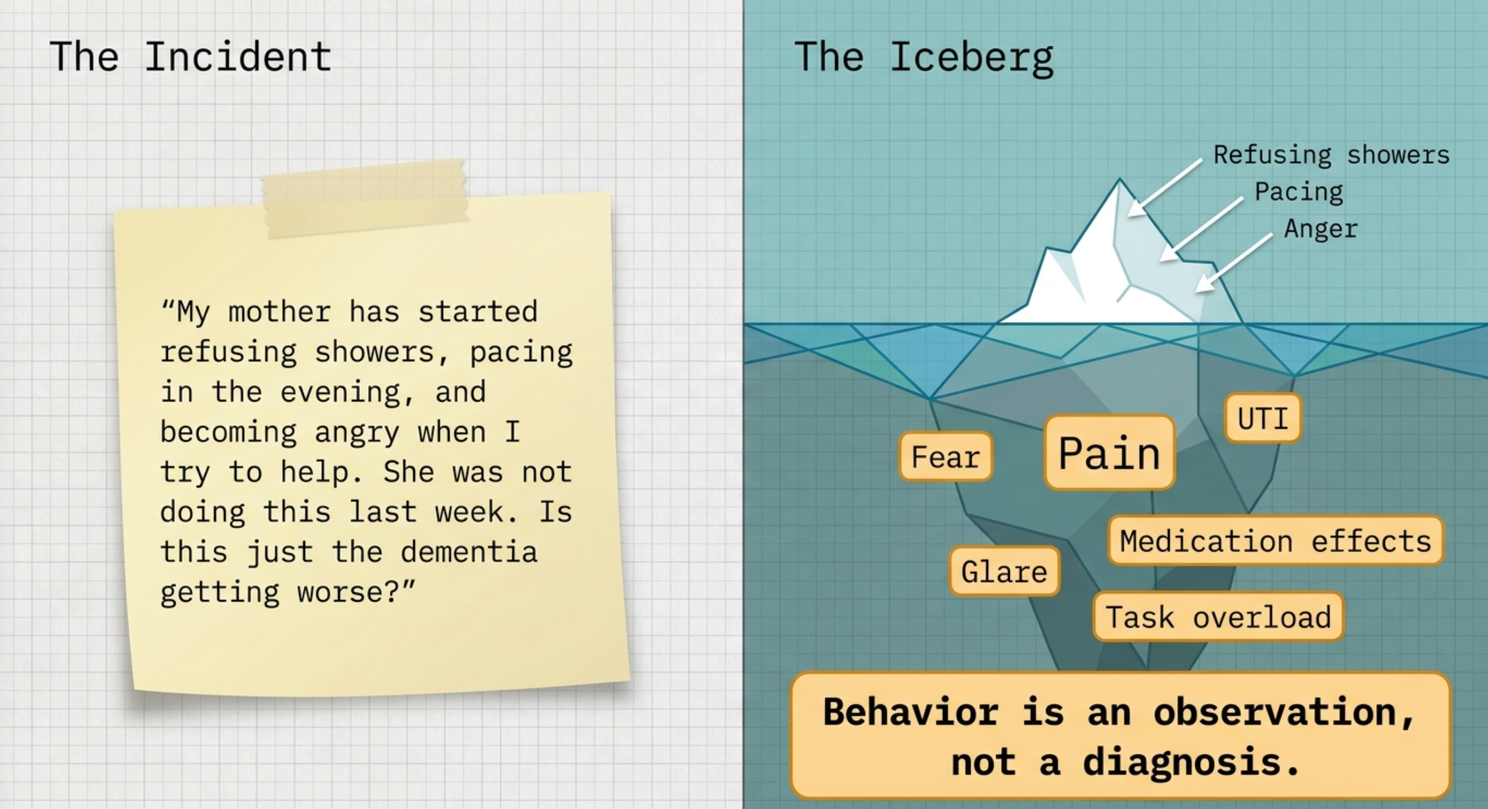
“Dr. Erik, my mother suddenly refuses to shower. She paces every evening, and when I try to help her, she gets angry. Is this just the dementia getting worse?”
Caregivers ask me questions like this all the time.
And listen, I understand why families immediately blame the dementia.
Yesterday, Mom took a shower.
Last week, she was calm in the evening.
Now she pulls away, yells, paces the hallway, or pushes your hand away.
So the family thinks:
“The disease must be progressing.”
“Maybe she needs medication.”
“Maybe she is becoming aggressive.”
But before we jump to any of those conclusions, I want you to stop and remember something very important:
A behavior is a clue.
It is not the diagnosis.
The behavior is what you can see. It does not automatically tell you why it is happening.
Your loved one may be in pain.
The task may feel overwhelming.
The room may look frightening.
A medication may have changed.
They may be tired, hungry, overstimulated, or afraid.
They may not understand why someone is removing their clothing or touching their body.
So instead of immediately asking, “How do I stop this behavior?” I want caregivers to ask a better question:
“What is this behavior trying to tell me?”
My name is Dr. Erik Ilyayev. I’m a dementia care physician, a board member of the South Florida Alzheimer's Association®, and the CEO of MedBetterHealth.org — one of the organizations selected by Medicare to participate in the GUIDE Model, an 8-year CMS initiative designed to support people living with dementia and the family caregivers caring for them at home.
In this issue, I want to show you how to become what I call a dementia detective: how to describe what actually happened, look for reversible or modifiable contributors, and respond without automatically blaming the person or assuming that every change is “just the dementia.”
DESCRIBE WHAT HAPPENED — DO NOT LABEL THE PERSON
One of the first mistakes we make is using a label instead of describing the event.
We say:
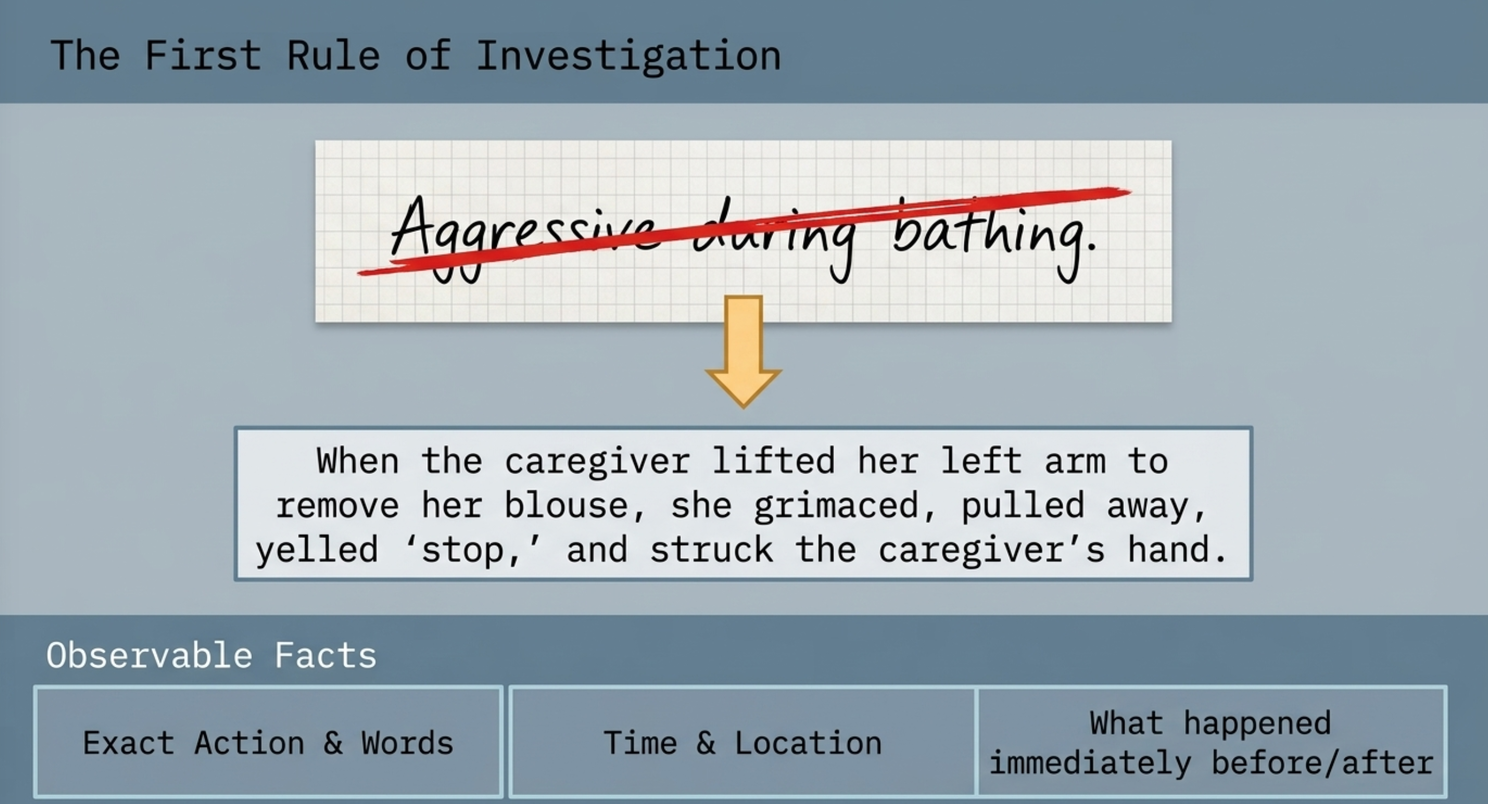
“Mom was aggressive during the shower.”
Okay, but what does “aggressive” actually tell us?
Not much.
It describes how the interaction felt to the caregiver, but it does not help us understand the cause.
Now let’s describe the same event differently:
“When the caregiver lifted Mom’s left arm to remove her blouse, Mom grimaced, pulled her arm away, yelled ‘Stop,’ and struck the caregiver’s hand.”
Do you see the difference?
Now we have information.
She grimaced when her left arm moved.
Could that suggest discomfort or limited movement?
She pulled away while her clothing was being removed.
Could she have felt frightened, exposed, or out of control?
She yelled “Stop.”
Was she trying to communicate that the task hurt or that she did not understand what was happening?
We still do not have a diagnosis.
But now we have something useful to investigate.
So instead of writing:
“Dad was difficult.”
Write:
“Dad stood at the bathroom entrance for five minutes and refused to step onto the dark mat.”
Instead of:
“Mom became combative.”
Write:
“Mom pushed my hand away after I gave her four instructions quickly.”
Record the exact action.
Record the words.
Record the time and location.
Record what happened immediately before and after.
The more precisely you describe the event, the easier it becomes for the family and medical team to ask the right questions.
SUDDEN CHANGE IS DIFFERENT FROM GRADUAL CHANGE
Now, I want to be very clear about something.
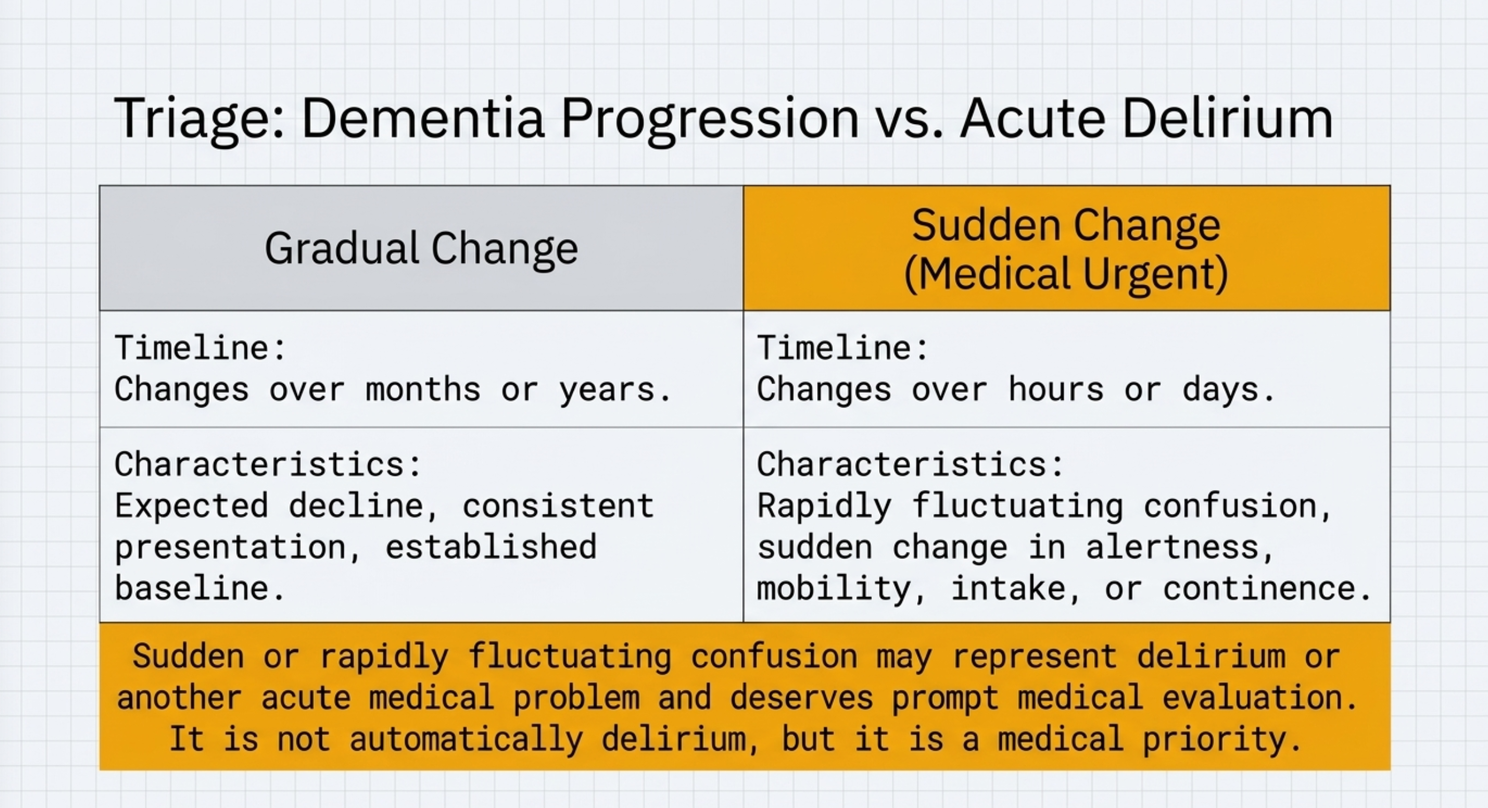
Dementia generally changes over time.
A family may notice a gradual decline over months or years. The person needs more help. Familiar tasks become harder. Communication changes. The baseline slowly shifts.
But a sudden or rapidly fluctuating change is different.
If your loved one becomes dramatically more confused over a few hours or days, suddenly has trouble staying awake, stops eating or drinking, develops new difficulty walking, has a fever, falls, or becomes completely different from their normal baseline, do not simply say:
“It is the dementia.”
That deserves prompt medical evaluation.
Could it be delirium or another acute medical problem?
Possibly.
Could it be an infection, dehydration, medication effect, pain, or something else?
Possibly.
But a caregiver cannot diagnose the cause from the behavior alone.
The important point is that sudden change is a medical priority.
Do not spend a week keeping a behavior journal while someone is rapidly deteriorating.
Call the medical team.
And if there are signs of a stroke, severe breathing trouble, chest pain, uncontrolled bleeding, serious injury, or an inability to maintain basic safety, seek emergency help.
THE THREE AREAS I WANT FAMILIES TO INVESTIGATE
When a behavior changes, I want you to investigate three areas:
The body.
The person’s mind and the task being requested.
The room and surrounding environment.
Do not decide that one behavior always has one meaning.
Pacing does not always mean pain.
Refusing a shower does not always mean fear.
Anger does not always mean infection.
Every episode is a new puzzle.
Sometimes one contributor is responsible.
Very often, several things are happening at the same time.
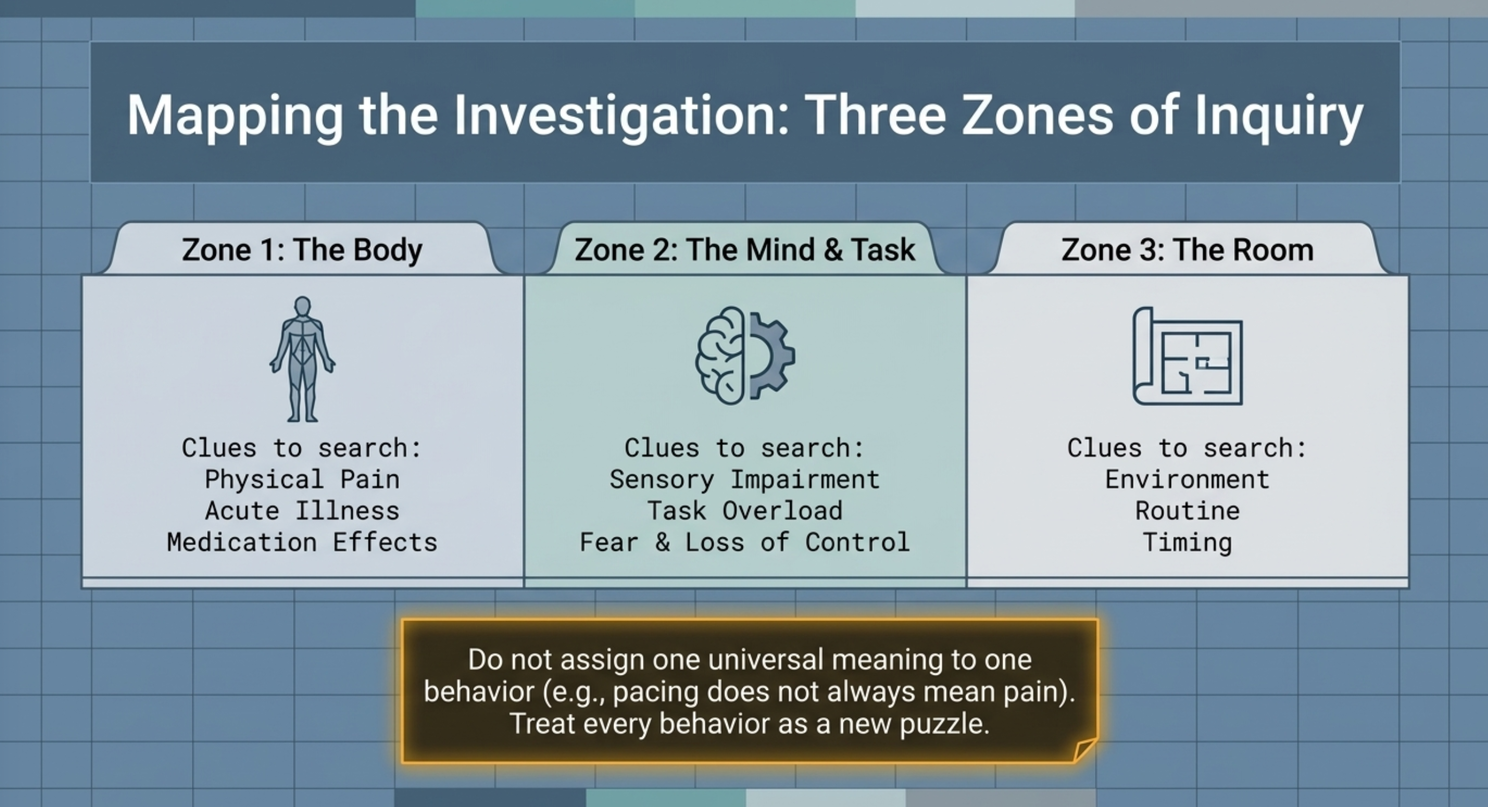
CLUE 1: PAIN OR PHYSICAL DISCOMFORT
People living with dementia may not always be able to tell you:
“My shoulder hurts when you lift my arm.”
“My tooth is aching.”
“I am constipated.”
“My arthritis is worse today.”
Instead, you may see a grimace.
They may guard one side of the body.
They may refuse to stand.
They may become restless during dressing.
They may yell when you touch a particular area.
That does not prove pain.
But it is a clue.
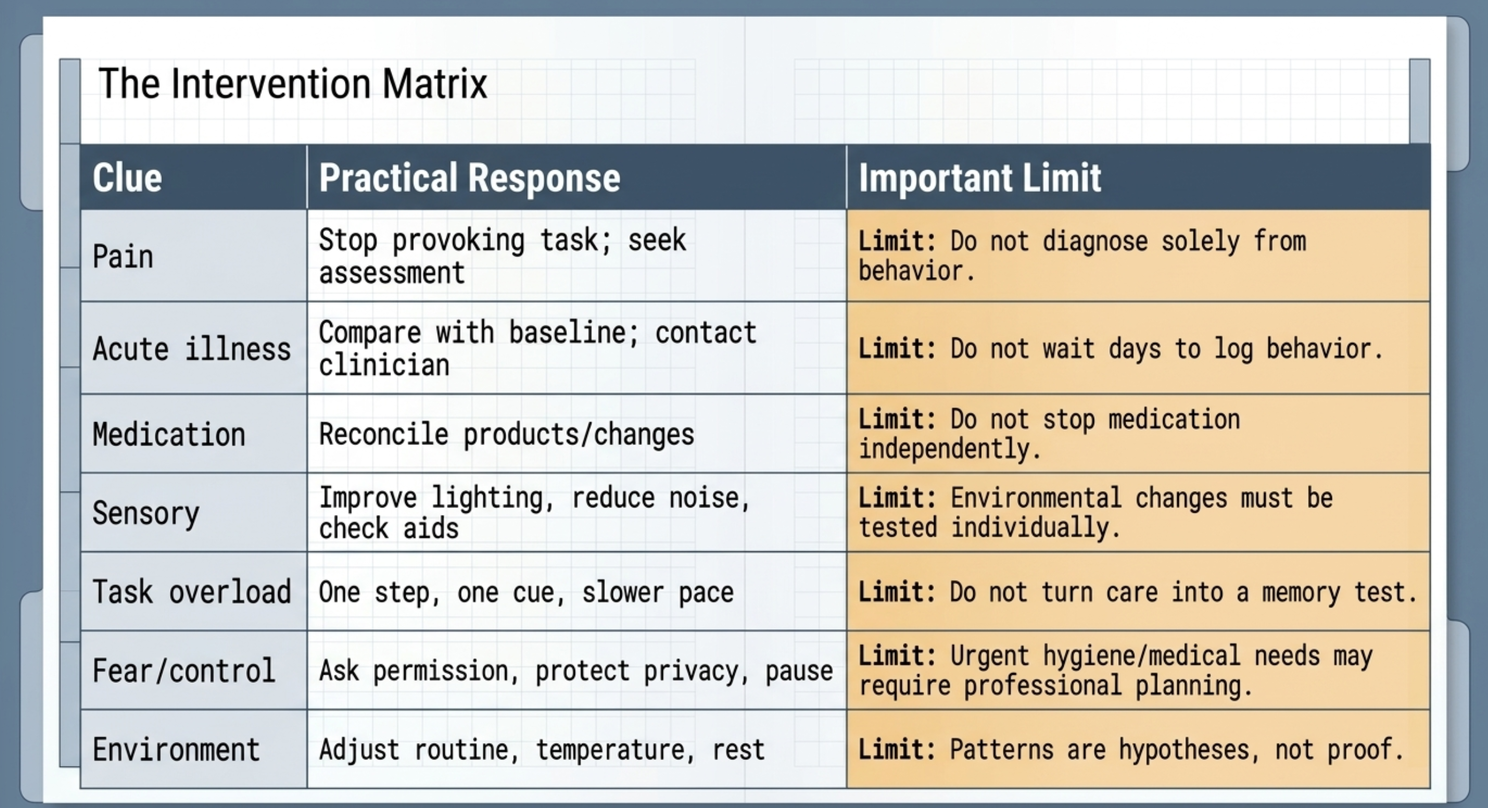
If a task appears to cause discomfort, stop forcing the task. Observe what movement seems to trigger the response and contact the appropriate healthcare professional for assessment.
Do not diagnose the source of pain from behavior alone.
And do not independently start, stop, or change medication based on your own theory.
CLUE 2: ACUTE ILLNESS
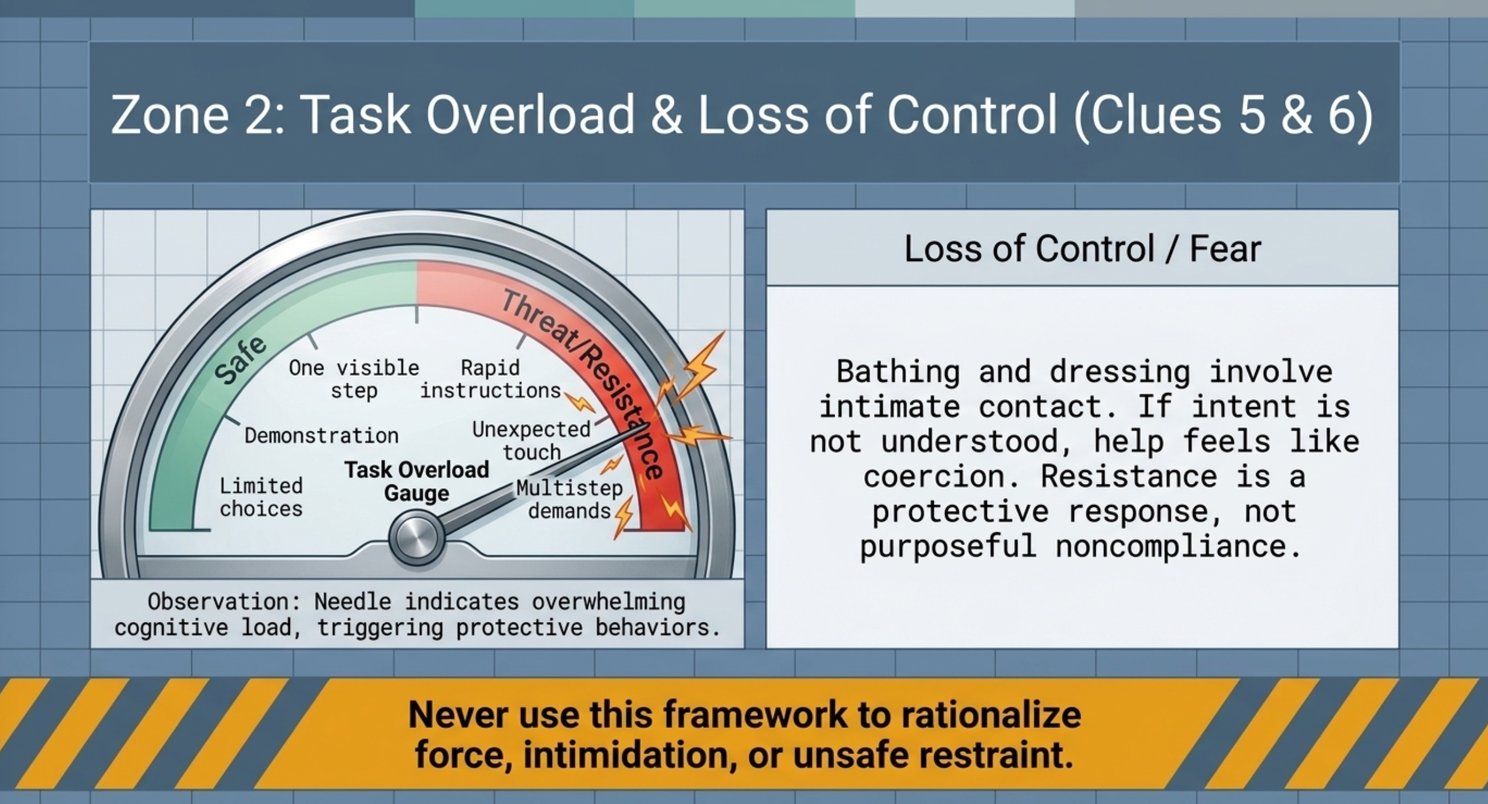
Look for changes beyond the behavior.
Fever.
Breathing difficulty.
Reduced food or fluid intake.
A recent fall.
New urinary symptoms.
Sudden weakness.
A significant change in alertness.
A rapid decline in mobility.
These details matter because the visible behavior may be the only way the person can show that something feels wrong.
Again, the caregiver’s job is not to diagnose an infection or delirium.
The caregiver’s job is to recognize that the baseline changed and report the details promptly.
CLUE 3: MEDICATIONS
Ask whether anything recently changed.
Was a medication started?
Was a dose increased or decreased?
Was a dose missed?
Did the hospital add something new?
Is the person taking over-the-counter products or supplements that the clinician may not know about?
Bring an updated medication list to the doctor or pharmacist and ask for a review.
But never stop a prescribed medication independently.
CLUE 4: WHAT DOES THE PERSON SEE AND HEAR?
This is one of the most overlooked parts of dementia care.
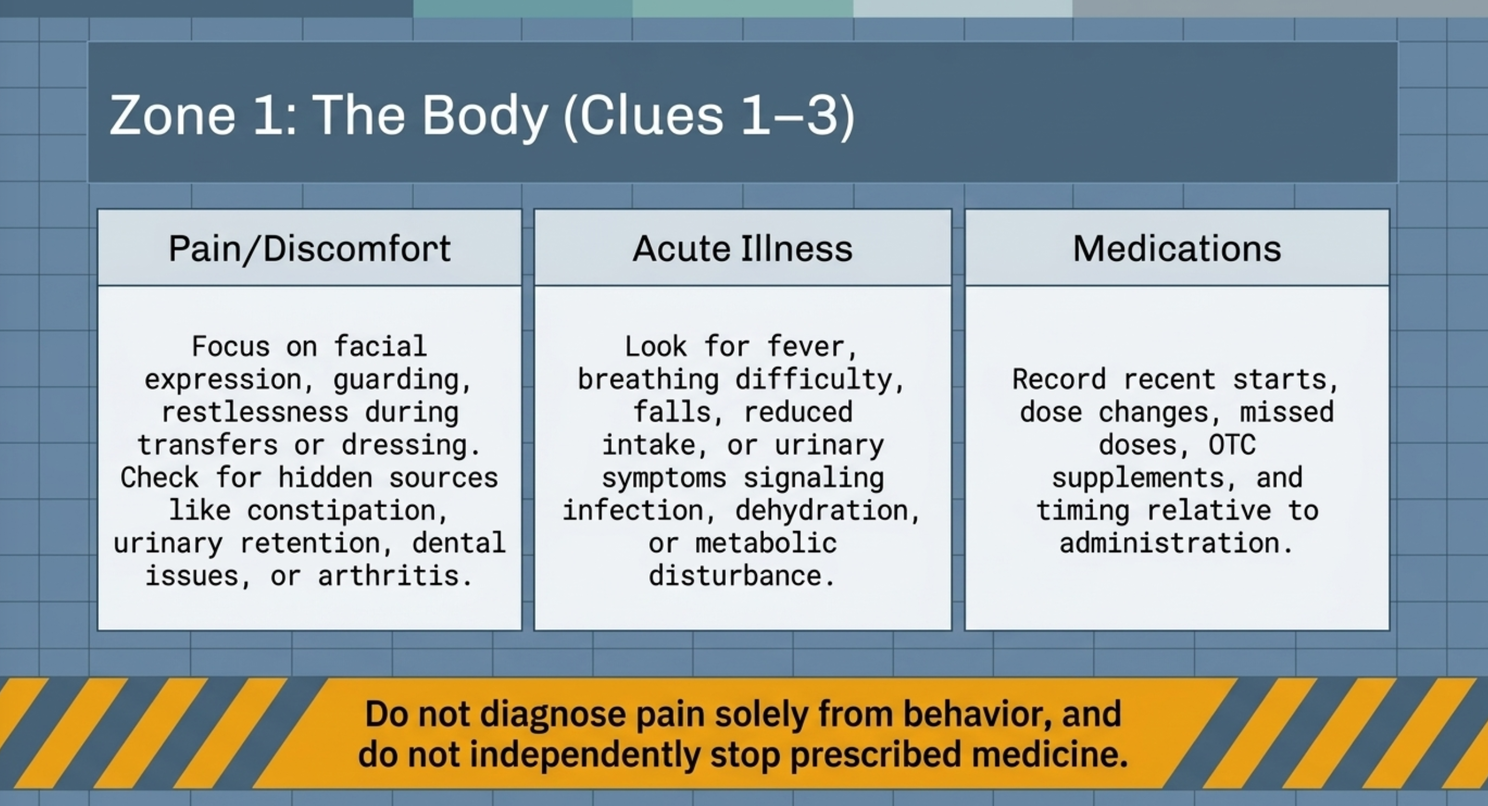
You walk into the bathroom and see a dark bath mat.
Your loved one may see a hole.
You see a shadow on the floor.
They may see an object blocking the path.
You hear the television, running water, and two people talking.
They may experience overwhelming noise with no ability to filter it.
Check the environment.
Is the lighting harsh?
Is the room too dark?
Is there glare?
Is there poor contrast?
Are the person’s glasses clean and available?
Are their hearing aids working?
Is the room crowded or noisy?
Environmental changes should be tested carefully because not every change helps every person. But sometimes the “behavior problem” becomes smaller when the person can see, hear, and understand the space more clearly.
CLUES 5 AND 6: TASK OVERLOAD AND LOSS OF CONTROL
Let’s go back to the shower.
You may be saying:
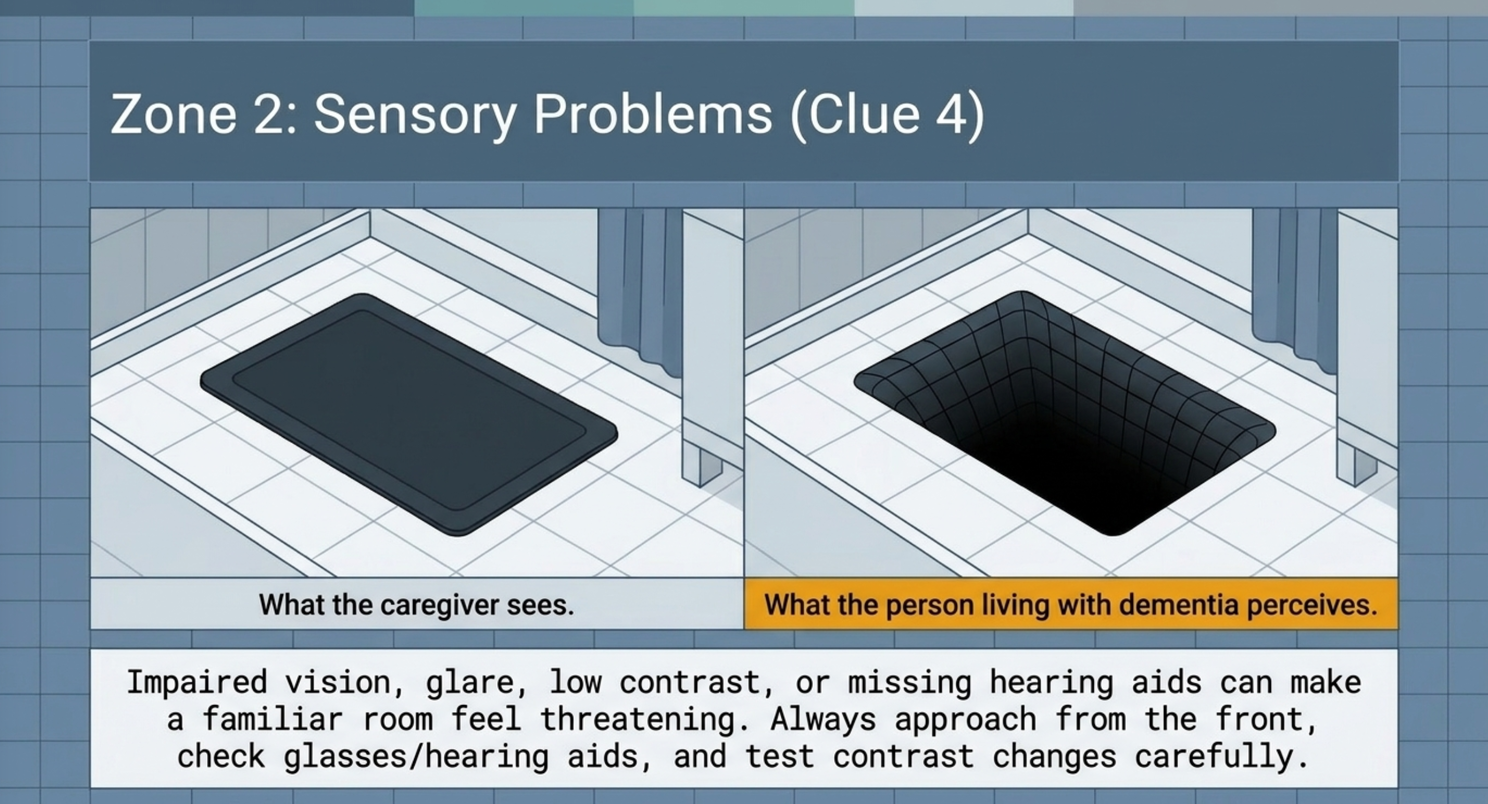
“Come into the bathroom, take off your shirt, lift your arm, sit down, turn around, step into the shower, and hold the bar.”
To you, that is help.
To a person living with dementia, that may be six demands arriving at once.
The brain cannot organize them.
The person feels overwhelmed.
Then the caregiver moves closer, starts removing clothing, and tries to move faster.
Now imagine what that experience feels like if the person does not understand your intention.
Someone is touching their body.
Removing their clothes.
Moving them toward water.
Giving rapid instructions.
They may experience your help as a threat.
Their resistance may be protective—not purposeful noncompliance.
So slow down.
Give one instruction at a time.
Demonstrate the action.
Offer simple choices when real choices are available.
Ask permission before touching.
Explain what you are about to do.
Protect privacy.
Use a towel or robe to keep the person covered.
And if the person becomes distressed, pause.
Do not use this framework to justify force, intimidation, or unsafe restraint.
Safety and dignity both matter.
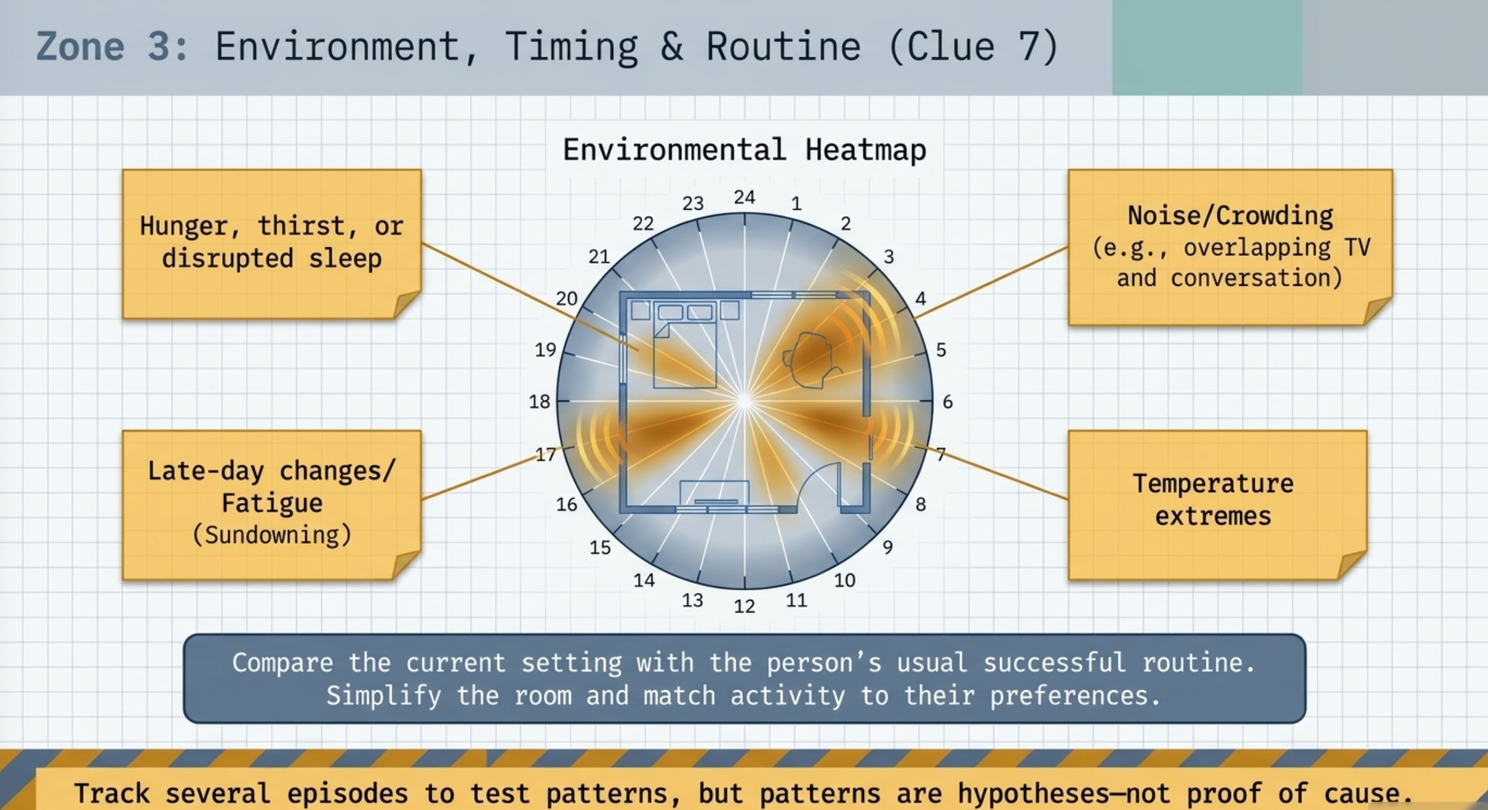
CLUE 7: ENVIRONMENT, TIMING, AND ROUTINE
Sometimes the task itself is not the main problem.
The timing is.
Maybe the person is exhausted in the evening.
Maybe they are hungry or thirsty.
Maybe they slept poorly.
Maybe the room is cold.
Maybe the television is loud.
Maybe several people are talking at once.
Maybe the family changed a routine the person relied on for years.
Compare the difficult episode with the person’s usual successful routine.
When are they most alert?
What time do they normally bathe?
Does the person prefer a shower or a sponge bath?
Does a quiet room help?
Would the task work better after breakfast instead of before bed?
Patterns can guide us.
But patterns are hypotheses to test, not proof of a diagnosis.
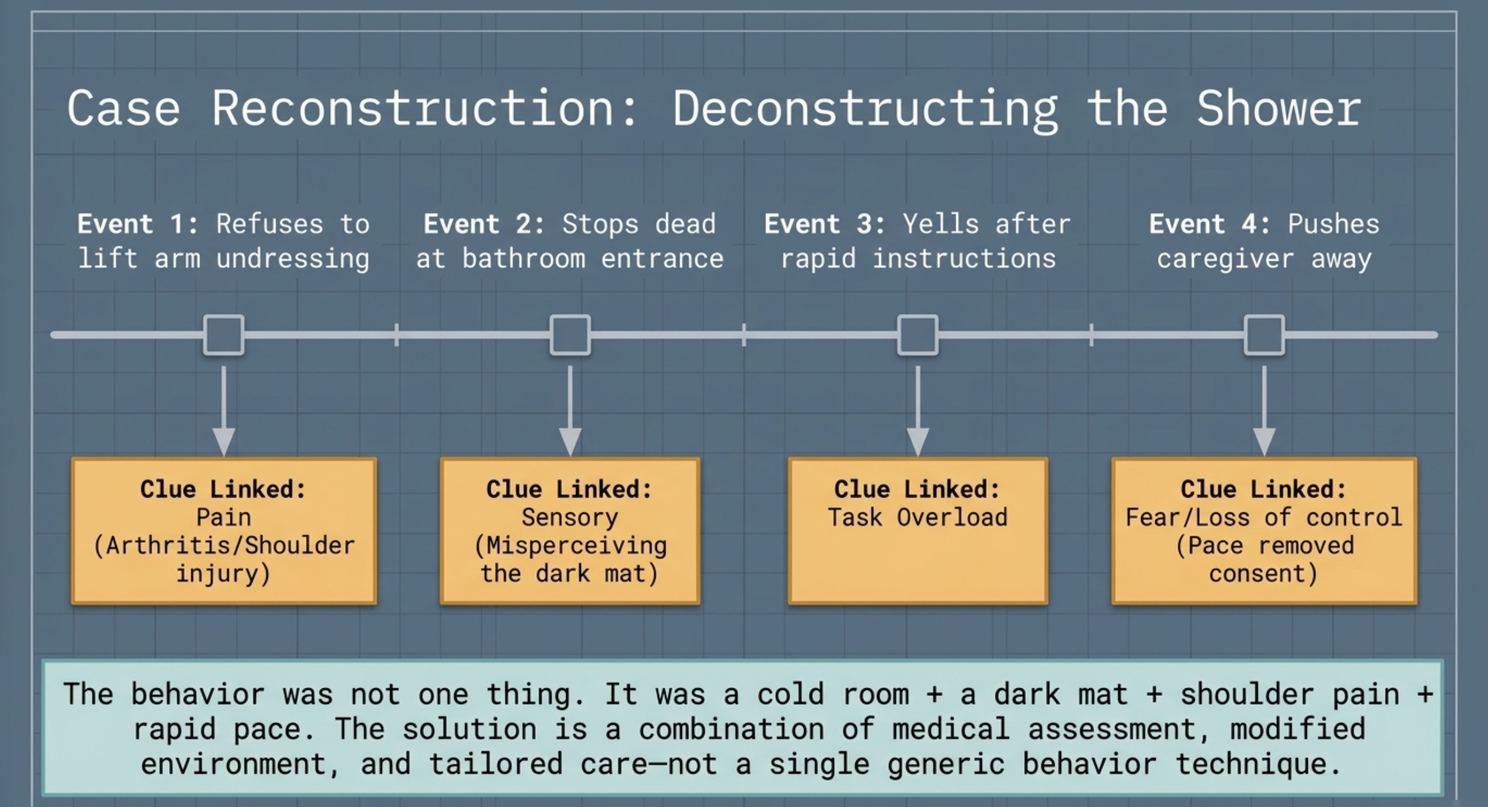
RECONSTRUCTING THE SHOWER
Now let’s put all of this together.
Mom refuses to lift her arm while undressing.
Possible clue: shoulder pain or limited movement.
She stops at the bathroom entrance.
Possible clue: the dark mat looks unsafe because of altered visual perception.
She yells after several rapid instructions.
Possible clue: task overload.
She pushes the caregiver away while her clothes are being removed.
Possible clue: fear, loss of control, or the need for privacy.
So was this one behavior?
No.
It may have been a cold bathroom, a dark mat, shoulder discomfort, rapid instructions, intimate contact, and a caregiver trying to finish the task quickly.
That means the solution may also need several parts:
Ask the medical team to assess the discomfort.
Remove or change the dark mat.
Warm the room.
Slow the pace.
Use one cue at a time.
Ask permission.
Preserve privacy.
Try the shower at a different time.
That is very different from saying:
“Mom is aggressive. She needs something to calm her down.”
Medication may sometimes be clinically appropriate, but that decision belongs to the treating healthcare professional after assessing the situation, risks, benefits, severity, and alternatives.
The caregiver’s first job is to investigate safely—not to suppress every visible reaction.
THE PAUSE FRAMEWORK
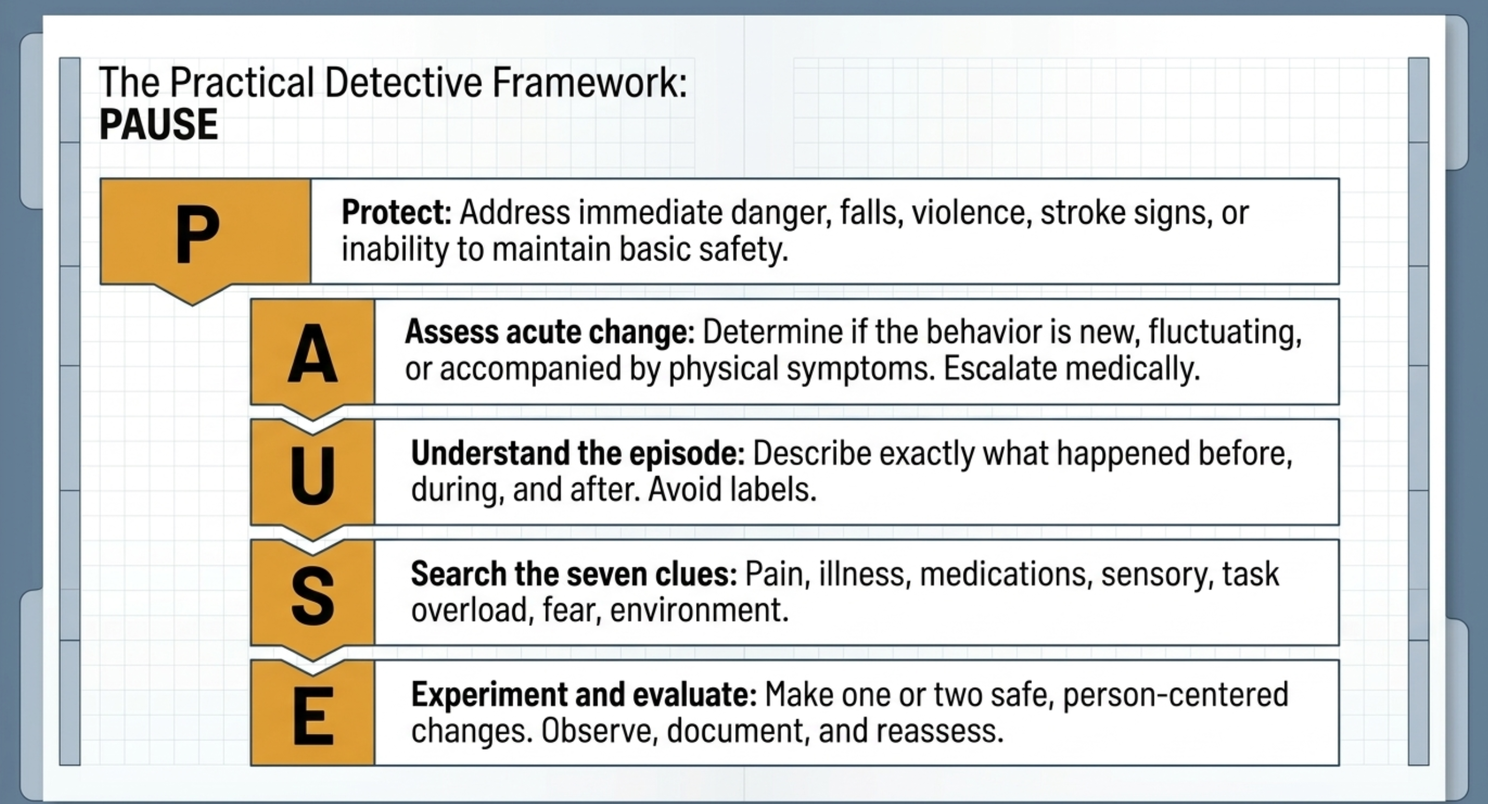
Here is the framework I want you to remember:
PAUSE.
P — Protect.
Address immediate danger first. Falls, violence, stroke warning signs, serious medical symptoms, or the inability to maintain basic safety come before behavioral investigation.
A — Assess for acute change.
Is this entirely new?
Did it become dramatically worse overnight?
Is the person fluctuating?
Are there new physical symptoms?
If yes, contact the medical team promptly.
U — Understand the episode.
What exactly happened before, during, and after?
Describe the behavior without labels.
S — Search the clues.
Pain.
Illness.
Medication changes.
Sensory problems.
Task overload.
Fear or loss of control.
Environment, timing, and routine.
E — Experiment and evaluate.
Make one or two safe, person-centered changes.
Then observe.
Did the person become calmer?
Was the task easier?
Did the behavior continue?
Document what happened and reassess.
This framework is not a replacement for medical care.
It is a way to help caregivers observe more clearly, communicate better with clinicians, and avoid jumping to conclusions.
WHAT I WANT CAREGIVERS TO REMEMBER
The next time your loved one refuses care, paces the hallway, yells, pulls away, or becomes distressed, do not immediately decide:
“They are difficult.”
“They are aggressive.”
“The dementia suddenly got worse.”
“They need a medication.”
Take a breath.
Describe what actually happened.
Compare it with their normal baseline.
Check the body.
Check recent medication changes.
Check what they can see and hear.
Check whether the task is too complicated.
Check whether they feel frightened or exposed.
Check the room, timing, and routine.
Then make one or two safe changes and watch the response.
And if the change is sudden, severe, rapidly fluctuating, physically dangerous, or accompanied by concerning medical symptoms, do not delay professional evaluation.
Behavior is not always a problem to stop.
Sometimes it is the only language the person has left to tell you:
“I am hurting.”
“I am afraid.”
“I do not understand.”
“This is too much.”
“Please slow down.”
The question is not only:
“How do I make this behavior stop?”
The better question is:
“What is this clue trying to tell me?”
Slide deck note
Extra visual from this issue


Common questions
Quick answers from this issue
Is the Dementia Getting Worse — or Is the Behavior a Clue?
“Dr. Erik, my mother suddenly refuses to shower. She paces every evening, and when I try to help her, she gets angry. Is this just the dementia getting worse?” Caregivers ask me questions like this all the time. And listen, I understand why families immediately blame the dementia.
What should caregivers try first?
Write down what changed, when it started, and what was happening right before it. Reduce noise, slow the conversation down, and use one simple step at a time. Share the pattern with the family, care team, or clinician so everyone responds consistently.
When should families call a clinician?
Call a clinician promptly if the change is sudden, severe, unsafe, tied to a fall, fever, pain, dehydration, medication change, hallucinations, paranoia, or new confusion. Call emergency services for immediate danger.