

“Dr. Erik, I answered Mom five times. Why is she asking me again?”
Caregivers ask me this all the time.
“What time is the appointment?”
“When are we leaving?”
“Where is my husband?”
“Are we going home?”
Sometimes the same question comes back every five minutes.
And listen, I understand the frustration.
You are tired. You are trying to cook, answer the phone, manage medications, schedule appointments, and keep the whole house together. Then the question comes again.
Your first reaction may be:
“Mom, I already told you.”
But here is what I want you to remember:
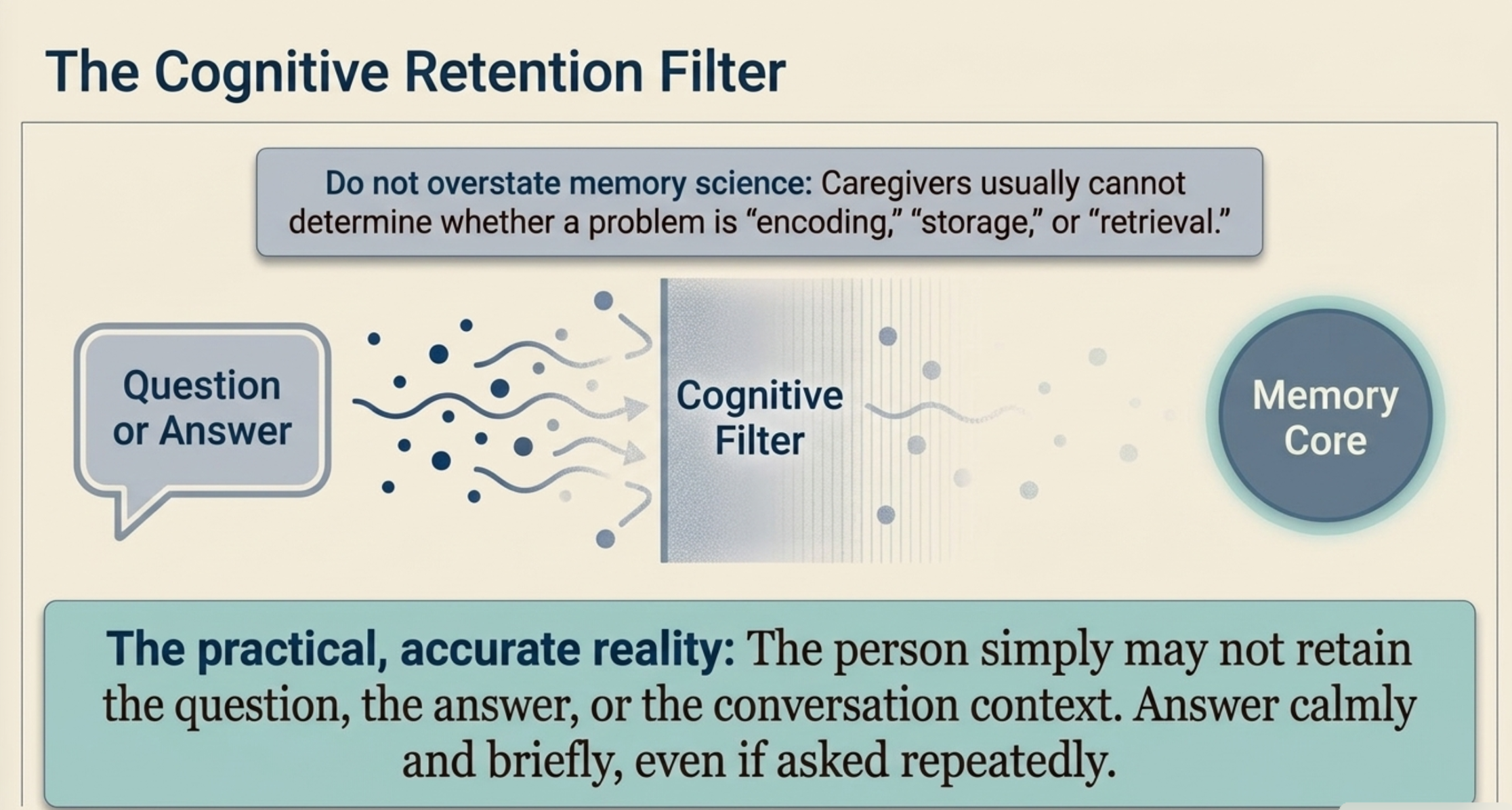
Your loved one may not remember asking the question.
They may not retain the answer.
For them, it may feel like the first time they asked.
That does not make the repetition easy for you. But it changes how we respond.
My name is Dr. Erik Ilyayev. I’m a dementia care physician, a board member of the South Florida Alzheimer's Association® , and the CEO of MedBetterHealth.org — one of the organizations selected by Medicare to participate in the GUIDE Model, an 8-year CMS initiative designed to support people living with dementia and the family caregivers caring for them at home.
In this issue, I want to explain why repetitive questions happen, what may be hiding underneath the words, and how caregivers can respond without arguing, shaming, or losing the dignity of the person they love.
THEY ARE NOT DOING THIS TO YOU
Let’s start there.
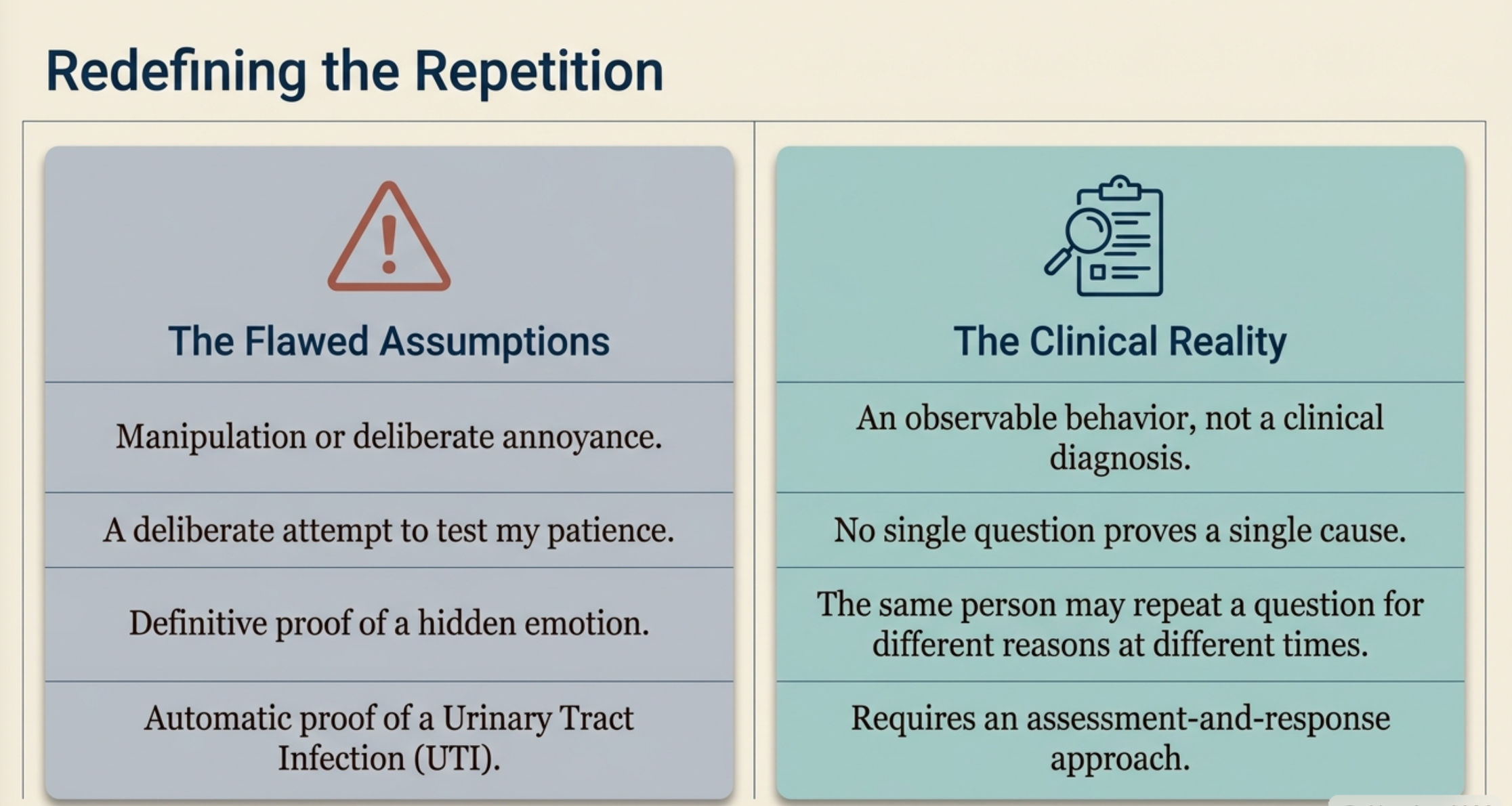
Your loved one is usually not repeating the question to test your patience.
They are not sitting there thinking:
“Let me ask this again and make my daughter angry.”
The person may simply be unable to hold onto the conversation.
You answer the question.
The answer passes through.
A few minutes later, the uncertainty returns.
So they ask again.
This is why saying, “I already told you,” usually does not solve the problem.
You are reminding them of something their brain may not be able to retrieve. Now the person may still have the same question, but they may also feel embarrassed, corrected, or ashamed.
We have to change the goal.
The goal is not to prove that we answered correctly.
The goal is to help the person feel safe.
WHAT IS UNDERNEATH THE QUESTION?
Now, here is where you become a detective.
The words may be:
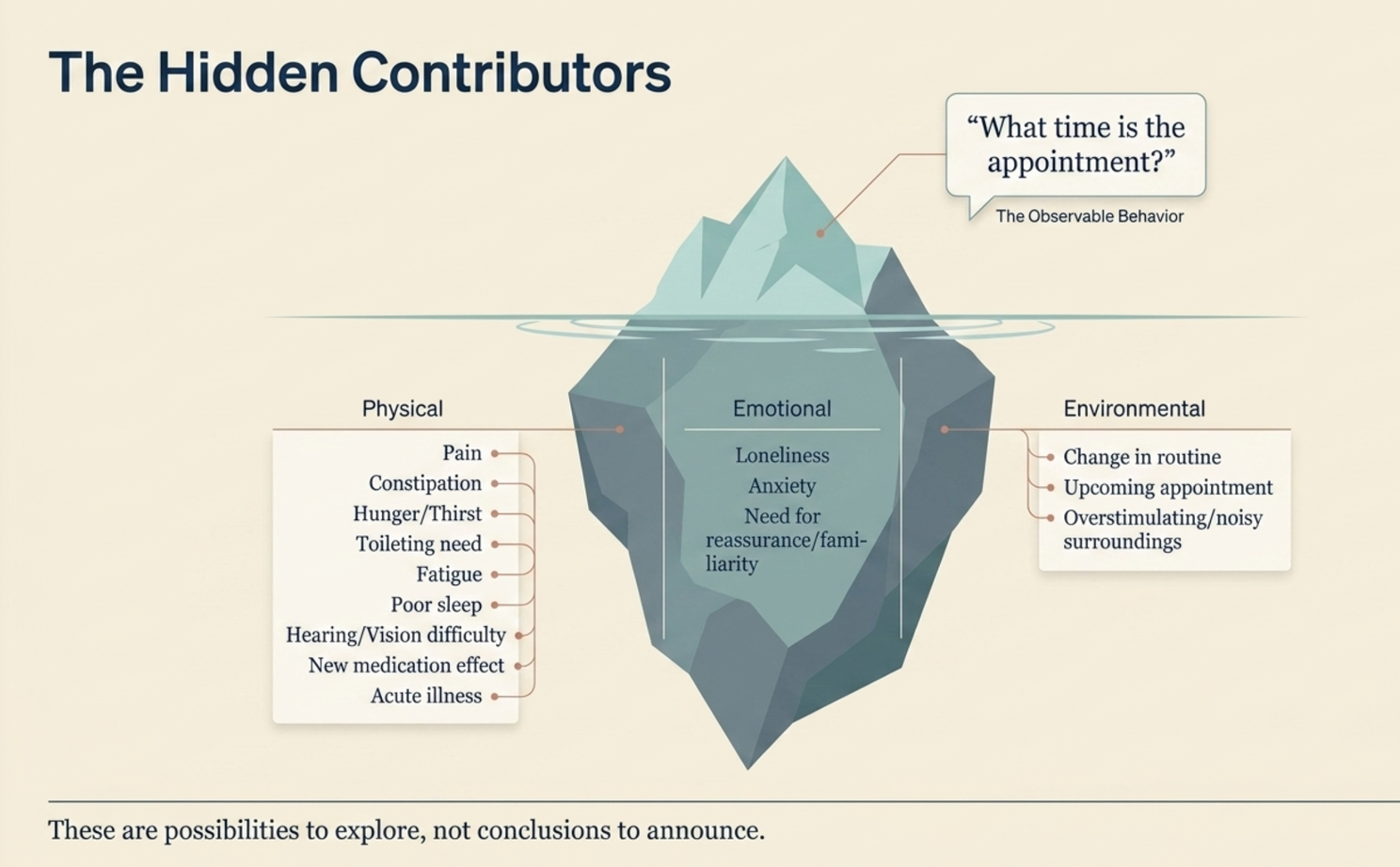
“What time is the appointment?”
But the emotion may be:
“I am afraid we will be late.”
“I do not understand what is happening today.”
“I need reassurance that you have everything under control.”
“I am worried you are going to leave me.”
Or maybe the cause is physical or environmental.
Are they hungry?
Thirsty?
Tired?
In pain?
Do they need the bathroom?
Is the television too loud?
Did the routine suddenly change?
Are they having difficulty hearing you?
Did a new medication recently begin?
The same question can come from different needs on different days.
So do not hear one repeated question and immediately announce:
“This is anxiety.”
“This is a UTI.”
“This is the dementia getting worse.”
Those may be possibilities to explore.
They are not conclusions for a caregiver to diagnose alone.
HOW I WANT YOU TO RESPOND
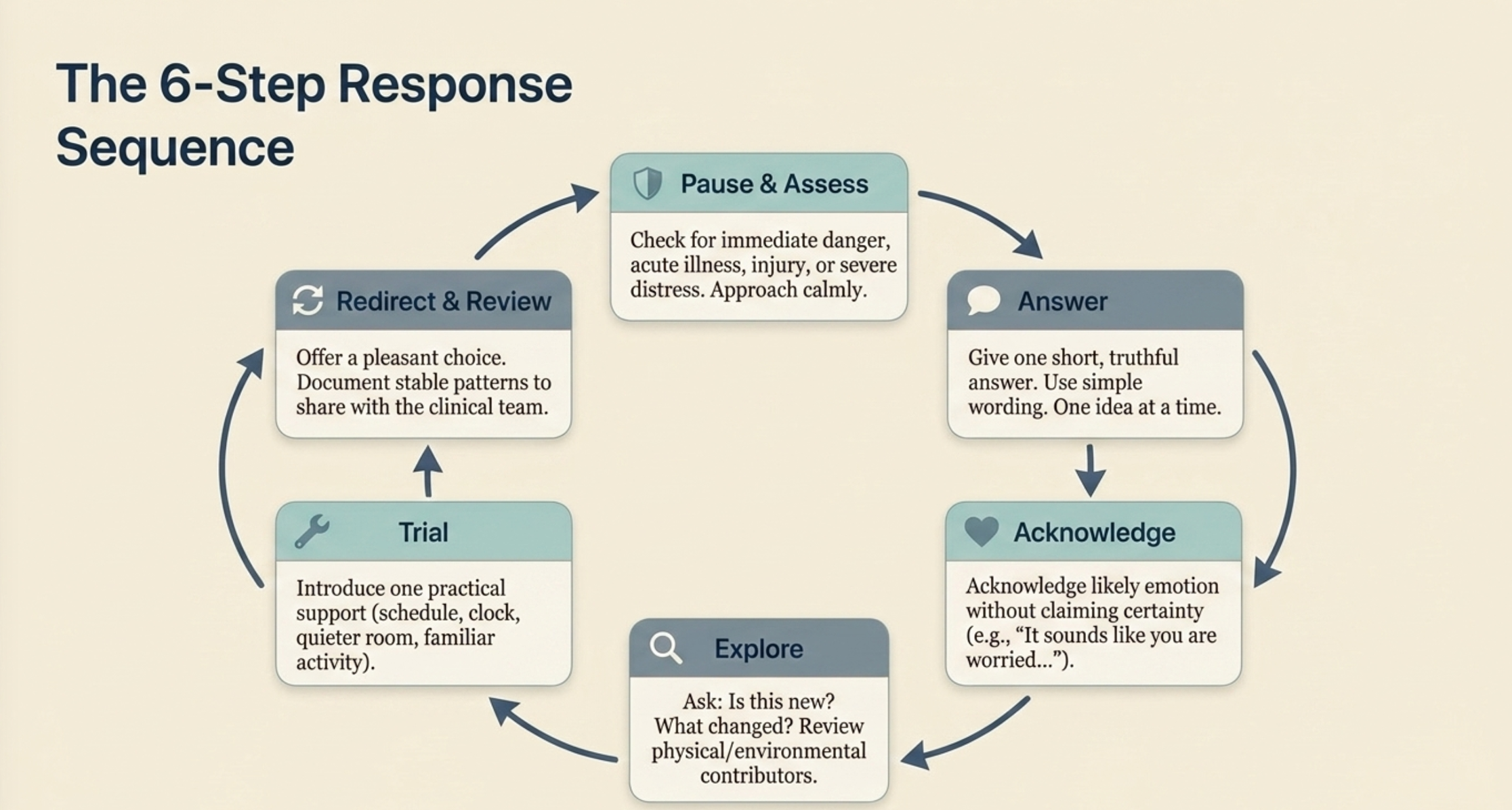
When the question comes again, use this sequence.
First, pause.
Before you answer, check yourself.
Are you rushing?
Are you raising your voice?
Are you answering from exhaustion?
Take one breath and approach calmly.
Second, give one short, truthful answer.
“Lunch is at noon.”
“The appointment is this afternoon.”
“Your daughter will be here after dinner.”
Do not give a five-minute explanation. The longer the answer, the harder it may be to process and retain.
Third, acknowledge the emotion.
“You sound worried.”
“I know you want to make sure we are on time.”
“You are safe. I am here with you.”
Fourth, look for the need underneath the question.
Are they uncomfortable?
Do they need the bathroom?
Is the environment too noisy?
Are they waiting with nothing meaningful to do?
Fifth, try one practical support.
A simple note.
A visible clock.
A written schedule.
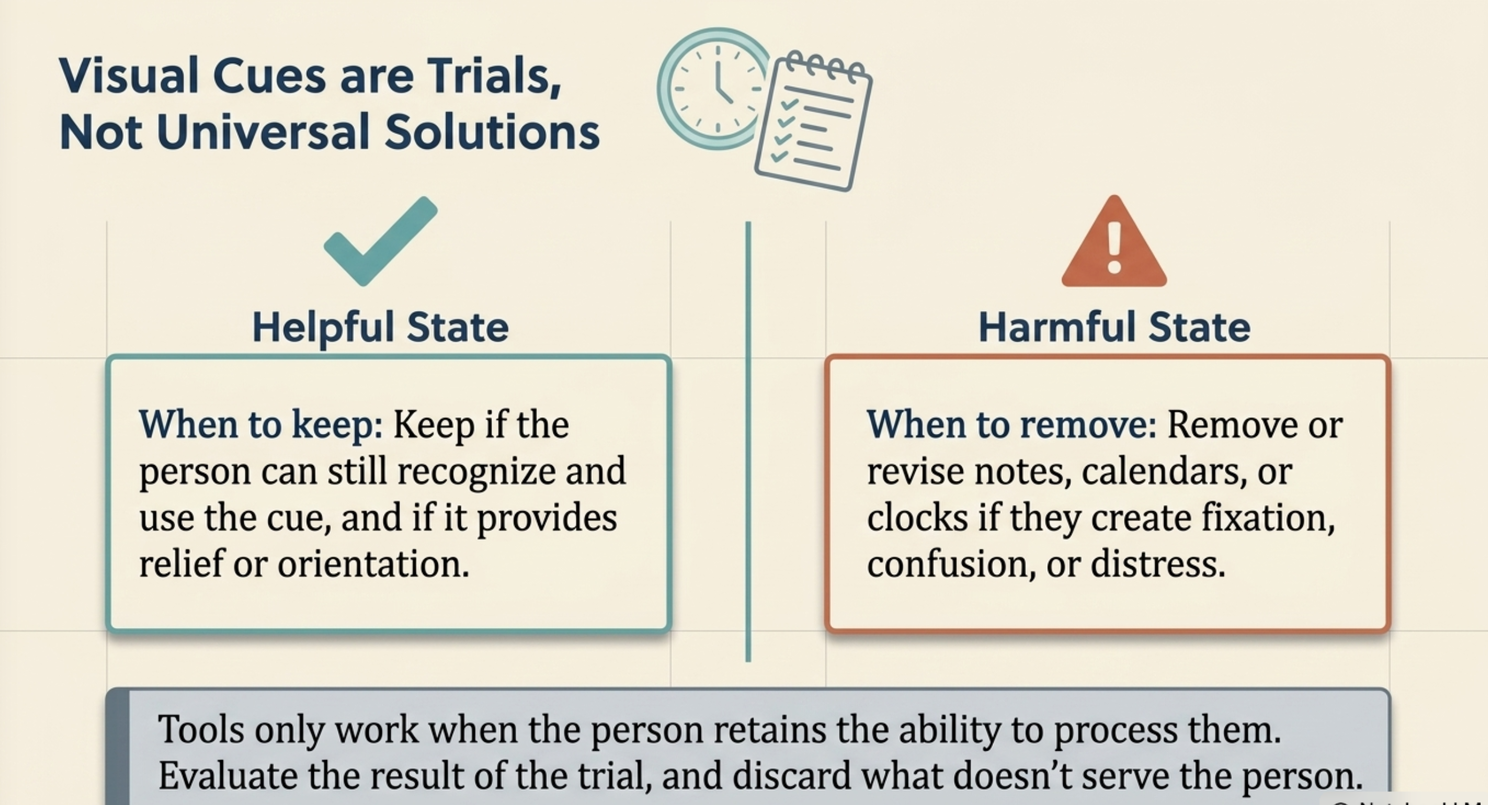
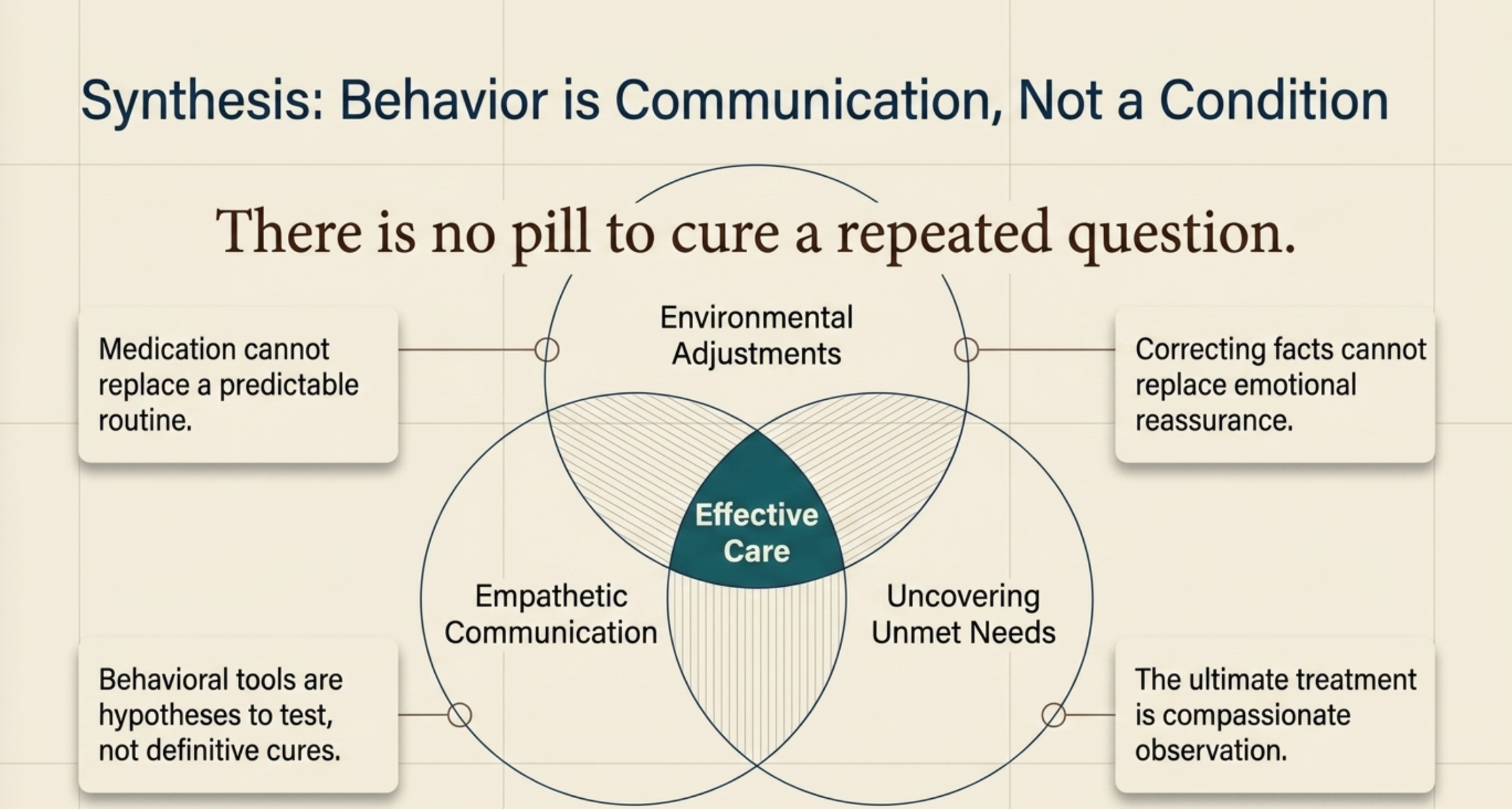
But remember: a visual cue is a trial, not a universal solution. If the note creates more fixation or confusion, remove it.
Then redirect gently.
“Lunch is at noon. Come help me fold these towels.”
“The appointment is later. Let’s have some tea first.”
That is a much more effective response than arguing about how many times the question has already been asked.
USE WORDS THAT PROTECT DIGNITY
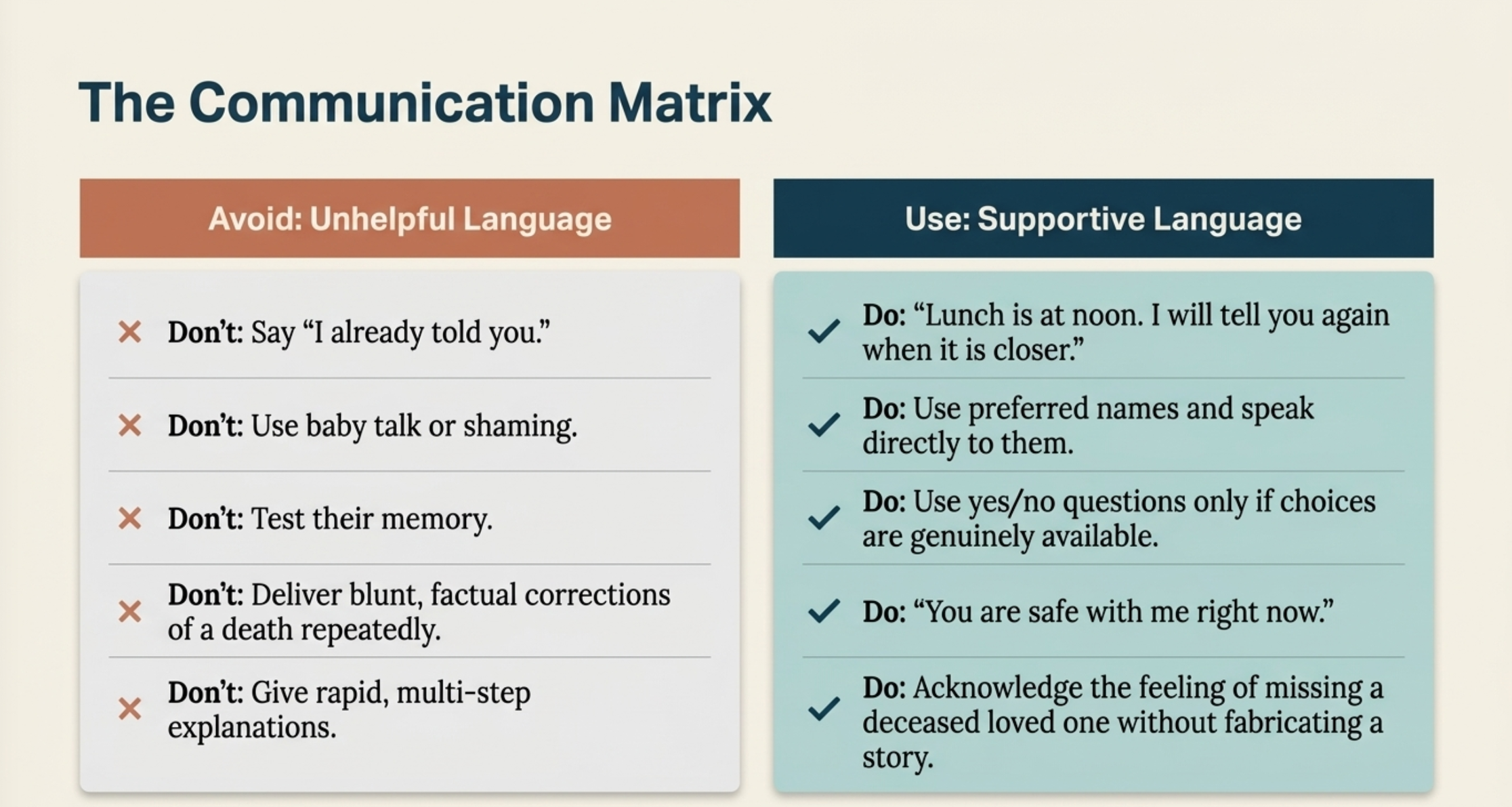
Try to avoid:
“I already told you.”
“How many times are you going to ask?”
“Don’t you remember?”
“You know the answer.”
“Stop asking me.”
I understand why caregivers say these things.
You are human.
But those phrases may increase shame without helping the person remember.
Instead, try:
“Lunch is at noon. I’ll remind you again when it gets closer.”
“You are safe with me right now.”
“Yes, we are going later. I have everything ready.”
“I know this is important to you.”
Use the person’s preferred name.
Speak directly to them, not around them.
Do not use baby talk.
Do not test their memory.
Give one idea at a time.
And when choices are appropriate, keep them simple:
“Would you like tea or water?”
“Would you like to sit here or by the window?”
We are not trying to win a memory test.
We are trying to preserve connection.
DOES THE NOTE OR CLOCK ACTUALLY HELP?
Caregivers often ask me about signs, calendars, notes, and clocks.
These tools can help.
But they do not help every person at every stage.
A note that says, “Lunch is at noon,” may reassure one person.
Another person may read it every two minutes and become even more focused on lunch.
So watch the result.
Does the tool reduce anxiety?
Does it help the person orient themselves?
Or does it create more confusion and fixation?
Keep what helps.
Change what does not.
This is dementia care.
We observe.
We try something.
We watch the response.
Then we adjust.
WHEN REPETITION NEEDS MEDICAL ATTENTION
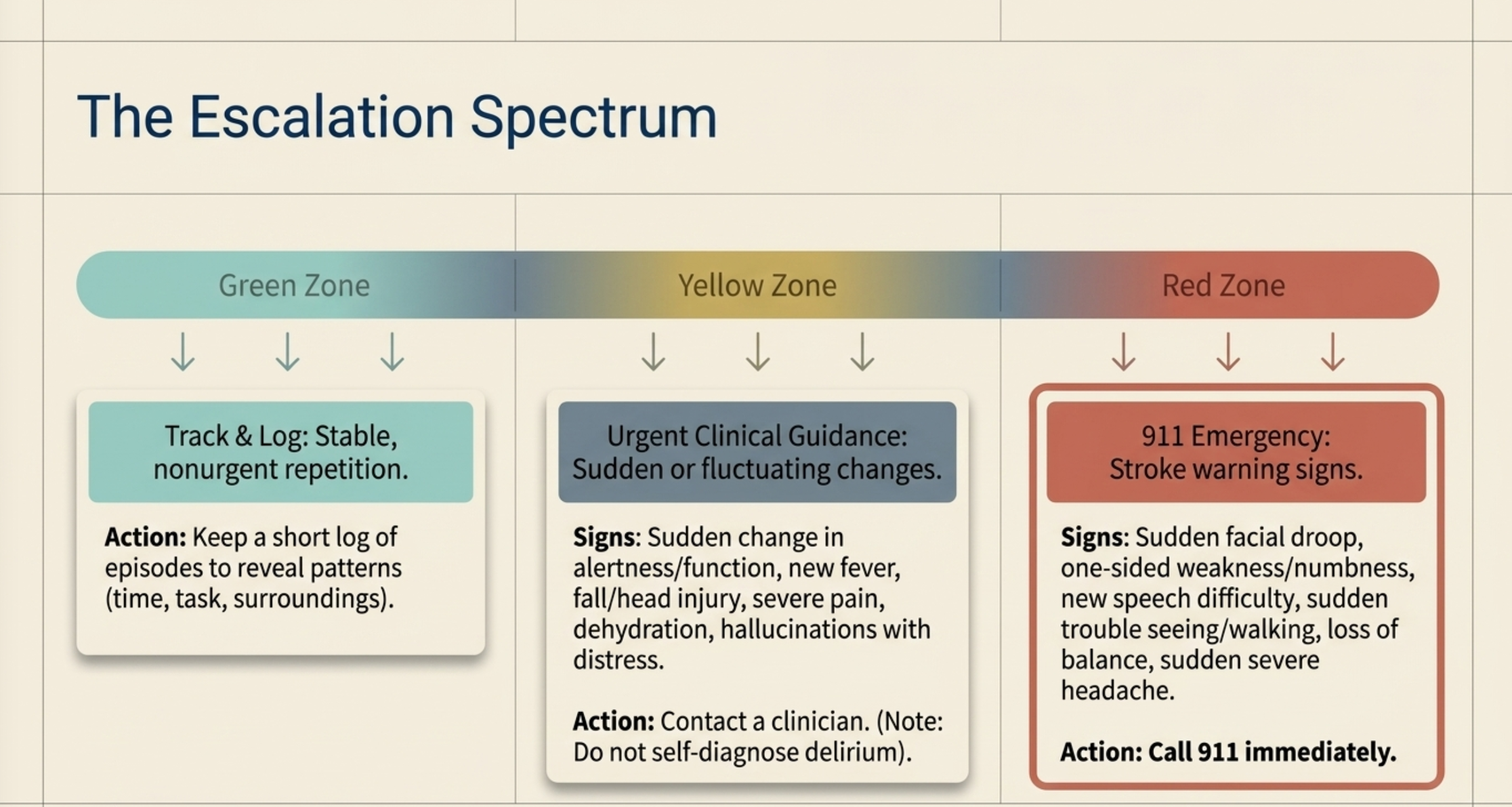
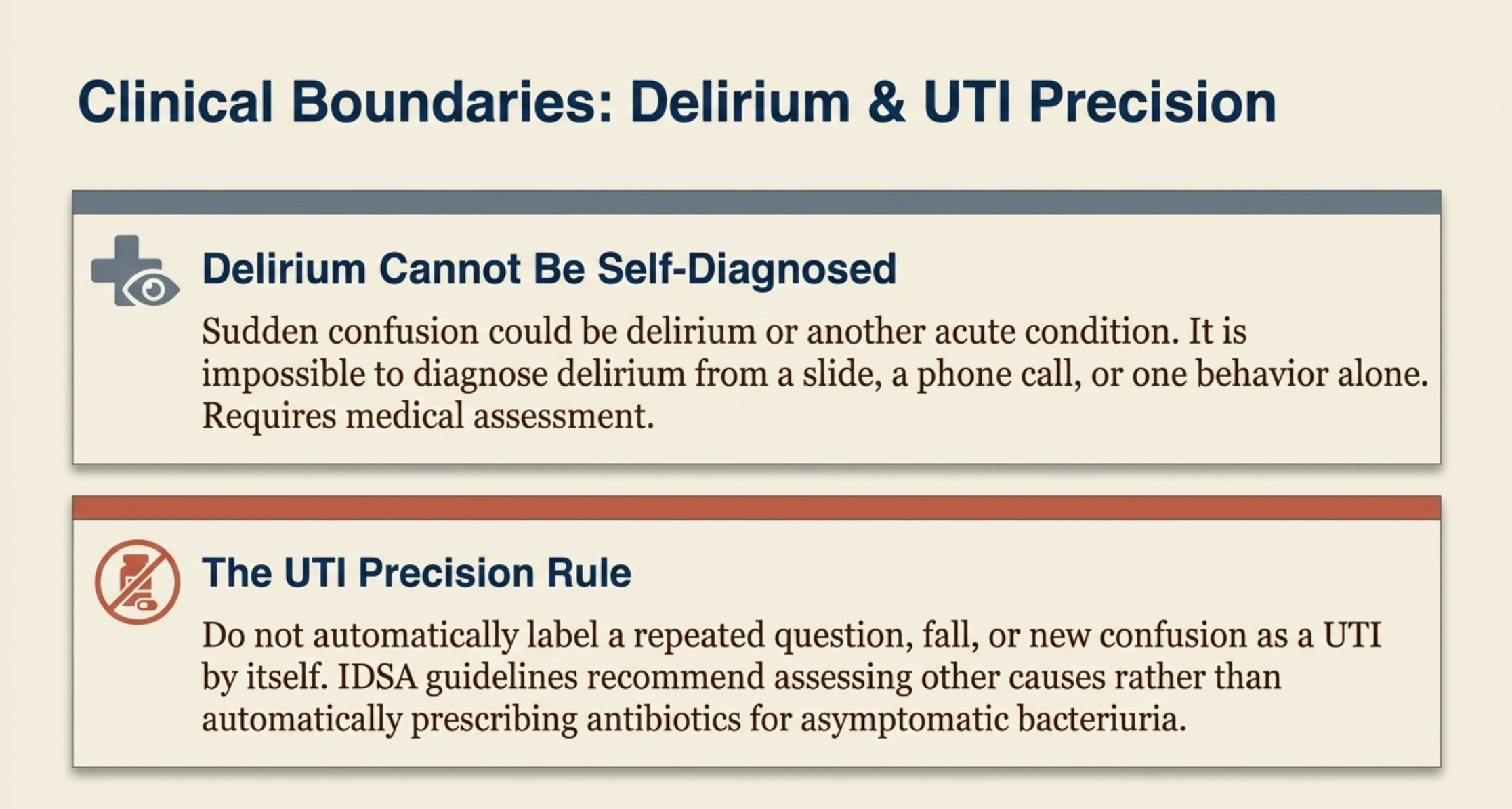
Stable repetitive questioning can often be tracked and managed with communication, routine, and environmental changes.
But a sudden change is different.
If the repetition suddenly becomes much worse, or the person has a rapid change in alertness, behavior, function, or thinking, contact the medical team.
Look for other changes:
Fever.
New pain.
A recent fall or head injury.
Reduced food or fluid intake.
New incontinence or urinary symptoms.
A recent medication change.
Hallucinations.
Severe distress.
Sudden fluctuating confusion.
Do not automatically assume it is a UTI.
Do not automatically assume it is delirium.
Do not automatically assume the dementia progressed overnight.
Those conditions require medical assessment.
And if you see sudden facial drooping, one-sided weakness or numbness, new speech difficulty, sudden trouble seeing or walking, loss of balance, or a sudden severe headache, call 911.
At that point, this is no longer a communication strategy issue.
It is an emergency.
THE CAREGIVER’S FRUSTRATION MATTERS TOO
I do not want to pretend that repeating the same answer calmly is easy.
It is not.
The tenth question can feel very different from the first one.
So if you feel yourself becoming angry, step away briefly when the person is safe.
Take a breath.
Ask someone else to step in.
Use respite and caregiver support when available.
Because the answer is not only teaching the caregiver better phrases.
The caregiver also needs enough rest and support to use them.
You cannot give calm reassurance all day while your own nervous system is collapsing.
That is why caregiver care is part of dementia care.
Slide deck note
Extra visual from this issue


Common questions
Quick answers from this issue
Why Does My Loved One Ask the Same Question Over and Over?
“Dr. Erik, I answered Mom five times. Why is she asking me again?” Caregivers ask me this all the time. “What time is the appointment?”
What should caregivers try first?
Write down what changed, when it started, and what was happening right before it. Reduce noise, slow the conversation down, and use one simple step at a time. Share the pattern with the family, care team, or clinician so everyone responds consistently.
When should families call a clinician?
Call a clinician promptly if the change is sudden, severe, unsafe, tied to a fall, fever, pain, dehydration, medication change, hallucinations, paranoia, or new confusion. Call emergency services for immediate danger.