

Every week, caregivers ask me some version of the same question:
“Dr. Erik, what can I actually do to protect my brain or help my loved one living with dementia?”
And usually, people are expecting me to talk about medications.
They ask about pills.
They ask about vitamins.
They ask about supplements.
They ask about treatments that might slow down the disease.
And listen, those conversations matter. Medications, diagnosis, staging, blood tests, imaging, clinical evaluation, and physician guidance all have their place.
But today, I want to ask you a different question:
Can you eat your memory away?
I know that sounds dramatic.
But a new study out of Harvard looked at this question in a serious way. Not for one week. Not for one month. Over years.
The question was simple:
What happens to the aging brain when people eat more ultra-processed foods compared to people who eat more whole, minimally processed foods?
And the answer should make every family pause.
Because when we talk about dementia risk, we cannot only talk about what happens after the diagnosis. We also have to talk about the years before the diagnosis. The blood pressure. The diabetes. The vascular health. The food environment. The caregiver who is so overwhelmed that they are living on fast food because they have no time to take care of themselves.
Dementia care is not only reactive.
It has to become preventive.
My name is Dr. Erik Ilyayev. I’m a dementia care physician, a board member of the South Florida Alzheimer's Association®, and the CEO of MedBetterHealth.org — one of the organizations selected by Medicare to participate in a groundbreaking new program designed to change how America cares for people living with dementia.
In this issue, I want to walk you through what this study found, why ultra-processed foods may matter for brain health, why whole foods may be protective, and why caregivers need to think about their own health too.
Because the person living with dementia matters.
But so does the caregiver standing next to them.
THE STUDY: 5,370 MINDS OVER 9 YEARS
This was not a tiny study.
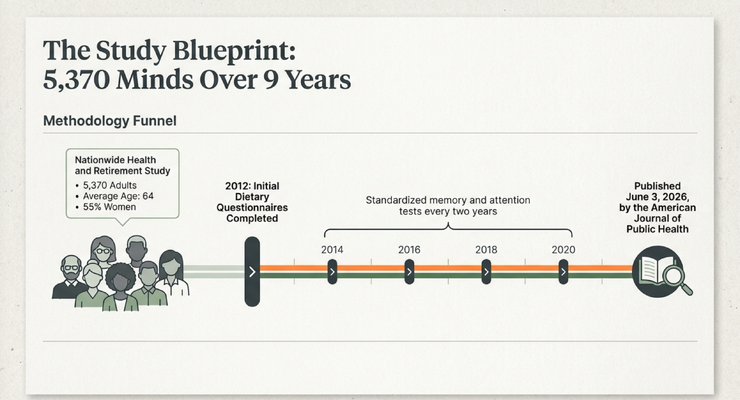
The researchers looked at 5,370 adults in a nationwide Health and Retirement Study. The average age was around 64. More than half were women. In 2012, participants completed detailed dietary questionnaires. Then, every two years, from 2014 through 2020, they completed standardized memory and attention testing.
That matters because brain health is not something you understand in one snapshot.
You need time.
You need patterns.
You need to watch what happens as people age.
And the researchers were looking at two very different eating patterns.
On one side: ultra-processed foods.
On the other side: whole, minimally processed foods.
Now, let’s define that in a practical way.
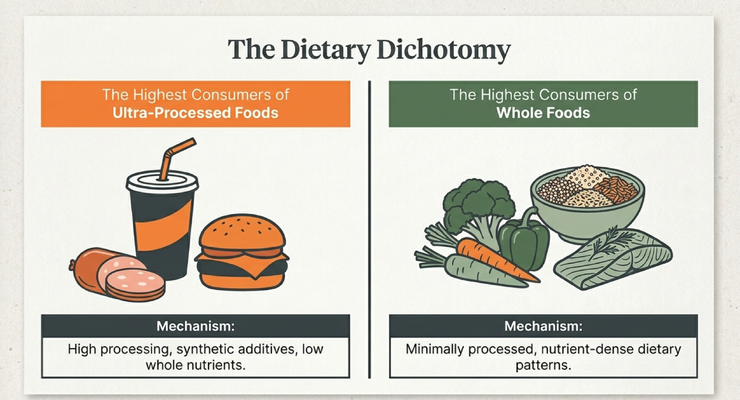
Ultra-processed foods are the foods that often come from a factory more than a kitchen. Sugary drinks. Packaged snacks. Processed meats. Fast-food items. Artificial ingredients. Synthetic additives. Foods engineered for shelf life, taste, and convenience — but often stripped of the nutrients the body actually needs.
Whole foods are the opposite.
Vegetables. Fruits. Beans. Fish. Nuts. Seeds. Whole grains. Minimally processed foods that look much closer to how they came from the earth, the tree, the water, or the farm.
This was not really a comparison between “perfect diet” and “bad diet.”
It was a comparison between two paths.
One path that keeps pushing the body toward inflammation, vascular stress, metabolic disease, and nutrient depletion.
Another path that gives the body the nutrients, fiber, antioxidants, and vascular support it needs to age better.
THE 99-POINT RISK DIVIDE
Here is where the numbers become important.
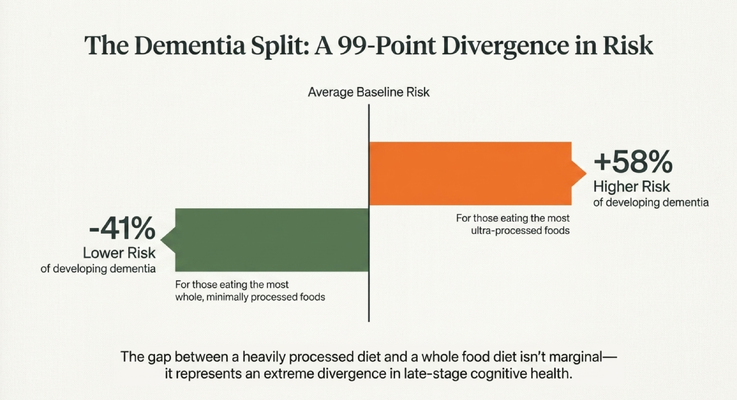
According to the transcript, the study found that the people eating the most whole, minimally processed foods had a 41% lower risk of developing dementia.
The people eating the most ultra-processed foods had a 58% higher risk of developing dementia.
That is a 99-point divergence.
Now let’s slow down here.
This does not mean if you eat a cookie, you will get dementia.
It does not mean food alone determines your future.
It does not mean diet replaces medical evaluation, blood pressure management, diabetes control, exercise, sleep, social connection, cognitive engagement, medication review, or professional care.
But it does mean this:
Food is not a side issue.
The way we eat over years may affect the environment the brain has to live in.
And when we are talking about dementia risk, that matters.
Because families often ask me, “Dr. Erik, what pill can I take? What vitamin can I take? What supplement should I buy?”
And my answer is often:
Let’s not skip the basics.
What are you eating every day?
How is your blood pressure?
How is your diabetes?
Are you sleeping?
Are you moving?
Are you isolated?
Are you treating your body like it has to carry your brain for another 20 or 30 years?
Because it does.
THE EARLY WARNING: COGNITIVE IMPAIRMENT BEFORE DEMENTIA
The study did not only look at dementia.
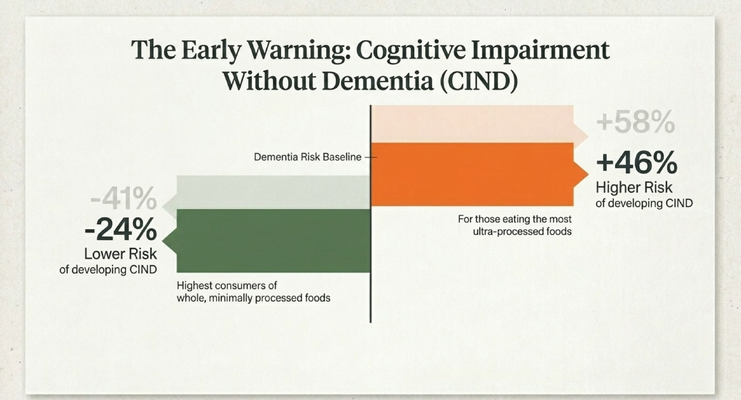
It also looked at cognitive impairment without dementia.
That is important.
Because before someone is diagnosed with dementia, there can be a stage where memory, attention, or thinking starts to change, but the person does not yet meet the criteria for dementia.
This is the window where families often say:
“Mom is a little more forgetful, but maybe it’s just aging.”
“Dad is repeating himself, but he still seems okay.”
“She is still driving.”
“He is still paying bills.”
“We are not sure if this is something serious.”
That window matters.
People eating more whole, minimally processed foods had a 24% lower risk of developing cognitive impairment without dementia. People eating more ultra-processed foods had a 46% higher risk.
Again, this does not prove that one specific food directly causes dementia in one specific person.
But it does show a powerful association.
And as a physician, when I see a pattern like that, I do not ignore it.
Because cognitive impairment is not something families should wait on until it becomes a crisis.
If food patterns are connected to earlier cognitive changes, then the conversation has to happen earlier.
Not after the diagnosis.
Not after the fall.
Not after the hospital stay.
Not after the caregiver is already overwhelmed.
Earlier.
WHY FOOD IS ALSO A VASCULAR ISSUE
Now let’s talk about the mechanism.
Food does not only affect the stomach.
Food affects the vascular system.
Your blood vessels.
Your blood pressure.
Your cholesterol.
Your diabetes risk.
Your weight.
Your inflammation.
And the brain depends on blood flow.
The brain is not floating in isolation. It is fed by blood vessels. It depends on oxygen. It depends on nutrients. It depends on vascular health.
So when we talk about ultra-processed foods, we are not only talking about calories.
We are talking about a dietary pattern that may contribute to obesity, diabetes, hypertension, high LDL cholesterol, vascular damage, and systemic inflammation.
And those are not small issues.
Those are dementia issues.
Because what damages the vascular system can ultimately damage the brain.
This is especially important when we talk about vascular dementia. Many families think dementia only means Alzheimer’s disease. But vascular dementia is different. It has to do with blood vessels, strokes, small vessel disease, hypertension, diabetes, and the brain not getting what it needs over time.
So if a caregiver asks me, “Dr. Erik, what does diet have to do with dementia?”
My answer is:
A lot.
Not because food is magic.
Because food affects the systems that protect or injure the brain.
THE CAREGIVER PIECE MOST PEOPLE MISS
Now I want to speak directly to caregivers.
Because this issue is not only about the person living with dementia.
It is also about you.
Caregivers often eat last.
They sleep last.
They go to the doctor last.
They exercise last.
They rest last.
They take care of everyone else first.
And then they wonder why their own body starts breaking down.
I see this all the time.
A caregiver is taking care of Mom with dementia. They are working. They are driving to appointments. They are managing medications. They are dealing with shower refusal, repeated questions, nighttime confusion, financial stress, family conflict, and guilt.
Then dinner becomes whatever is fastest.
Fast food.
Packaged snacks.
Sugary drinks.
Frozen meals.
Whatever can be eaten quickly between crises.
And listen, I am not judging that caregiver.
I understand why it happens.
When you are exhausted, you are not thinking, “Let me prepare a perfect Mediterranean-style dinner with leafy greens, beans, fish, olive oil, and whole grains.”
You are thinking:
“I need to get through tonight.”
But this is the problem.
Caregiver health matters.
If you are caring for someone living with dementia, your brain matters too. Your blood pressure matters. Your diabetes risk matters. Your sleep matters. Your depression matters. Your nutrition matters.
Because if the caregiver collapses, the entire care environment becomes fragile.
That is why caregiver support is not optional.
It is part of dementia care.
WHOLE FOODS DO NOT HAVE TO BE COMPLICATED
Sometimes when people hear “whole foods,” they think it has to be expensive, fancy, or impossible.
It does not.
A whole-food pattern simply means trying to move the family’s daily eating closer to foods that still look like food. Meals built around vegetables, proteins, beans, fish, oats, nuts, berries, whole grains, olive oil, and other minimally processed ingredients. Not perfect meals. Not expensive meals. Real meals.
And for most families, especially caregivers, the goal cannot be perfection. A caregiver who is exhausted, working, driving to appointments, managing medications, and answering the same question all day does not need another reason to feel guilty.
The goal is direction.
Can one packaged snack become fruit, nuts, or yogurt? Can one sugary drink become water? Can one fast-food meal become something prepared at home? Can one dinner include vegetables instead of only processed carbohydrates? Can the pantry make the healthier choice easier instead of harder?
That is where change begins.
Not with guilt. Not with shame. Not with an all-or-nothing diet plan. With small changes repeated consistently enough that the household’s default begins to shift.
Because in dementia care, we talk about routine all the time. Routine matters for behavior. Routine matters for sleep. Routine matters for anxiety. And routine matters for food too.
The question is not, “Can we eat perfectly?”
The better question is, “Can we make the brain-healthier choice more normal in this house?”
THE BOTTOM LINE ON BRAIN HEALTH
The bottom line is this:
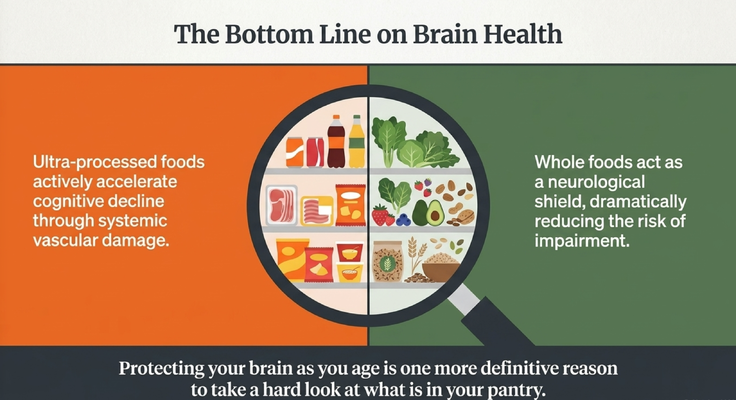
Ultra-processed foods appear to be associated with a higher risk of cognitive decline and dementia. Whole, minimally processed foods appear to be associated with a lower risk.
And while one study should never be turned into panic, this pattern fits with what we already understand about vascular health, inflammation, diabetes, hypertension, cholesterol, and brain aging.
So I want families to take this seriously.
Not fearfully.
Seriously.
Because prevention is not one dramatic decision. Prevention is the pattern you repeat. What you eat most days. How you move most days. How you sleep most nights. How you manage blood pressure, diabetes, cholesterol, depression, isolation, and stress. How early you speak with your doctor when memory changes begin.
Food is not the only answer.
But food is one piece of the brain-health puzzle that families can begin changing before the crisis.
And for caregivers, this matters twice. It matters for the person you are caring for, and it matters for you. Because the caregiver’s brain, body, and stamina are part of the dementia care plan too.
So yes, take a hard look at what is in the pantry.
Not to blame yourself.
To give your family a better default.
WHAT I WANT FAMILIES TO REMEMBER
If you are a caregiver, here is what I want you to remember: do not wait until dementia is advanced to start thinking about brain health. Do not ignore memory changes. Do not assume every change is “just aging.” And do not rely only on pills, supplements, or quick fixes.
Ask better questions earlier.
What are we eating? How is blood pressure? How is diabetes? How is cholesterol? How is sleep? How is mood? How much support does the caregiver actually have? And what is one thing we can change this week?
Not everything.
Something.
Because a family that changes one habit today may be creating a different path for tomorrow. And if you are already caring for someone living with dementia, this still matters.
Better food may not reverse dementia. I do not want anyone to hear that message. But nutrition can still support overall health, energy, strength, vascular stability, diabetes control, mood, and caregiver endurance.
And in dementia care, caregiver endurance matters.

Common questions
Quick answers from this issue
Can What You Eat Affect Your Dementia Risk?
Every week, caregivers ask me some version of the same question: “Dr. Erik, what can I actually do to protect my brain or help my loved one living with dementia?” And usually, people are expecting me to talk about medications.
What should caregivers try first?
Write down what changed, when it started, and what was happening right before it. Reduce noise, slow the conversation down, and use one simple step at a time. Share the pattern with the family, care team, or clinician so everyone responds consistently.
When should families call a clinician?
Call a clinician promptly if the change is sudden, severe, unsafe, tied to a fall, fever, pain, dehydration, medication change, hallucinations, paranoia, or new confusion. Call emergency services for immediate danger.