

Every week, caregivers ask me some version of the same question:
“Dr. Erik, why is my loved one accusing me of things I would never do?”
And if this has happened to you, you know how painful it feels.
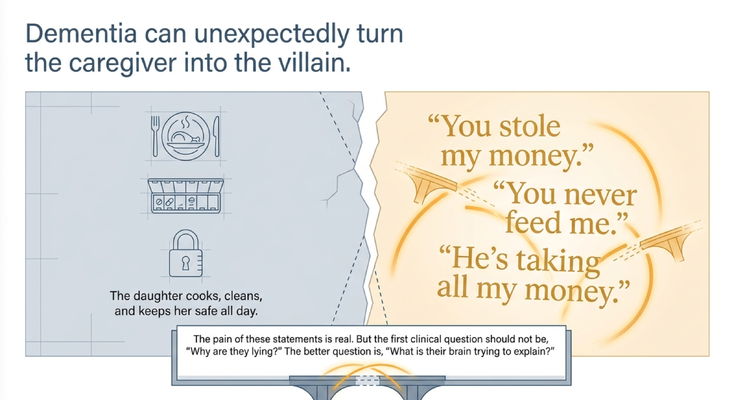
You cook for them.
You clean for them.
You manage their medications.
You keep them safe.
You give up your time, your sleep, your energy, your emotions, and sometimes your own health.
And then suddenly, the person you are caring for looks at you and says:
“You stole my money.”
“You never feed me.”
“You took my purse.”
“He is taking all my money.”
And now the caregiver becomes the villain.
Not because they did anything wrong.
But because dementia can change the way the brain explains fear, missing memories, misplaced items, anxiety, and confusion.
That is why the first question should not be:
“Why are they lying?”
The better question is:
“What is their brain trying to explain?”
My name is Dr. Erik Ilyayev. I’m a dementia care physician, a board member of the South Florida Alzheimer's Association® , and the CEO of MedBetterHealth.org — one of the organizations selected by Medicare to participate in a groundbreaking new program designed to change how America cares for people living with dementia.
In this issue, I want to walk you through why false accusations happen in dementia, why the person may sincerely believe something that is not true, and how caregivers can respond without turning every moment into a fight.
THE ACCUSATION FEELS PERSONAL
Let’s start with the emotional reality.
When your mother says, “You stole my purse,” it hurts.
When your father says, “You are taking my money,” it hurts.
When your loved one says, “You never feed me,” especially in front of relatives, neighbors, or home care staff, it can feel humiliating.
And the instinct is very human.
You want to defend yourself.
You want to say:
“Mom, that is not true.”
“Dad, I would never steal from you.”
“You just ate lunch.”
“I have been taking care of you all day.”
“Why would you say that about me?”
I completely understand that reaction.
But in dementia care, the first response cannot always be self-defense. Because the person may not be making a calculated accusation. They may be trying to explain a fear their brain does not know how to organize.
The purse is missing.
The money feels unsafe.
The stomach feels empty.
The room feels unfamiliar.
The caregiver is nearby.
So the brain builds a story.
And once the story feels real, the emotion becomes real too.
That is why this is so painful for caregivers. The accusation may be false, but the fear underneath it may be very real.
LYING REQUIRES INTENT
This is the key distinction.
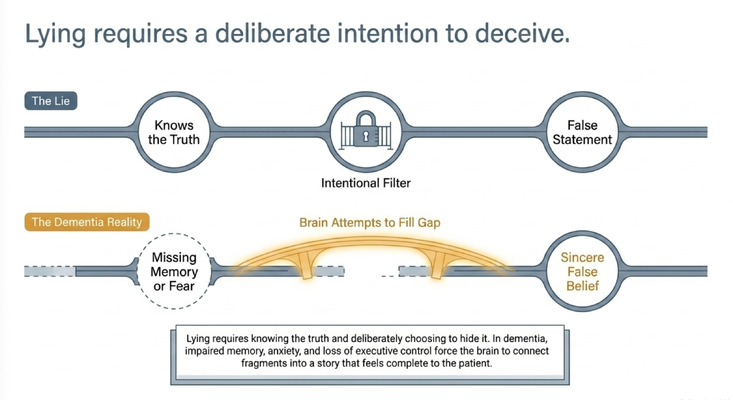
Lying requires a person to know the truth and deliberately choose to hide it.
A child takes candy from the jar. You ask, “Did you take the candy?” The child knows they took it, but says, “No.” That is a lie because there is intent to deceive.
Dementia is different.
In dementia, there may be a missing memory, a misplaced item, anxiety, fear, and impaired executive control. The brain does not tolerate an empty space well, so it tries to fill the gap.
The person does not remember moving the purse.
Now the purse is gone.
They feel anxious.
They feel out of control.
Their brain needs an explanation.
So it creates one:
“Someone stole it.”
That may be completely wrong.
But to the person living with dementia, it may feel complete.
It may feel logical.
It may feel true.
That is why false statements in dementia are often not lies in the usual sense. They are the brain’s attempt to connect broken fragments into a story that makes sense to the person in that moment.
THE BRAIN FILLS THE GAP
Memory is not a perfect recording.
It is a reconstruction.
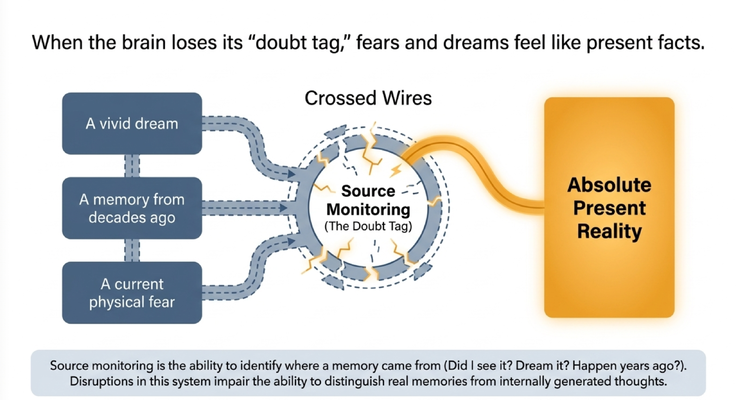
The brain has to store information, retrieve information, identify where the memory came from, and check whether the memory makes sense.
Did this happen today?
Did it happen years ago?
Did I dream it?
Did someone tell me?
Did I imagine it?
Did I see it?
That source-checking system can break down in dementia.
So a vivid dream may feel like something that happened this morning.
A memory from decades ago may feel like present reality.
A physical fear may become attached to the wrong explanation.
A missing purse may become a theft.
A hunger cue may become “You never feed me.”
A confused feeling about money may become “He is stealing everything.”
The brain is trying to build a bridge across a gap.
But the bridge may be wrong.
And once that bridge is built, the person is not responding to your reality. They are responding to their own reality.
That is why saying, “No, that did not happen,” often does not work.
Because the feeling is already there.
The fear is already there.
The story already feels true.
THE PURSE EXAMPLE
Let’s make this practical.
Mom says:
“You stole my purse.”
Now, what is the caregiver’s natural response?
“Nobody stole it.”
“I did not take your purse.”
“You probably misplaced it.”
“Stop accusing me.”
Again, I understand why you want to say that.
But that response usually goes straight into conflict.
Why?
Because you are correcting the conclusion, but she is reacting to the fear.
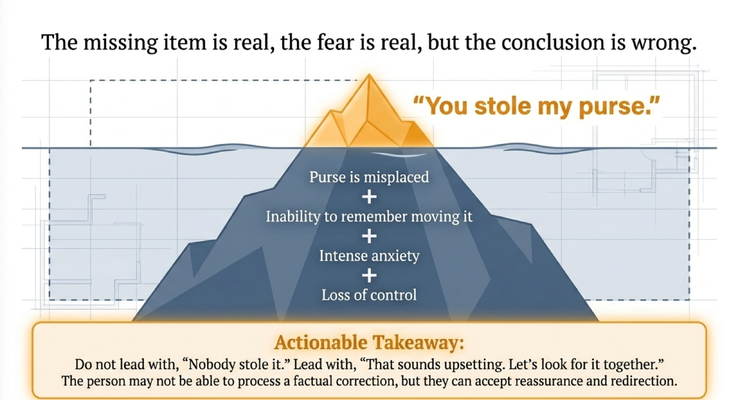
In her mind, the purse is gone. She does not remember moving it. She feels anxious. She feels a loss of control. And now the brain has filled the gap with one explanation:
“Someone stole it.”
So if you lead with the fact, “Nobody stole it,” she may feel dismissed, attacked, or ignored.
The better response is to lead with the emotion.
“Mom, that sounds really upsetting.”
“I can see you’re worried.”
“Let’s look for it together.”
Now you are not agreeing that someone stole the purse. You are validating the distress and moving into collaborative action.
That is the difference.
You are not saying, “Yes, someone stole it.”
You are saying, “I see that this feels upsetting, and I am here with you.”
That approach gives the person reassurance and redirection without forcing their brain to accept a correction it may not be able to process in that moment.
DO NOT LEAD WITH THE CORRECTION
This is one of the biggest mistakes caregivers make.
They lead with correction.
“You just ate.”
“Your mother passed away.”
“Nobody stole your purse.”
“You are retired.”
“You do not need to go to work.”
“That did not happen.”
And again, the facts may be accurate.
But the problem is not always the fact.
The problem is the fear underneath the fact.
If your loved one says, “You never feed me,” the feeling may be hunger, insecurity, confusion, or the inability to remember the meal.
So instead of saying, “You just ate lunch 30 minutes ago,” you might say:
“You’re feeling hungry? Let me get you something small.”
If your loved one says, “I have to go to work,” the feeling may be identity, purpose, routine, or structure.
So instead of saying, “You are retired. You have not worked in years,” you might say:
“You always worked so hard. Tell me about your job.”
If your loved one says, “Where is my mother?” the feeling may be attachment, comfort, fear, or loneliness.
So instead of saying, “Your mother died years ago,” you might say:
“You miss your mom. Tell me about her.”
That is not about lying for convenience.
It is about reducing distress.
It is about meeting the emotion first.
Because in dementia care, if you correct the facts while ignoring the feeling, the person may not retain the correction, but they will retain the hurt.
THE ESCALATION LOOP
Here is what often happens.
The person states a false belief or fear.
The caregiver provides a blunt factual correction.
The person feels threatened, accused, embarrassed, or freshly hurt.
Anxiety spikes.
The brain’s ability to sort reality may get worse.
The false belief hardens.
Then the caregiver tries even harder to prove the truth.
Now the loop continues.
This is how a small accusation becomes a full argument.
And the caregiver walks away thinking:
“I do everything for this person, and somehow I am the enemy.”
That emotional wound is real.
I do not want to minimize it.
False accusations can severely damage the caregiver emotionally. You may know intellectually that it is the disease, but it still hurts when the person you love says something cruel or untrue.
Understanding the brain does not erase the hurt.
But it can stop you from carrying blame that does not belong to you.
WHEN A SUDDEN FALSE BELIEF IS A RED FLAG
Now I want to be very clear.
We should not assume every false accusation is simply “just dementia.”
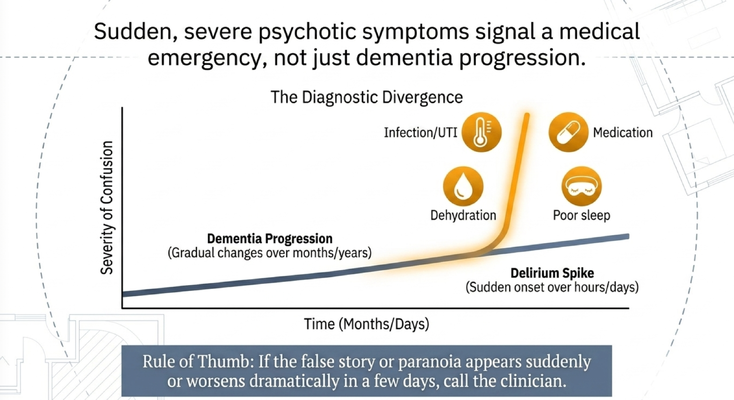
If a false story, paranoia, hallucination, or severe confusion appears suddenly or worsens dramatically over hours or days, that can be a medical warning sign.
A sudden change may suggest delirium, infection, dehydration, medication side effects, poor sleep, pain, or another acute medical issue.
This matters.
Dementia progression is usually gradual.
Delirium can come on suddenly.
So if Mom was not paranoid yesterday, and today she is suddenly extremely suspicious, frightened, hallucinating, refusing care, or acting completely different, do not simply say, “Well, she has dementia.”
Call the clinician.
Seek urgent medical guidance when symptoms are severe, dangerous, sudden, or medically concerning.
And if there is immediate danger, seek emergency help.
A sudden change in mental status is not something to ignore.
THE CAREGIVER RESPONSE: VALIDATE, SEARCH, REDIRECT
When a false accusation happens, I want caregivers to slow down and follow a simple approach.
First, pause.
Do not immediately defend yourself. Take one breath. You may feel hurt, but if you react from hurt, the situation may escalate.
Second, name the emotion.
“That sounds scary.”
“I can see you’re worried.”
“That must feel upsetting.”
Third, search for the trigger.
Are they hungry? In pain? Missing an item? Tired? Afraid? Overstimulated? Confused by the environment? Did something happen earlier in the day?
Fourth, redirect into action.
“Let’s look together.”
“Let’s get a snack.”
“Let’s sit for a minute.”
“Let’s check the room.”
That is the practical shift.
You are not arguing over the stated fact.
You are treating the underlying emotion.
Because the story may be wrong, but the feeling underneath is real.
WHAT CAREGIVERS SHOULD REMEMBER
If you are caring for someone living with dementia, here is what I want you to remember.
False accusations are painful, but they are not always intentional.
A person living with dementia may sincerely believe something that is not true because the brain is trying to fill missing information with a story that feels complete.
So before you respond, ask yourself:
“What is the fear underneath this statement?”
“What gap is the brain trying to fill?”
“What emotion can I validate?”
“What trigger can I investigate?”
“What safer action can I redirect toward?”
Do not make every moment a courtroom.
You do not have to prove your innocence every time dementia creates a false story.
Instead, respond to the distress.
Investigate sudden changes.
Protect safety.
And remind yourself that the accusation is not the whole truth of your relationship.
It is a symptom.
It is a moment.
It is the disease creating a false bridge across broken memory.
That does not make it easy.
But it can make it less personal.
And sometimes, that is what allows a caregiver to keep going.

Common questions
Quick answers from this issue
Why Is My L.O. Accusing Me of Stealing?
Every week, caregivers ask me some version of the same question: “Dr. Erik, why is my loved one accusing me of things I would never do?” And if this has happened to you, you know how painful it feels.
What should caregivers try first?
Write down what changed, when it started, and what was happening right before it. Reduce noise, slow the conversation down, and use one simple step at a time. Share the pattern with the family, care team, or clinician so everyone responds consistently.
When should families call a clinician?
Call a clinician promptly if the change is sudden, severe, unsafe, tied to a fall, fever, pain, dehydration, medication change, hallucinations, paranoia, or new confusion. Call emergency services for immediate danger.