

Every week, caregivers ask me some version of the same question:
“Dr. Erik, when are we supposed to start talking about the hard decisions?”
And I understand why families avoid this conversation.
Nobody wants to sit at the kitchen table and talk about CPR, ventilators, feeding tubes, hospital transfers, healthcare proxies, living wills, DNR forms, POLST forms, MOLST forms, or what Mom would want if she could no longer speak for herself.
It feels heavy.
It feels uncomfortable.
It can feel like you are giving up.
But I want to tell you something very important:
Advance care planning is not giving up.
Advance care planning is protection.
It is how we protect the person living with dementia from unwanted interventions. It is how we protect the caregiver from having to make impossible decisions alone. It is how we protect families from fighting in the hospital hallway when the crisis is already happening.
And I learned this lesson very early in my medical career.
When I was a resident physician, I remember being in the intensive care unit. The ICU is not a quiet place. Machines are beeping. Nurses and doctors are moving quickly. Patients are very sick. Families are scared.
There was an elderly man lying in bed. He was intubated, connected to a ventilator, swollen, unconscious, with tubes and lines everywhere. His wife and daughter were sitting next to him.
And the daughter asked the mother a question I never forgot:
“Mom, is this what Dad wanted?”
The mother said something like, “Your father and I spoke about this. He told me he did not want this. But I wasn’t home. The home health aide was there. We did not have anything written. We did not have doctor’s orders. EMS came. They saw he had no pulse. They did what they are trained to do. They resuscitated him. They intubated him. And by the time I got to the hospital, this is where we were.”
That moment stayed with me.
Not because CPR is wrong.
Not because intubation is wrong.
Not because there is one correct answer for every family.
There is not.
These are personal decisions. They should be discussed with your family, your doctors, and, for many people, your clergy or spiritual advisors. The point is not that everyone should choose the same thing.
The point is that if a person has made their wishes known, those wishes need to be documented clearly enough that the medical system can actually follow them.
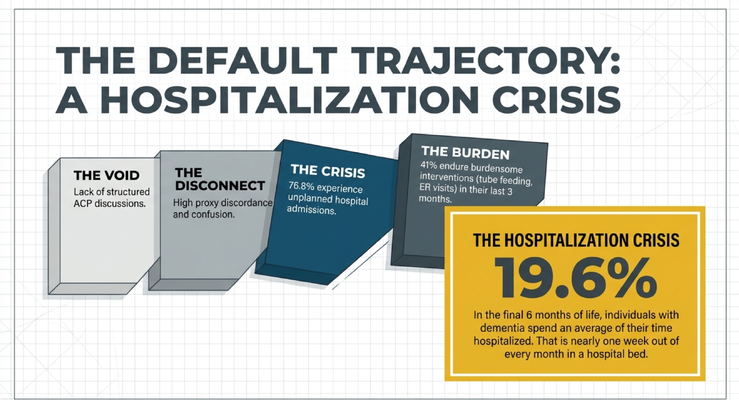
Because in a crisis, if there is no plan, the system defaults to action.
My name is Dr. Erik Ilyayev. I’m a dementia care physician, a board member of the South Florida Alzheimer's Association® , and the CEO of MedBetterHealth.org — one of the organizations selected by Medicare to participate in a groundbreaking new program designed to change how America cares for people living with dementia.
In this issue, I want to walk you through why dementia families need to plan earlier, what documents matter, why a living will is not the same thing as a medical order, and how families can avoid being forced into crisis decision-making when the person they love can no longer speak for themselves.
WHY DEMENTIA MAKES PLANNING DIFFERENT
Dementia changes the timeline.
In many medical conditions, a person may be able to communicate their wishes for a long time. They can explain what they want. They can ask questions. They can weigh options. They can say, “This is acceptable to me,” or “No, I would not want that.”
But dementia is different because decision-making capacity can decline over time.
A person may be able to participate meaningfully in early conversations. They may still understand their values. They may still say, “I would want to be home,” or “I would not want aggressive treatment if there is no meaningful recovery,” or “I want my daughter to make decisions because she knows me best.”
But if the family waits until advanced dementia, that opportunity may be gone.
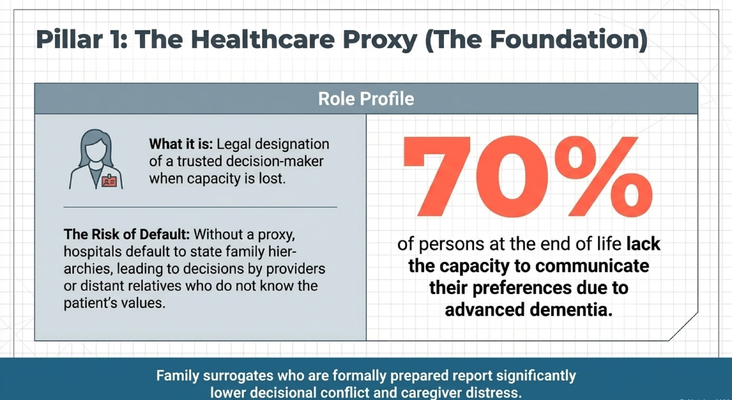
The person may no longer understand the medical situation. They may not be able to communicate preferences. They may not be able to compare options. They may not be able to explain what quality of life means to them.
And then the decision falls on the caregiver.
That is where the burden becomes enormous.
Imagine siblings standing around a hospital bed. One says, “Mom would want everything done.” Another says, “No, Mom never wanted to be kept alive by machines.” Another says, “I don’t know. I can’t make this decision.” The doctors are asking for direction. The patient cannot answer. The clock is moving.
That is not the moment to begin planning.
That is the difficult situation.
And I say this all the time:
It is better to have difficult conversations than to be in difficult situations.
THE HEALTHCARE PROXY: WHO DECIDES?
The first foundation is the healthcare proxy.
A healthcare proxy is the legal designation of a trusted decision-maker who can speak for the person when that person no longer has the capacity to make medical decisions.
This matters because when a person living with dementia cannot make a decision, the medical team needs to know who has authority.
Not who is loudest.
Not who arrived first.
Not who feels strongest.
Who is legally designated to decide?
If there is no proxy, hospitals may have to follow state family hierarchy rules. That can create confusion. It can involve relatives who may not know the patient’s values. It can place decision-making pressure on people who were never prepared for it.
And here is the part families do not always understand:
Choosing a healthcare proxy is not only about choosing someone who loves you.
It is about choosing someone who knows your values and can carry them out under pressure.
That person needs to understand what you would want if you could not speak. They need to know how you think about suffering, comfort, independence, machines, hospitalization, feeding tubes, resuscitation, and quality of life.
A proxy without a conversation is still guessing.
So do not only sign the form.
Have the conversation.
THE LIVING WILL: WHAT DO YOU VALUE?
The second piece is the living will.
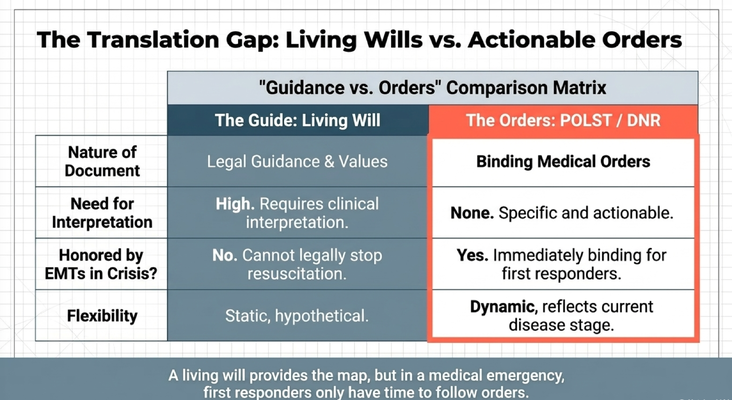
A living will is different from a healthcare proxy. The proxy answers, “Who decides?” The living will helps answer, “What would this person want?”
A living will can describe values and preferences. It can explain what matters most to the person. It can guide the family and clinicians when the person cannot speak for themselves.
But here is the limitation:
A living will often requires interpretation.
It may say, “I do not want heroic measures,” or “I do not want to be kept alive artificially,” or “I want comfort-focused care.”
Those statements matter. They are important. But in an emergency, first responders may not have time to interpret broad language. They need clear orders.
This is why families can get confused.
They say, “But we had a living will.”
And yes, that living will may be meaningful. It may guide the family. It may guide the doctors. It may clarify values.
But a living will alone may not stop CPR in the home if first responders arrive and there is no immediately valid medical order available.
A living will provides the map.
But in a medical emergency, first responders often need orders.
DNR, DNI, POLST, AND MOLST: TURNING VALUES INTO ORDERS
Now let’s talk about the documents families often hear about but do not fully understand.
DNR means Do Not Resuscitate.
DNI means Do Not Intubate.
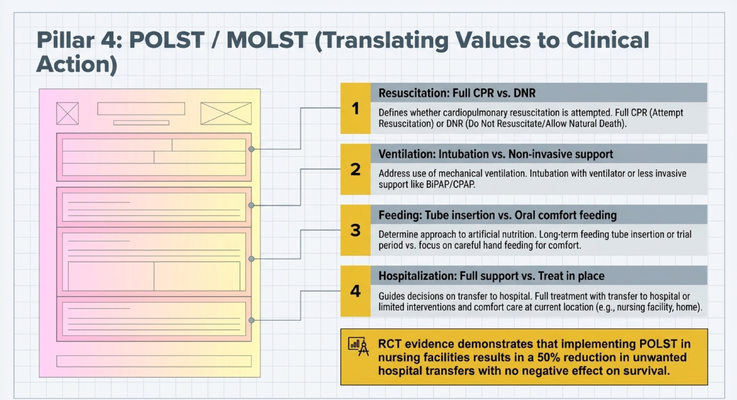
POLST or MOLST forms vary by state, but the idea is similar: they help translate a person’s medical wishes into actionable medical orders.
These documents can address questions like:
Should CPR be attempted if the heart stops?
Should intubation and mechanical ventilation be used if the person cannot breathe?
Should artificial nutrition, such as a feeding tube, be used in advanced disease?
Should the person be transferred to the hospital, or should the focus be treatment in place when appropriate?
These are not easy questions.
And I want to be very clear: I am not telling every family what to choose.
There is no single right answer for every person.
Some families may want full intervention. Some may not. Some decisions may change depending on stage of disease, prognosis, reversibility of the illness, religious beliefs, cultural beliefs, and the person’s own values.
The point is not to force one decision.
The point is to prevent guessing.
Because if the person living with dementia can no longer speak, and there is no documentation, the caregiver is left trying to make a medical, emotional, legal, and moral decision in real time.
That is too much weight to place on a family when it could have been discussed earlier.
THE DOCUMENT HAS TO BE AVAILABLE WHERE THE PERSON IS
There is another practical point that families miss all the time.
The document has to be accessible.
If a DNR, POLST, or MOLST form exists but it is sitting in the daughter’s apartment while Mom is at home with an aide, what happens when EMS arrives?
They need the form.
They need it there.
Not later.
Not in someone’s email.
Not in a drawer three towns away.
If the person lives at home, the relevant medical orders should be stored where responders and caregivers can find them, according to the rules in that state. The home health aide, family members, and key caregivers should know where it is. The medical team should know it exists. Copies should be handled according to state requirements.
Again, this is not about telling families what to choose.
It is about making sure that whatever has been chosen can actually be followed.
A plan nobody can find in a crisis is not really a plan.
THE HIERARCHY OF DOCUMENTS
Families often think one form solves everything.
It usually does not.
Better planning is built in layers.
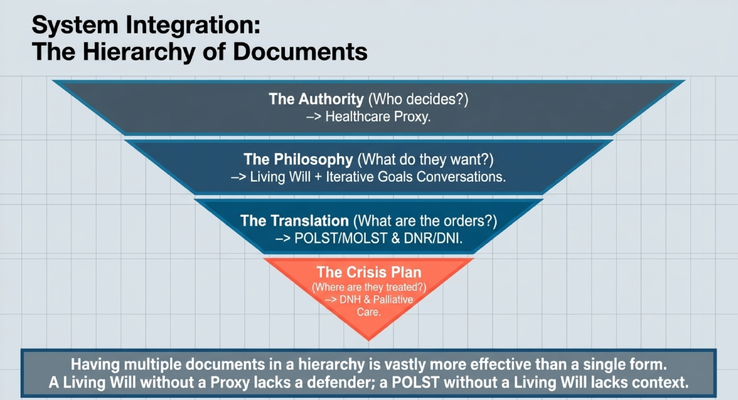
The first layer is authority: who decides? That is the healthcare proxy.
The second layer is philosophy: what does the person want? That is the living will and the ongoing goals-of-care conversation.
The third layer is translation: what are the medical orders? That is where DNR, DNI, POLST, or MOLST forms may apply.
The fourth layer is the crisis plan: where should the person be treated, and what should happen when fever, infection, swallowing problems, breathing problems, falls, or decline appear?
This hierarchy matters because each document does a different job.
A living will without a proxy may lack a defender.
A POLST without values may lack context.
A proxy without conversations may still be guessing.
And a plan without accessible orders may fail during the crisis.
So when I talk to families about advance care planning, I do not want them to think, “We signed one paper. We are done.”
No.
This is a process.
It is a conversation.
It is a structure.
It is a way of protecting the person’s voice before dementia makes that voice harder to access.
COMMON MYTHS ABOUT END-OF-LIFE CARE
There are several myths that make families delay planning.
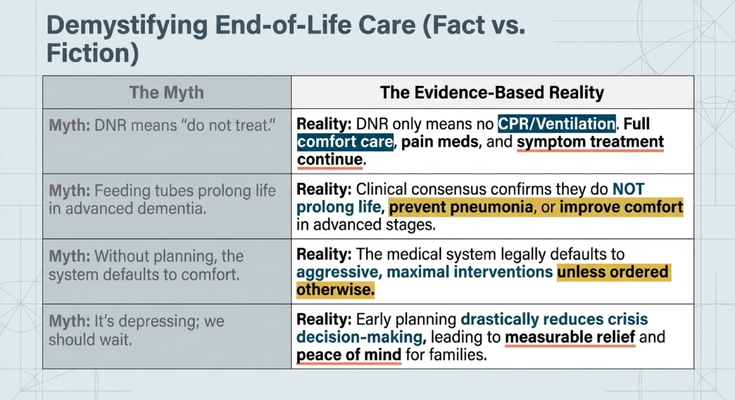
The first myth is that DNR means “do not treat.”
That is not true.
DNR means do not perform CPR if the heart stops. It does not mean the person is abandoned. It does not mean pain is ignored. It does not mean infections are never treated. It does not mean comfort care disappears.
Comfort care, pain management, symptom treatment, dignity, and appropriate medical care continue.
The second myth is that feeding tubes necessarily prolong life in advanced dementia.
This is one of the hardest conversations families face. When Mom is not eating, the adult child naturally thinks, “I have to do something.” That feeling is human. Watching someone you love eat less is painful.
But in advanced dementia, feeding tubes do not always do what families hope they will do. They may not prolong life, prevent pneumonia, or improve comfort in the way families expect. These decisions must be discussed carefully with qualified clinicians, but families should know the question is more complex than “food equals life.”
The third myth is that without planning, the system defaults to comfort.
Actually, the medical system often defaults to maximal intervention unless there are clear orders or clear direction. That is not because clinicians are bad. It is because, legally and ethically, when there is uncertainty in an emergency, the system is built to act.
The fourth myth is that these conversations are too depressing and should be delayed.
I understand that feeling. But waiting does not remove the decision. It only moves the decision into a crisis.
Early planning does not create the problem.
Early planning gives the family peace, clarity, and protection before the problem arrives.
WHAT I WANT CAREGIVERS TO REMEMBER
If you are caring for someone living with dementia, I want you to remember this:
Advance care planning is not one conversation at the end of life.
It is a structured process of love, clarity, and protection.
You are not planning because you want something bad to happen.
You are planning because dementia can eventually take away the person’s ability to speak clearly for themselves.
You are planning so their values do not get lost.
You are planning so the caregiver does not have to guess.
You are planning so siblings do not have to fight in the hallway.
You are planning so first responders and clinicians know what to do.
You are planning so crisis does not make the decision for you.
Start with the healthcare proxy.
Then talk about values.
Then talk about what those values mean medically.
Then ask your clinician what documents are needed in your state.
Then make sure those documents are accessible.
And please do not wait until advanced dementia to begin.
If your loved one is still able to participate in these conversations, include them. Ask what matters. Ask what they fear. Ask what comfort means. Ask what quality of life means. Ask who they trust to speak for them.
These are not easy conversations.
But they are compassionate conversations.

Common questions
Quick answers from this issue
What Happens If Dementia Families Wait Too Long to Plan?
Every week, caregivers ask me some version of the same question: “Dr. Erik, when are we supposed to start talking about the hard decisions?” And I understand why families avoid this conversation.
What should caregivers try first?
Write down what changed, when it started, and what was happening right before it. Reduce noise, slow the conversation down, and use one simple step at a time. Share the pattern with the family, care team, or clinician so everyone responds consistently.
When should families call a clinician?
Call a clinician promptly if the change is sudden, severe, unsafe, tied to a fall, fever, pain, dehydration, medication change, hallucinations, paranoia, or new confusion. Call emergency services for immediate danger.