

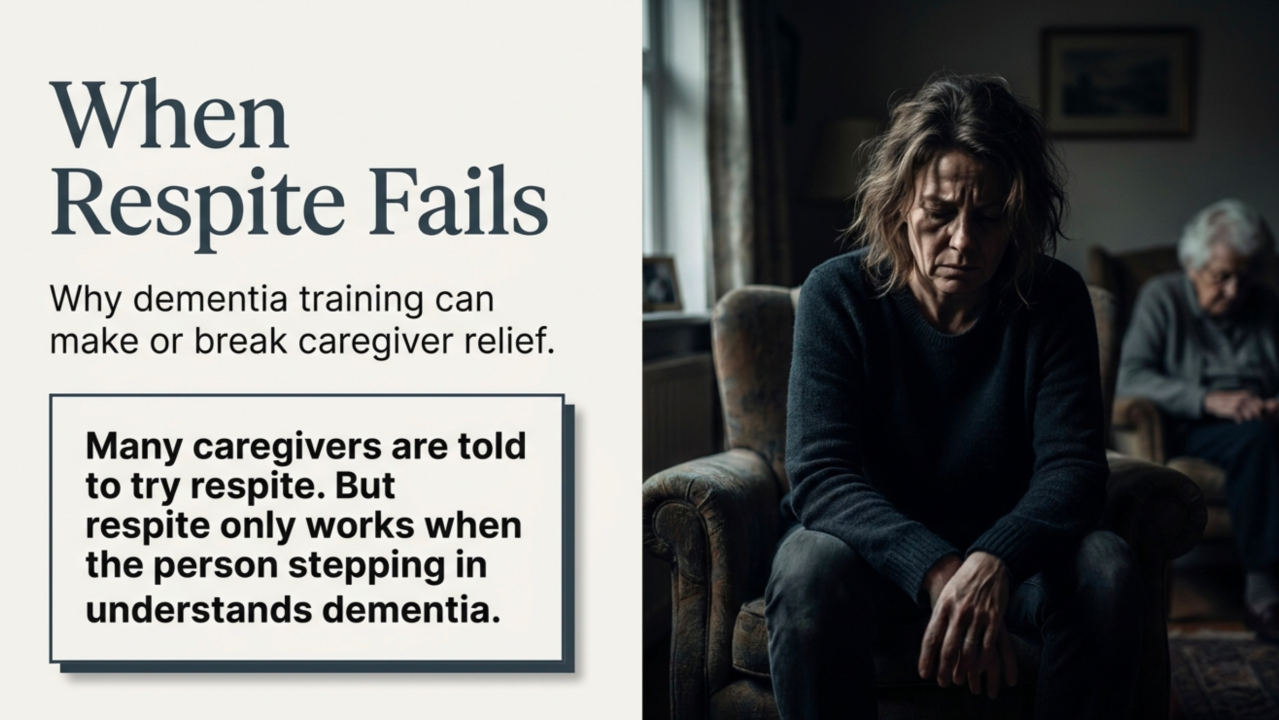
Every week, caregivers ask me some version of the same question:
“Dr. Erik, everyone tells me I need respite. But when I finally try it, my loved one gets agitated, the aide cannot handle it, and I end up getting called back anyway. What am I supposed to do?”
I had that exact conversation with a caregiver recently.
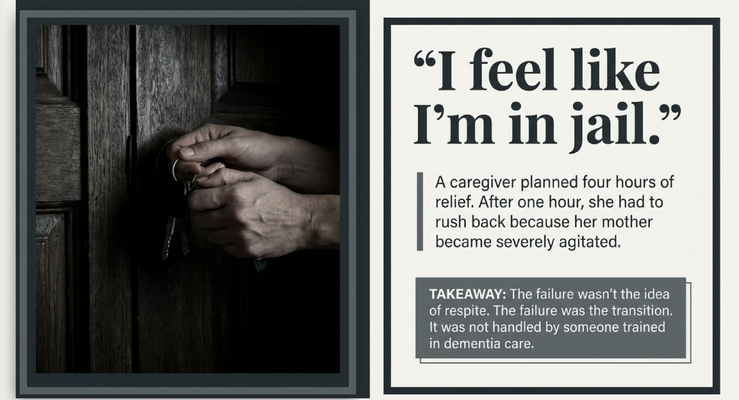
She told me she arranged private duty home care so she could step away for four hours. Four hours. That was all she wanted. Just a small window to breathe, recover, and feel like a person again.
But after one hour, she had to come back.
Her mother became severely agitated. The worker could not manage the situation. And the caregiver said something that stayed with me:
“Dr. Erik, I feel like I’m in jail.”
That sentence is painful, but I know many caregivers understand it.
Because dementia caregiving can make you feel trapped. You want help, but the help does not always work. You want a break, but every break feels like it creates another crisis. You want to step away, but your loved one only wants you.
And then people say, “Just get respite.”
But respite is not magic.
Respite only works when the person stepping in understands dementia.
My name is Dr. Erik Ilyayev. I’m a dementia care physician, a board member of the South Florida Alzheimer's Association®, and the CEO of MedBetterHealth.org — one of the organizations selected by Medicare to participate in a groundbreaking new program designed to change how America cares for people living with dementia.
In this issue, I want to talk about why respite sometimes fails, why that failure does not mean you are stuck forever, and how caregivers can make respite safer, calmer, and more realistic.
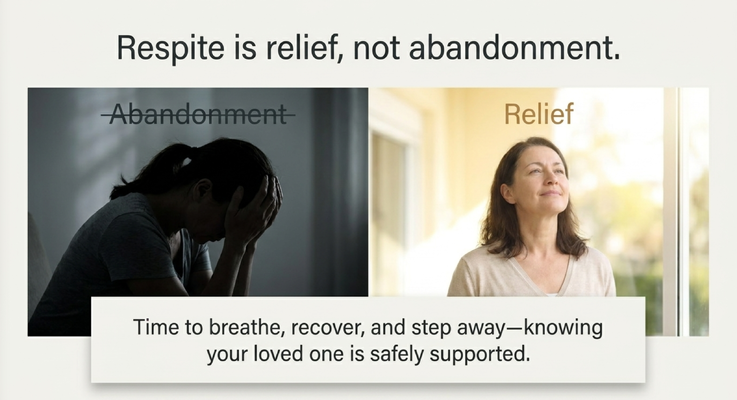
RESPITE IS RELIEF, NOT ABANDONMENT
The first thing I told this caregiver was simple:
You should not feel like you are abandoning your loved one because you need relief.
Respite is not abandonment.
Respite is relief.
It is time to breathe. Time to recover. Time to go to the store without panic. Time to sit in silence. Time to sleep. Time to remember that you are a person too.
And I know caregivers struggle with this.
You may think, “If I leave, something bad will happen.”
You may think, “Nobody understands her like I do.”
You may think, “He only trusts me.”
You may think, “It is easier if I just do it myself.”
But here is the problem: if you become the only support system, eventually the whole care environment becomes fragile.
Dementia care cannot depend on one exhausted person holding everything together indefinitely.
That is not sustainable.
And it is not fair to the caregiver.
WHY THE WRONG APPROACH CAN TRIGGER FEAR
Now, let’s talk about why respite failed in this situation.
The problem was not necessarily the idea of respite.
The problem was the transition.
The person who came into the home may not have known how to approach someone living with dementia.
That matters.
A person living with dementia may not process a new worker the way we do. They may not understand, “This is a helper who is here so my daughter can take a break.”
They may see a stranger.
They may feel rushed.
They may feel watched.
They may feel like something is being done to them.
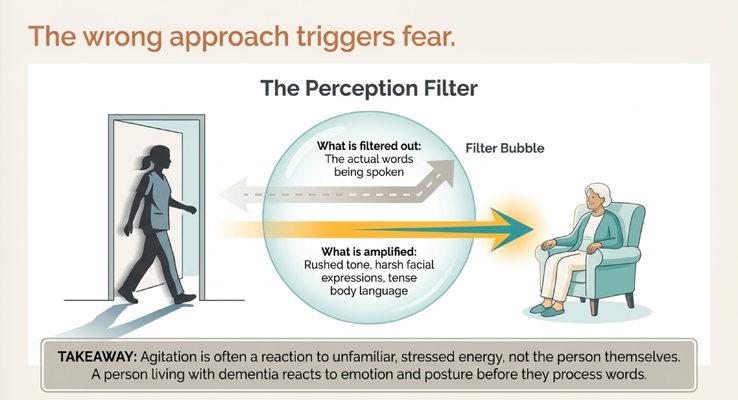
They may react to facial expression, tone, posture, speed, clothing, or body language before they ever process the words being spoken.
If the worker walks in quickly, speaks in a task-focused tone, wears clinical scrubs, looks stressed, or immediately tries to “get things done,” the person living with dementia may feel threatened.
And once the brain feels threatened, agitation can follow.
This is why dementia care is not only about physical assistance.
It is about emotional safety.
A person living with dementia may not remember the worker’s name. But they can still feel the worker’s energy. They can still react to a rushed approach. They can still feel whether the person is calm, warm, and safe.
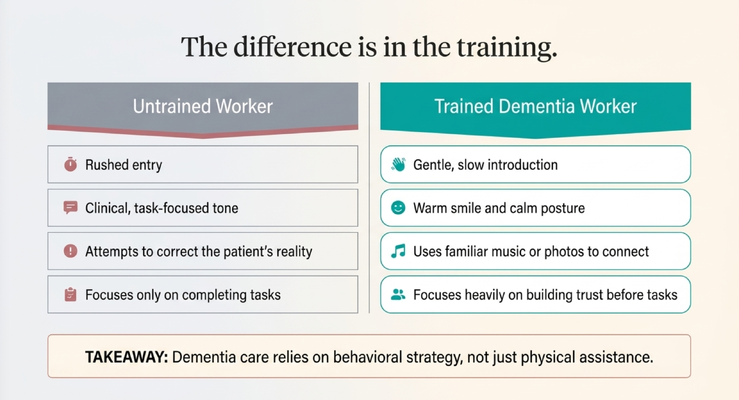
THE DIFFERENCE IS TRAINING
This is where training matters.
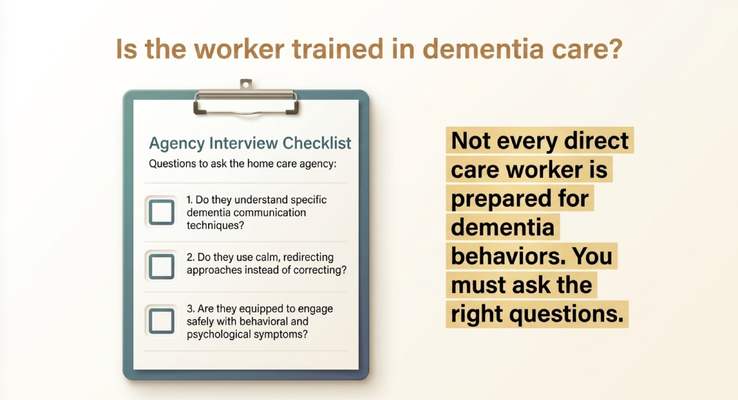
Not every direct care worker is prepared for dementia behaviors.
That does not mean they are bad people. It means dementia care requires a specific skill set.
An untrained worker may walk in quickly, speak in a clinical tone, focus immediately on tasks, correct the person’s reality, or try to force cooperation.
A trained dementia worker approaches differently.
They enter slowly. They smile. They use a calm posture. They introduce themselves gently. They do not rush straight into bathing, toileting, medication, or task completion. They use familiar music, photos, conversation, and connection before care.
They understand that trust comes before tasks.
That is the sentence I want families and home care agencies to remember:
Trust comes before tasks.
If the person living with dementia does not feel safe with the worker, the task will fail. Bathing will fail. Dressing will fail. Medication reminders will fail. Respite will fail.
But if the worker knows how to build trust first, the entire visit can change.
WHAT CAREGIVERS SHOULD ASK BEFORE TRYING RESPITE AGAIN
If respite failed once, do not assume it can never work.
Instead, ask better questions before trying again.
When you speak with a home care agency, ask:
Are your workers trained specifically in dementia care?
Do they understand how to approach someone with behavioral and psychological symptoms of dementia?
Do they know how to redirect calmly instead of correcting?
Do they know how to build trust before starting tasks?
Do they know how to use familiar music, photos, and routines?
Are they comfortable with agitation, resistance, repeated questions, paranoia, or confusion?
What do they do if the person refuses care?
How do they communicate with the family if something changes?
These are not rude questions.
These are necessary questions.
Because if you bring in someone who is not trained in dementia care, you may not get respite. You may get one more crisis.
And caregivers do not need another crisis.
They need relief that actually works.
YOU CANNOT BE THE ONLY SUPPORT SYSTEM
The second thing I told this caregiver was this:
You cannot be there 24/7 forever.
I know that sounds harsh, but it is true.
Many caregivers feel like they have no choice. They believe, “I am the only one who can calm her down.” Or, “I am the only one who understands him.” Or, “If I am not there, everything falls apart.”
And maybe right now, that feels true.
But that is exactly why we have to build a better support system.
In Florida, many dementia caregivers are managing their own chronic health conditions. Many caregivers also experience depression, and those are only the numbers that get reported.
Caregiver burnout is not a side issue.
It directly affects the care environment.
If you are exhausted, sleep-deprived, depressed, overwhelmed, and physically worn down, that does not stay separate from caregiving. It affects patience. It affects decision-making. It affects emotional regulation. It affects your ability to respond calmly when dementia behaviors escalate.
This is why caregiver support is not optional.
It is part of the care plan.
PUT YOUR OWN MASK ON FIRST
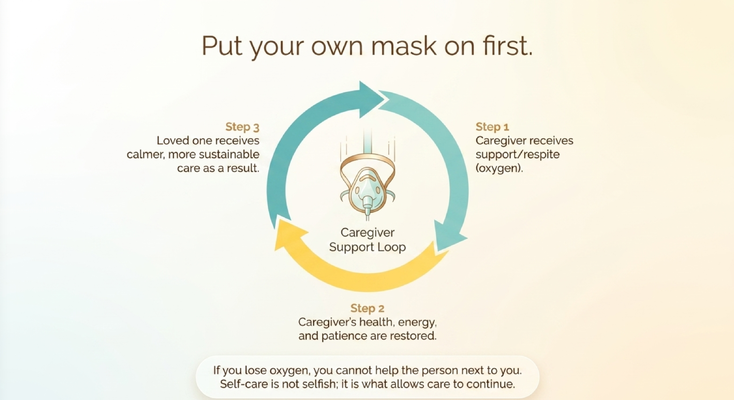
I always use the airplane example.
When you are on an airplane and the oxygen masks drop, what do they tell you?
Put your own mask on first.
Why?
Because if you lose oxygen, you cannot help the person next to you.
Dementia caregiving works the same way.
If you do not take care of yourself, eventually you will not be able to take care of your loved one.
That does not mean you love them less.
It means you are human.
Self-care is not selfish. Respite is not abandonment. Relief is not betrayal.
Relief is what allows care to continue.
If you want your loved one to receive calm, patient, sustainable care, then the caregiver needs oxygen too.
THE RIGHT PERSON IN THE RIGHT SEAT
The goal is not just to bring in any person and hope it works.
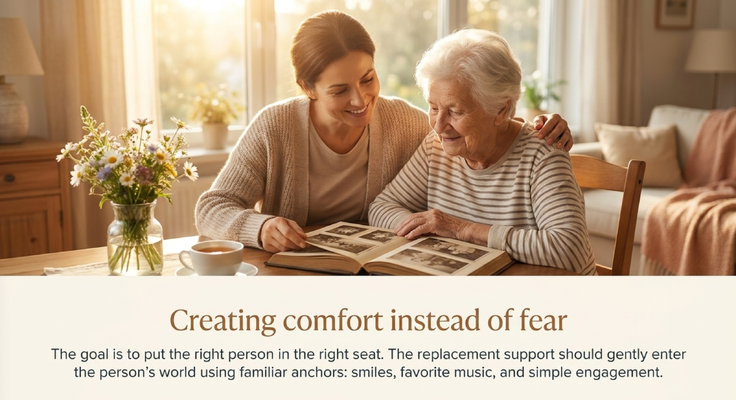
The goal is to put the right person in the right seat.
That means someone trained in dementia care. Someone who understands how to enter the home slowly. Someone who knows not to rush. Someone who can smile, connect, use music, point to photos, speak gently, and build trust before trying to complete tasks.
Maybe the worker comes in and says:
“Hi, Mrs. Smith. It is so nice to see you.”
Maybe they sit for a few minutes before doing anything.
Maybe they look at family photos.
Maybe they put on a favorite song.
Maybe they ask about something familiar.
Maybe they let the person living with dementia feel safe before the caregiver steps away.
That is the difference.
The replacement support should not feel like a stranger taking over.
It should feel like someone gently entering the person’s world.
HOW TO TRY RESPITE AGAIN
If respite failed the first time, I would not tell a caregiver, “Just give up.”
I would say, “Let’s rebuild the transition.”
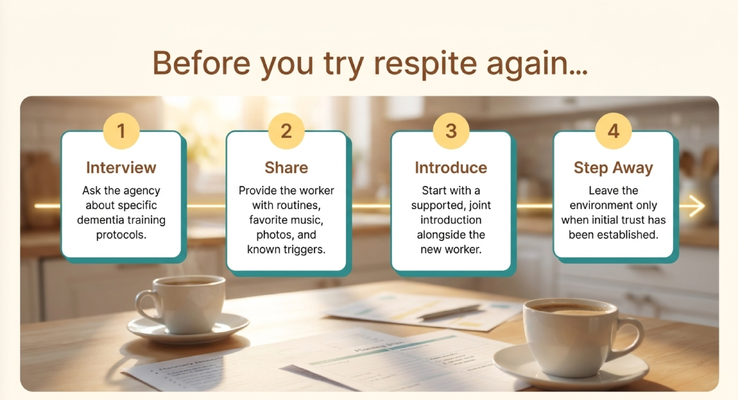
First, interview the agency. Ask about dementia training. Ask how they handle agitation, refusal, paranoia, and confusion.
Second, share what matters. Give the worker your loved one’s routine, favorite music, favorite photos, known triggers, preferred foods, calming activities, and personal history.
Third, introduce the worker while you are still present. Do not disappear immediately. Let your loved one see you interacting calmly with the worker. Let trust transfer slowly.
Fourth, step away only after the first layer of trust is established. Maybe the first visit is not four hours alone. Maybe the first visit is one hour with you nearby. Maybe the second visit is a little longer. The goal is to build tolerance gradually.
This is not failure.
This is dementia care.
Sometimes you have to train the transition before you can use the support.
DEMENTIA CARE TAKES A TEAM
I want caregivers to hear this clearly:
You were not meant to do this alone.
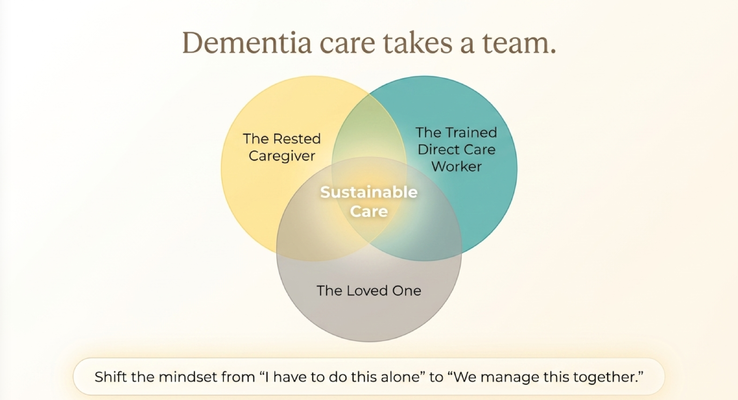
Dementia care takes a team.
The loved one needs support. The caregiver needs support. The direct care worker needs training. The family needs guidance. The home care agency needs a plan. The medical team needs to understand what is happening inside the home.
Sustainable care happens where those pieces overlap.
The rested caregiver.
The trained direct care worker.
The loved one living with dementia.
That is the goal.
Not one person carrying everything.
A team.

Common questions
Quick answers from this issue
Why Does Respite Care Sometimes Fail for Dementia Caregivers?
Every week, caregivers ask me some version of the same question: “Dr. Erik, everyone tells me I need respite. But when I finally try it, my loved one gets agitated, the aide cannot handle it, and I end up getting called back anyway. What am I supposed to do?” I had that exact conversation with a caregiver recently.
What should caregivers try first?
Write down what changed, when it started, and what was happening right before it. Reduce noise, slow the conversation down, and use one simple step at a time. Share the pattern with the family, care team, or clinician so everyone responds consistently.
When should families call a clinician?
Call a clinician promptly if the change is sudden, severe, unsafe, tied to a fall, fever, pain, dehydration, medication change, hallucinations, paranoia, or new confusion. Call emergency services for immediate danger.