

Every week, caregivers ask me some version of the same question:
“Dr. Erik, why does my loved one keep doing this?”
Why does Mom pace the same hallway?
Why does Dad check the door again and again?
Why does my husband ask the same question every five minutes?
Why does my wife rummage through drawers, move things around, or follow me from room to room?
And I understand why families get exhausted.
Because when you are living with these behaviors every day, it can feel like the person is being difficult on purpose.
But here is what I want you to remember:
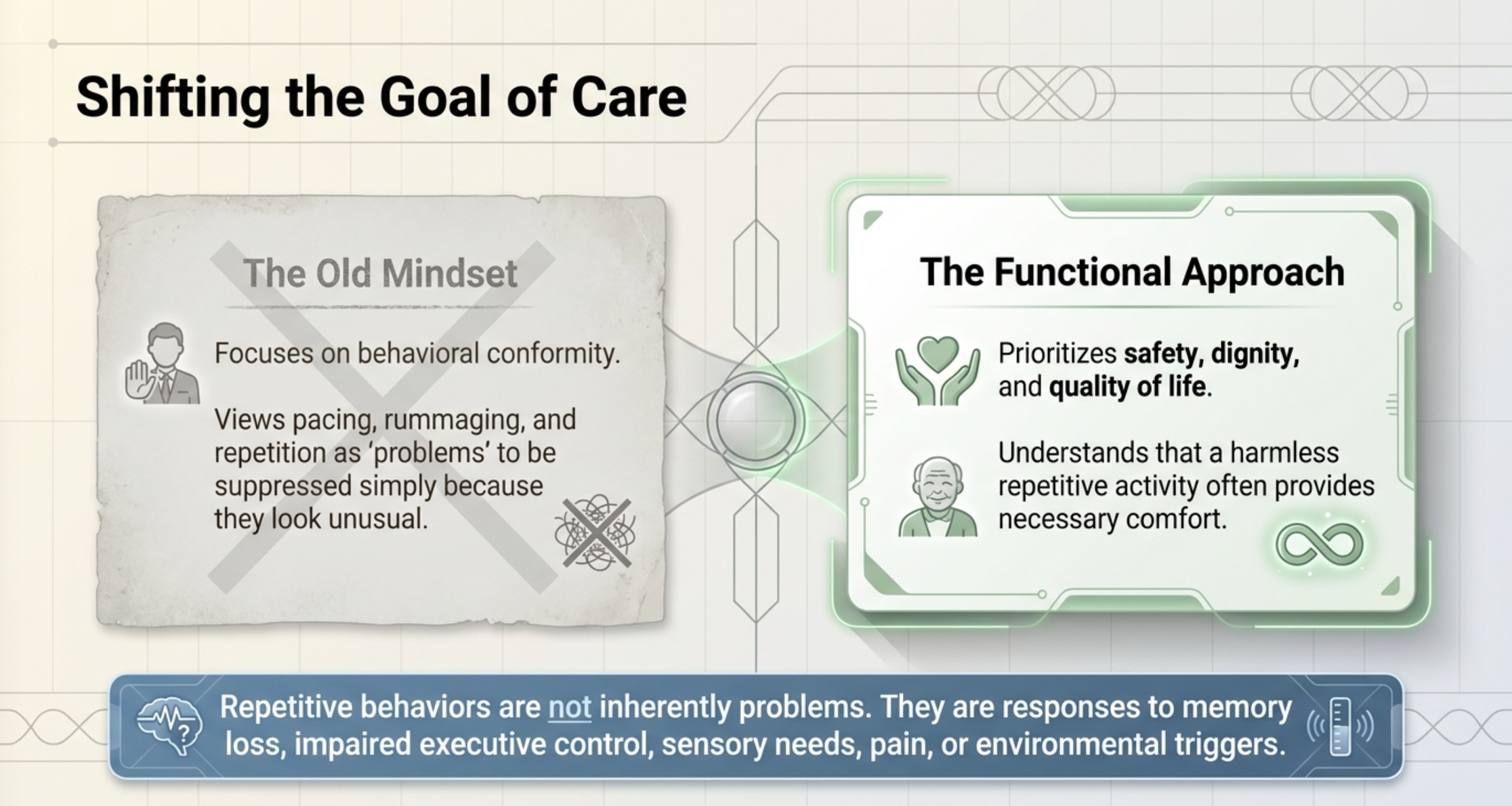
Behavior is communication.
When memory changes, language becomes harder. Reasoning becomes harder. Executive function becomes harder. The person may not be able to say, “I am scared,” or “I am bored,” or “I am in pain,” or “I need something familiar.”
So the behavior starts speaking for them.
My name is Dr. Erik Ilyayev. I’m a dementia care physician, a board member of the South Florida Alzheimer's Association® , and the CEO of MedBetterHealth.org — one of the organizations selected by Medicare to participate in the GUIDE Model, an 8-year CMS initiative designed to support people living with dementia and the family caregivers caring for them at home.
In this issue, I want to talk about a simple tool caregivers can use when dementia behaviors become confusing.
It is called the ABC method.
And no, this is not about blaming the person.
This is about becoming a detective.
Because once you understand what is happening before, during, and after the behavior, you can stop guessing and start responding with more confidence.
BEHAVIOR IS NOT RANDOM
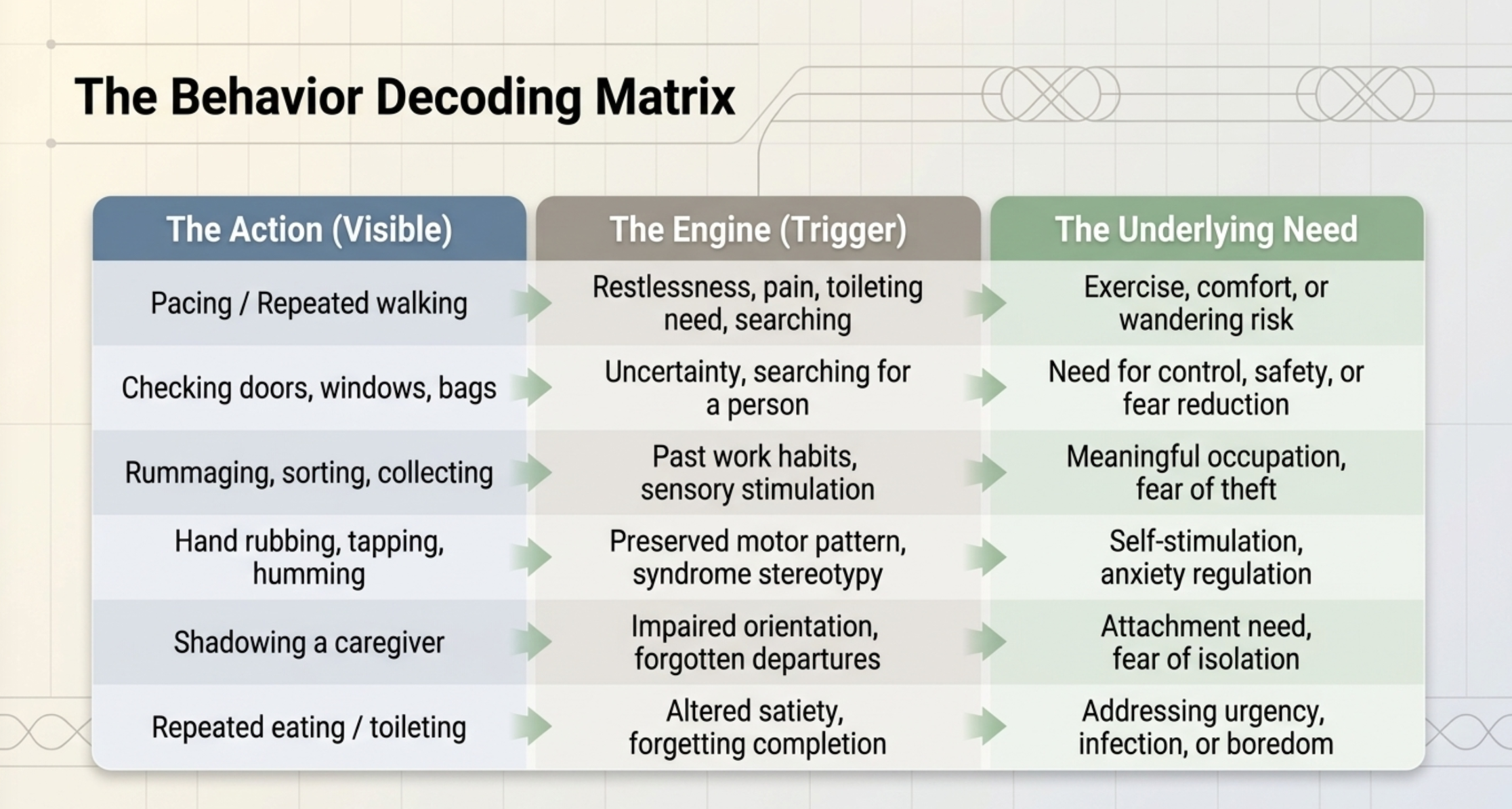
Let’s say your loved one is pacing.
The first reaction may be:
“Why won’t they sit down?”
But pacing may not be random.
Maybe they are anxious.
Maybe they are in pain.
Maybe they are looking for something familiar.
Maybe the room is too loud.
Maybe they are tired.
Maybe they used to walk every day after work, and the body still remembers that routine even when the mind cannot explain it.
Or maybe your loved one keeps checking the locks.
You may think:
“Why do they keep doing that? I already told them the door is locked.”
But maybe the behavior is coming from fear.
Maybe they do not feel safe.
Maybe they need control.
Maybe they are trying to protect the home the only way they know how.
This is why we have to slow down.
Not every behavior needs to be stopped.
Some behaviors need to be understood.
THE ABC METHOD
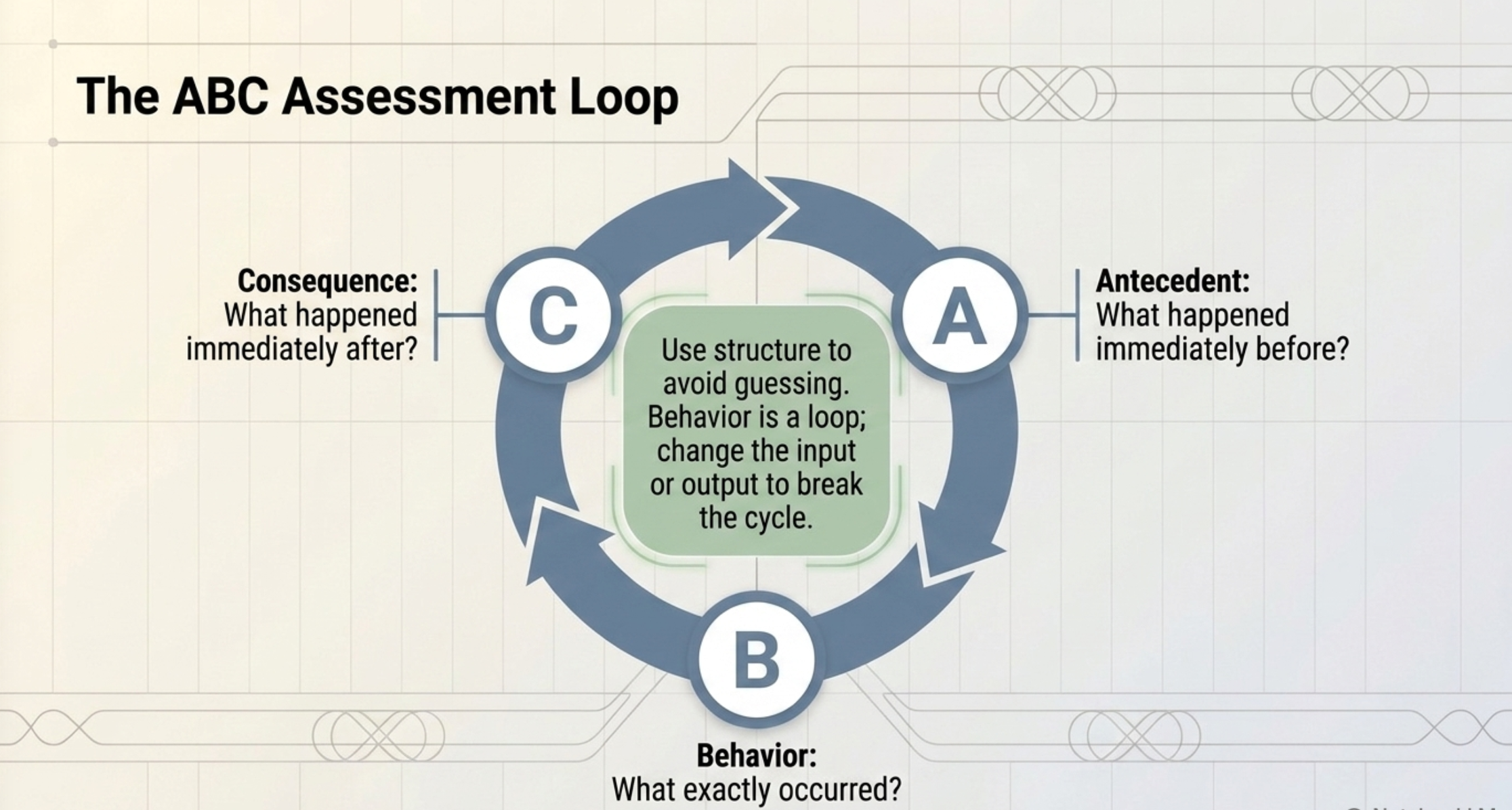
The ABC method is simple.
A stands for Antecedent.
B stands for Behavior.
C stands for Consequence.
That means we ask three questions.
What happened right before the behavior?
What exactly did the person do?
What happened right after?
That is it.
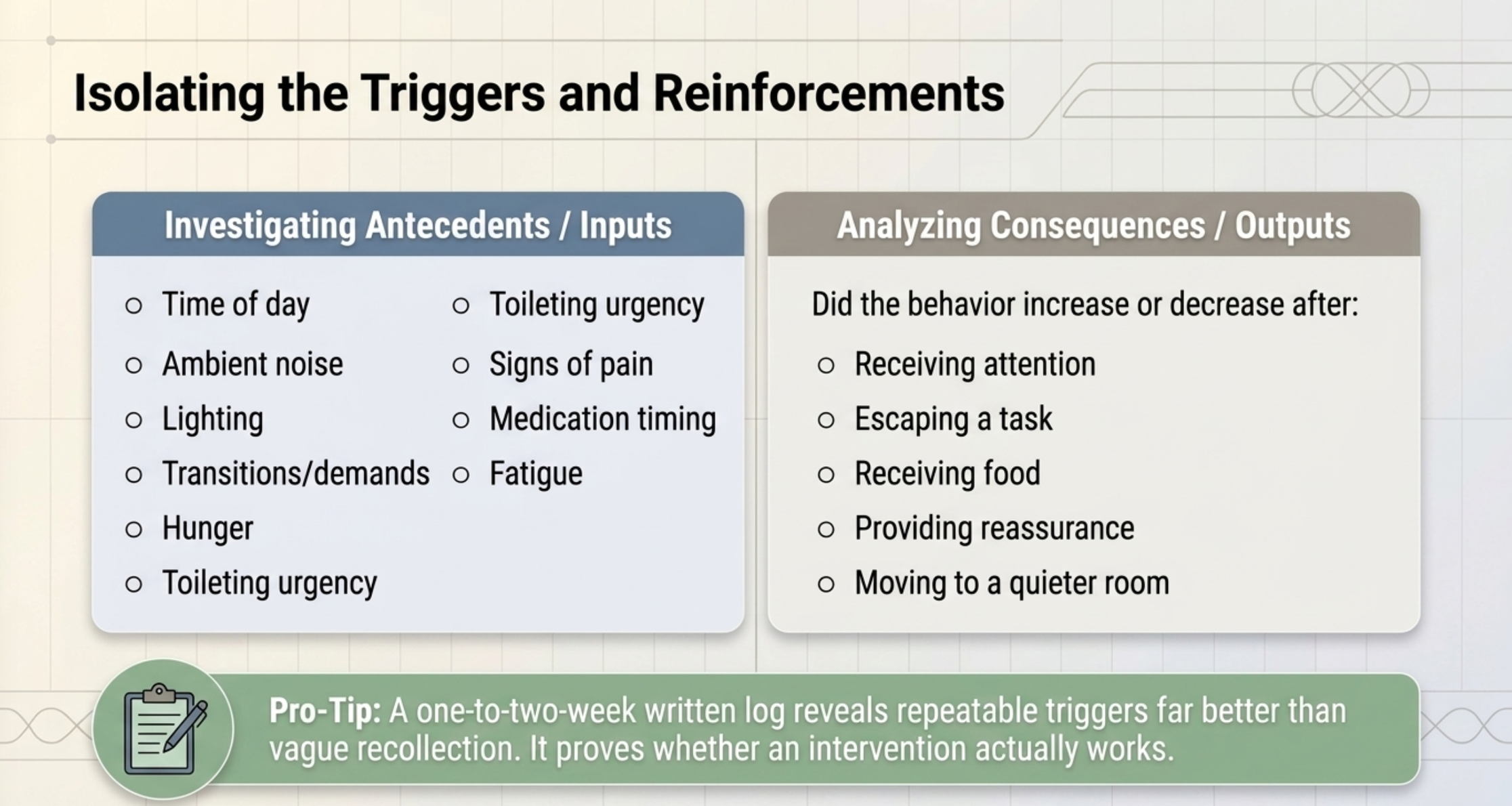
But if you write this down for one or two weeks, patterns start showing up.
Maybe the pacing happens every evening when the house gets darker.
Maybe the repeated questions happen when the room is noisy.
Maybe the agitation happens after a shower is mentioned.
Maybe the rummaging happens when the person is bored and has nothing meaningful to do.
Maybe the behavior gets worse when too many people are talking at once.
Now you are not just reacting.
You are learning.
And that changes everything.
DROP THE LABELS
When you write down the behavior, do not write:
“Mom was being difficult.”
“Dad was aggressive.”
“She was acting crazy.”
“He was doing it on purpose.”
Those words do not help you solve the problem.
Write what actually happened.
“Mom paced the hallway for 30 minutes.”
“Dad asked about work 12 times in one hour.”
“She opened the kitchen drawer five times.”
“He tried to leave through the front door twice.”
That gives you useful information.
It gives the doctor useful information.
It gives the care team useful information.
And it helps you respond instead of just react.
ASK THE HARM QUESTION
Before you intervene, ask yourself:
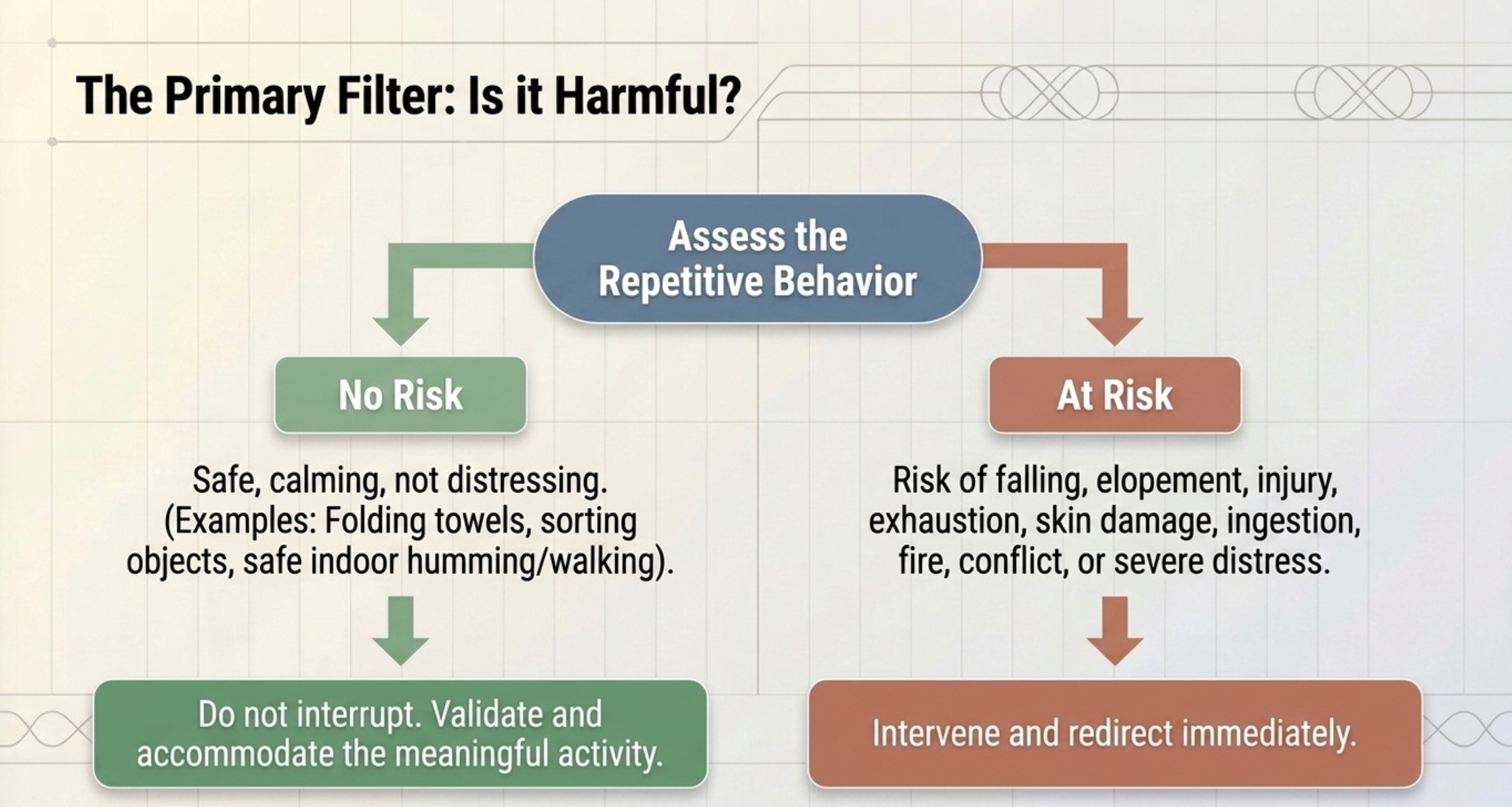
Is this behavior actually harmful?
Because sometimes caregivers interrupt behaviors that are not dangerous.
If your loved one is folding the same towel again and again, and they are calm, safe, and not distressed, maybe we do not need to stop that.
If they are humming, sorting safe objects, pacing in a clear safe hallway, or repeating a harmless routine that brings comfort, maybe the behavior is serving a purpose.
But if the behavior is dangerous, that is different.
Trying to leave the house.
Turning on the stove.
Drinking something unsafe.
Taking the wrong medication.
Handling knives.
Falling repeatedly.
Becoming severely exhausted.
Those behaviors need intervention.
So the question is not:
“Does this look strange to me?”
The question is:
“Is this unsafe, distressing, or harmful?”
That is a better question.
PRESERVE THE NEED, CHANGE THE RISK
Here is the key.
Do not only try to stop the behavior.
Try to understand the need underneath it.
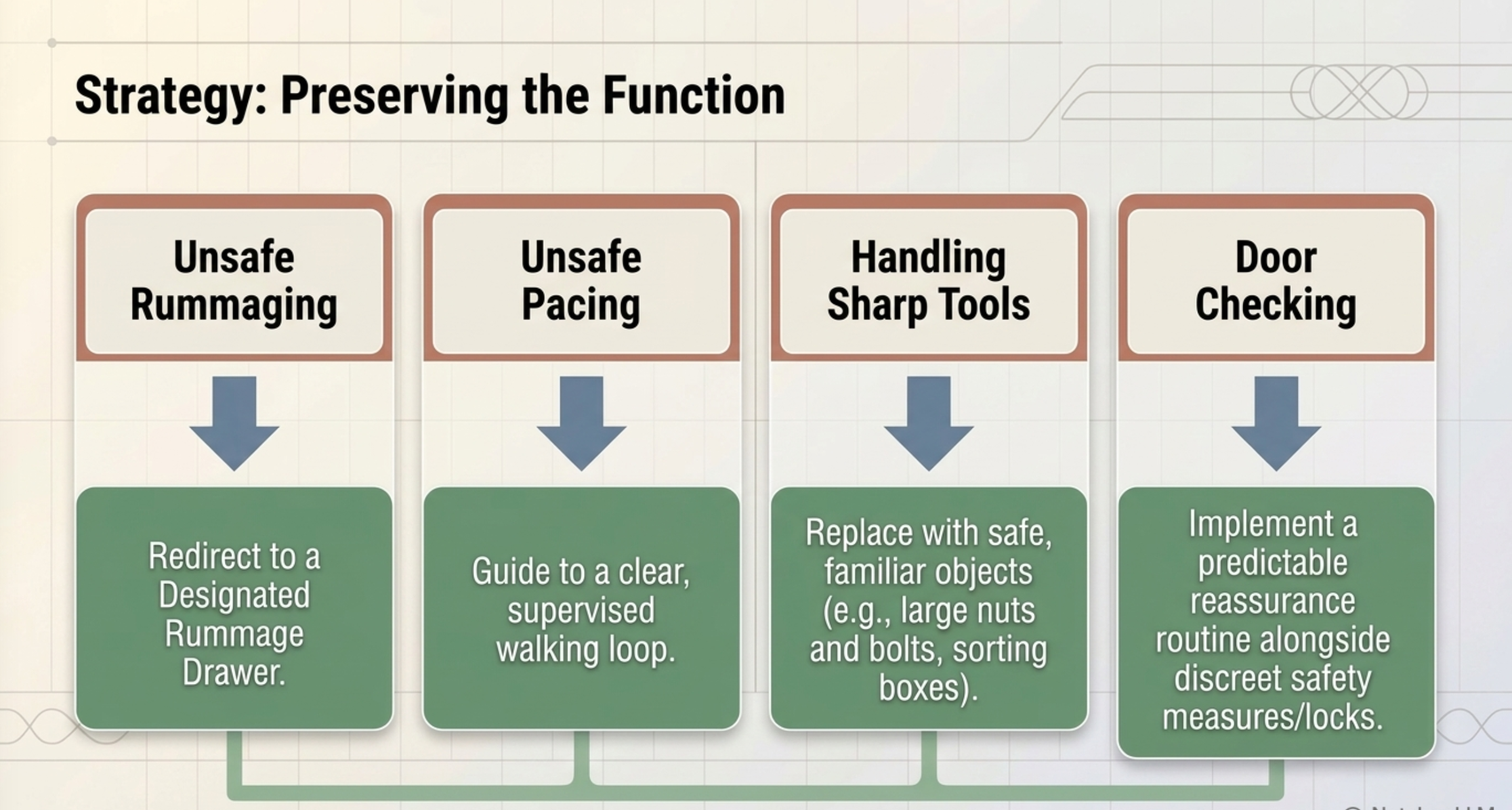
If your loved one is rummaging through unsafe drawers, create a safe rummage drawer.
Put in familiar objects.
Old photos.
Soft fabric.
Safe household items.
Things they can touch, sort, and explore without danger.
If your loved one is pacing in an unsafe area, create a safer walking loop.
Clear the path.
Improve the lighting.
Remove clutter.
Make sure they are not walking near stairs, the stove, or the front door.
If your loved one keeps reaching for sharp tools, replace them with safe familiar objects.
The goal is not to win an argument.
The goal is to preserve the function of the behavior while reducing the risk.
That is dementia care.
That is meeting the person where they are.
VALIDATE BEFORE YOU REDIRECT
One of the biggest mistakes families make is arguing with the reality of the person living with dementia.
If Dad says, “I need to go to work,” and he retired 20 years ago, you may want to say:
“Dad, you do not work anymore. Stop saying that.”
But that usually does not help.
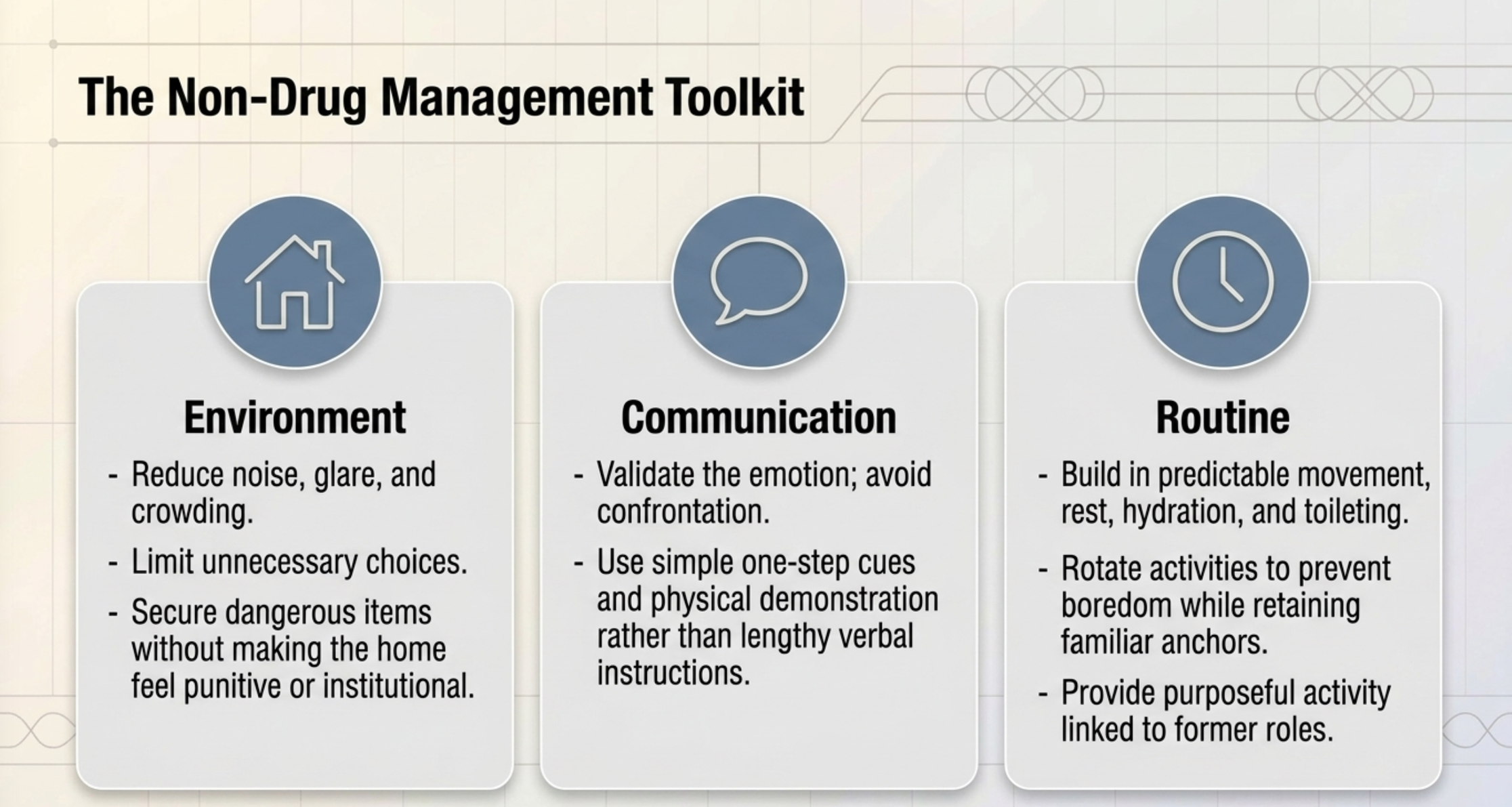
Instead, try to validate the feeling.
“You were always such a hard worker.”
“You always cared about showing up on time.”
“I know that was important to you.”
Then redirect.
“Let’s get your jacket and sit for a minute.”
“Come help me with this.”
“Let’s have some coffee first.”
You are not lying to hurt them.
You are connecting with the emotion instead of fighting the facts.
That matters.
WHEN TO CALL THE DOCTOR
Now, I want to be very clear.
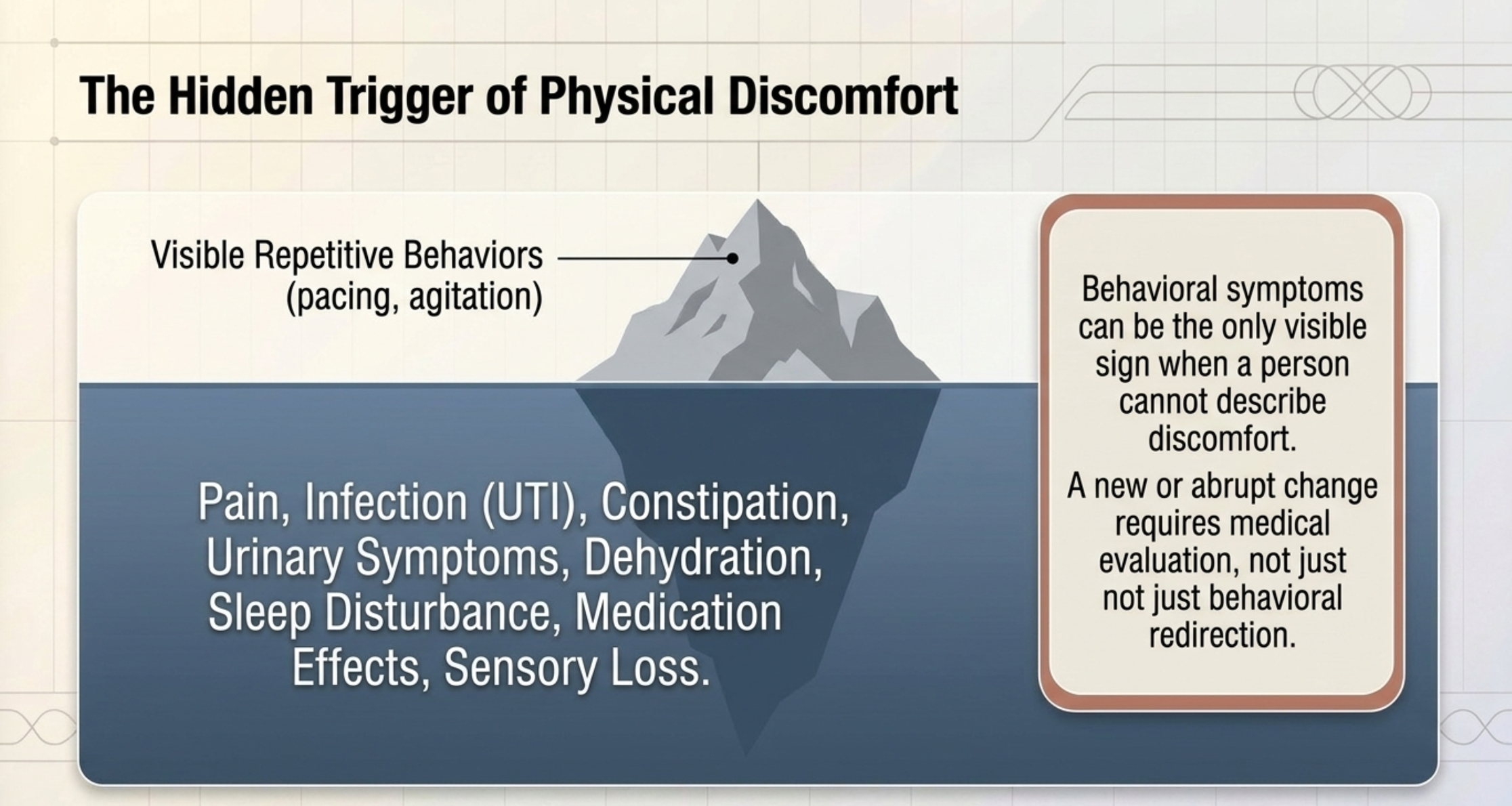
Do not assume every new behavior is “just dementia.”
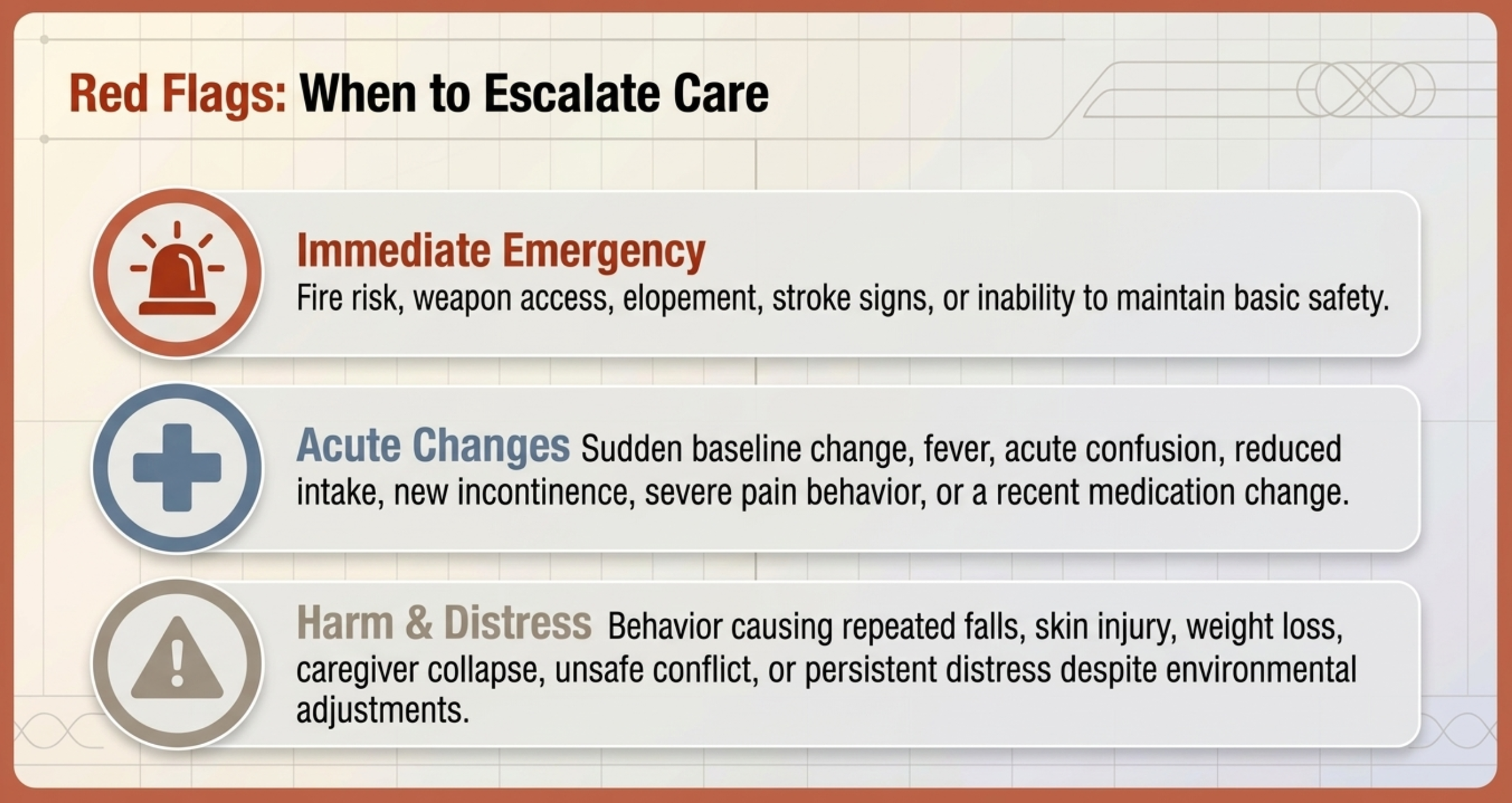
If a behavior changes suddenly, call the doctor.
If your loved one becomes suddenly more confused, suddenly agitated, suddenly sleepy, suddenly paranoid, or suddenly different, that can be a medical issue.
It could be infection.
Dehydration.
Constipation.
Pain.
Medication side effect.
Delirium.
Something else happening in the body.
A sudden change deserves attention.
And if there is immediate danger — fire risk, wandering outside, access to weapons, repeated falls, injury, or severe distress — do not wait.
Get help.
This is education, not medical advice, but I want families to understand this clearly:
A sudden behavior change is not something to brush off.
THE CAREGIVER MATTERS TOO
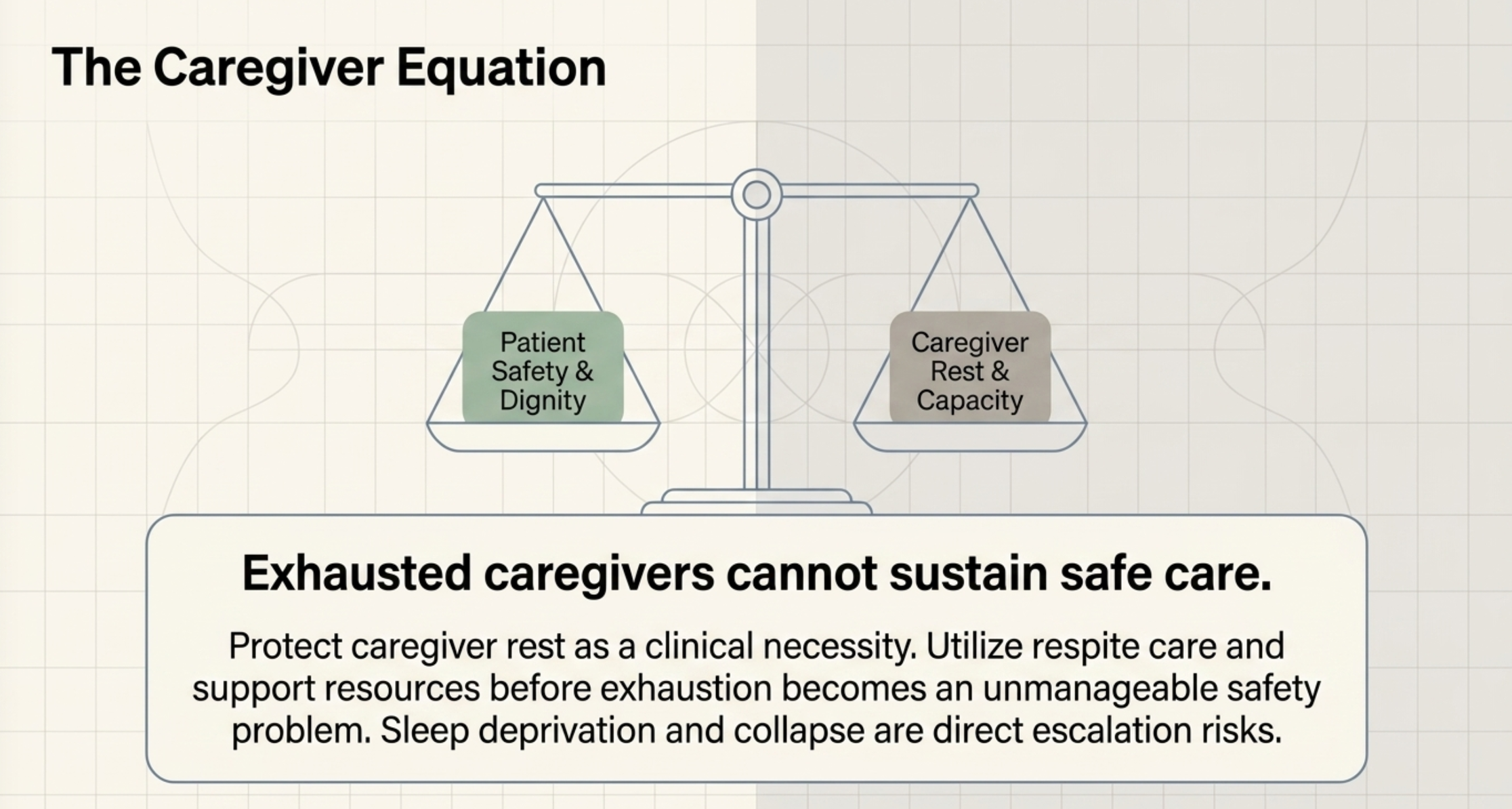
None of this works if the caregiver is running on empty.
You cannot be calm every day if you never sleep.
You cannot problem-solve every behavior if you are exhausted, isolated, and carrying everything alone.
You cannot build a peaceful home if you are constantly in emergency mode.
So when we talk about dementia behaviors, we also have to talk about caregiver support.
Caregivers need rest.
Caregivers need education.
Caregivers need backup.
Caregivers need someone to help them understand what is happening and what to do next.
That is not weakness.
That is care.
Slide deck note
Extra visual from this issue


Common questions
Quick answers from this issue
What Is Your Loved One’s Behavior Trying to Tell You?
Every week, caregivers ask me some version of the same question: “Dr. Erik, why does my loved one keep doing this?” Why does Mom pace the same hallway?
What should caregivers try first?
Write down what changed, when it started, and what was happening right before it. Reduce noise, slow the conversation down, and use one simple step at a time. Share the pattern with the family, care team, or clinician so everyone responds consistently.
When should families call a clinician?
Call a clinician promptly if the change is sudden, severe, unsafe, tied to a fall, fever, pain, dehydration, medication change, hallucinations, paranoia, or new confusion. Call emergency services for immediate danger.