

Every week, caregivers ask me some version of the same question:
“Dr. Erik, my mom has dementia. But what stage is she in? And what am I supposed to do now?”
That is a very important question.
Because a diagnosis by itself is not enough.
You may go with mom or dad to the neurologist, and the doctor says, “Your loved one has Alzheimer’s disease,” or “Your loved one has vascular dementia.” Maybe they prescribe medication. Maybe they schedule a follow-up appointment. And then you walk out of the office, get in the car, and life continues.
But now the real questions begin.
Can mom still live alone?
Should dad still be driving?
When do we need to start thinking about legal documents?
When does wandering become a serious risk?
When do we need home care?
When should we talk about goals of care, hospice, or end-of-life wishes?
These are not small questions.
And the answer depends heavily on one thing:
What stage of dementia are we dealing with?
My name is Dr. Erik Ilyayev. I’m a dementia care physician, a board member of the South Florida Alzheimer's Association®, and the CEO of MedBetterHealth.org — one of the organizations selected by Medicare to participate in a groundbreaking new program designed to change how America cares for people living with dementia.
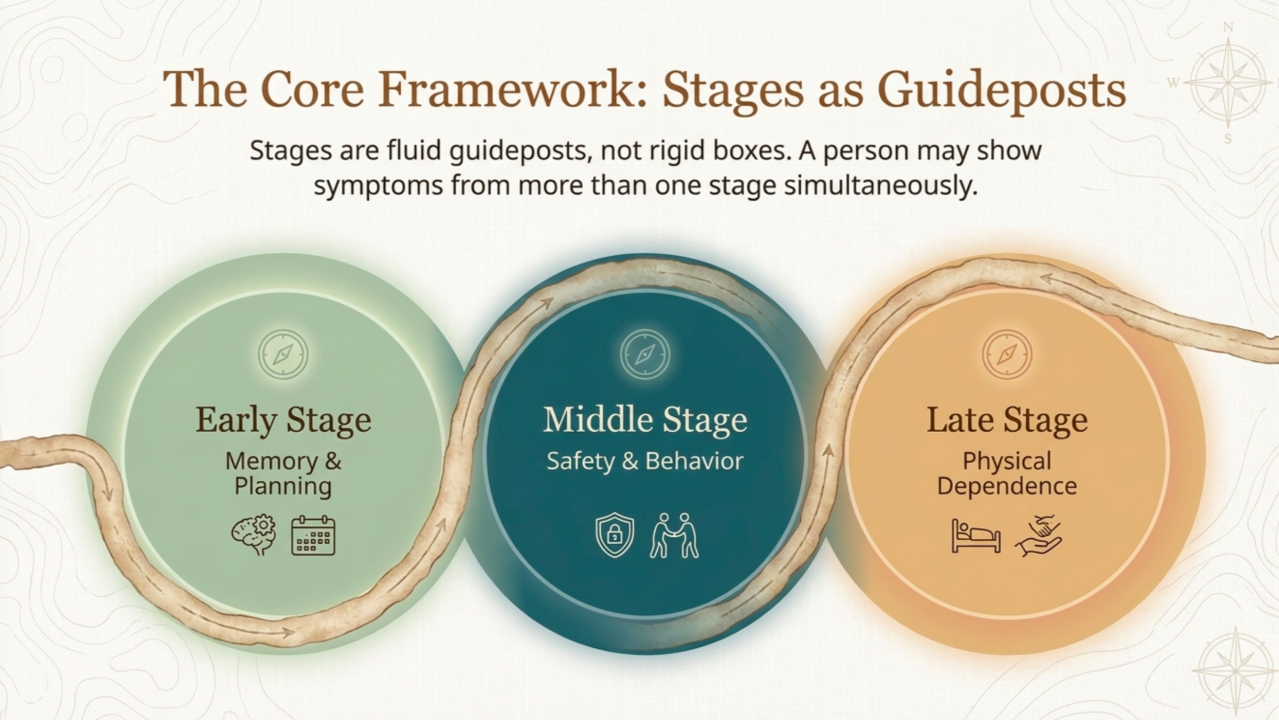
In this issue, I want to walk you through the early, middle, and late stages of dementia — not as labels, but as guideposts. Because once you understand the stage, you can stop guessing and start planning.
WHY STAGING MATTERS
Dementia staging is not about putting your loved one into a box.
It is about understanding what the brain can still handle, what abilities are changing, and what kind of support the caregiver needs to build next.
There are tools clinicians may use to help stage dementia. One is called the FAST scale, which stands for Functional Assessment Staging Tool. Another is the CDR, or Clinical Dementia Rating scale.
The CDR is interesting because it does not only ask the person living with dementia a few quick questions. It also asks the caregiver detailed questions. What was your loved one like before? What has changed? What can they still do? What can they no longer manage? What happened last week? What happened last month? How are they functioning at home?
Then the clinician compares the caregiver’s report with the person’s answers and overall function.
Why does that matter?
Because dementia does not only affect memory.
It affects daily life.
It affects planning, judgment, safety, bathing, dressing, medication management, finances, driving, sleep, behavior, swallowing, mobility, and eventually physical dependence.
So when we talk about dementia stage, we are really asking:
What does this person need now?
And what does the caregiver need to prepare for next?
THE GLOBAL LANDSCAPE: YOU ARE NOT ALONE
Before we talk about the stages, I want caregivers to understand the scale of this.
Dementia is not a rare problem happening to a small number of families. It is a major global public health issue. The field guide highlights an estimated 55 million global cases of dementia, with about 10 million new cases each year. Alzheimer’s disease is the most common cause, accounting for an estimated 60% to 80% of dementia cases.
Those numbers matter because caregivers often feel completely alone.
You may be sitting in your kitchen at 10 PM trying to figure out why mom is confused, why dad is wandering, why your spouse is asking the same question again, or why your loved one is suddenly unable to do something they did their whole life.
And it can feel like nobody understands.
But millions of families are navigating this same journey. The problem is that most caregivers were never given a map.
That is what staging gives you.
Not a perfect prediction.
A map.
THE PROGNOSIS PARADOX
One of the most common questions families ask is:
“How long does someone live after a dementia diagnosis?”
And I understand why families ask that. They are trying to plan. They are trying to understand what comes next. They are trying to prepare emotionally, financially, legally, and practically.
But the answer is not simple.
The field guide explains what I call the prognosis paradox: the average is broad, not exact. Average life expectancy after an Alzheimer’s diagnosis is often discussed around 4 to 8 years, but some individuals live much longer, even up to 20 years.
Age matters. A diagnosis at 65 is not the same as a diagnosis at 90. Overall health matters. Heart disease, frailty, recurrent infections, falls, and other medical conditions can change the trajectory. Dementia type matters. Alzheimer’s disease, Lewy body dementia, vascular dementia, and frontotemporal dementia may progress differently.
And support matters.
Caregiver education, structured routines, safety modifications, medical care, and environmental support can reduce crises and help families navigate the journey with more stability.
So I want families to hear this clearly:
The stage does not tell you the exact future.
But it does tell you what to prepare for.
EARLY STAGE DEMENTIA: MEMORY AND PLANNING
Early stage dementia is often the planning stage.
This is where the person may still live independently with support. They may still hold conversations, participate in decisions, and understand much of what is happening. But you begin to see signs.
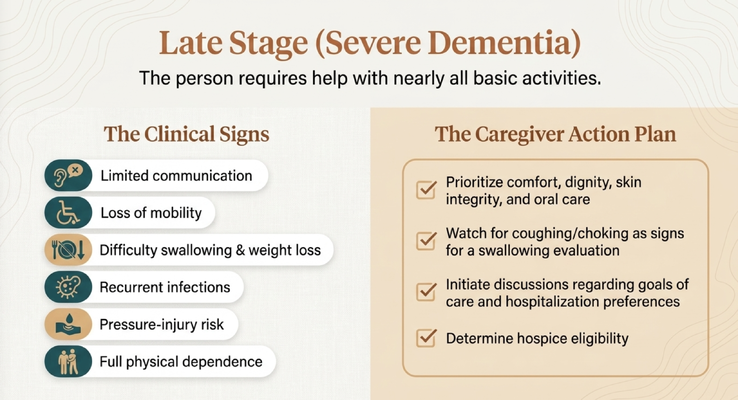
Short-term memory loss. Missed appointments. Word-finding problems. Difficulty managing finances. Medication errors. Getting lost. Social withdrawal.
Maybe mom was always meticulous with her pill box, and now the pills are mixed up. Maybe dad always paid every bill on time, and now there are late notices on the table. Maybe your spouse is still doing well socially, but you notice more confusion with dates, directions, or planning.
This stage can be deceptive because the person may still look “fine” to the outside world.
But the caregiver knows something has changed.
This is the stage where you should confirm the diagnosis and dementia type. This is where you review medications. This is where you begin legal and financial planning. Power of attorney. Will. Advance directives. Healthcare proxy. Goals of care. Driving. Home safety. Support network.
And I know these conversations are uncomfortable.
But I always say this:
It is better to have difficult conversations than to be stuck in difficult situations.
Because if you wait until the middle or late stage, your loved one may no longer be able to participate meaningfully in those decisions. Then the family is left guessing.
What would mom have wanted?
Would dad have wanted aggressive treatment?
Who should make decisions?
What happens to the house?
Who is responsible for care?
These questions can tear families apart if they are ignored early.
Early stage is not only about memory.
It is about planning while your loved one can still be part of the plan.
MIDDLE STAGE DEMENTIA: SAFETY AND BEHAVIOR
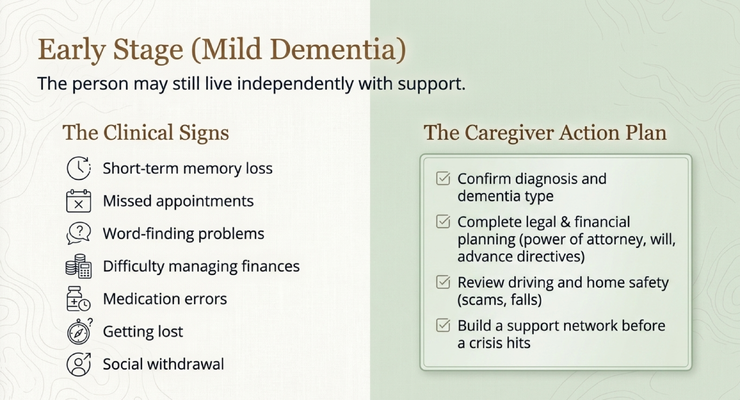
Middle stage dementia is often the longest and most demanding caregiving phase.
This is where the person may need much more help. The caregiver starts to ask, “Can I still leave mom alone?” or “Is dad safe in the house by himself?”
Clinical signs may include obvious confusion, needing help with dressing or bathing, wandering risk, sleep disruption, agitation, paranoia, hallucinations, repetitive questions, and incontinence.
This is where dementia stops being only a memory issue and becomes a full daily-care issue.
A loved one may put on a winter coat in Florida summer because the brain no longer matches clothing to weather. They may wake up at night and become confused. They may accuse you of stealing. They may see or hear things that are not there. They may wander. They may ask the same question 40 times. They may resist bathing, medications, or changing clothes.
And for the caregiver, this is exhausting.
This is the stage where structure becomes medicine.
Create a 24-hour supervision plan. Keep daily routines consistent. Simplify the home. Improve lighting. Label important areas. Lock hazards. Remove unsafe chemicals. Secure medications. Plan for wandering risk. Schedule respite care early.
And most importantly, track behaviors as communication.
Agitation may mean pain.
Repetitive questions may mean anxiety.
Wandering may mean hunger, boredom, fear, or the need for the bathroom.
Sundowning may mean overstimulation, fatigue, light changes, or disrupted routine.
Do not only ask, “How do I stop this behavior?”
Ask, “What is this behavior trying to tell me?”
That question changes everything.
LATE STAGE DEMENTIA: PHYSICAL DEPENDENCE AND COMFORT
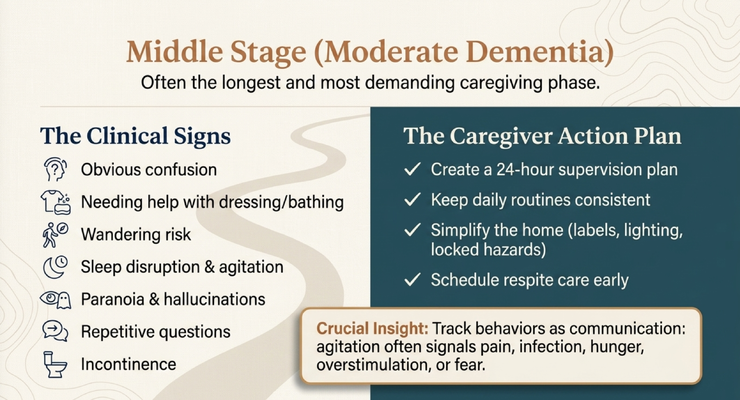
Late stage dementia is where the person requires help with nearly all basic activities.
This stage can include limited communication, loss of mobility, difficulty swallowing, weight loss, recurrent infections, pressure-injury risk, and full physical dependence.
At this stage, the caregiver’s role changes again.
The priority becomes comfort, dignity, skin integrity, oral care, safe feeding, infection prevention, and goals of care.
If your loved one is coughing or choking when eating, that may be a sign of swallowing difficulty. Sometimes food or liquid can go down the wrong way into the airway and lungs. That can lead to aspiration and pneumonia. This is not something to ignore. Families should speak with the medical team and consider whether a swallowing evaluation is needed.
If your loved one is spending more time in bed or a chair, you have to think about pressure injuries. Repositioning, skin checks, nutrition, hydration, and appropriate support surfaces become very important.
This is also where families often need to discuss goals of care.
What would mom have wanted?
Would dad want hospitalization?
Would your loved one want resuscitation or intubation?
What kind of care brings comfort?
When should hospice be discussed?
These are heavy conversations. But they are part of dementia care, and ideally, they should begin earlier — before the crisis.
Late stage care is not about giving up.
It is about changing the goal from pushing function to protecting comfort, dignity, and peace.
THE CAREGIVER’S BLUEPRINT
So what do you do with all of this?
You use the stage as a guide.
In early stage, focus on legal and administrative planning. Complete powers of attorney, wills, advance directives, diagnosis confirmation, medication review, driving assessment, home safety review, and support-network building.
In middle stage, focus on safety and behavior. Secure adult day care or in-home help. Implement 24-hour supervision if needed. Simplify the home layout. Manage behaviors by tracking triggers. Schedule respite. Build routines.
In late stage, focus on comfort and goals of care. Confirm hospice eligibility when appropriate. Prioritize skin integrity, oral care, comfortable positioning, infection prevention, swallowing concerns, and family conversations about what kind of care your loved one would want.
This is the point of staging.
It tells you what to stop expecting and what to start building.
If your loved one is in middle stage dementia and cannot reliably bathe without help, that is not stubbornness. That is the brain losing the ability to sequence and tolerate the task.
If your loved one is in late stage dementia and cannot communicate pain clearly, you have to watch behavior, facial expression, posture, appetite, sleep, and agitation.
If your loved one is in early stage dementia and still has insight, do not waste that window. Use it. Plan while they can still participate.
The stage tells us what the brain can handle.
And once we understand that, we stop expecting skills the disease has already taken away.

Common questions
Quick answers from this issue
What Stage of Dementia Is My Loved One In And What Should I Do Next?
Every week, caregivers ask me some version of the same question: “Dr. Erik, my mom has dementia. But what stage is she in? And what am I supposed to do now?” That is a very important question.
What should caregivers try first?
Write down what changed, when it started, and what was happening right before it. Reduce noise, slow the conversation down, and use one simple step at a time. Share the pattern with the family, care team, or clinician so everyone responds consistently.
When should families call a clinician?
Call a clinician promptly if the change is sudden, severe, unsafe, tied to a fall, fever, pain, dehydration, medication change, hallucinations, paranoia, or new confusion. Call emergency services for immediate danger.