

Every week, caregivers ask me some version of the same question:
“Dr. Erik, why does my mom fight me every time I try to help her shower?”
And I understand why this becomes so frustrating.
Bathing is hygiene. It is safety. It is infection prevention. It is dignity. It is part of being human. So when your loved one refuses, yells, pulls away, grabs your wrist, or says, “I already took a shower,” the caregiver naturally starts thinking:
“Why are they being so stubborn?”
“Why won’t they just let me help?”
“Why does this turn into a fight every time?”
But in dementia care, bathing refusal is not always refusal.
Sometimes the caregiver sees a hygiene task, but the person living with dementia experiences a loss of control.
Sometimes the caregiver sees a shower, but the person feels exposed.
Sometimes the caregiver sees water, soap, and a towel, but the person feels cold air, loud water, bright lights, slippery floors, and fear.
Sometimes the caregiver thinks, “They need to get clean,” but the person living with dementia is thinking, “I do not feel safe.”
That is the shift I want caregivers to understand.
When a person with dementia fights the shower, they are not always refusing hygiene. They may be defending their dignity, their privacy, their body, and their sense of safety.
My name is Dr. Erik Ilyayev. I’m a dementia care physician, a board member of the South Florida Alzheimer's Association® , and the CEO of MedBetterHealth.org — one of the organizations selected by Medicare to participate in a groundbreaking new program designed to change how America cares for people living with dementia.
In this issue, I want to walk you through why bathing becomes so difficult in dementia, why forcing the shower usually makes things worse, and how caregivers can move from bathroom battles to a calmer, more person-centered bathing routine.
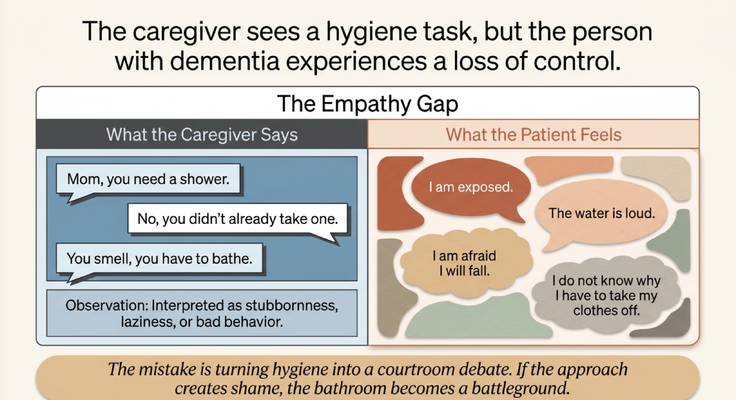
THE CAREGIVER SEES HYGIENE. THE PERSON FEELS THREAT.
Let’s start with what usually happens.
The caregiver says:
“Mom, you need a shower.”
Mom says:
“No, I don’t.”
The caregiver says:
“Mom, it’s been five days.”
Mom says:
“I already took one.”
The caregiver says:
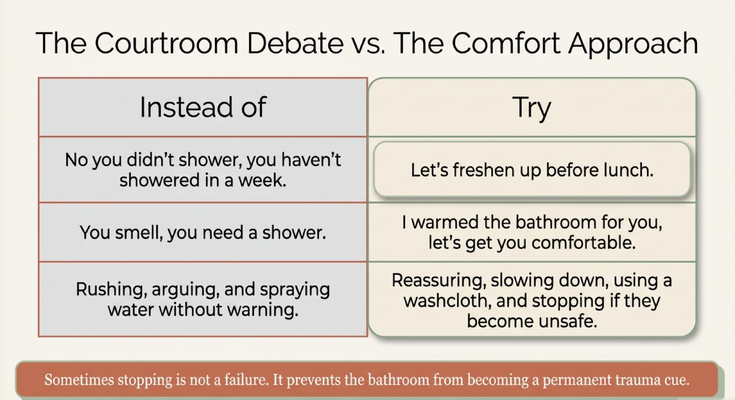
“No, you didn’t. You smell. You have to bathe.”
And now what happened?
The caregiver believes they are telling the truth. And they are.
But the person living with dementia may now feel embarrassed, corrected, exposed, and cornered.
That is where the bathroom becomes a courtroom.
The caregiver starts presenting evidence:
“You didn’t shower.”
“You smell.”
“You need to bathe.”
“Everyone can tell.”
But the person living with dementia is not processing this as helpful information. They may be processing it as shame, threat, and loss of control.
And once shame enters the room, cooperation usually leaves.
This is why bathing cannot begin with accusation. It cannot begin with embarrassment. It cannot begin with “you smell.” It cannot begin with a debate over whether they already showered.
Because the more you turn hygiene into a courtroom argument, the more the bathroom becomes a battleground.
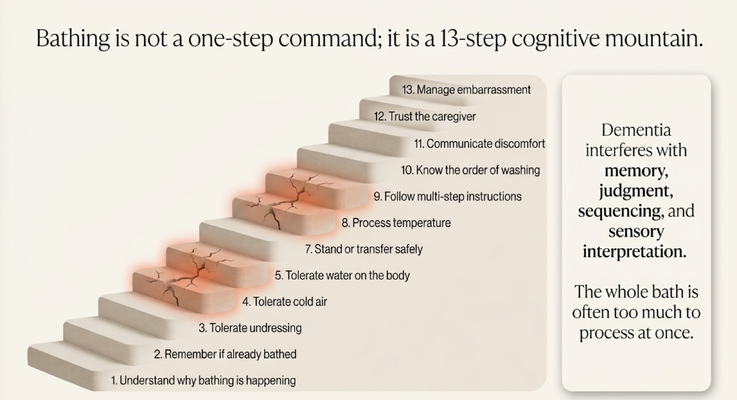
BATHING IS A 13-STEP COGNITIVE MOUNTAIN
Caregivers often think bathing is one task.
“Go take a shower.”
But for a person living with dementia, bathing is not one task. It is a long sequence of cognitive, sensory, emotional, and physical steps.
They have to understand why bathing is happening. They have to remember whether they already bathed. They have to tolerate undressing. They have to tolerate cold air. They have to tolerate water on the body. They have to stand or transfer safely. They have to process temperature. They have to follow multi-step instructions. They have to know the order of washing. They have to communicate discomfort. They have to trust the caregiver. And they have to manage the embarrassment of being exposed.
That is a lot.
And dementia interferes with memory, judgment, sequencing, sensory interpretation, communication, and emotional regulation.
So when we say, “Go take a shower,” we may think we gave one simple instruction.
But the brain may hear a mountain.
That is why a person may refuse before the shower even starts. They may not be refusing the entire bath. They may be overwhelmed by the size of the request.
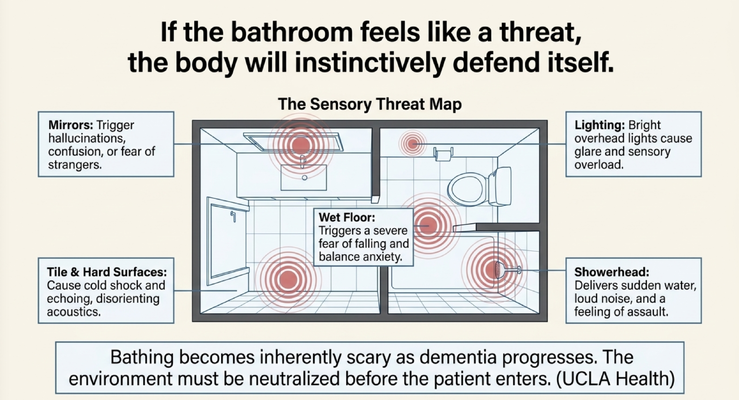
THE BATHROOM CAN FEEL LIKE A THREAT
Now let’s look at the bathroom itself.
To you, it may look normal.
A sink. A mirror. A toilet. A shower. Tile. Lights. Water.
But to a person living with dementia, the bathroom can become one of the most threatening rooms in the house.
Mirrors can trigger confusion. A person may not recognize their own reflection and may think there is a stranger in the room.
Tile and hard surfaces can feel cold, slippery, and unsafe.
Bright overhead lighting can cause glare and sensory overload.
The showerhead can create sudden water, loud noise, and a feeling of being attacked.
A wet floor can trigger fear of falling.
Cold air on exposed skin can create discomfort before the caregiver even begins washing.
So again, the caregiver says, “It’s just a shower.”
But the person living with dementia may feel:
“I am exposed.”
“I am cold.”
“I am afraid I will fall.”
“The water is loud.”
“I do not know why I have to take off my clothes.”
“This room does not feel safe.”
If the bathroom feels like a threat, the body will defend itself.
That defensive reaction may look like resistance, yelling, grabbing, pushing away, or refusing care. But underneath the behavior may be fear.
And if the trigger is fear, force will not solve it.
Preparation will.
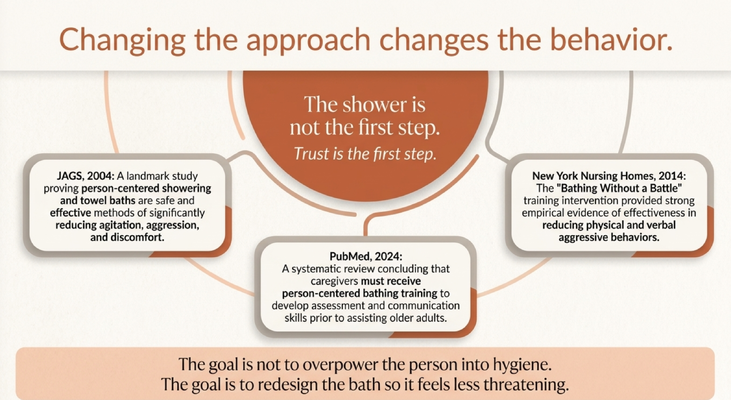
THE SHOWER IS NOT THE FIRST STEP. TRUST IS.
This is one of the most important principles in dementia bathing care:
The shower is not the first step.
Trust is the first step.
If the person does not feel safe with you, the bathing routine is already in trouble. If they feel rushed, corrected, embarrassed, or physically overpowered, their brain may interpret your help as a threat.
The goal is not to overpower the person into hygiene.
The goal is to redesign the bath so it feels less threatening.
That means your tone matters. Your pace matters. The room matters. The towel matters. The music matters. The lighting matters. The temperature matters. The way you approach the person matters.
A calmer approach can change the behavior because the behavior is often responding to the approach.
If the approach creates fear, you get resistance.
If the approach creates trust, you may get cooperation.
PREPARE THE ENVIRONMENT BEFORE YOU INVITE THEM IN
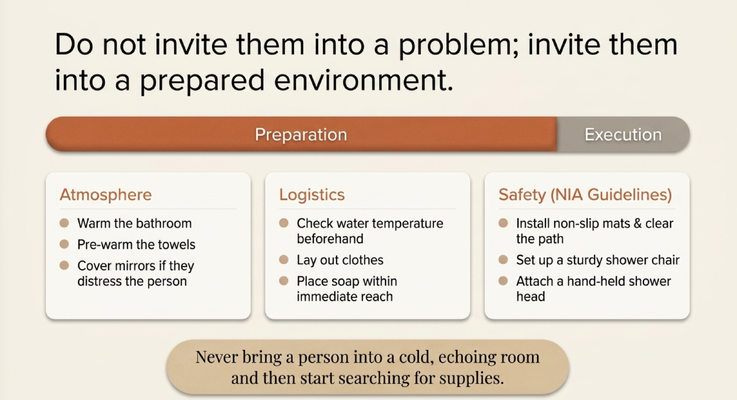
Do not invite a person living with dementia into a problem.
Invite them into a prepared environment.
That means the bathroom should be ready before they arrive.
Warm the room. Pre-warm the towels. Check the water temperature before bringing them in. Lay out clothes. Place soap, washcloths, towels, and supplies within immediate reach. Clear the path. Use non-slip mats. Set up a sturdy shower chair if needed. Use a hand-held showerhead when appropriate, because it gives more control and creates less sudden water exposure than a fixed showerhead spraying from above.
If mirrors distress the person, cover them.
If the lights are too harsh, soften them.
If the floor is cold, use safe non-slip surfaces.
If the room echoes, reduce noise.
What you should not do is bring someone into a cold, echoing bathroom, start undressing them, and then begin searching for towels, clothes, soap, or supplies while they are standing there exposed and confused.
That creates panic.
Preparation lowers threat.
And in dementia care, lowering threat is often the difference between cooperation and combat.
YOU ARE NOT JUST CLEANING THE BODY
This part matters deeply.
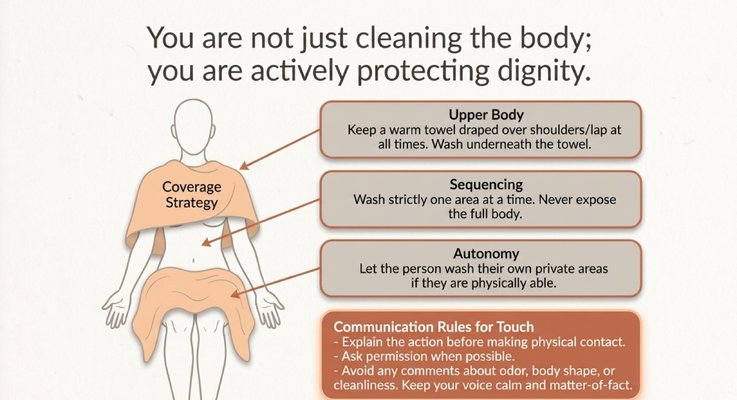
You are not just cleaning the body.
You are protecting dignity.
I want every caregiver to pause and think about this personally.
Imagine you are 80 or 85 years old. Imagine someone has to help you undress. Imagine your adult child is standing there. Imagine you are cold, confused, exposed, and unsure why this is happening.
How would that feel?
Most people would not feel comfortable.
So why do we assume the person living with dementia should feel comfortable?
Dementia changes memory. It changes sequencing. It changes communication. But it does not erase modesty. It does not erase embarrassment. It does not erase the human need to feel respected.
So protect dignity.
Keep a warm towel draped over the shoulders or lap. Wash underneath the towel. Wash one area at a time. Never expose the whole body at once. Let the person wash their own private areas if they are physically able. Explain before you touch. Ask permission when possible. Avoid comments about odor, body shape, cleanliness, or embarrassment.
Keep your voice calm.
Keep your face relaxed.
Make the person feel covered, respected, and safe.
Because if the person feels humiliated, the bath is not just a bath anymore.
It becomes trauma.
GIVE CONTROL, BUT NOT TOO MUCH CONTROL
There is a balance here.
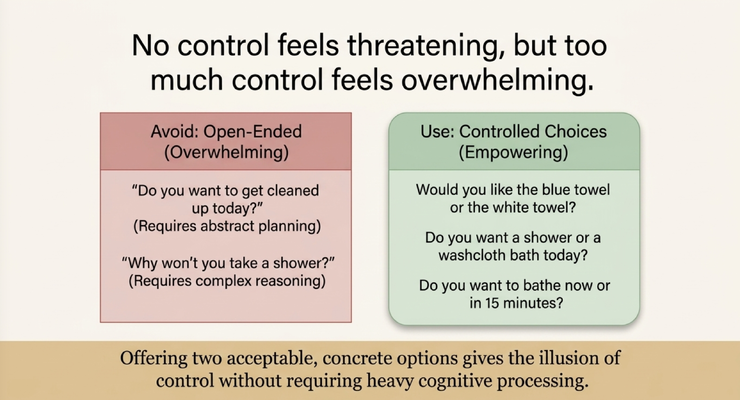
No control feels threatening.
Too much control feels overwhelming.
If you say, “Do you want to get cleaned up today?” the answer may be no.
If you say, “Why won’t you take a shower?” now you are asking the person living with dementia to use reasoning, memory, and explanation skills that may already be impaired.
Open-ended questions can be too much.
Instead, offer controlled choices.
“Would you like the blue towel or the white towel?”
“Would you like a shower or a washcloth bath today?”
“Would you like to wash up now or in 15 minutes?”
These choices are concrete. They are limited. And both options are acceptable.
That gives the person a sense of control without overwhelming the brain.
This is not manipulation.
This is support.
You are giving autonomy inside a safe structure.
That is how we preserve dignity without creating chaos.
DO NOT GIVE THEM THE WHOLE SHOWER
Do not give them the whole shower.
Give them the next step.
That is the practical rule.
A person living with dementia may not be able to process the entire bathing sequence all at once. “Go take a shower” may be too big, too abstract, and too threatening.
So break it down.
“Let’s walk to the bathroom together.”
“Here is a warm towel for your shoulders.”
“Please sit on this chair.”
“Hold this washcloth for me.”
“Let’s wash your hands first.”
That is much easier to process.
One visible step at a time.
One calm instruction at a time.
One body area at a time.
If they refuse, they may not be refusing the entire bath. They may be overwhelmed by the size of the request.
So reduce the request.
Make it smaller.
Make it safer.
Make it easier for the brain to follow.
THE WARM TOWEL FIRST TECHNIQUE
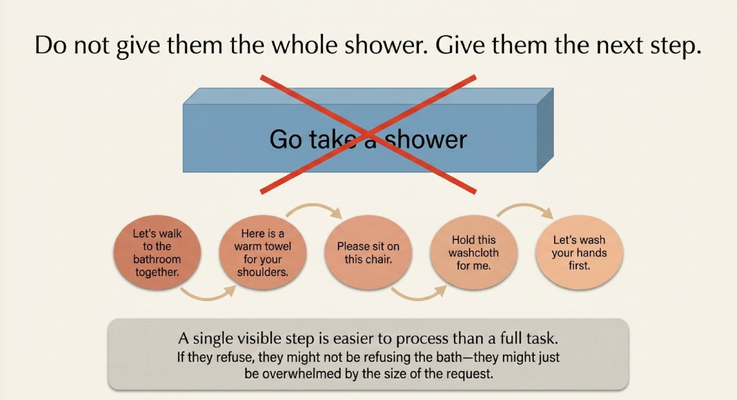
One of the simplest shifts is what I call the warm towel first technique.
Do not start with:
“Take your clothes off.”
That immediately signals exposure.
Start with comfort.
Offer a warm towel or warm washcloth before removing any clothes. Let the person feel warmth and safety first. Begin with non-threatening areas like the hands or face. Let them hold something, such as soap or a second washcloth, so their hands are occupied. Narrate calmly as you go.
“I’m going to wash your hands now.”
“Here’s a warm towel.”
“You’re doing okay.”
“We’re just going one step at a time.”
Then assess constantly.
If they escalate, stop. Cover them. Let them calm down. Restart later if it is safe.
Stopping is not failure.
Sometimes stopping prevents the bathroom from becoming a permanent trauma cue.
Because if every bath becomes a battle, the person may begin to fear the bathroom before they even enter it.
CLEAN IS THE GOAL. THE SHOWER IS ONLY ONE TOOL.
This may be the most freeing idea for caregivers.
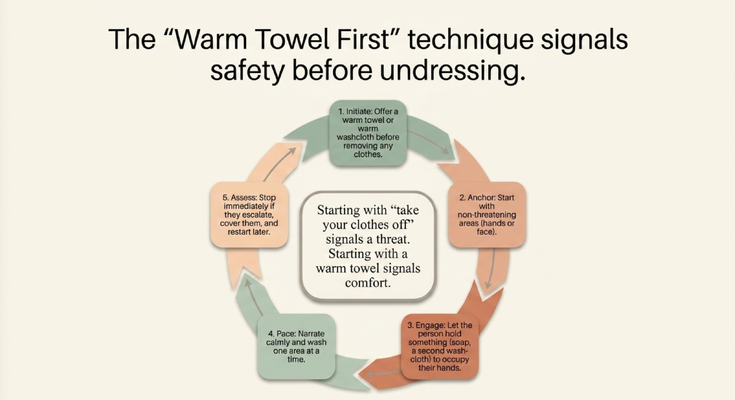
Clean is the goal.
The shower is only one tool.
A full standing shower may be the highest-stress version of hygiene. It may involve standing, balancing, undressing, cold air, water hitting the body, loud sound, and fear of falling.
But there are lower-stress options.
A shower chair with a hand-held spray.
A towel bath.
A sponge bath.
A targeted partial bath for face, hands, underarms, and private areas.
A washcloth routine.
Dry shampoo.
A salon sink for hair.
A damp washcloth instead of water running over the face.
This is especially important with hair washing. For many people living with dementia, water hitting the face can create panic. So separate hair washing from body washing when possible. Use dry shampoo, a salon sink, or a damp washcloth if that works better.
And no, daily bathing is not always necessary.
Unless the person is incontinent or has a specific hygiene need, bathing once or twice a week may be sufficient for many people. Families should discuss personal hygiene needs with the care team, especially if there are wounds, skin breakdown, incontinence, infection risk, or other medical concerns.
The point is not to lower hygiene standards.
The point is to stop treating the shower as the only path to cleanliness.
If the shower creates war, use another tool.
WHEN REFUSAL IS SUDDEN, LOOK FOR A MEDICAL TRIGGER
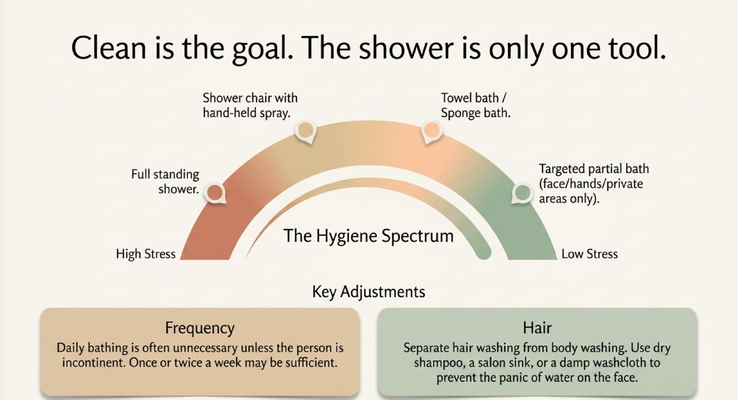
Do not assume they hate bathing.
They may hate what bathing feels like right now.
And if bathing refusal suddenly changes, pay attention.
If a person who normally tolerates bathing suddenly becomes severely distressed, aggressive, fearful, or physically resistant, do not dismiss it as “just dementia.”
Ask better questions.
Could there be pain?
Arthritis?
Skin breakdown?
A wound?
Pain during transfers?
Could the bathroom be too cold?
Could the water temperature be uncomfortable?
Could the lights be too bright?
Could they be fatigued because the bath is happening at the wrong time of day?
Could they be afraid of falling?
Could they have dizziness, poor balance, new weakness, or a medical change?
Could there be signs of infection, fever, urinary symptoms, rash, sudden confusion, shortness of breath, or a major change in sleep?
Sudden refusal can be a symptom.
Not a personality trait.
If there is sudden out-of-character aggression, visible pain during movement, signs of infection, sudden dizziness, fainting, shortness of breath, new weakness, major sleep changes, or sudden new confusion, call the care team or seek appropriate medical guidance.
Sometimes the problem is not the bath.
Sometimes the bath exposed the problem.
WHAT I WANT CAREGIVERS TO REMEMBER
If you are caring for someone living with dementia, here is what I want you to remember.
Do not start with the shower.
Start with safety.
Start with trust.
Start with dignity.
Start with the environment.
The person living with dementia may not be refusing hygiene. They may be overwhelmed by the sequence, embarrassed by exposure, afraid of falling, distressed by cold air, confused by the mirror, overloaded by bright lights, or frightened by water hitting their face.
So stop making the shower the enemy.
Prepare the room.
Warm the towels.
Reduce the noise.
Cover the mirrors if needed.
Use a shower chair.
Use non-slip mats.
Offer controlled choices.
Protect modesty.
Wash one area at a time.
Use calm narration.
Give one step at a time.
And remember: clean is the goal. The shower is only one tool.
A towel bath that preserves dignity is better than a forced shower that creates trauma.
That is dementia care.
Not overpowering.
Understanding.
Not shaming.
Protecting.
Not turning hygiene into a courtroom.
Turning bathing into a calmer, safer, more human experience.

Common questions
Quick answers from this issue
Why Does Bathing Become a Battle in Dementia?
Every week, caregivers ask me some version of the same question: “Dr. Erik, why does my mom fight me every time I try to help her shower?” And I understand why this becomes so frustrating.
What should caregivers try first?
Write down what changed, when it started, and what was happening right before it. Reduce noise, slow the conversation down, and use one simple step at a time. Share the pattern with the family, care team, or clinician so everyone responds consistently.
When should families call a clinician?
Call a clinician promptly if the change is sudden, severe, unsafe, tied to a fall, fever, pain, dehydration, medication change, hallucinations, paranoia, or new confusion. Call emergency services for immediate danger.