

One of the hardest parts of dementia care is that the “right” thing is not always obvious.
A caregiver sees water on the floor, and the logical response is to stop the person from washing dishes. A caregiver hears their loved one asking for someone who passed away years ago, and the logical response is to correct them. A caregiver sees confusion, and the logical response is to explain the facts again.
And listen, I understand why families do this. You are trying to protect the person you love. You are trying to prevent falls. You are trying to avoid arguments. You are trying to keep the home calm. You are trying to do the right thing.
But dementia care does not always work by logic alone.
Sometimes the logical answer creates an emotional problem. Sometimes the thing we remove for safety is also the thing that gave the person purpose. Sometimes the truth we say out loud is technically correct, but emotionally painful for the person living with dementia.
I learned both of those lessons in a very personal way from my own grandmother.
My name is Dr. Erik Ilyayev. I’m a dementia care physician, a board member of the South Florida Alzheimer's Association® tion®, and the CEO of MedBetterHealth.org — one of the organizations selected by Medicare to participate in a groundbreaking new program designed to change how America cares for people living with dementia.
In this issue, I want to talk about one of the most important questions in dementia care:
How do we protect the body without breaking the spirit?
THE HEAVY BURDEN OF PROTECTION
When you are caring for someone living with dementia, protection can become all-consuming.
You are constantly scanning the home. Is the floor wet? Is the stove on? Did they take the wrong medication? Are they going to wander? Are they going to fall? Are they going to get hurt while I am in the other room?
That level of responsibility changes how you think. You start seeing every object as a possible danger. Every routine as a possible risk. Every activity as something that could go wrong.
And sometimes, the safest answer seems obvious: remove the risk.
No more dishes. No more cooking. No more laundry. No more going outside alone. No more helping.
But here is the question we have to ask: when we remove the risk, what else are we removing?
Because in dementia care, an activity is not always just an activity. Washing dishes may not be about clean dishes. Folding laundry may not be about folded clothes. Setting the table may not be about dinner being ready.
Sometimes the activity is identity. Sometimes it is contribution. Sometimes it is the person’s way of saying, “I still belong here. I still matter. I still have something to give.”
THE DISHES WERE NOT JUST DISHES
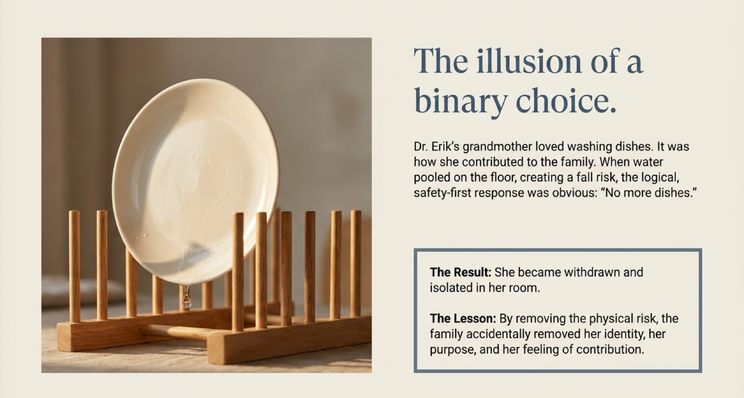
My grandmother loved washing dishes.
Now to me, washing dishes was just washing dishes. It was a chore. Something you do after dinner. Something that needs to get done.
But to her, it was not just about the dishes. It was how she helped. It was how she contributed. It was how she felt useful in the house. It was her role.
One day, I saw water on the floor. And immediately, my medical brain kicked in.
Water on the floor means fall risk. Fall risk means possible injury. Possible injury means hospital. And for someone living with dementia, a hospital stay can change everything.
So I did what a lot of people would do.
I said, “Grandma, no more dishes.”
In my mind, I was protecting her. No water on the floor. Less risk. Safer environment. Problem solved.
But then I started noticing something. She became quieter. She stayed in her room more. She was not engaging with the family the same way.
And then it hit me.
I did not just take away the dishes. I took away her purpose.
I took away the thing that made her feel useful. I took away a role that mattered to her. I removed the risk, but I also removed something emotionally important.
That is the part of dementia care we do not talk about enough.
Safety matters. Of course it matters. I am not saying ignore fall risks. I am not saying let someone do something dangerous just because they want to do it.
But we have to ask a better question.
Not just, “How do I stop this?”
The better question is, “How do I make this safer without taking away the whole thing?”
ADAPT BEFORE YOU ELIMINATE
This is one of the most practical shifts caregivers can make.
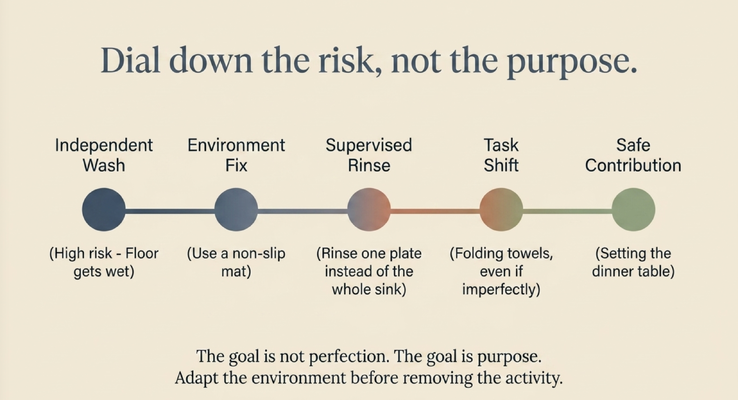
Before you eliminate the activity, ask whether you can adapt it.
Can we put down a non-slip mat? Can we supervise? Can we simplify the task? Can we let her rinse one plate instead of washing the whole sink? Can we let her fold towels, even if we have to refold them later? Can we let her set the table? Can we give her a version of the task that still lets her feel involved?
Because the goal is not perfection.
The goal is purpose.
And for someone living with dementia, purpose matters. Feeling useful matters. Having a role in the family matters. Being needed matters.
Dementia changes memory. It changes communication. It changes behavior. But it does not erase the human need to matter.
A person may not fold the towels perfectly. They may not wash the plate the way you would wash it. They may set the table in the wrong order. They may need supervision. They may need the environment adjusted.
That is okay.
The question is not, “Did they perform the task perfectly?”
The question is, “Did this task help them feel human, included, and connected?”
That is dementia care.
THE OTHER SIDE OF DIGNITY: DO NOT ARGUE WITH DEMENTIA REALITY
There was another moment with my grandmother that taught me something different.
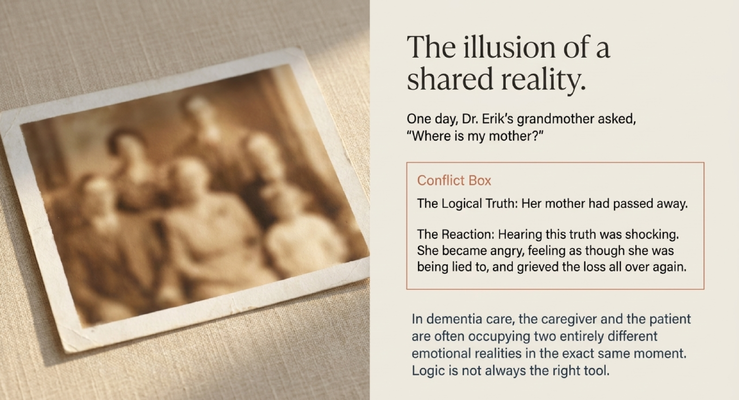
One day, she asked, “Where is my mother?”
Now logically, we knew the answer. Her mother had passed away.
So what do most people do? They tell the truth. They say, “Your mother passed away.”
And I understand why. You are trying to be honest. You are trying to correct the confusion. You are trying to bring the person back to reality.
But what happened?
She became upset. She felt hurt. She felt like she was being lied to. She became angry.
And now the caregiver, who is showing up every day, who is doing all the work, who is trying to help, becomes the enemy in that moment.
That is painful.
And if you are a caregiver, you know exactly what I mean. You are doing everything you can. You are sacrificing your time, your energy, your sleep, your emotions. And somehow, in that moment, you become the person they are upset with.
This is why I always tell families: do not argue with dementia reality.
I know that sounds strange at first, because every logical part of you wants to correct them.
You want to say, “No, that’s not true.”
“No, your mother is not coming.”
“No, you don’t live there anymore.”
“No, that happened years ago.”
But sometimes, when you keep pushing the facts, you are not helping them understand. You are making them hurt all over again. You are making them feel attacked. You are creating a fight that nobody is going to win.
In dementia care, sometimes the person does not need the fact first.
They need reassurance.
They need comfort.
They need to feel safe.
VALIDATION FIRST. REDIRECTION SECOND.
So what do we do instead?
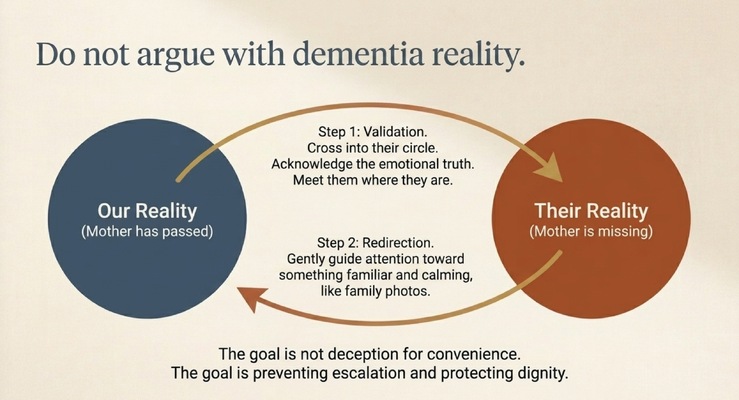
Validation first. Redirection second.
That means we meet the person emotionally before we try to move them somewhere else.
If your loved one asks, “Where is my mother?” the first step is not to force them into your reality. The first step is to understand what they may be feeling.
Maybe they are scared. Maybe they feel alone. Maybe they are searching for comfort. Maybe “mother” means safety, warmth, familiarity, or home.
So instead of saying, “She passed away,” and making them relive that pain, you respond to the emotion underneath the question.
You might say something gentle like, “You miss her. She loved you very much.”
Then you redirect.
You look at pictures. You talk about family. You put on familiar music. You offer a snack. You move into a calmer moment.
Some people struggle with this. They ask, “But isn’t that lying?”
Here is how I think about it.
The goal is not deception for convenience. The goal is emotional safety.
You are not trying to trick the person. You are trying to lower distress. You are trying to protect them from pain they cannot process in that moment.
You are also protecting the caregiver, because if every conversation turns into a battle, eventually the whole house becomes exhausted.
PHYSICAL SAFETY AND EMOTIONAL SAFETY
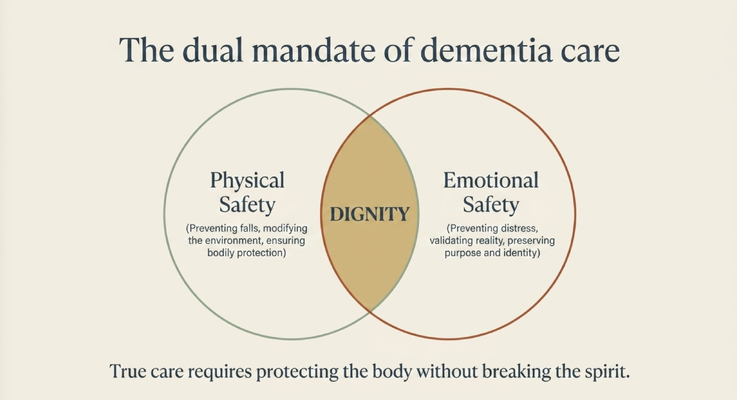
That is really the balance in dementia care: physical safety and emotional safety.
We have to protect the body. Yes. Prevent falls. Reduce hazards. Make the home safer. Watch for things that can cause harm.
But we also have to protect the spirit.
Preserve dignity. Protect purpose. Validate emotion. Lower distress. Help the person feel like they still belong.
Because if all we do is remove risk, we may remove the person’s life piece by piece.
No more dishes. No more cooking. No more folding laundry. No more helping. No more choices. No more role.
And before you know it, the person may be safer, but they feel useless.
That is not the goal.
The goal is not just to keep someone alive. The goal is to help them live with as much dignity, comfort, and connection as possible.
For caregivers, this is one of the hardest emotional tensions. You are trying to prevent injury, but you are also trying not to crush independence. You are trying to be honest, but you are also trying not to cause unnecessary pain. You are trying to keep the home safe, but you are also trying to keep the person emotionally intact.
That is why dementia care is not simple.
It requires judgment. It requires flexibility. It requires knowing the person, not just the diagnosis.
A CAREGIVER’S FIELD GUIDE
So if you are caring for someone living with dementia, here is what I want you to remember.
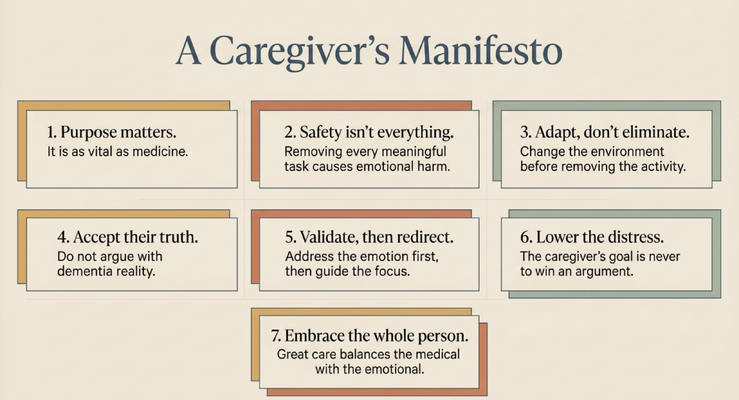
Do not take away purpose unless you have to. Adapt before you eliminate. Make the task safer before you remove it completely.
Do not argue with dementia reality. Validate first. Redirect second.
And when a moment feels difficult, ask yourself:
What is the person feeling right now?
What are they trying to communicate?
What did this activity mean to them?
Am I protecting safety while also protecting dignity?
Because that is the real work.
And I know it is not easy. Caregivers are making these decisions every single day. Do I step in? Do I let them try? Do I correct them? Do I redirect them? Do I stop the activity? Do I adapt it?
And most caregivers are making those decisions while they are tired, overwhelmed, and carrying guilt.
This is why support matters.
Dementia care is not just about knowing facts. It is about knowing how to respond in real life, inside the home, when emotions are high and the situation is not simple.

Common questions
Quick answers from this issue
What My Grandmother Taught Me About Dementia Care
One of the hardest parts of dementia care is that the “right” thing is not always obvious. A caregiver sees water on the floor, and the logical response is to stop the person from washing dishes. A caregiver hears their loved one asking for someone who passed away years ago, and the logical response is to correct them. A caregiver sees confusion, and the logical response is to explain the facts again.
What should caregivers try first?
Write down what changed, when it started, and what was happening right before it. Reduce noise, slow the conversation down, and use one simple step at a time. Share the pattern with the family, care team, or clinician so everyone responds consistently.
When should families call a clinician?
Call a clinician promptly if the change is sudden, severe, unsafe, tied to a fall, fever, pain, dehydration, medication change, hallucinations, paranoia, or new confusion. Call emergency services for immediate danger.