

Every week, I speak to caregivers who are carrying far more than most people realize.
They are working full-time jobs, raising families, managing their own health, and then going back after work to check on mom, dad, a spouse, or a loved one living with dementia. They are making sure there is food in the house. They are managing medications. They are answering phone calls. They are coordinating appointments. They are trying to keep somebody safe while still keeping their own life from falling apart.
And when I ask them how they are doing, most of them say some version of the same thing:
“Dr. Erik, I’m exhausted.”
But here is what I want you to understand. That exhaustion is not weakness. It is not selfishness. It is not a lack of love. It is not because you are failing.
Caregiver exhaustion in dementia care is a documented medical reality. And in this issue, I want to focus on the person who is too often ignored in dementia care: you, the caregiver.
My name is Dr. Erik Ilyayev. I’m a dementia care physician, a board member of the South Florida Alzheimer's Association®, and the CEO of MedBetterHealth.org — one of the organizations selected by Medicare to participate in a groundbreaking new program designed to change how America cares for people living with dementia.
Today, we are talking about Caregiver Burden Syndrome.
THE HIDDEN WORKFORCE OF DEMENTIA CARE
Let’s start with the scale of this.
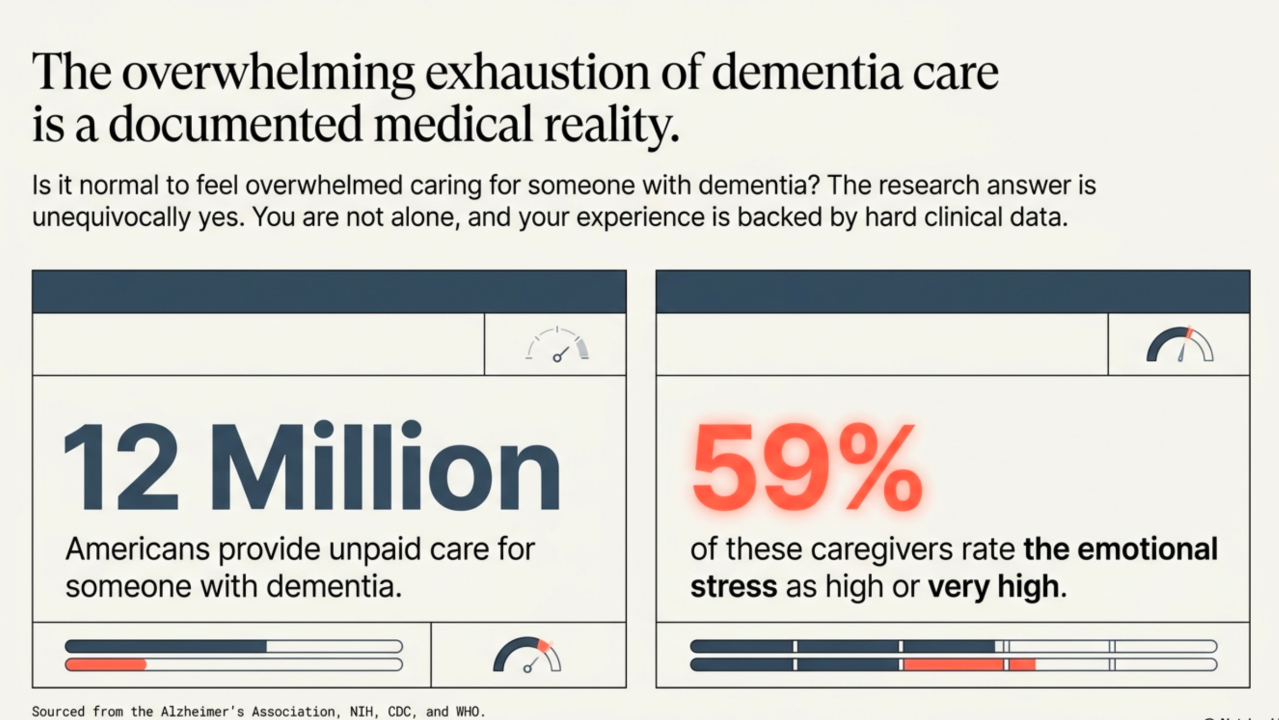
There are roughly 12 million unpaid dementia caregivers in the United States. Twelve million people taking care of a spouse, a parent, a grandparent, a sibling, or someone they love.
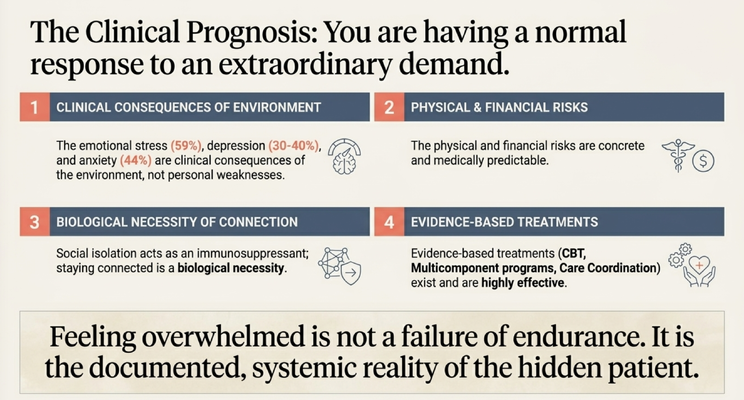
And 59% of these caregivers rate their emotional stress as high or very high.
That means more than half of dementia caregivers are not simply “busy.” They are living under sustained emotional pressure.
And if you are a caregiver, you probably know exactly what that feels like. You may work all day, sit in traffic, and then drive straight to mom’s house at 6 PM to make sure she ate, took her medications, and has enough food for the week. You may be trying to keep your own household together while also managing another person’s entire life.
This is why I call dementia caregivers the invisible workforce of dementia care. Because the work is happening every day, but most of the world does not see it.
THE ECONOMIC VALUE NOBODY TALKS ABOUT
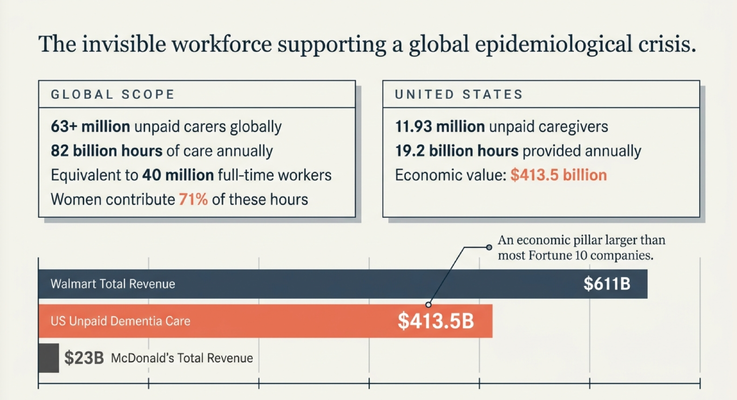
If someone had to pay for the unpaid dementia care families provide in the United States, the economic value would be approximately $413.5 billion.
Let me put that into perspective.
Walmart’s annual revenue is larger than that, but not by as much as people would expect. McDonald’s annual revenue is far smaller. So when we talk about family caregivers, we are not talking about a small group of people doing a little bit of extra help on the side.
We are talking about a massive unpaid care system holding up dementia care in this country.
No uniform. No paycheck. No official title. No clock-out time. Just responsibility after responsibility after responsibility.
And for many families, this is not a part-time role. It starts as “I’ll just help mom a little bit,” and slowly becomes a second job. Then it becomes the thing that interrupts your first job. Then it becomes the thing that takes over your evenings, your weekends, your sleep, your money, your relationships, and sometimes your health.
WHEN CAREGIVING STARTS TO AFFECT YOUR JOB
One of the things families do not talk about enough is how dementia caregiving affects employment.
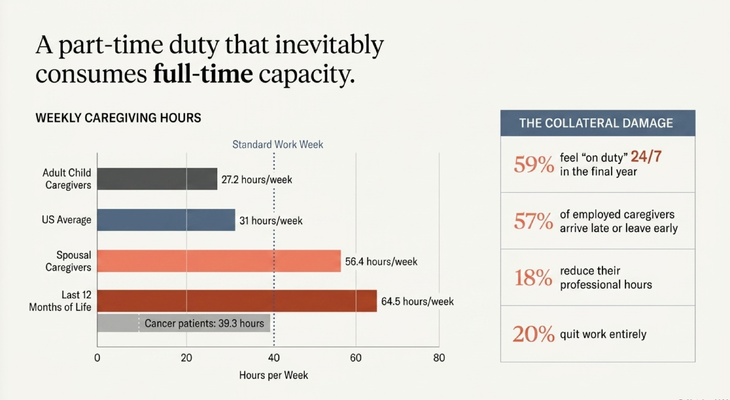
The data shows that 57% of employed caregivers arrive late or leave work early because of caregiving responsibilities. 18% reduce their professional hours. 20% quit work entirely.
One in five leave the workforce completely.
That is not a small inconvenience. That is a life-changing burden.
And if this sounds familiar, I want you to know you are not alone. Maybe you have had to leave a meeting because your loved one wandered. Maybe you have had to call out of work because the home care aide canceled. Maybe you have had to reduce hours because your parent can no longer be left alone.
Maybe your coworkers see you physically present, but emotionally you are somewhere else because your phone could ring at any moment.
That is the reality for millions of dementia caregivers.
THE FINANCIAL BURDEN IS REAL
Now let’s talk about the part many families feel deeply but are embarrassed to say out loud: dementia care is expensive.
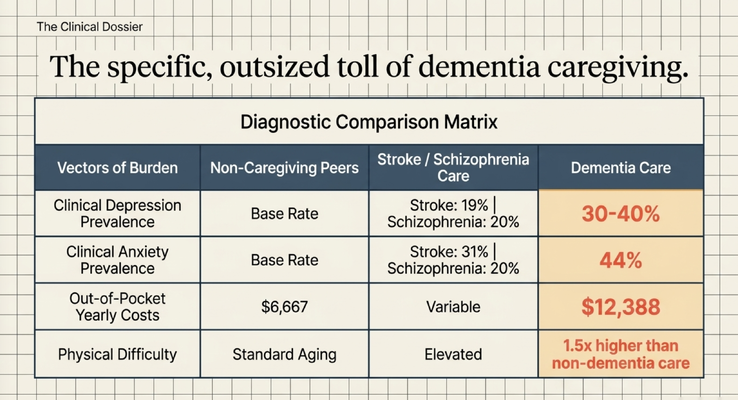
If you are caring for someone without dementia, the yearly out-of-pocket cost may already be significant. But when dementia enters the picture, the financial burden can roughly double.
Why?
Because dementia is not only memory loss. Dementia affects supervision, safety, transportation, bathing, nutrition, medication management, wandering risk, behavioral symptoms, home modifications, adult day care, and private duty home care.
Maybe you need someone to sit with mom while you are at work. Maybe dad cannot be left alone anymore. Maybe you are paying for adult day care because staying isolated at home is making the symptoms worse. Maybe you are buying supplies, modifying the home, cutting your own spending, or quietly draining savings just to keep everything moving.
This is one of the cruelest parts of dementia care. The disease takes an emotional toll, but it also creates a financial drain that families often absorb privately.
And when we compare dementia caregiving to other types of caregiving, the burden is not equal. Dementia caregivers face higher rates of depression, higher rates of anxiety, higher yearly out-of-pocket costs, and greater physical difficulty than many non-dementia caregiving situations.
WHEN PRESSURE BECOMES DANGEROUS
There is one data point in this presentation that should make all of us stop.
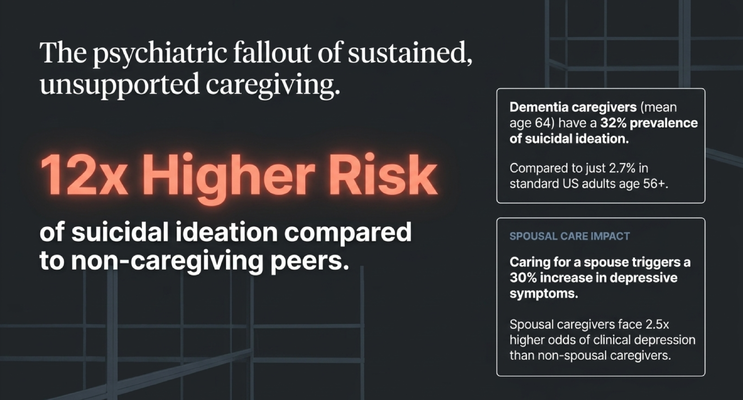
Among dementia caregivers, the prevalence of suicidal ideation is dramatically higher than among non-caregiving peers. The presentation highlights a 12x higher risk of suicidal ideation compared to non-caregiving peers.
That is not “just stress.” That is not something we should minimize. That is not something a caregiver should be expected to silently carry.
If you apply pressure to something long enough, eventually it breaks. And you are not titanium. You are a human being.
You can love someone deeply and still be overwhelmed. You can be committed and still be exhausted. You can be doing your best and still need help.
Those things are not contradictions. They are the reality of dementia caregiving.
If you are ever feeling unsafe, hopeless, or like you may harm yourself, please seek immediate help by calling 988 in the United States or going to the nearest emergency room. Caregiver burden is real, but you do not have to face a crisis alone.
THE BODY KEEPS SCORE
Caregiver burden does not stay only in the mind. It enters the body.
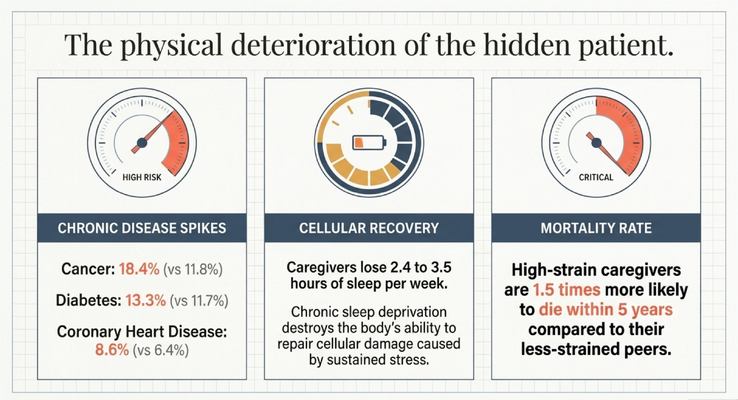
Caregivers lose sleep. And when sleep disappears, the body loses one of its most important recovery systems.
Sleep is when the body repairs. Sleep is when the brain restores. Sleep is when emotional regulation resets. Sleep is when the immune system gets a chance to recover.
But many dementia caregivers do not get that recovery. They are listening at night. They are waking up to wandering. They are responding to agitation. They are sleeping lightly because they are afraid something will happen.
Even when they are technically in bed, their nervous system is still on duty.
And over time, chronic stress and poor sleep affect physical health. The presentation points to higher rates of chronic disease among caregivers, including cancer, diabetes, and coronary heart disease. High-strain caregivers are also shown to have a higher mortality risk compared to less-strained peers.
This is why I always use the airplane example.
When the oxygen mask drops, who do they tell you to put it on first? Yourself.
Why?
Because if you lose oxygen, you cannot help the person next to you.
Dementia caregiving is the same. If you collapse, the care system collapses with you.
SOCIAL ISOLATION MAKES EVERYTHING WORSE
Another part of caregiver burden is isolation.
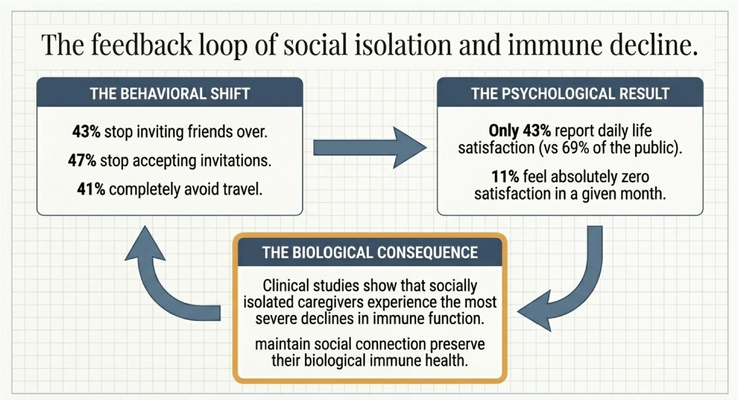
Caregivers stop inviting friends over. They stop accepting invitations. They stop traveling. They stop going to dinner. They stop doing the small things that used to make them feel like themselves.
And slowly, the world gets smaller.
This creates a dangerous loop. Stress leads to isolation. Isolation leads to depression and anxiety. Depression and anxiety make caregiving feel even heavier. And the caregiver becomes more trapped.
Connection is not a luxury for caregivers. It is biological protection.
You need people. You need education. You need a place to ask questions. You need support that does not judge you. You need someone who understands what dementia care actually looks like inside the home.
Not the polished version. The real version.
The version where mom refuses to shower. The version where dad asks the same question 40 times. The version where your loved one is up at 3 AM. The version where the family disagrees. The version where you feel guilty because you are exhausted by someone you love.
That version needs support.
THE TREATMENT PLAN: WHAT ACTUALLY HELPS?
So what do we do?
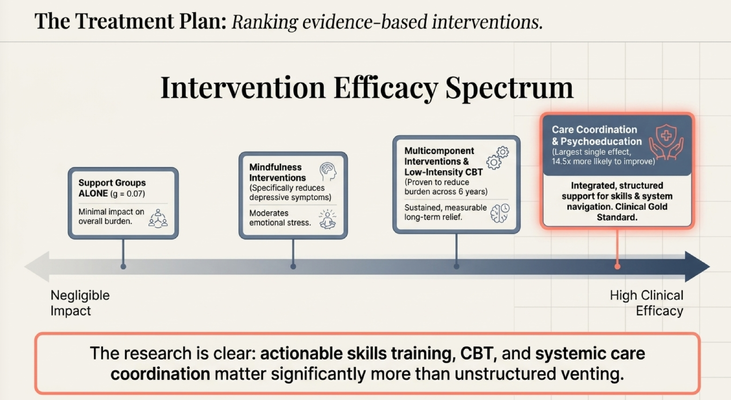
Support groups matter. I talk about support groups often because they help caregivers feel heard. Sometimes you need to sit with people who understand and say the thing you have been afraid to say out loud. Sometimes you need to put everything on the table and have somebody say, “I understand. I’ve been there too.”
That matters.
But support groups alone do not solve the full burden.
Why?
Because caregiver burden is not only emotional. It is behavioral. It is logistical. It is medical. It is financial. It is social. It is physical.
That means the solution has to be more complete.
Mindfulness can help. Therapy can help. Low-intensity cognitive behavioral therapy can help. Caregiver training can help. Care coordination can help.
But the strongest approach is not one isolated intervention. The strongest approach is structured, ongoing support.
Caregivers need education, skills training, care coordination, respite, behavioral support, and someone to call when the situation at home changes.
In other words, caregivers need more than encouragement.
They need infrastructure.
Slide deck note
Extra visual from this issue

Common questions
Quick answers from this issue
Is It Normal To Feel Overwhelmed Caring For Someone With Dementia?
Every week, I speak to caregivers who are carrying far more than most people realize. They are working full-time jobs, raising families, managing their own health, and then going back after work to check on mom, dad, a spouse, or a loved one living with dementia. They are making sure there is food in the house. They are managing medications. They are answering phone calls. They are coordinating appointments.
What should caregivers try first?
Write down what changed, when it started, and what was happening right before it. Reduce noise, slow the conversation down, and use one simple step at a time. Share the pattern with the family, care team, or clinician so everyone responds consistently.
When should families call a clinician?
Call a clinician promptly if the change is sudden, severe, unsafe, tied to a fall, fever, pain, dehydration, medication change, hallucinations, paranoia, or new confusion. Call emergency services for immediate danger.