

Every week, caregivers ask me some version of the same question:
“Dr. Erik, my mom barely sleeps anymore. She wakes up constantly, wanders the house, calls out at night, and by morning we’re both exhausted. Is this just part of dementia?”
The answer is yes — but not in the way most families think.
Nighttime dementia behaviors are not simply “bad sleep.” They are the result of physical changes happening inside the brain itself. And once you understand what those changes are, you can begin building a system that restores stability, reduces nighttime agitation, and protects both your loved one and your own health.
My name is Dr. Erik Ilyayev. I’m a dementia care physician, a board member of the South Florida Alzheimer's Association®, and the CEO of MedBetterHealth.org — one of the organizations selected by Medicare to participate in a groundbreaking new program designed to change how America cares for people living with dementia.
In this issue, I want to walk you through why dementia disrupts sleep, what sundowning actually is, and the practical interventions caregivers can begin implementing immediately.
THE 3 AM REALITY: YOU ARE NOT ALONE
One of the most dangerous misconceptions in dementia care is the belief that nighttime disturbances are somehow caused by poor caregiving.
They are not.
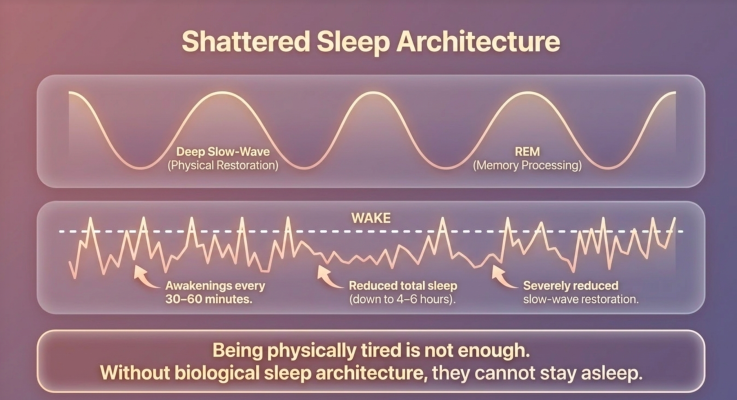
Nearly 70% of dementia caregivers struggle with nighttime sleep disturbances themselves. That means waking up multiple times per night, listening for wandering, responding to confusion, or staying partially awake out of fear something may happen while they sleep.
The symptom might look behavioral on the surface:
wandering calling out pacing nighttime confusion
But underneath it is biology.
What you are seeing is a brain losing its ability to regulate its own internal clock.
THE BROKEN BIOLOGICAL CLOCK
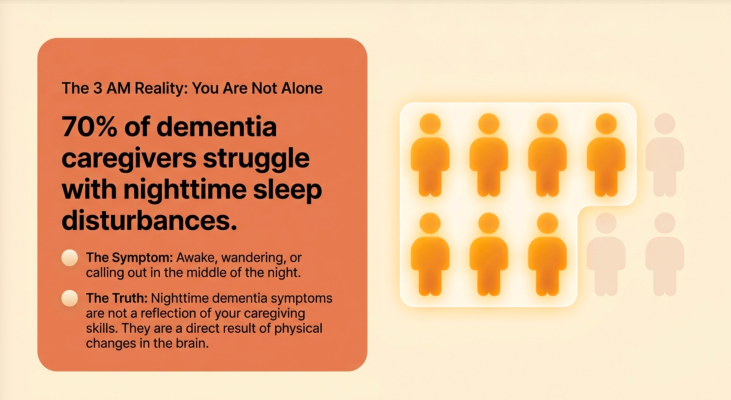
Inside the brain is a structure called the suprachiasmatic nucleus — the SCN. Think of it as the body’s master clock. Its job is to tell the brain when it is daytime, when it is nighttime, and when the body should begin preparing for sleep.
In a healthy brain, this rhythm stays relatively stable.
In a dementia-affected brain, that clock begins to break down.
Research shows that Alzheimer’s disease can dramatically reduce melatonin production — sometimes by as much as 50% to 75%. The result is devastating: the brain loses its ability to properly distinguish day from night, even when the body is physically exhausted.
This is why many dementia patients seem tired all day but remain awake or restless all night.
Physical exhaustion alone is no longer enough to trigger restorative sleep.
SHATTERED SLEEP ARCHITECTURE
Caregivers often say:
“But they slept for eight hours.”
What they usually mean is that their loved one remained in bed for eight hours.
That is not the same thing as restorative sleep.
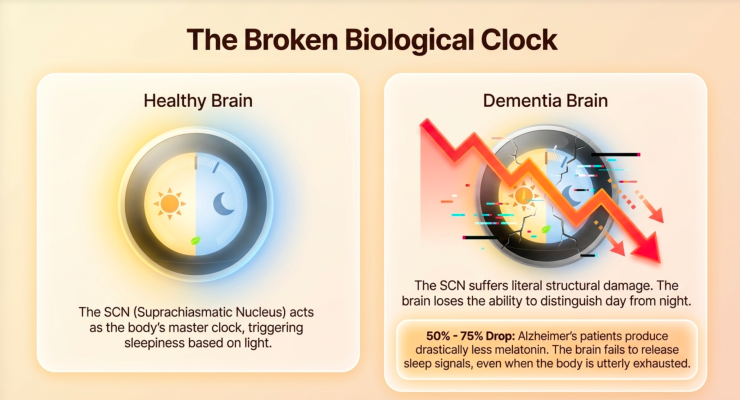
Healthy sleep follows a structured neurological pattern — cycling through deep slow-wave sleep and REM sleep. Dementia disrupts that architecture entirely. Sleep becomes fragmented. Patients wake repeatedly every 30 to 60 minutes. Deep restorative sleep becomes severely reduced.
Many dementia patients ultimately sleep only four to six effective hours per night — even if they appear to be in bed much longer.
And when restorative sleep disappears, everything worsens:
agitation confusion anxiety fall risk hallucinations caregiver exhaustion
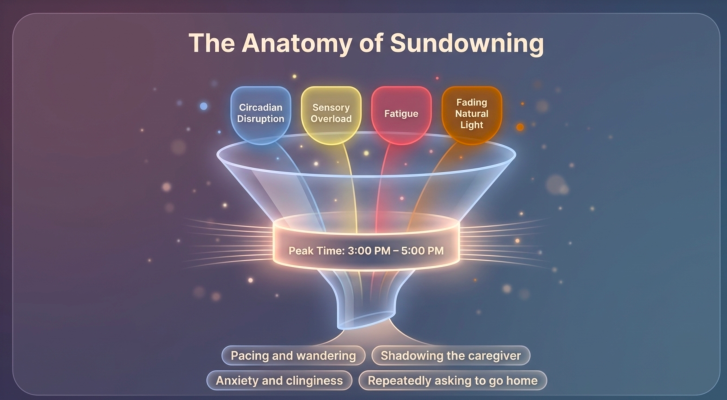
THE ANATOMY OF SUNDOWNING
Sundowning is not random.
It is the collision of four forces happening simultaneously:
circadian disruption sensory overload accumulated fatigue fading natural light
And it almost always peaks between 3 PM and 5 PM.
This is why caregivers often notice the exact same pattern every evening:
pacing shadowing the caregiver clinginess agitation repeatedly asking to “go home”
The brain is entering what I call the Vulnerability Zone — a period where its ability to process and regulate the environment begins collapsing under accumulated strain.
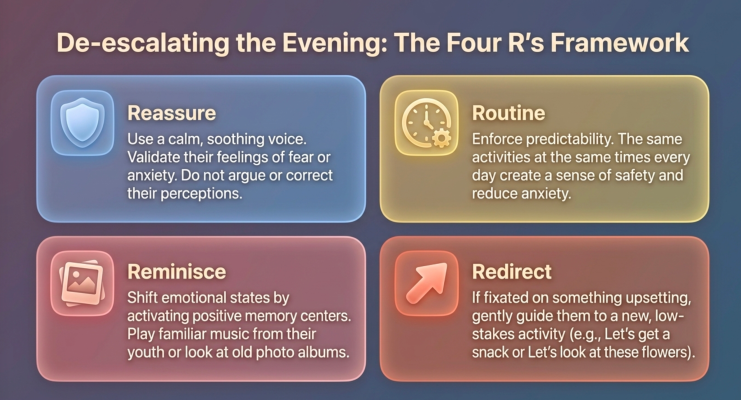
THE FOUR R’S: DE-ESCALATING THE EVENING
One of the biggest mistakes families make is trying to “correct” a person living with dementia during an episode.
Logic rarely works once the brain has entered a state of neurological distress.
Instead, caregivers should focus on four interventions:
Reassure
Use a calm voice. Validate fear or confusion instead of arguing with it.
Routine
Predictability reduces anxiety. The brain becomes calmer when evenings follow the same sequence every day.
Reminisce
Activate positive memory pathways with familiar music, old photographs, or emotionally safe memories.
Redirect
Shift attention gently toward a calming activity instead of confronting the fixation directly.
These interventions may seem simple. But consistency matters more than complexity.
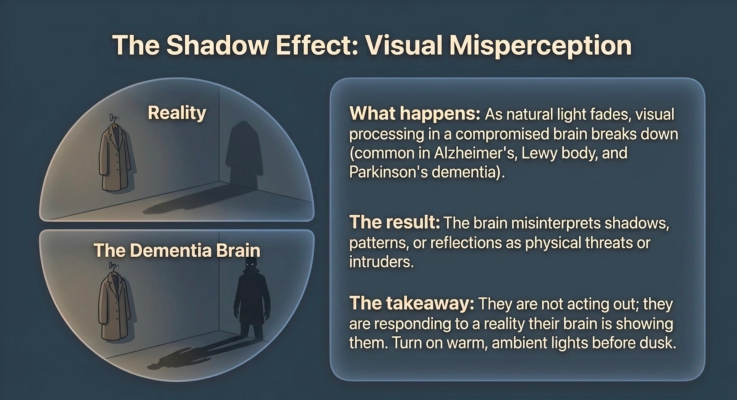
WHY SHADOWS BECOME THREATS
As natural light fades, the dementia brain struggles to interpret visual information accurately.
A shadow on the wall may look like a stranger.
A reflection in a dark window may appear threatening.
A coat hanging in the corner can suddenly feel frightening or unfamiliar.
This is not imagination or stubbornness. It is neurological misinterpretation caused by impaired visual processing.
That is why lighting matters so much.
Warm ambient lighting before dusk can dramatically reduce nighttime agitation by minimizing visual distortions before they begin.
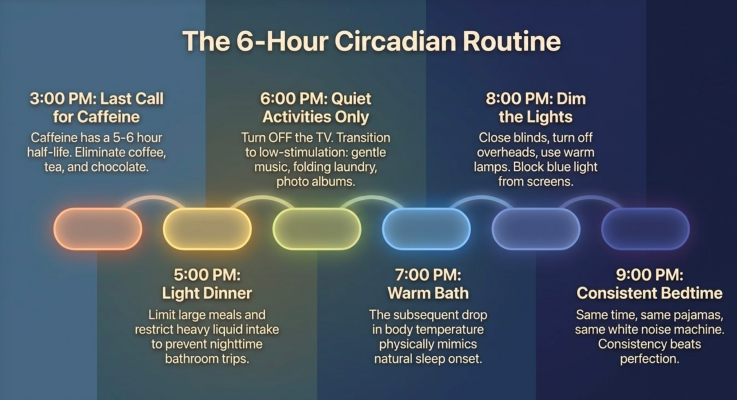
THE 6-HOUR EVENING ROUTINE
Caregivers often ask me:
“What should our evenings actually look like?”
The answer is structure.
Here is a simple rhythm I recommend:
3 PM
Cut off caffeine completely.
5 PM
Serve a lighter dinner and reduce excessive fluid intake.
6 PM
Transition away from television and overstimulation.
7 PM
Warm bath or calming sensory routine.
8 PM
Dim lights, close blinds, reduce blue light exposure.
9 PM
Consistent bedtime — same room, same environment, same sequence.
Consistency stabilizes the circadian rhythm over time.
Perfection is not required. Repetition is.
THE HIDDEN PATIENT: THE CAREGIVER
There is another person losing sleep every night in dementia care.
You.
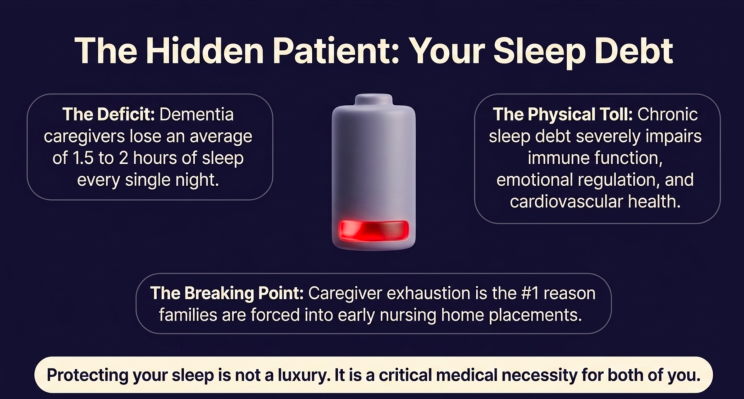
Dementia caregivers lose an average of 1.5 to 2 hours of sleep every single night. Chronic sleep deprivation damages emotional regulation, immune function, cardiovascular health, and cognitive performance.
And eventually, exhaustion becomes the breaking point that forces many families into premature nursing home placement.
Protecting your own sleep is not selfish.
It is medically necessary.
WHEN TO CALL THE DOCTOR
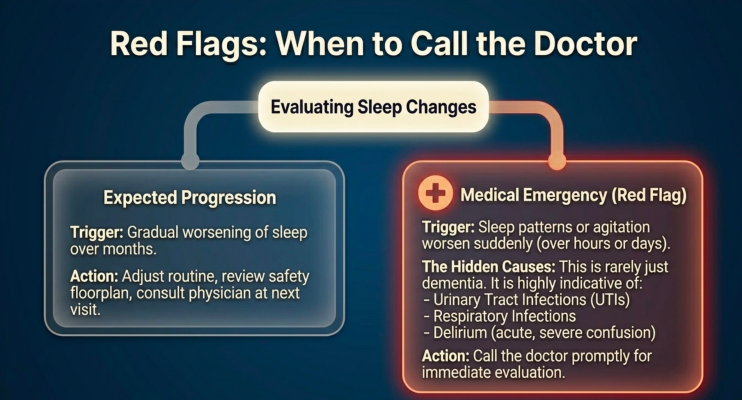
Not every sleep change is “just dementia.”
If nighttime agitation or confusion worsens suddenly over hours or days, it may indicate:
urinary tract infections respiratory infections delirium medication reactions acute medical illness
Sudden behavioral changes should always be evaluated promptly.
Gradual progression is common in dementia.
Rapid escalation is a red flag.

Common questions
Quick answers from this issue
“Why Is My Loved One Awake All Night?” — The Biological Reason Dementia Destroys Sleep
Every week, caregivers ask me some version of the same question: “Dr. Erik, my mom barely sleeps anymore. She wakes up constantly, wanders the house, calls out at night, and by morning we’re both exhausted. Is this just part of dementia?” The answer is yes — but not in the way most families think.
What should caregivers try first?
Write down what changed, when it started, and what was happening right before it. Reduce noise, slow the conversation down, and use one simple step at a time. Share the pattern with the family, care team, or clinician so everyone responds consistently.
When should families call a clinician?
Call a clinician promptly if the change is sudden, severe, unsafe, tied to a fall, fever, pain, dehydration, medication change, hallucinations, paranoia, or new confusion. Call emergency services for immediate danger.