

Every week I get asked some version of the same question: "Dr. Erik, I barely have time to shower. Where am I supposed to find time for a support group?"
It's just another thing on an already impossible schedule. Another commitment. Another hour away from your loved one. I get it. I really do. But let me tell you a story that changed how I think about support groups forever — and it might change how you think about them too.
My name is Dr. Erik Ilyayev. I'm a dementia care physician, a board member of the South Florida Alzheimer's Association®, and the CEO of MedBetterHealth.org — one of the organizations selected by Medicare to participate in a groundbreaking new program designed to change how America cares for people living with dementia.
This issue is different from most. I am going to walk you through a real moment I witnessed in a caregiver support group — a moment that moved me to tears and revealed something about dementia caregiving that no medical textbook ever taught me.
THE STORY: HARRY, THE HOARDING, AND THE REAL PROBLEM
I was sitting in a support group, being a fly on the wall. There was a caregiver there — I'll call him Harry. Harry was taking care of his wife, who has dementia. And Harry was frustrated.
"My wife hoards everything," he said. "Our house is full of stuff she won't throw away. I'm a neat freak, and it drives me crazy."
I did what doctors do. I used logic.
"Have you tried hiring a professional organizer?" I asked. "Have you tried setting up a system? Have you tried this, have you tried that?"
Every time I offered a solution, Harry shut it down.
"No, that's not going to work."
"No, we tried something like that."
"No, it's not going to work."
I was getting frustrated. Harry, I thought, you just don't want anything to work.
Then another caregiver in the group — I'll call her Lucy — she looked at Harry and asked a simple question.
"Harry, can I be honest with you?"
Full pause. You could feel the room hold its breath.
"I don't think the real problem is the hoarding," Lucy said. "I think the real problem is that you don't know whether you can keep taking care of your loved one anymore. That's the real problem. The hoarding is just what you're saying it is."
I braced myself. I thought, here we go. Gloves are coming off.
But instead of anger, there was silence. Harry looked at Lucy. And then he started to cry.
"You're right," he said. "That's the real reason. I keep saying it's the hoarding, but inside, I'm not sure I can keep doing this. I feel guilty even thinking it. This is someone I love. But it's eating me up, and I don't know who to talk to about it."
THE BREAKTHROUGH: WHEN LOGIC FAILS AND EMOTION WINS
I watched something extraordinary happen in that room. I came in as a doctor armed with logic — do this, try that, here's the solution. And it got me nowhere. Lucy came in as a peer armed with emotion — I've been there, I see you, I know what this really is. And it changed Harry's life.
That's when I realized something that reshaped how I practice medicine:
Where doctors and clinicians use logic, your own peers use emotion. And in caregiving, logic doesn't always work. The only thing that truly breaks through is someone who has been in the same spot — or is in the same spot right now.
Another caregiver in that group spoke up after Harry's breakthrough. She said, "Harry, I know exactly what you're going through. I had the same thing with my husband. But let me tell you what I did."
And that's when I saw the magic happen.
Harry went from using hoarding as an excuse to having a real, honest conversation with people who understood him. No judgment. No prescriptions. Just people who had walked the same road and were willing to walk it with him.
That was life-changing for Harry. And it was life-changing for me as a physician.
THE STATISTICS: 557 DAYS LONGER AT HOME
Now, I know some of you reading this are thinking, "That's a nice story, Dr. Erik, but where's the proof?" Fair question. Let me give you the numbers.
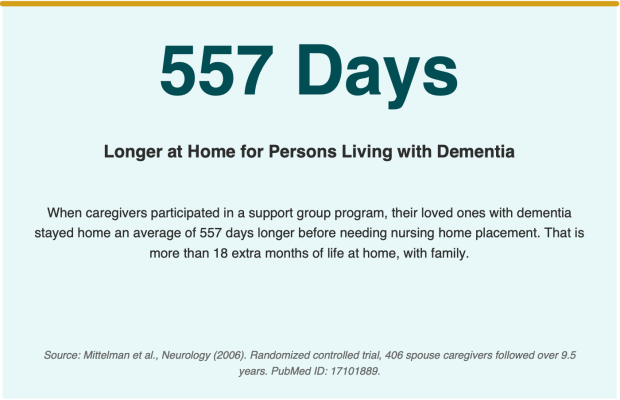
A controlled study by Mittelman et al., published in Neurology in 2006, followed 406 spouse caregivers for 9.5 years in a randomized controlled trial. This isn't some internet survey — this is peer-reviewed research published in one of the most respected neurology journals in the world. PubMed ID: 17101889.
Here's what they found:
When caregivers participated in a support group, their loved ones with dementia stayed at home an average of 557 days longer before needing nursing home placement.
Let that sink in. 557 days. That's more than 18 extra months of life at home with the person you love — simply because the caregiver had support.
Why? Because caring for the caregiver matters. When caregivers burn out faster because they have no one to share with, no one to say "I can't handle this" to, the whole system collapses. But when you have a group of people who get it — who can say "I did this and it made my life easier, why don't you try it?" — you're able to keep your loved one with you longer. Much longer.
THE COMPOUNDING EVIDENCE: 28% FEWER PLACEMENTS
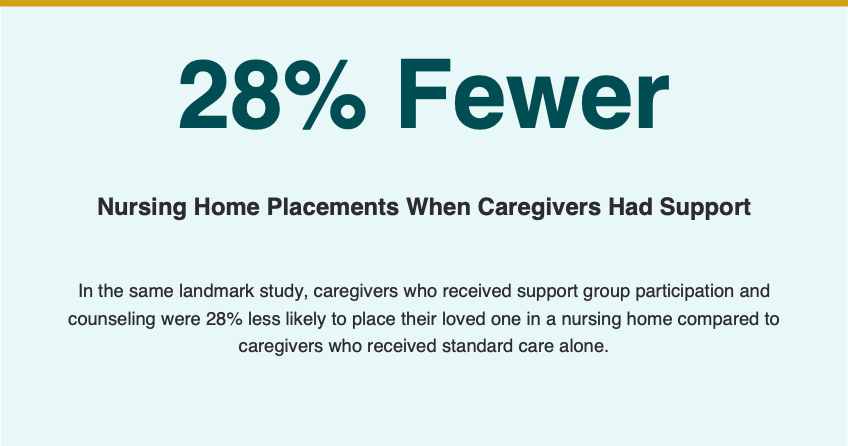
Here's another number from that same landmark study that should get your attention: 28% fewer nursing home placements.
Caregivers who received support group participation and counseling were 28% less likely to place their loved one in a nursing home compared to caregivers who received standard care alone. The hazard ratio was 0.717 with a p-value of 0.025 — that's statistically significant, clinically meaningful, and undeniably real.
That's not a small difference. That's transformative. In a field where we often feel powerless against the progression of dementia, support groups delivered measurable, quantifiable outcomes. Not in months. In years. Over nearly a decade of follow-up.
And it gets better.
THE KICKER: 30 OF 30 STUDIES CONFIRMED IT
Researchers looked at 30 different independent research studies — thousands of caregivers across all of them. Not five. Not ten. Thirty.
A comprehensive meta-analysis by Chien et al. in 2011, reviewed by Cochrane/DARE (PubMed ID: 21308785, NCBI NBK91330), found the same results across the board: caregiver support groups consistently reduced depression, eased emotional burden, and improved overall well-being in caregivers of people living with dementia.
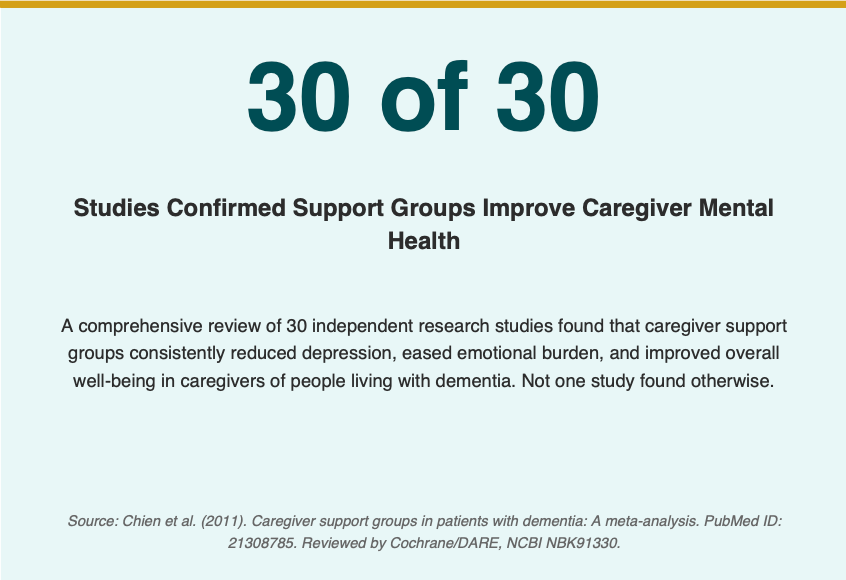
Not one study found otherwise. Thirty for thirty. All saying the same thing: support groups work. They work for the caregiver. And when the caregiver is supported, the person living with dementia benefits too.
THE GUIDE MODEL: YOUR PATH TO SUPPORT
You might be reading this and thinking, "Okay, Dr. Erik, I get it. Support groups matter. But where do I find one? And who watches my loved one while I'm there?"
Great questions. And here's where I need to tell you about a program that most caregivers still don't know exists.
There's a new program from Medicare called the GUIDE Model — Guiding an Improved Dementia Experience. It was specifically designed to focus on caregivers like you. Things like connecting you to support groups in your area that you may not know about. Providing caregiver education. And yes — paying for respite care so someone qualified can stay with your loved one while you go to that support group.
Medicare covers it. You don't change your doctor. You don't change your insurance. It's just additional support that you're entitled to as a caregiver of someone with dementia.
The Invisible Weight: Caregiver Exhaustion
If you're reading this and Harry's story hit close to home, I want you to know something: what you're feeling is real. The exhaustion. The guilt. The moment at 2am when you wonder if you can keep doing this. The way you focus on the hoarding, or the shower refusal, or the repeated questions — because focusing on the symptom is easier than facing the weight of it all.
You are not failing. You are human. And you were never meant to carry this alone.
Support groups aren't another item on your to-do list. They're the thing that makes the rest of your to-do list survivable. They're where someone like Lucy sees through your words to your heart. They're where you finally get to say out loud what you've only been able to whisper to yourself in the dark.
You should not have to do this alone. And thanks to a new Medicare program, you don't have to.

Common questions
Quick answers from this issue
THE POWER OF CAREGIVER SUPPORT GROUPS
Every week I get asked some version of the same question: "Dr. Erik, I barely have time to shower. Where am I supposed to find time for a support group?" It's just another thing on an already impossible schedule. Another commitment. Another hour away from your loved one. I get it. I really do.
What should caregivers try first?
Write down what changed, when it started, and what was happening right before it. Reduce noise, slow the conversation down, and use one simple step at a time. Share the pattern with the family, care team, or clinician so everyone responds consistently.
When should families call a clinician?
Call a clinician promptly if the change is sudden, severe, unsafe, tied to a fall, fever, pain, dehydration, medication change, hallucinations, paranoia, or new confusion. Call emergency services for immediate danger.