

Every week, caregivers ask me some version of the same question:
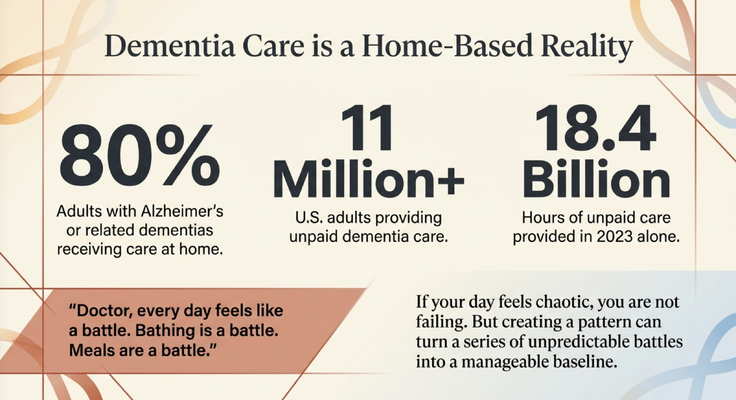
“Dr. Erik, every day feels like a battle. Showers are a battle. Meals are a battle. Getting dressed is a battle. My loved one gets confused, anxious, agitated, and I do not know how to calm the day down. What am I supposed to do?”
And I want you to understand something.
If your day feels chaotic, you are not failing.
Dementia changes the way the brain processes the world. A person living with dementia may not be able to handle sudden shifts, too many choices, loud environments, rushed instructions, or unexpected transitions the way you and I can.
So when the day feels unpredictable, their brain can become overloaded.
That overload may come out as anxiety.
It may come out as agitation.
It may come out as refusal.
It may come out as repeated questions.
It may come out as confusion.
And yes, there are many reasons a person living with dementia may become anxious or agitated. Pain, infection, dehydration, constipation, medication side effects, poor sleep, depression, sensory loss, and many other issues can contribute.
But one of the things caregivers can control at home is routine.
Not a rigid schedule.
A rhythm.
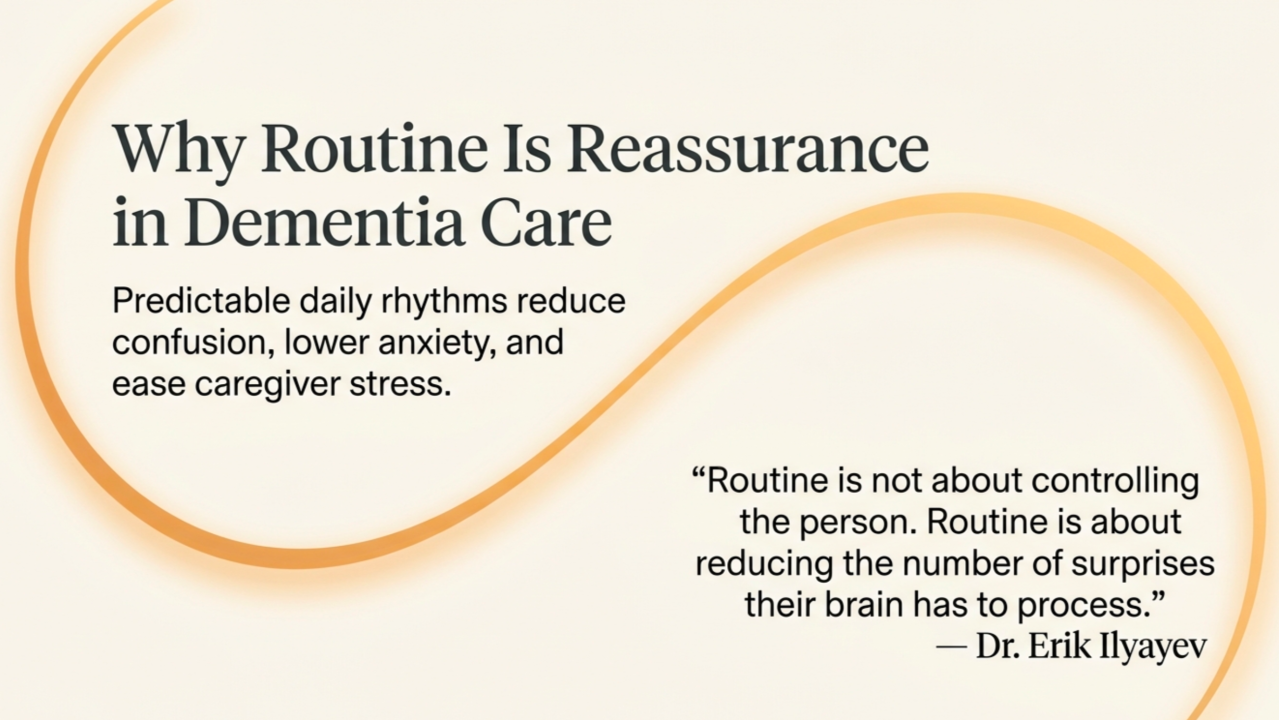
Because routine is not about controlling the person.
Routine is about reducing the number of surprises their brain has to process.
My name is Dr. Erik Ilyayev. I’m a dementia care physician, a board member of the South Florida Alzheimer's Association®, and the CEO of MedBetterHealth.org — one of the organizations selected by Medicare to participate in a new model designed to change how America cares for people living with dementia.
In this issue, I want to walk you through why routine matters, the difference between a schedule and a rhythm, and the five daily anchors caregivers can use to make the home feel safer, calmer, and more predictable.
ROUTINE IS REASSURANCE
Dementia care is a home-based reality.
Most people living with Alzheimer’s disease or related dementias are receiving care at home, and millions of unpaid caregivers are carrying that daily work.
That means dementia care does not only happen in the doctor’s office.
It happens at breakfast.
It happens in the bathroom.
It happens when someone refuses to shower.
It happens when the caregiver tries to get out the door for an appointment.
It happens when the house gets loud.
It happens when the sun goes down and shadows begin to look threatening.
And if every part of the day feels unpredictable, the person living with dementia has to keep trying to interpret what is happening.
Where am I?
What time is it?
Who is this person?
What are they asking me to do?
Why am I being rushed?
Why are there so many sounds?
Why do I feel unsafe?
That is too much cognitive load.
A familiar routine lowers that burden.
It tells the brain:
You are safe.
This is familiar.
This is what happens next.
You are not alone.
That is why routine can reduce confusion and anxiety. Not because it cures dementia. It does not. But because it makes the environment easier for the brain to process.
A predictable rhythm can turn a series of unpredictable battles into a more manageable baseline.
A SCHEDULE IS NOT THE SAME AS A RHYTHM
This is very important.
A schedule and a routine are not the same thing.
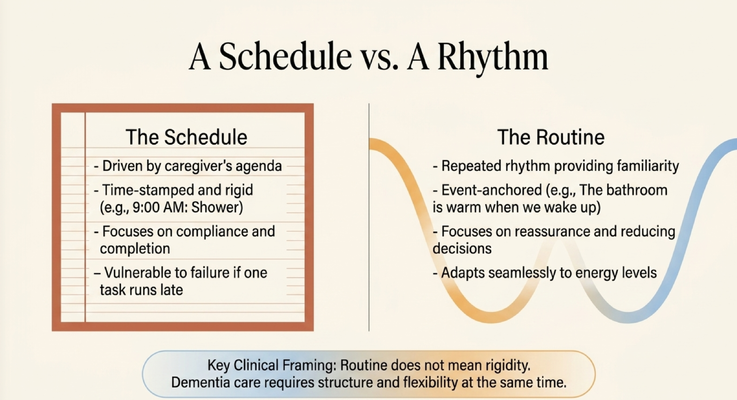
A schedule is driven by the caregiver’s agenda.
“Mom, it is 9 AM. You have to shower now.”
“Dad, we are late. You need to get dressed.”
“Come on, we have an appointment. Hurry up.”
A schedule is rigid. It is time-stamped. It focuses on compliance and completion. And if one task runs late, the whole day starts to feel like failure.
The caregiver becomes frustrated.
That frustration shows.
The person living with dementia senses the tension.
Now anxiety rises.
And suddenly the shower, meal, medication, or appointment becomes a battle.
A rhythm is different.
A rhythm is repeated familiarity.
It is event-anchored.
The bathroom is warm when we wake up.
The blinds open in the morning.
Breakfast happens in the same place.
The same calm greeting starts the day.
The evening lights come on before the shadows deepen.
A rhythm focuses on reassurance and reducing decisions.
It gives structure, but it also allows flexibility.
That is the key.
Routine does not mean rigidity.
Dementia care requires structure and flexibility at the same time.
WHY CHANGE IS SO HARD IN DEMENTIA
For someone without dementia, a small change may be annoying but manageable.
A different breakfast.
A new caregiver.
A later shower.
A noisy room.
A rushed morning.
A change in chair.
A new route to the doctor.
You and I may adjust.
But for a person living with dementia, unpredictability can feel physically threatening.
Their brain may struggle to sequence, interpret, and respond to sudden shifts. They may not be able to explain what feels wrong. They may not even know why they feel unsafe.
They just feel it.
And that feeling may show up as behavior.
This is why I always tell caregivers:
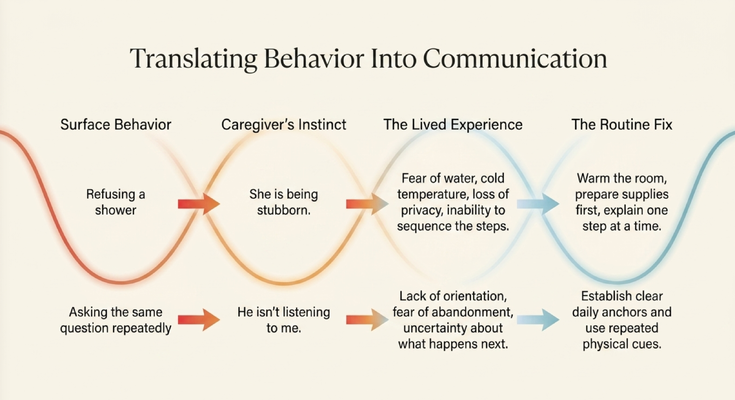
Behavior is communication.
When someone refuses a shower, the message may not be, “I am stubborn.”
It may be, “I am cold.”
“I am embarrassed.”
“I am scared.”
“I do not understand the steps.”
“I feel exposed.”
“I do not like the water.”
“I do not know why you are rushing me.”
When someone asks the same question again and again, the message may not be, “I am trying to annoy you.”
It may be, “I do not feel oriented.”
“I do not know what happens next.”
“I am afraid you are leaving.”
“I need reassurance.”
So instead of asking only, “How do I stop this behavior?”
Ask:
“What is this behavior trying to communicate?”
That question changes dementia care.
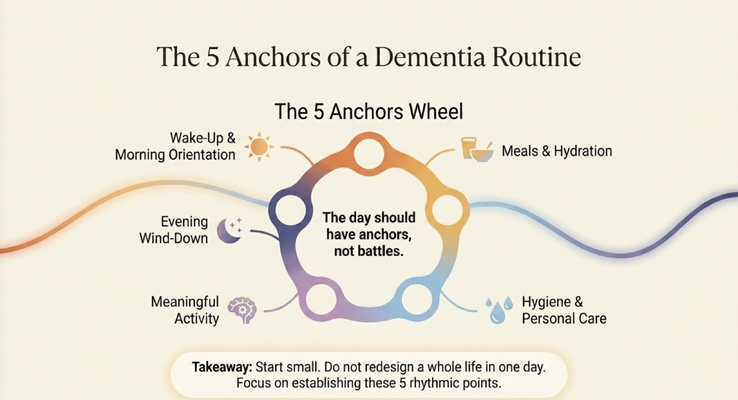
THE FIVE ANCHORS OF A DEMENTIA ROUTINE
I want caregivers to think about the day in five anchors.
Not 50 tasks.
Not a perfect schedule.
Five anchors.
Wake-up and morning orientation.
Meals and hydration.
Hygiene and personal care.
Meaningful activity.
Evening wind-down.
Now, before you hear that and say, “Okay, Dr. Erik, I’m going to implement all five tomorrow,” slow down.
That is not how this works.
How do you eat an elephant?
Not all at once.
Small pieces.
So start small. Pick one or two anchors. Build consistency. Watch what works. Adjust with dignity.
You are not trying to redesign the whole life in one day.
You are trying to build a rhythm the brain can trust.
ANCHOR 1: WAKE-UP AND MORNING ORIENTATION
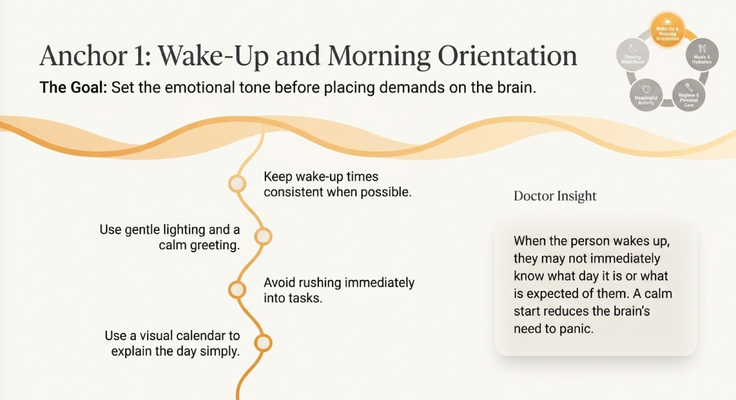
The goal of the morning is simple:
Set the emotional tone before placing demands on the brain.
That means we do not start the day like a drill sergeant.
Not:
“Wake up.”
“Take your medication.”
“Get dressed.”
“Come on, we are late.”
That approach may work for someone without dementia. It often fails in dementia care.
Instead, start with connection.
Use gentle lighting.
Use a calm greeting.
“Good morning, Mom. You look beautiful today.”
“I love you.”
“I’m so happy to have breakfast with you.”
That may sound simple, but it changes the emotional tone.
Then orient gently.
Use a visual calendar if appropriate. Keep it simple. Do not put 20 things on it. Use the top three or four things that matter that day. Write clearly. Make it visible.
Keep wake-up times consistent when possible.
Avoid rushing immediately into tasks.
Because when the person wakes up, they may not immediately know what day it is, where they are, who is there, or what is expected of them.
A calm start reduces the brain’s need to panic.
ANCHOR 2: MEALS AS ORIENTATION POINTS
Meals are not just about nutrition.
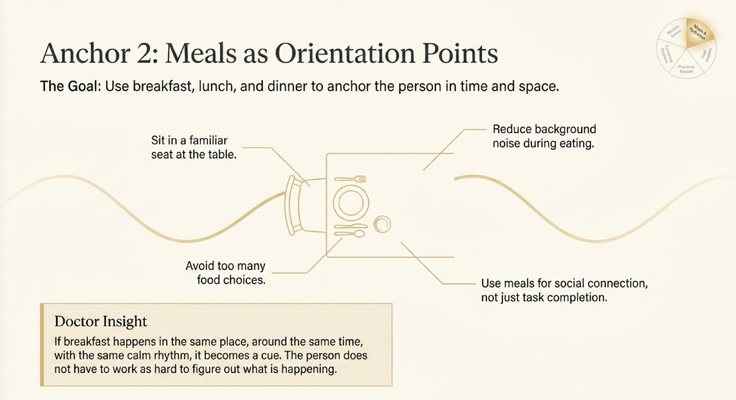
Meals can anchor the person in time and space.
Breakfast, lunch, and dinner tell the brain where it is in the day.
So keep meals familiar.
Have the person sit in the same familiar seat when possible. Keep the setting consistent. Reduce background noise. Avoid loud television, loud music, cleaning, vacuuming, or too many people talking at once.
Avoid too many food choices.
Do not ask:
“Do you want broccoli, chicken, pasta, soup, salad, pastrami, rice, or something else?”
That overwhelms the brain.
Keep it simple.
Offer one or two choices.
And use meals for social connection, not just task completion.
This is not only, “Finish your food.”
It is:
“Mom, I love you.”
“Look at this picture.”
“Remember when we used to go here?”
“You were always such a great mother.”
That connection matters.
If breakfast happens in the same place, around the same time, with the same calm rhythm, the meal becomes a cue. The person does not have to work as hard to figure out what is happening.
ANCHOR 3: HYGIENE AND PERSONAL CARE
Now let’s talk about one of the hardest areas for many families.
Bathing.
Showering.
Changing clothes.
Personal care.
The goal is not to force hygiene.
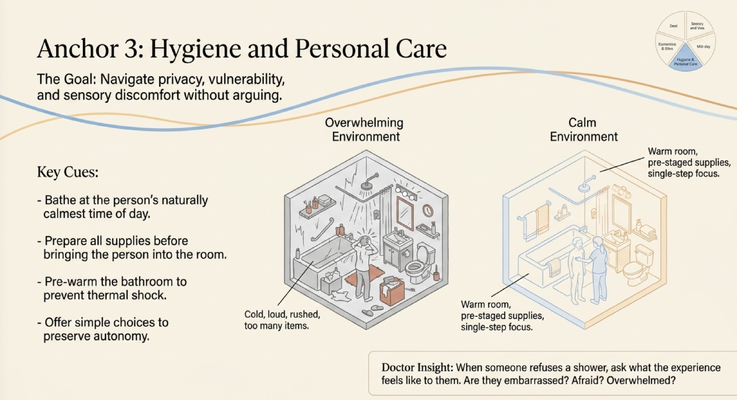
The goal is to navigate privacy, vulnerability, and sensory discomfort without arguing.
Think about this honestly.
How many of us would feel comfortable getting completely undressed in front of our adult children?
Most people would say, “Absolutely not.”
So why do we assume that a person living with dementia suddenly does not care about dignity?
They may have memory loss.
They may have confusion.
They may have trouble communicating.
But that does not mean they no longer feel embarrassment, discomfort, fear, or vulnerability.
So when someone refuses a shower, ask what the experience feels like to them.
Are they embarrassed?
Are they afraid?
Are they overwhelmed?
Is the room cold?
Is the water too hot?
Is the water too cold?
Is there too much noise?
Are there too many items in the bathroom?
Are too many people present?
Are they being rushed?
A better routine can help.
Bathe at the person’s naturally calmest time of day, not the caregiver’s most convenient time.
Prepare all supplies before bringing them into the room.
Pre-warm the bathroom to prevent that cold shock.
Offer simple choices to preserve autonomy.
Use towels to protect privacy.
Go one step at a time.
The environment should be warm, calm, pre-staged, and focused.
Not cold, loud, rushed, and overwhelming.
If you want the shower to go better, stop treating it like a task and start treating it like a sensory and dignity experience.
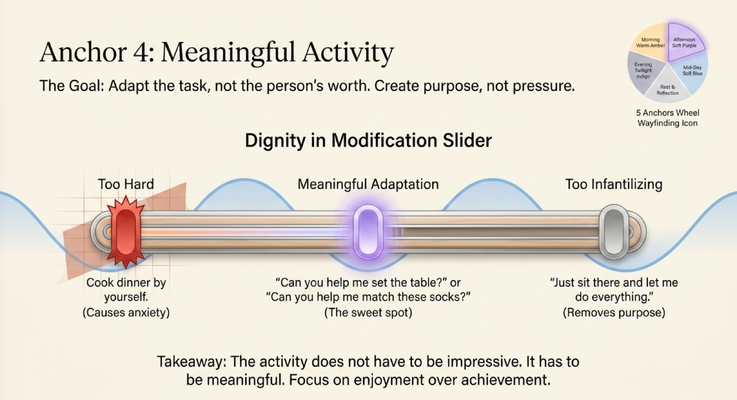
ANCHOR 4: MEANINGFUL ACTIVITY
The fourth anchor is meaningful activity.
The goal is to adapt the task, not the person’s worth.
Create purpose, not pressure.
There are two mistakes families often make.
One side says:
“Dad, you need to do everything yourself.”
“Come on, you can still do this.”
“We have to force him to keep using his brain.”
That may be too much.
The other side says:
“Just sit there. I’ll do everything.”
That can remove purpose.
The better place is the middle.
Can you help me set the table?
Can you help me match these socks?
Can you hold this towel?
Can you help me fold this shirt?
Can you stir this for a moment?
Can you choose between these two options?
The activity does not have to be impressive.
It has to be meaningful.
The goal is not achievement.
The goal is involvement.
A person living with dementia still needs to feel useful. They still need dignity. They still need a role. They still need to feel like they matter.
So do not remove every task in the name of safety unless you have to.
Adapt the task.
Simplify the task.
Make it safe.
But preserve the person’s sense of contribution.
ANCHOR 5: EVENING WIND-DOWN
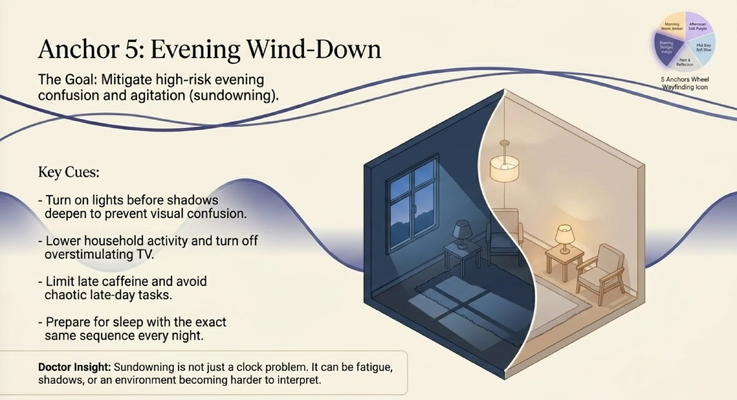
The final anchor is evening wind-down.
This is especially important because evenings can become high-risk.
Confusion may worsen.
Agitation may increase.
Shadows may become threatening.
The person may become tired, overstimulated, or harder to redirect.
This is what many families call sundowning.
And sundowning is not just a clock problem.
It can be fatigue.
It can be shadows.
It can be overstimulation.
It can be the environment becoming harder for the brain to interpret.
So prepare before the evening gets difficult.
Turn on lights before shadows deepen.
Close blinds.
Reduce overstimulating television.
Lower household activity.
Limit late caffeine and heavy food intake.
Use motion-sensor lights if the person gets up at night.
Prepare for sleep with the same sequence every night.
Same lighting.
Same tone.
Same rhythm.
Same calm ending.
The goal is not perfection.
The goal is predictability.
COMMON CAREGIVER MISTAKES
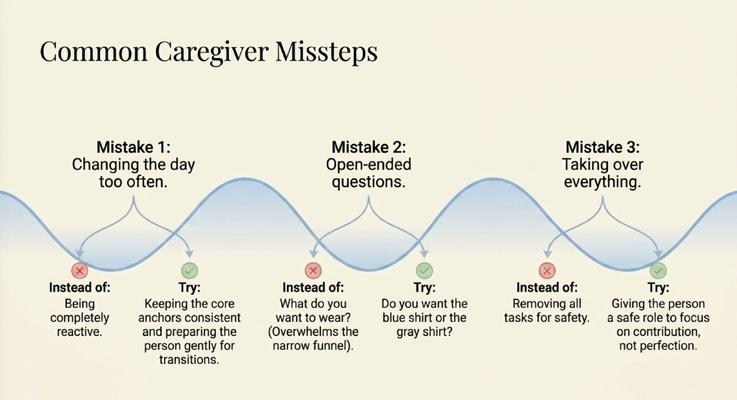
There are a few common mistakes caregivers make with routine.
The first is changing the day too often.
Sometimes families become completely reactive. Every day is different. Every meal is different. Every shower attempt is different. Every evening is different.
The person living with dementia never knows what is coming next.
Try to keep the core anchors consistent, and prepare the person gently for transitions.
The second mistake is asking too many open-ended questions.
“What do you want to wear?”
That may seem respectful, but it can overwhelm the brain.
Instead, offer a simple choice:
“Do you want the blue shirt or the gray shirt?”
That preserves autonomy without flooding the person with too many options.
The third mistake is taking over everything.
Yes, some tasks may need to be removed for safety. But do not remove every role.
Give the person a safe way to contribute.
Focus on contribution, not perfection.
ROUTINE ALSO HELPS YOU SPOT MEDICAL RED FLAGS
Routine does not only calm the person.
Routine gives the caregiver a baseline.
And baseline matters.
If your loved one usually showers calmly with music, a warm room, and a familiar sequence, but today they are suddenly terrified, that is information.
If your loved one usually eats breakfast at the table, but today they cannot sit up, cannot hold a spoon, or seems suddenly confused, that is information.
If your loved one usually asks repeated questions in the evening, but today they are suddenly hallucinating, weak, feverish, or much sleepier than usual, that is information.
A predictable routine helps you recognize when something is different.
And when the change is sudden, do not automatically assume, “This is just the dementia.”
Sudden behavioral change can be a medical red flag.
Watch for acute triggers:
Sudden confusion or rapid decline.
New agitation or worsening sleepiness.
Fever, urinary symptoms, or signs of pain.
Dehydration, constipation, or appetite changes.
New falls or sudden weakness.
If the change is sudden, something medical may be going on.
Call the doctor when appropriate. Seek emergency care when symptoms are severe or concerning.
The routine helps you spot the difference between a predictable pattern and a sudden change.
WHERE TO BEGIN
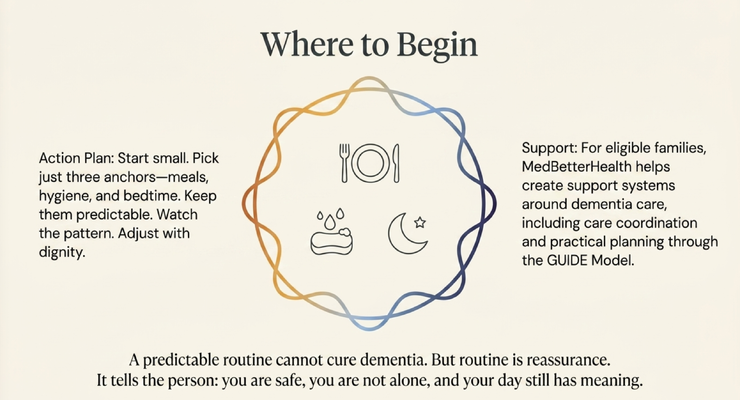
If you are a caregiver reading this, start small.
Do not try to fix the whole day tomorrow.
Pick three anchors.
Meals.
Hygiene.
Bedtime.
Keep them predictable.
Watch the pattern.
Adjust with dignity.
Maybe breakfast always happens in the same chair with the same calm greeting.
Maybe the bathroom is always warmed before the shower.
Maybe the evening lights always come on before shadows appear.
That is where routine begins.
A predictable routine cannot cure dementia.
But routine is reassurance.
It tells the person:
You are safe.
You are not alone.
Your day still has meaning.
And sometimes, that is exactly what the brain needs.

Common questions
Quick answers from this issue
Why Does Routine Matter So Much in Dementia Care?
Every week, caregivers ask me some version of the same question: “Dr. Erik, every day feels like a battle. Showers are a battle. Meals are a battle. Getting dressed is a battle. My loved one gets confused, anxious, agitated, and I do not know how to calm the day down. What am I supposed to do?” And I want you to understand something.
What should caregivers try first?
Write down what changed, when it started, and what was happening right before it. Reduce noise, slow the conversation down, and use one simple step at a time. Share the pattern with the family, care team, or clinician so everyone responds consistently.
When should families call a clinician?
Call a clinician promptly if the change is sudden, severe, unsafe, tied to a fall, fever, pain, dehydration, medication change, hallucinations, paranoia, or new confusion. Call emergency services for immediate danger.