

Every week I get asked some version of the same question: "Dr. Erik, can you tell me about adult day care centers? What are they really? And is my loved one actually going to benefit from one?"
Most caregivers immediately picture a dreary room where older adults sit in a circle staring at a television. That image stops families from even considering what might be the single most powerful — and most underutilized — intervention in dementia care. By the time you finish reading this issue, I want you to see adult day services for what they really are: a clinically validated, community-based tool that protects both your loved one and you.
My name is Dr. Erik Ilyayev. I'm a dementia care physician, a board member of the South Florida Alzheimer's Association®, and the CEO of MedBetterHealth.org — one of the organizations selected by Medicare to participate in a groundbreaking new program designed to change how America cares for people living with dementia.
WHAT ADULT DAY SERVICES ARE — AND WHY THE STEREOTYPE IS WRONG
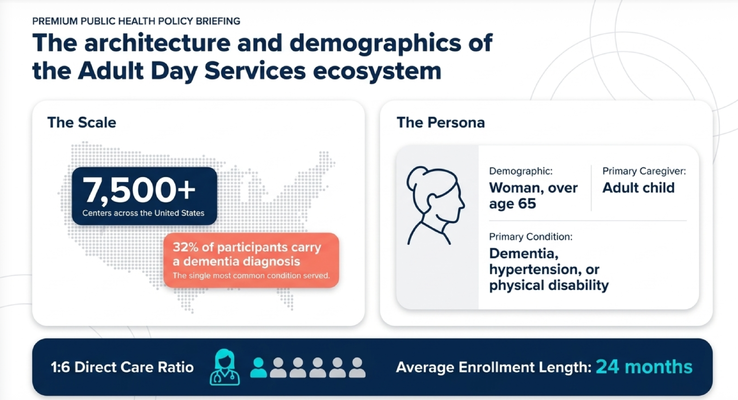
An adult day care center is not a nursing home. It is not a drop-off facility where people wait out the hours. It is a structured, supervised environment designed specifically for adults 65 and over, offering music, nutritious meals, entertainment, physical exercise, and cognitive stimulation programs. There are approximately 7,500 adult day care centers across the United States, and 32% of participants carry a dementia diagnosis — making it the single most common condition served.
The typical participant is a woman over the age of 65, though both men and women attend. Women tend to utilize these services more frequently. The caregiver most often involved in selecting a center is an adult child — someone juggling their own family, career, and the crushing weight of watching a parent decline.
Most centers operate with a 1:6 direct care ratio and offer an average enrollment length of 24 months. That is two full years of structured daytime support that your loved one can benefit from while remaining in their home with you.
THE THREE RINGS OF IMPACT: PATIENT, CAREGIVER, AND SYSTEM
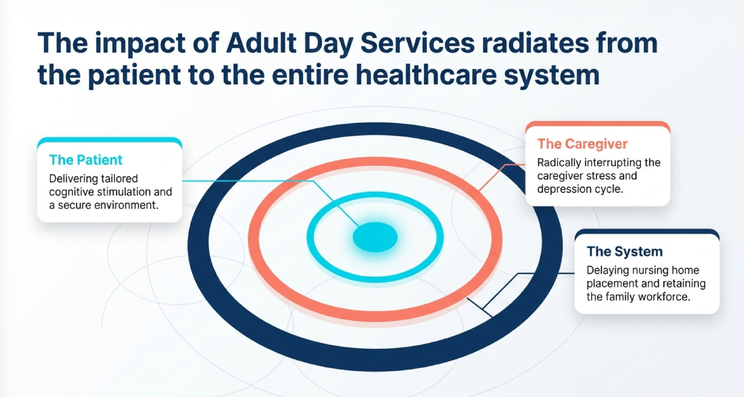
The impact of adult day services radiates outward in three concentric circles. At the center is the patient: your loved one receives tailored cognitive stimulation and a secure environment that directly counters the isolation and loneliness that accelerate dementia progression. In the middle ring is you, the caregiver: the center radically interrupts the cycle of caregiver stress and depression that builds when you never get a break. And in the outer ring is the broader healthcare system: these services delay nursing home placement and help family members remain in the workforce.
THE COST OF DOING NOTHING: SOCIAL ISOLATION AND COGNITIVE DECLINE
Here is what happens when a loved one with moderate dementia stays home all day. They watch television. That is the activity. They are not engaging cognitively. They are not socially stimulated. And because you, the caregiver, are afraid to leave them home alone, you stay home too. You skip your appointments. You miss your own needs. The exhaustion compounds until it becomes your baseline.
Research shows that social isolation can push a person from moderate dementia to severe dementia within three to six months. That is not a small risk. That is a rapid, clinically significant decline that could have been slowed or prevented with structured daytime engagement. As the saying goes in neurology: if you do not use it, you lose it. The brain requires stimulation to maintain function. Adult day centers are built specifically to provide that stimulation.
THE EVIDENCE: WHAT THE RESEARCH ACTUALLY SHOWS
Let me give you the numbers that matter. 90% of adult day centers offer cognitive stimulation programs. 80% provide dedicated memory training. These are not passive environments — they are active clinical interventions.
On the days a loved one attends adult day services, caregivers experience up to a 40% reduction in exposure to care-related stressors. That is not theoretical. That is daily, measurable relief. The Zarit Study showed significant behavioral shifts within just 90 days — lower levels of stress, anger, and depression compared to control groups. And a 2025 systematic review confirmed that regular use provides protective effects on physical stress biomarkers, delivering genuine physiological protection over the long term.
DELAYED NURSING HOME PLACEMENT: THE OUTCOME THAT MATTERS MOST
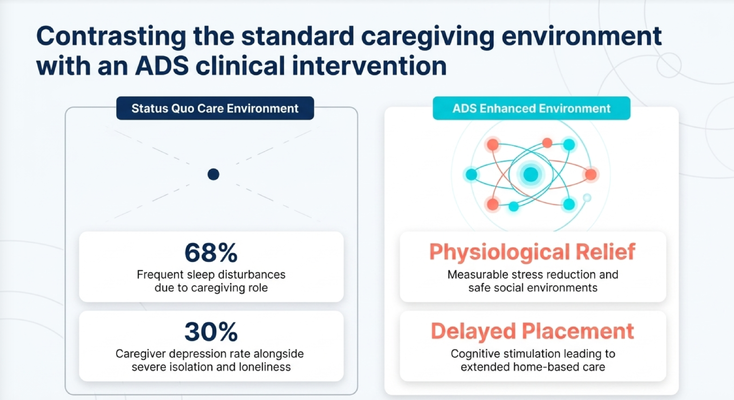
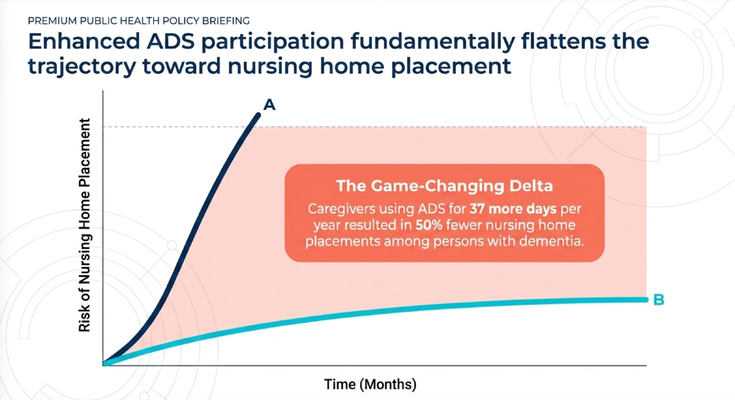
This is the statistic that changes how families think about adult day services. Caregivers who utilize adult day services for just 37 more days per year result in 50% fewer nursing home placements among persons with dementia. Let me say that again: fifty percent fewer placements.
Adult day services fundamentally flatten the trajectory toward institutional care. Your loved one gets the stimulation, social connection, and supervised care they need during the day. They come home to you at night. And because the center is handling the daytime care burden, you get the rest you need to continue providing home-based care for longer — months, sometimes years longer.
THE MULTIDISCIPLINARY TEAM: MORE THAN SUPERVISION
Behind every quality adult day center is a clinical infrastructure most families never see. Nursing staff. Social work professionals. Healthcare administrators. Therapeutic activities specialists. Gerontology-trained caregivers. These are multidisciplinary clinical teams delivering structured, evidence-based interventions — not babysitters passing time.
Centers also provide essential caregiver education programs, support groups, and individual counseling. And on the economic side, they allow family members to return to or remain in the workforce, knowing their loved one is in a localized, safe, professionally staffed environment.

The Invisible Weight: Caregiver Exhaustion
I know what you are living through. Sixty-eight percent of caregivers have sleep disturbances directly attributable to their caregiving role. Thirty percent experience clinical depression — and that is just the reported number. How many of you would actually say the words "I am depressed" out loud? The real figure is almost certainly higher.
You wake up to find the bathroom a mess. You are constantly managing chaos you did not create. You are exhausted. And somewhere in the back of your mind, you are thinking: "I just need a break. I just need some time for myself." That thought does not make you a bad caregiver. It makes you a human being who has been carrying an unsustainable load alone.
You should not have to do this alone. And thanks to a new Medicare program, you don't have to.

Common questions
Quick answers from this issue
The One Resource Most Dementia Caregivers Overlook (And It's Not a Medication)
Every week I get asked some version of the same question: "Dr. Erik, can you tell me about adult day care centers? What are they really? And is my loved one actually going to benefit from one?" Most caregivers immediately picture a dreary room where older adults sit in a circle staring at a television.
What should caregivers try first?
Write down what changed, when it started, and what was happening right before it. Reduce noise, slow the conversation down, and use one simple step at a time. Share the pattern with the family, care team, or clinician so everyone responds consistently.
When should families call a clinician?
Call a clinician promptly if the change is sudden, severe, unsafe, tied to a fall, fever, pain, dehydration, medication change, hallucinations, paranoia, or new confusion. Call emergency services for immediate danger.