

"They Keep Walking Around." — What Wandering Really Means, and How to Keep Your Loved One Safe
Every week I hear from caregivers who say: "Dr. Erik, my mom just paces back and forth all day. She almost walked out the front door last night. What do I do?"
It's one of the most frightening things a caregiver can face. And it's also one of the most misunderstood.
Wandering is not just "the dementia." It is communication. Once you understand what's really being communicated — and how to respond — everything changes.
My name is Dr. Erik Ilyayev. I'm a dementia care physician, a board member of the South Florida Alzheimer's Association, and the CEO of MedBetter Health — one of the organizations selected by Medicare to participate in a groundbreaking new program designed to change how America cares for people living with dementia.
In this issue, I want to walk you through what wandering actually is, why it happens, the difference between wandering and elopement, and what you can do about it today.
WANDERING vs ELOPEMENT — Know the Difference
Wandering is repetitive, aimless movement. Pacing back and forth, searching without knowing what for. It is a signal — of distress, anxiety, or an unmet need.
Elopement is what happens next. Wandering leads your loved one to a door — the door opens — and now they are outside, alone, and disoriented. On a road. Near a canal. In a neighborhood they no longer recognize.
Here is the statistic I need you to remember: 6 in 10 people diagnosed with dementia will wander. And if not found within 24 hours, 50% of those who elope face serious injury or death — from traffic, drowning, dehydration, or falls. That number comes from the Cleveland Clinic.
This is not meant to scare you. It is meant to prepare you.
WHAT'S REALLY DRIVING IT
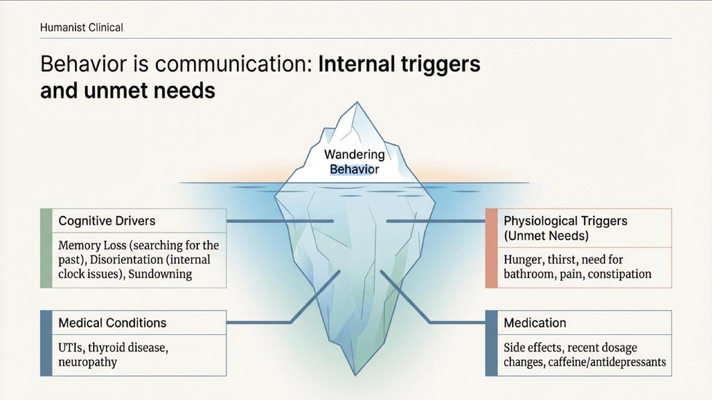
Before you react to the behavior, look underneath it. Wandering is almost always driven by something hidden:
• Physical needs — hunger, thirst, needing the bathroom, pain, or constipation. They cannot tell you, so they walk.
• Medical conditions — a UTI, thyroid issues, a new medication, or even too much caffeine can trigger sudden behavioral changes.
• Cognitive and emotional factors — memory loss, disorientation, boredom, loneliness, or anxiety. A person sitting in a chair all day with nothing to do will pace.
• Environmental triggers — loud noise, dim lighting, seeing coats and keys near the door, or a change in the household routine.
• Caregiver triggers — rushing them, visible frustration, touching without warning. Their reality has been altered by dementia, but they can still read your energy. And it affects them.
Before assuming the disease is simply progressing, ask: what changed?
WHAT YOU CAN DO TODAY
Step 1 — Secure the environment without restricting movement
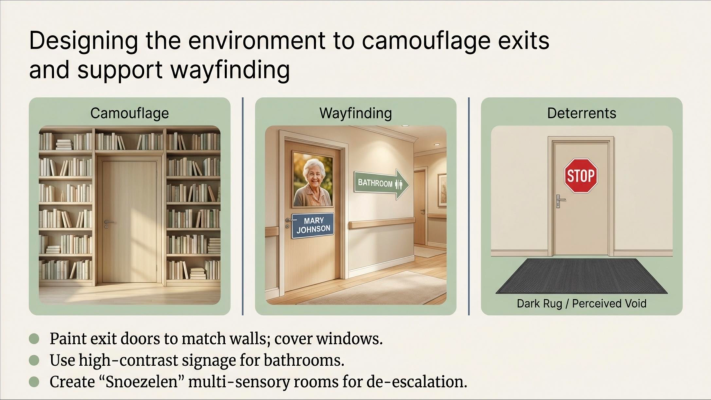
A bookshelf door sticker (search "bookshelf door sticker" on Amazon) placed over your exit door effectively camouflages the exit. To a person with dementia, the door disappears. They see a wall of books and walk away.
A large, dark matte rug placed in front of the door works similarly — people with dementia perceive the dark contrast as a void or hole. They will not step on it. Simple and inexpensive.
Step 2 — Give them something meaningful to do
Boredom and unstructured time are major triggers. Folding clothes, sorting silverware, a simple task connected to something they used to do — these create a sense of purpose and dramatically reduce restlessness.
Step 3 — Validate and redirect, never argue
When they are heading for the door and insisting they need to leave, do not argue. You will not win, and it will only increase their fear and agitation.
Instead:
❌ "You can't go home. You live here now."
✅ "I can see you're worried about your house. You are safe here with me. Tell me about your garden…"
Acknowledge the feeling. Validate it. Then gently redirect their attention. Their reality has been altered — meet them there.
Step 4 — Build your safety net
Door alarms and pressure mats will alert your phone the moment an exit is approached or opened. A dedicated 5G GPS wearable — not just a regular smartwatch — sends you a real-time location the moment they leave the property. Around $100 with a ~$20/month plan.
If the worst happens, have a current daily photo ready, and keep a worn sock sealed in a dated Ziploc bag. Search and rescue dogs use scent to track — first responders will ask for it.
Know your Silver Alert system. Just like the Amber Alert for children, the Silver Alert is the U.S. emergency notification system for missing adults with cognitive impairments.
The Invisible Weight: Caregiver Exhaustion
Being on high alert every day — every door, every moment of quiet — is exhausting. Many caregivers tell me they haven't slept soundly in months. They are afraid to leave the room.
You should not have to do this alone. And thanks to a new Medicare program, you don't have to.

Common questions
Quick answers from this issue
WANDERING & ELOPEMENT
"They Keep Walking Around." — What Wandering Really Means, and How to Keep Your Loved One Safe Every week I hear from caregivers who say: "Dr. Erik, my mom just paces back and forth all day. She almost walked out the front door last night. What do I do?" It's one of the most frightening things a caregiver can face. And it's also one of the most misunderstood.
What should caregivers try first?
Write down what changed, when it started, and what was happening right before it. Reduce noise, slow the conversation down, and use one simple step at a time. Share the pattern with the family, care team, or clinician so everyone responds consistently.
When should families call a clinician?
Call a clinician promptly if the change is sudden, severe, unsafe, tied to a fall, fever, pain, dehydration, medication change, hallucinations, paranoia, or new confusion. Call emergency services for immediate danger.